Forte de São João do Arade
Ferragudo Faro Portugal
fortress
Forte de São João do Arade
Ferragudo Faro Portugal
fortress
The Fort of São João do Arade (Portuguese: Forte de São João do Arade), sometimes referred to as the Castle of Arade, is a medieval fortification situated in the civil parish of Ferragudo in the Portuguese Algarve municipality of Lagoa
O Castelo de São João do Arade, igualmente conhecido como Castelo de Ferragudo, Forte de São João do Arade, Forte de São João Baptista ou Castelo do Arade, é um monumento militar, situado junto à vila de Ferragudo, no concelho de Lagoa, na região do Algarve, em Portugal
Previous names
Forte de São João do Arade, Forte de São João do Arade
Description
The Fort of São João do Arade (Portuguese: Forte de São João do Arade), sometimes referred to as the Castle of Arade, is a medieval fortification situated in the civil parish of Ferragudo in the Portuguese Algarve municipality of Lagoa.
History
The first fortification on the site consisted of a watch tower erected in the reign of King John II of Portugal. Later, following the settlement of Ferragudo (around 1520), it is believed that the castle was encircled by a defensive wall (built on the rudimentary walls of the older walls): giving rise to its original name Castle of Arade.
The origins of the Fort of Arade (or Ferragudo, as it is also known) date back to the Philippine Dynasty, and the need by the Habsburg rulers to defend the coast of the peninsula from attacks by pirates and privateers in service to the Crowns of northern Europe. Yet, even at the beginning decades of the 17th century, no fortress was constructed owing to the indecision on whether to locate the fortification on the left or right margin (location of Vila Nova de Portimão).
Engineer Alexandre Massai defended a new construction in Portimão, while the left margin proposal (in Ferragudo) was defended by the municipality of Silves. According to a report by Alexandre Massai, the battlements already existed in 1621, since he refers to “um sítio cercado chamado Ferragudo” (“a walled site called Ferragudo”).
The Portuguese Restoration War, once again, justified the construction of a new fortress. It was in 1640 that the order to construct a fortification came down from King John IV; the fortress was built to substitute the Castle of Ferragudo (Portuguese: Castelo de Ferragudo) which had lost its effectiveness.[ This bulwark was erected downstream on a rocky platform, but the effects of erosion and Atlantic storms (especially a violent storm in 1669) caused severe damage to the original bulwark.
Within four years (2 May 1644), the first captain was assigned to the fort: Francisco da Costa Barros. The strategic location of this castle, from the beginning, made the fortress more than just a military structure. The fort controlled a privileged place at the mouth of the River Arade, with the capacity to strike as far as the margins of Portimão.
An inspection carried-out by the Governor of the Kingdom of the Algarve, D. Rodrigo António de Noronha e Meneses, considered the fortification to be in perfect condition. At that time there were two artillery batteries: the lower battery, with three pieces of artillery; and the upper battery, with four pieces. The 1755 Lisbon earthquake did not result in any damages, in comparison to many of the buildings/structures along the southern coast, partly due to its construction on soft rock. By 1821, the fort remained active, referencing two, heavily armed batteries on its upper tier.
The area was also a transit point for boats leaving the river, making it a responsible for fluvial traffic that entered and left Silves. But, this role was fleeting; after the Concession of Evoramonte, the fort fell into disuse and was declassified in 1896. Its history since then was of slow deterioration and abandon, that culminated in 1896, with its public sale: it was sold at a public auction for 600,000 reis.
Untouched throughout the 20th century, the group of structures maintained there state, waiting on rigorous studies and archaeological investigation. After its sale, it was adapted as a summer residence, by the poet Coelho Carvalho, who undertook extensive renovations to create a residence reflecting his personal taste. Still in private hands, it was classified in 1975 as a historic building by the Instituto Português do Património Arquitectónico (IPPAR), forerunner of the IGESPAR.
But, today, it is practically abandoned: the local authority petitioned for its transformation into cultural centre; in 1976, the Junta Freguesia de Ferragudo solicited the national government in order to occupy the fort.
Architecture
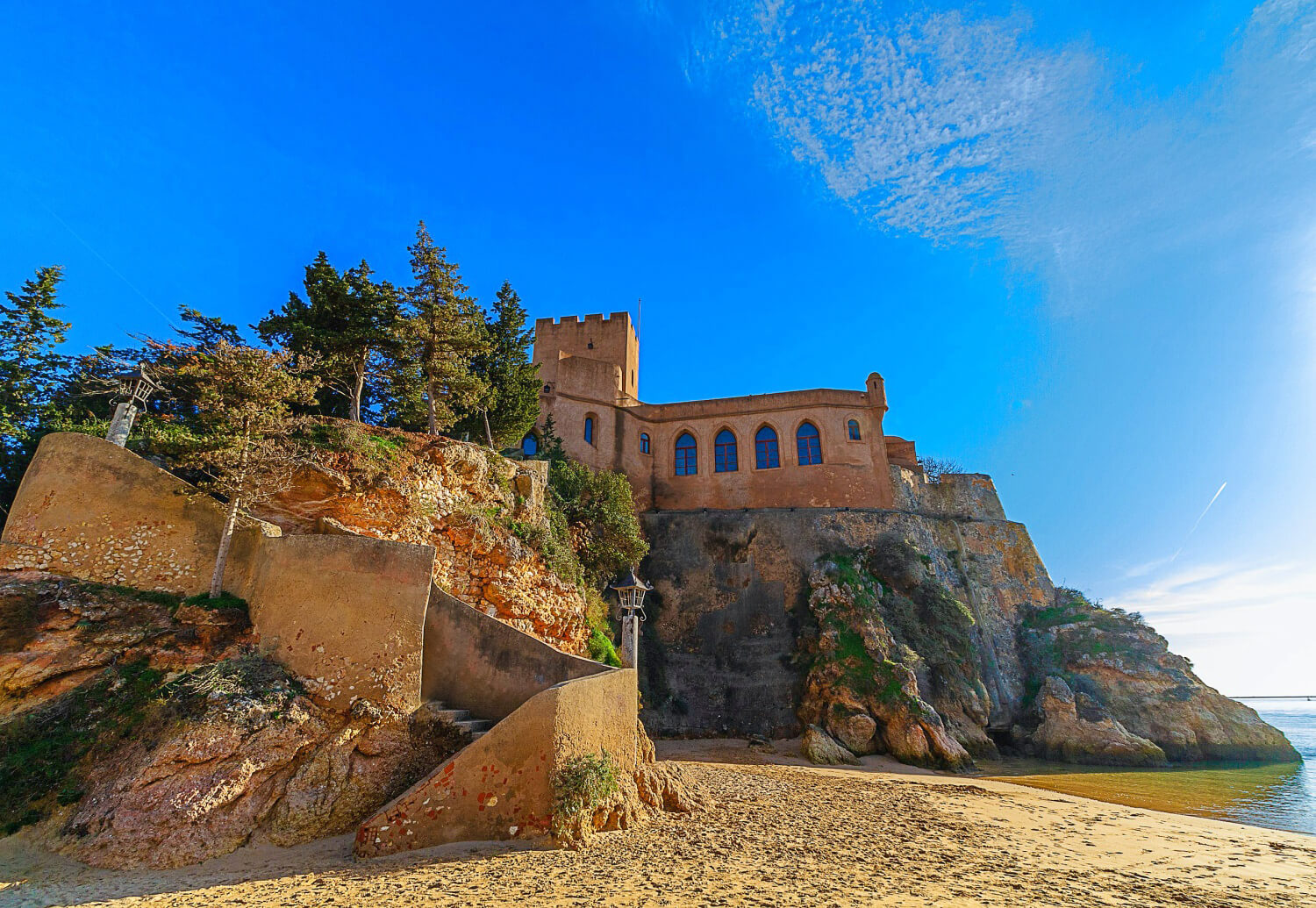
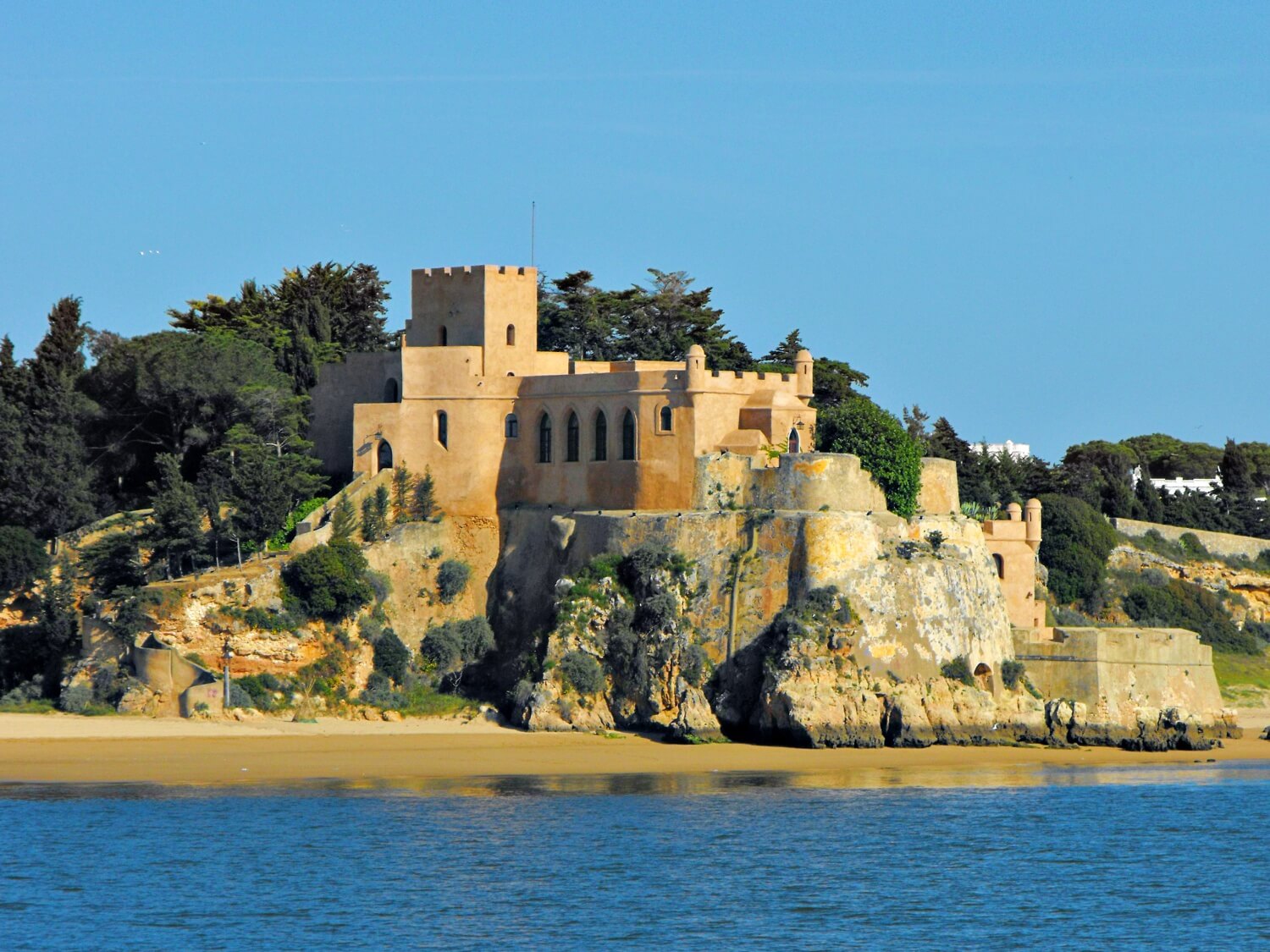
Its location belies its status as a rural fortification, located on a hillock, overlooking the left margin of the Portimão estuary, isolated on a vast wooded property. Situated in a dominant position at the mouth of the Arade River, the elevated site divides two beaches: the Praia da Angrinha and the Praia Grande. Together with the Fort of Santa Catarina, on the water front of Portimão, the fort guards the estuary and mouth of the river.
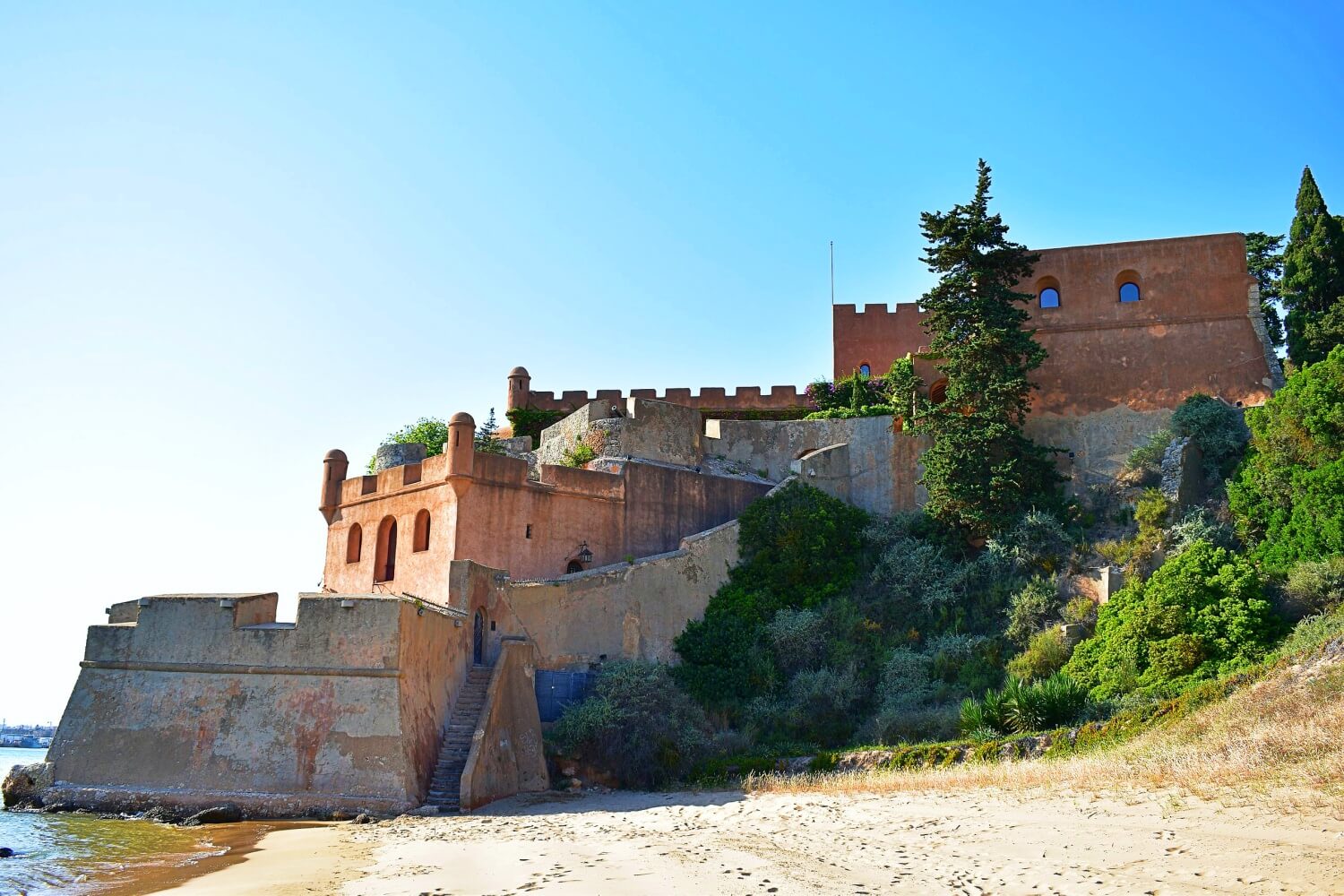
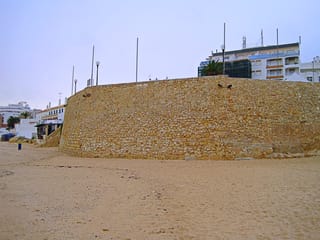
The plan of the fort is an irregular trapezoid, implanted on a high spot, with a keep and various spaces oriented to the sea. The vertical facades are covered with windows and barbicans.
The structure of the fort is easily identifiable, with its battlements serving as positioning batteries. It was designed vertically, in order to permit visibility both from its battlements, and from sea. Its height, makes it one of the more interesting features of the structure, permitting observation.
The site is well preserved, with a large walled garden stretching from Praia da Angrinha to Praia Grande, that includes a large residence.
O Castelo de São João do Arade, igualmente conhecido como Castelo de Ferragudo, Forte de São João do Arade, Forte de São João Baptista ou Castelo do Arade, é um monumento militar, situado junto à vila de Ferragudo, no concelho de Lagoa, na região do Algarve, em Portugal. Foi classificado como Imóvel de Interesse Público em 1974. Serviu originalmente para defender a barra do Rio Arade, e controlar o movimento das embarcações.
História
A zona onde se ergue o castelo foi habitada pelo menos desde a época romana, devido à presença de tanques de salga nas suas proximidades. No Século XV, foi construída uma torre de vigia no local aproximado do castelo.
Nos princípios do Século XVII, quando o território português estava sob o domínio Filipino, o governo iniciou um programa para a construção de várias fortalezas ao longo da costa, de forma a defendê-la dos ataques dos piratas e corsários. Neste sentido, foi planeada a instalação de uma fortaleza na foz do Rio Arade, embora inicialmente não se tenha chegado a acordo sobre em que lado da foz é que deveria ser construída. O engenheiro militar italiano Alexandre Massai argumentou a favor da margem esquerda, onde se poderia fazer uma melhor defesa de Vila Nova de Portimão, pelo que foi deste lado que foi construída a fortaleza.
Assim, foi só após a restauração da independência, em 1640, que se começou a planear a construção do castelo na margem direita, como forma de proteger o litoral contra ataques espanhóis. As obras decorreram entre 1643 e 1644, no local da antiga torre de vigia, conhecida como Castelo de Ferragudo, que já não era considerada eficaz. Logo em 2 de Maio de 1646, O rei D. João IV nomeou Francisco da Costa Barros como capitão do castelo, o que prova que seria já de grande importância, como parte das defesas costeiras do Barlavento algarvio. Com efeito, servia não só para proteger mas também para controlar a foz do Arade, sendo ponto de registo aduaneiro para os navios que navegavam pelo rio até à cidade de Silves. Em 1654, o castelo foi alvo de um processo de reequipamento.
Apesar da sua importância, o edifício foi sendo progressivamente abandonado, estando já arruinado em 1669. No entanto, o castelo ainda foi alvo de obras de ampliação no Século XVIII, tendo sido pouco atingido pelo Sismo de 1755, devido ao terreno em que se implanta, em rocha maciça.
Em 1821 ainda estavam a funcionar duas baterias na parte mais elevada do castelo, ambas com canhoneiras. Em 1861 estava novamente em ruínas, e em 1892 foi arrendada ao escritor e diplomata Joaquim José Coelho de Carvalho, cuja família comprou o edifício em 1896. Joaquim de Carvalho fez obras nos princípios do Século XX, que lhe deram uma aparência de castelo romântico. Algum tempo depois, passou a ser propriedade do político Francisco Vieira Machado.
O monumento não foi alvo de obras muito profundas no Século XX, pelo que se manteve, de forma geral, na mesma forma desde os finais de oitocentos. As alterações que foram feitas no seu interior serviram principalmente para a transformar numa residência de férias, embora grande parte do edifício tenha permanecido num estado de abandono. Em 1976, a Junta de Freguesia de Ferragudo pediu que lhe fosse cedido o forte, de forma a proceder à instalação de um centro cultural no seu interior.
Em Junho de 2010, a princesa Letícia da Espanha e as suas duas filhas estiveram no Castelo de São João de Arade, que nessa altura era propriedade da família Pereira Coutinho.
Useful information
Free
Great view
Private property, closed for visitors
-
Nearby castles

Forte de Santa Catarina (Portimão)
Portimão
0.7km
fortress
Castle of Alvor
Alvor
6.4km
castle, chateau
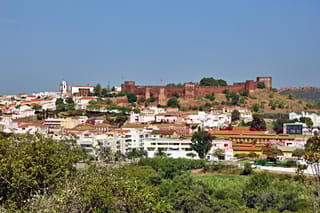
Castle of Silves
Silves
10.8km
castle, chateau
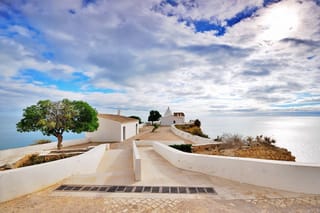
Fort of Nossa Senhora da Rocha (Porches)
Porches
12.3km
fortress
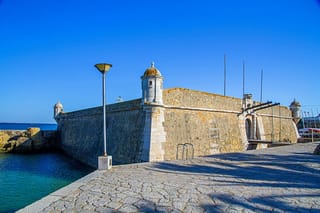
Forte da Ponta da Bandeira
Lagos
13.2km
fortress
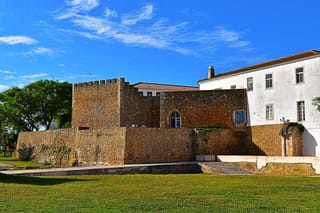
Castle of Lagos
Lagos
13.2km
castle, chateau
Fortaleza de Armação de Pêra
Armação de Pêra
14.6km
fortress