Belmarço Palace
Faro Faro Portugal
manor, mansion
Palacete Belmarço
Faro Faro Portugal
manor, mansion
The Belmarço Palace is a historic building in the city of Faro , in the region of Algarve in Portugal
O Palacete Belmarço é um edifício histórico na cidade de Faro, na região do Algarve, em Portugal
Previous names
Belmarço Palace, Palacete Belmarço
Description
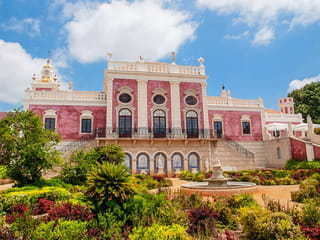
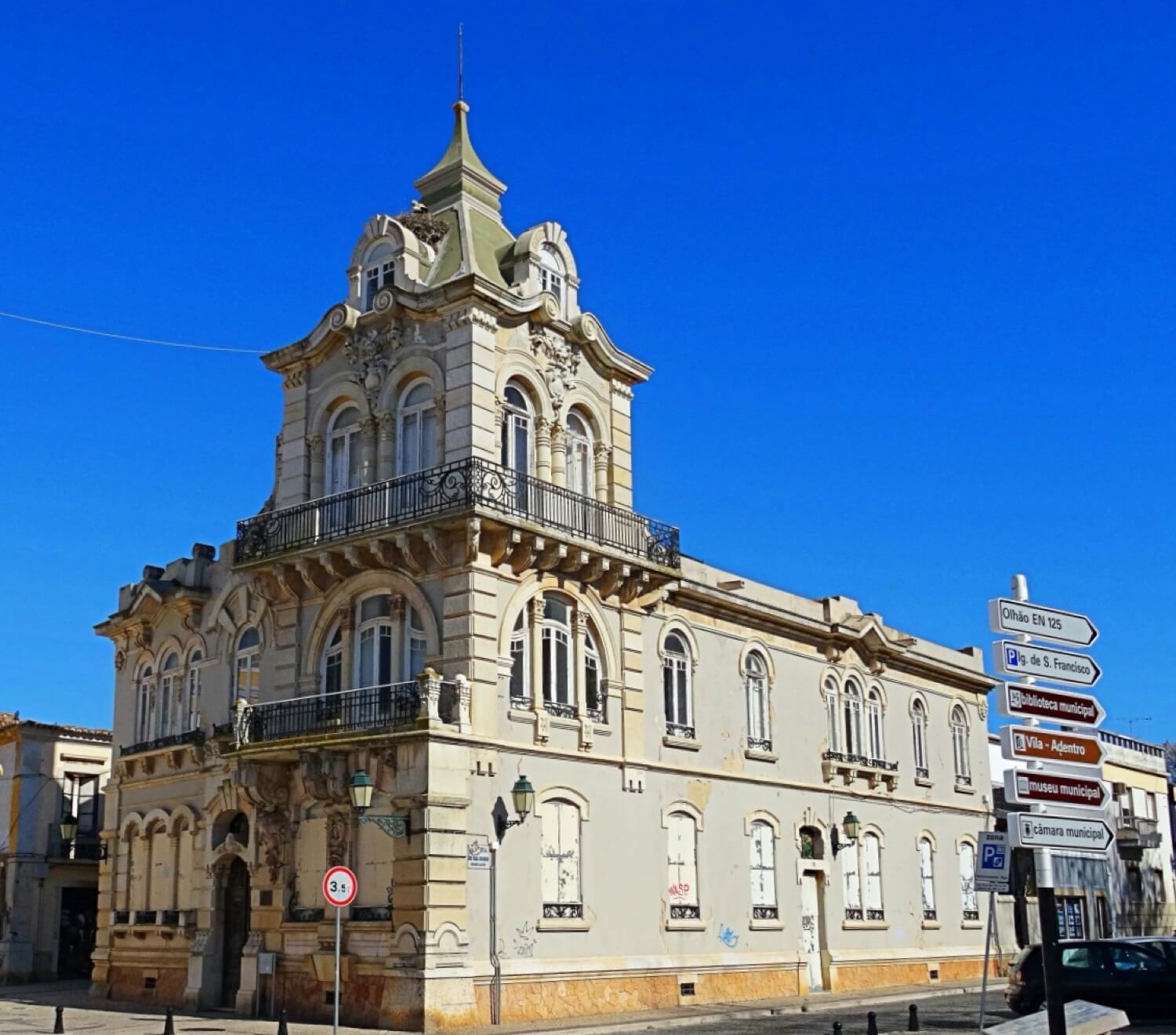
The Belmarço Palace is a historic building in the city of Faro , in the region of Algarve in Portugal . It was built at the beginning of the 20th century by the architect Manuel Joaquim Norte Júnior , in the revivalist style . It is considered as a symbol of Faro, and has been classified as a Monument of public interest .
Description
The palace is located in the historic center of Faro, in the old parish of Sé , next to one of the gates of the medieval center of the city. It is bordered by Largo D. Marcelino Franco, Rua José Maria Bandeira, and Rua de São Francisco.
It is an important testimony of bourgeois residential architecture, with an eclectic and revivalist tendency , in the period between the second half of the 19th century and the beginning of the 20th century, being considered the main example of revivalist architecture in Faro. Due to its architecture, it was classified as one of the notable buildings in the city, and an Ex libris of Faro.
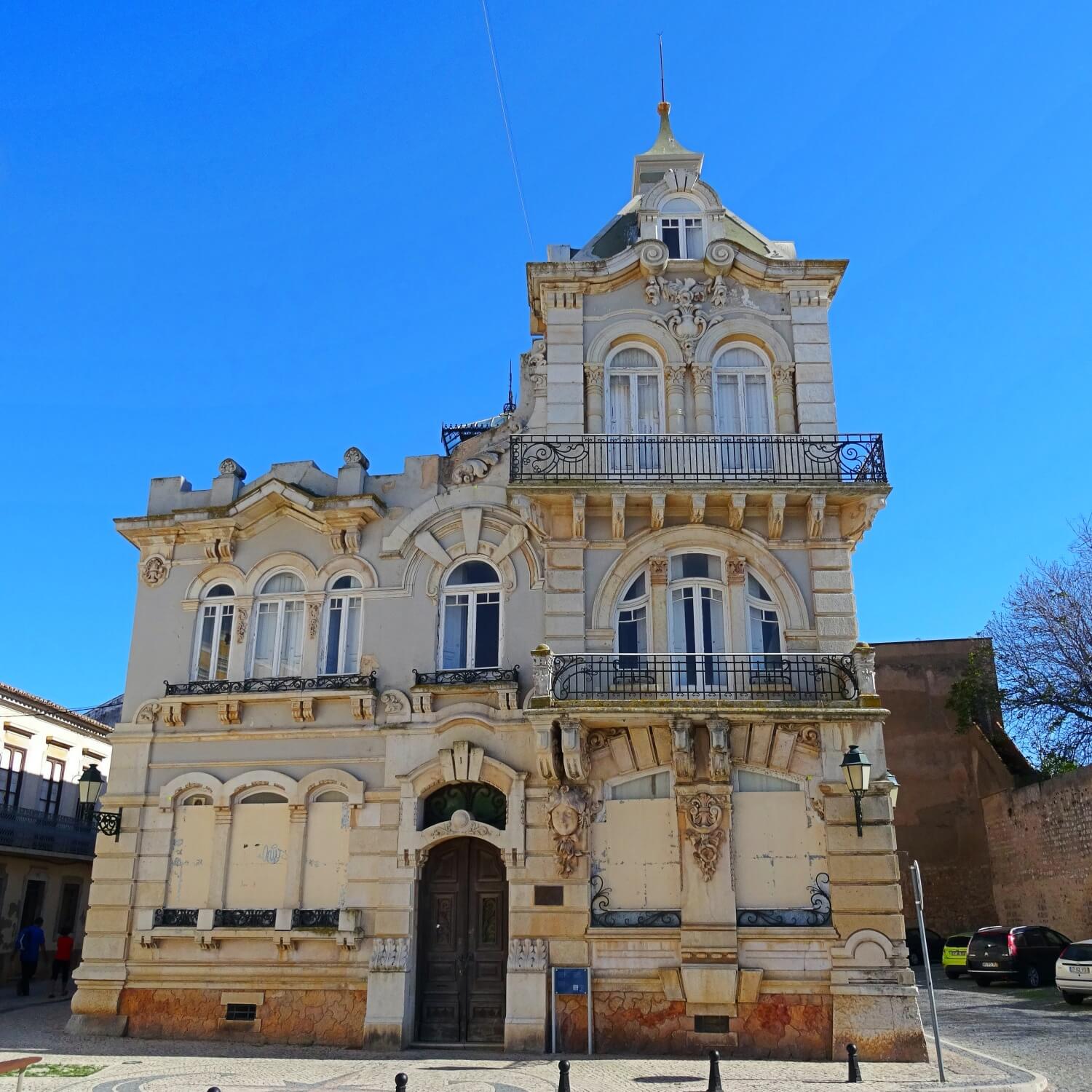
The mansion is divided into two floors, with a turret forming a third partial floor. This turret, located in the west corner of the building, is one of the most visible elements of the complex, standing out from the surrounding area. The first two registers of the main façade are divided into three panels, each with a formula different from the spans. Thus, the left panel features on both floors a window with a tripartite frame and an iron guard, with the pilasters in the upper register decorated with finials. The central body is torn by a Beaux-Arts style door on the lower floor, whose frame includes a lowered arch with a semi-sphere and finials, while the pediment, also curved, is topped by staves. This set is part of an alfizdecorated with acanthus leaves on the shaft, and a segmented pediment, with finials on the sides. Above the main door is a circular framed window, with an iron guard, which is topped by a double curved pediment and adorned with staves. The right panel has a twin window on the ground floor with a pillar in the middle, decorated with a raised wreath. Between this window and the main door and the ground floor window on the right side stands out a sculpture representing a female face, decorated with a bow and garlands of flowers. The first floor is opened by a round arched window, divided into three parts by Corinthian pilasters, and which has a balcony with iron guards, supported by carved staves with finials. This cloth is finished off, on the third floor, by a rectangular turret, whose two facades to the street are torn by double windows with frames of Corinthian columns, and which in the center have a medallion with an urn, decorated with flowers and wreaths. The turret ends in gabled roofs, in a pyramid-shaped shape, which is opened by mansard windows , with a round arch frame. Behind the turret, the building’s roof is torn by a square skylight, made of iron and glass.
The east facade of the building has two registers, punctuated symmetrically by windows with an iron guard, which on the first floor have a lowered arch frame, while on the second floor they have a perfect round arch. On this side there is also a curved pedimented door, hollow with an iron railing, and the access gate to the patio, topped by an iron balcony. The West West side of the building is symmetrical to the opposite side, having the same layout as the windows, door and gate topped by the iron balcony, the only difference being the corner of the turret on the second floor, whose two facades are identical.
The interior has also been carefully decorated, combining the revivalist style with various elements of Art Nouveau., noteworthy are the two tile panels, dating from 1916, signed by the artist Pinto, with drawings of national monuments. Another significant element in the interior is the staircase to the upper floor, with an iron structure in the Art Nouveau style. The ground floor consists of a vestibule, with entrance to the main façade, which gives access to the staircase to the first floor, and two identical accommodation units on the ground floor, each consisting of three bedrooms, a living room, a kitchen and a backyard. . The upper floor features a single fire, consisting of three bedrooms, three living rooms, a dining room, a kitchen and two terraces. The building plan is rectangular in shape, with a total building area of approximately 790 m².
History Planning and construction
The building was planned in 1912 by Manuel Joaquim Norte Júnior , one of the best known architects at the time, and who in Faro was also responsible for Café Aliança, built in 1908. It was commissioned by the rich merchant Manuel Belmarço, who accumulated his fortune with the coffee and cereal businesses. The works started in 1912 and were completed in 1917. Its construction was part of a phase of urban renewal in Faro, during which it sought to modernize the appearance of its buildings, in order to keep up with the new trends in Lisbon . In fact, Manuel Belmarço owned a house in the capital, on Avenida da Liberdade, probably as part of the bourgeois and cosmopolitan environment of Lisbon that Manuel Júnior, who had already gained notoriety as the designer of large urban palaces, would have known. In fact, Palacete Belmarço has some similarities with other Manuel Júnior houses, namely the José Maria Marques building or the building on Avenida Defensores de Chaves, no. 26.
The stonework of the palace was made by the workshop of the master Tomaz Ramos, who also worked in other buildings in Faro, such as the Fialho palace, the Aliança café, the plinth of João de Deus bust, the Guerreirinho palace, and the José Bento Ferreira obelisk de Almeida . The place where the mansion was built was previously occupied by a modest residential building, part of a block located next to a canal between São Francisco and Alagoa.
1990s and 2000s
The palace was acquired by the Municipality of Faro in 1995 or 1996, for an approximate value of 187,500 Euros, so that the future Court of Appeal of Faro could be installed there, a body that was instituted in 1999. Meanwhile, the building was occupied by the Court of Work until 1997. In order to facilitate the installation of the Court of Appeal, around 2000 the municipality gave the building, free of charge, to the Ministry of Justice, and in that year the restoration works were carried out outside the building, and modification and enhancement in the interior, in order to adapt it to function as a Court of Appeal. On May 2 and September 4, 2001, the Ministry of Justice launched the public tender for the rehabilitation of the building. However, the installation process has never progressed,low expected procedural volume », and due to the plans of the government of José Sócrates to create a judicial city in the Algarve elsewhere in the region, which also did not advance. In this way, the building was left unused for several years. Also as part of this process, the Faro City Council had started rehabilitation works on the building, which cost about 250 thousand Euros, but which were not completed, due to problems in excavating the basement to install the elevator, since the foundations were at the same level as the water in the Ria Formosa. As part of its adaptation to functions related to administration, the interior of the building has been profoundly modified, although some more emblematic elements have remained, such as the tile panels. However, on July 14, 2000, the first proposal for the classification of the building was made, on the initiative of the municipality of Faro.
After the failed attempt to install the court of appeal, the Directorate-General for Heritage sold the building to Estamo, a public company responsible for the state’s real estate, for 700,000 Euros in September 2006. However, this process was disputed by the municipality of Faro, which initiated a lawsuit, alleging that the purpose for which the building had been purchased, for the installation of the Court, had not been fulfilled, and that the notification deadlines for the municipality to exercise your preemptive rights. The result of this judicial process was favorable to the local authority, having then started to think about reusing the palace for public purposes, having considered the installation of the Regional Directorate for Culture of the Algarve, who at the time was paying rent for the use of two apartments in downtown Faro. However, these plans have not progressed due to the high cost of refurbishing the building, which was estimated at more than one million Euros.
Decade of 2010
On April 3, 2013, the Palace was classified as a Monument of Public Interest.
In April 2014, Estamo had the property for sale, for the amount of 459 thousand Euros, with the deadline for the submission of proposals ending in May of that year. However, at the beginning of September, it was sold to the Suburbs company for 481 thousand Euros, a value much lower than what the state had originally given for the building. This company, based in Faro but whose capital was mostly owned by the British firm Barod, had expressed an interest in buying the building since 2013. Also in 2014, it was acquired by businessman João Rodrigues, president of Sporting Clube Farense, for an approximate amount of 455 thousand Euros, in a public auction process promoted by the municipality. Afterwards, the rehabilitation works of the building started, which showed evident signs of degradation, mainly inside, with an attempt to restore the palace to its original appearance, both inside and outside. For example, the existing wood was recovered. instead of replacing them, a process that increased expenses, and the tile panels inside were restored. It was anticipated that after the end of the works, the mansion would be used as the headquarters of several companies of João Rodrigues, and of some of its partners, and could also host the back-officefrom the hotel that was planned in the old Primary School. The building could also be used for cultural purposes, and it was anticipated that the reception area could be used for classical music events or art exhibitions. This process was praised by the Mayor of Faro, Rogério Bacalhau, who would renovate and return to the city an « emblematic building ». The refurbishment of Palacete Belmarço was part of a phase of rehabilitation of several emblematic buildings in Faro, which also included transformation into hotels of the old Primary School, also by businessman João Rodrigues, and the old Atrium Shopping Center. On 26 January 2018, the Palace was visited by members of the Municipality of Faro, as part of the Faro Positivo visit cycle, whose purpose was to publicize the various works under consolidation in the municipality. At that time, the works, which lasted for about a year, were already in the finishing phase, and it was planned to open during the spring.
The building was used at least once as the stage for a concert, within the scope of the Dias de Jazz program.
https://wiki.acervolima.com/
O Palacete Belmarço é um edifício histórico na cidade de Faro, na região do Algarve, em Portugal. Foi construído nos princípios do Século XX pelo arquitecto Manuel Joaquim Norte Júnior, no estilo revivalista. É considerado como um símbolo de Faro, e foi classificado como Monumento de interesse público.
Descrição
O palacete está situado no centro histórico de Faro, na antiga freguesia da Sé, junto a uma das portas do núcleo medieval da cidade. Faz fronteira com o Largo D. Marcelino Franco, a Rua José Maria Bandeira, e a Rua de São Francisco.
É um importante testemunho da arquitectura residencial burguesa, de tendência ecléctica e revivalista, no período entre a segunda metade do século XIX e os princípios do século XX, sendo considerando o principal exemplo de arquitectura revivalista em Faro. Devido à sua arquitectura, foi classificado como um dos edifícios notáveis da cidade, e um ex-libris de Faro.
O palacete está dividido em dois pisos, com um torreão formando um terceiro piso parcial. Este torreão, situado no canto Oeste do edifício, é um dos elementos mais visíveis do conjunto, sobressaindo da zona envolvente. Os primeiros dois registos da fachada principal estão divididos em três panos, cada um com uma fórmula distinta dos vãos. Assim, o pano esquerdo apresenta em ambos os pisos uma janela com moldura tripartida e uma guarda em ferro, sendo as pilastras no registo superior decoradas com florões. O corpo central é rasgado por uma porta no estilo das Beaux-Arts no piso inferior, cuja moldura inclui um arco rebaixado com uma semi-esfera e florões, enquanto que a o frontão, igualmente de forma curva, é rematado por aduelas. Este conjunto é parte de um alfiz decorado com folhas de acanto no fuste, e um frontão de forma segmentar, com florões nos lados. Sobre a porta principal está uma janela com moldura de forma circular, com uma guarda em ferro, e que é rematada no topo por um frontão curvo, de forma dupla, e ornado com aduelas. O pano direito tem no rés-do-chão uma janela geminada com um pilar no meio, decorado com uma grinalda em relevo. Entre esta janela e a porta principal e a janela do piso térreo do lado direito sobressai uma escultura representando uma face feminina, decorada com um laço e grinaldas de flores. O primeiro andar é aberto por um janelão em arco de volta perfeita, dividido em três partes por pilastras de ordem coríntia, e que tem em frente com varandim igualmente com guardas de ferro, suportado por aduelas com florões esculpidos. Este pano é rematado, no terceiro piso, por um torreão de forma rectangular, cujas duas fachadas para a rua são rasgadas por janelas duplas com molduras de colunas coríntias, e que no centro possuem um medalhão com uma urna, decorada com florões e grinaldas. O torreão termina em telhados de quatro águas, de forma tronco-piramidal, que é aberto por janelas em mansarda, com moldura em arco de volta perfeita. Atrás do torreão, a cobertura do edifício é rasgada por uma clarabóia de forma quadrada, em ferro e vidro.
A fachada Este do edifício possui dois registos, pontuados de forma simétrica por janelas com guarda de ferro, que no primeiro piso possuem moldura de arco rebaixado, enquanto que no segundo apresentam arco de volta perfeita. Neste lado também se situam uma porta com frontão de forma curva, vazado com grade de ferro, e o portão de acesso ao pátio, encimado por uma varanda de ferro. O lado Oeste Oeste do edifício é simétrica à face oposta, possuindo a mesma disposição das janelas, da porta e do portão rematado pela varanda de ferro, sendo a única diferença correspondente ao canto do torreão no segundo piso, cujas duas fachadas são idênticas.
O interior também foi alvo de uma criteriosa decoração, que combina o estilo revivalista com vários elementos da Arte Nova, sendo de realçar os dois painéis de azulejos, com data de 1916, assinados pelo artista Pinto, com desenhos de monumentos nacionais. Outro elemento significativo no interior é a escada para o andar nobre, com uma estrutura em ferro no estilo da Arte Nova. O piso térreo é composto por um vestíbulo, com entrada na fachada principal e que dá acesso à escadaria para o primeiro andar, e duas unidades de alojamento idênticas no piso térreo, cada uma formada por três quartos, uma sala, uma cozinha e um quintal. O piso superior apresenta um só fogo, composto por três quartos, três salas, uma sala de jantar, uma cozinha e dois terraços. A planta do edifício é de forma rectangular, sendo a área total do edifício de aproximadamente 790 m².
História
Planeamento e construção
O edifício foi planeado em 1912 por Manuel Joaquim Norte Júnior, um dos mais conhecidos arquitectos na altura, e que em Faro também foi responsável pelo Café Aliança, construído em 1908. Foi encomendado pelo rico comerciante Manuel Belmarço, que acumulou a sua fortuna com os negócios do café e dos cereais. As obras iniciaram-se ainda em 1912, tendo sido concluídas em 1917. A sua construção inseriu-se numa fase de renovação urbana de Faro, durante a qual se procurou modernizar a aparência dos seus edifícios, de forma a acompanhar as novas tendências em Lisboa. Com efeito, Manuel Belmarço possuía uma casa na capital, na Avenida da Liberdade, tendo provavelmente sido como parte do ambiente burguês e cosmopolita de Lisboa que terá conhecido Manuel Júnior, que já tinha ganho notoriedade como o desenhador de grandes palacetes urbanos. Com efeito, o Palacete Belmarço apresenta algumas similitudes com outras casas de Manuel Júnior, nomeadamente o edifício José Maria Marques ou o edifício na Avenida Defensores de Chaves, n.º 26.
As cantarias do palácio foram feitas pela oficina do mestre Tomaz Ramos, que também trabalhou noutros imóveis em Faro, como o palácio Fialho, o café Aliança, o plinto do busto de João de Deus, o palacete Guerreirinho, e o obelisco a José Bento Ferreira de Almeida. O local onde foi construído o palacete estava antes ocupado por um modesto edifício residencial, parte de um quarteirão situado junto a um canal entre São Francisco e a Alagoa.
Décadas de 1990 e 2000
O palacete foi adquirido pela Câmara Municipal de Faro em 1995 ou 1996, pelo valor aproximado de 187.500 Euros, para que fosse ali instalado o futuro Tribunal da Relação de Faro, órgão que foi instituído em 1999. Entretanto, o edifício foi ocupado pelo Tribunal de Trabalho até 1997. De forma a facilitar a instalação do Tribunal da Relação, por volta de 2000 a autarquia cedeu o edifício, de forma gratuita, ao Ministério da Justiça, tendo nesse ano sido feitas as obras de recuperação no exterior do edifício, e de modificação e valorização no interior, de forma a proceder à sua adaptação para funcionamento como Tribunal da Relação. Em 2 de Maio e 4 de Setembro de 2001, o Ministério da Justiça lançou o concurso público para a realização de reabalhos de recuperação no edifício. Porém, o processo de instalação nunca avançou, tendo o Ministério da Justiça fundamentado a decisão devido ao «reduzido volume processual expectável», e devido aos planos do governo de José Sócrates para criar uma cidade judiciária do Algarve noutro local da região, que também não chegaram a avançar. Desta forma, o edifício ficou sem qualquer utilização durante vários anos. Também como parte deste processo, a Câmara Municipal de Faro tinha iniciado obras de reabilitação no edifício, que custaram cerca de 250 mil Euros, mas que não chegaram a ser concluídas, devido a problemas em escavar o subsolo para instalar o elevador, já que as fundações estavam ao mesmo nível da água na Ria Formosa. Como parte da sua adaptação para funções ligadas à administração, o interior do edifício foi profundamente modificado, embora tenham permanecido alguns elementos mais emblemáticos, como os painéis de azulejo. Entretanto, em 14 de Julho de 2000 foi feita a primeira proposta para a classificação do edifício, por iniciativa do município de Faro.
Após a tentativa falhada de instalar o tribunal da relação, a Direcção-Geral do Património vendeu o edifício à Estamo, empresa pública responsável pelo património imobiliário do estado, pelo valor de 700 mil Euros, em Setembro de 2006. Porém, este processo foi disputado pela autarquia de Faro, que iniciou uma acção judicial, alegando que o fim pelo qual tinha sido comprado o edifício, para a instalação do Tribunal, não tinha sido cumprido, além que não tinham sido respeitados os prazos de notificação para que o município pudesse exercer os seus direitos de preferência. O resultado deste processo judicial foi favorável à autarquia, tendo-se então começado a pensar em reutilizar o palacete para fins públicos, tendo-se ponderado a instalação da Direcção Regional de Cultura do Algarve, que na altura estava a pagar renda pela utilização de dois apartamentos na baixa de Faro. Porém, estes planos não chegaram a avançar devido aos elevados custos de recuperação do edifício, que foram computados em mais de um milhão de Euros.
Década de 2010
Em 3 de Abril de 2013 o Palacete foi classificado como Monumento de Interesse Público.
Em Abril de 2014, a Estamo tinha o imóvel à venda, pelo valor de 459 mil Euros, tendo o prazo para a entrega de propostas terminado em Maio desse ano. No entanto, nos princípios de Setembro, foi alienado à empresa Suburbs por 481 mil Euros, um valor muito inferior ao que o estado tinha dado originalmente pelo edifício. Esta sociedade, sedeada em Faro mas que era cujos capitais eram maioritariamente da firma britânica Barod, tinha manifestado interesse em comprar o edifício desde 2013. Ainda em 2014, foi adquirido pelo empresário João Rodrigues, presidente do Sporting Clube Farense, por um valor aproximado de 455 mil Euros, num processo de hasta pública promovido pela autarquia. Iniciaram-se depois as obras de reabilitação do edifício, que apresentava sinais evidentes de degradação, principalmente no seu interior, tendo-se procurado restaurar o palacete à sua aparência original, tanto no interior como no exterior Por exemplo, foram recuperadas as madeiras já existentes em vez de as substituir, processo que aumentou as despesas, e foram restaurados os painéis de azulejos no interior. Previa-se que após o final dos trabalhos, o palacete seria utilizado como sede de várias companhias de João Rodrigues, e de alguns dos seus parceiros, podendo também albergar o back-office do hotel que estava planeado no antigo Magistério Primário. O edifício também poderia ter fins culturais, tendo-se previsto que a zona da recepção podia ser utilizada em eventos de música clássica ou exposições de arte. Este processo foi elogiado pelo presidente da Câmara Municipal de Faro, Rogério Bacalhau, que iria renovar e devolver à cidade um «edifício emblemático». A recuperação do Palacete Belmarço inseriu-se numa fase de reabilitação de vários edifícios emblemáticos em Faro, que também incluía transformação em hotéis do antigo Magistério Primário, igualmente pelo empresário João Rodrigues, e do antigo Centro Comercial Atrium. Em 26 de Janeiro de 2018, o Palacete foi visitado por membros da Câmara Municipal de Faro, como parte do ciclo de visitas Faro Positivo, que tinha como fim divulgar as várias obras em fase de consolidação na autarquia. Nessa altura, as obras, que duraram cerca de um ano, já estavam na fase de acabamento, tendo sido prevista a sua abertura durante a Primavera.
O edifício foi utilizado pelo menos uma vez como palco de um concerto, no âmbito do programa Dias de Jazz.
Useful information
Charge
Closed for visitors
-
Nearby castles