Palace of Queluz
Queluz Lisboa Portugal
manor, mansion
Palácio Nacional de Queluz
Queluz Lisboa Portugal
manor, mansion
The Palace of Queluz (Portuguese: Palácio de Queluz, Portuguese pronunciation: [kɛˈɫuʃ]) is an 18th-century palace located at Queluz, a city of the Sintra Municipality, in the Lisbon District, on the Portuguese Riviera
O Palácio Nacional de Queluz é um palácio do século XVIII localizado na cidade de Queluz, no concelho de Sintra, distrito de Lisboa
Previous names
Palace of Queluz, Palácio Nacional de Queluz
Description
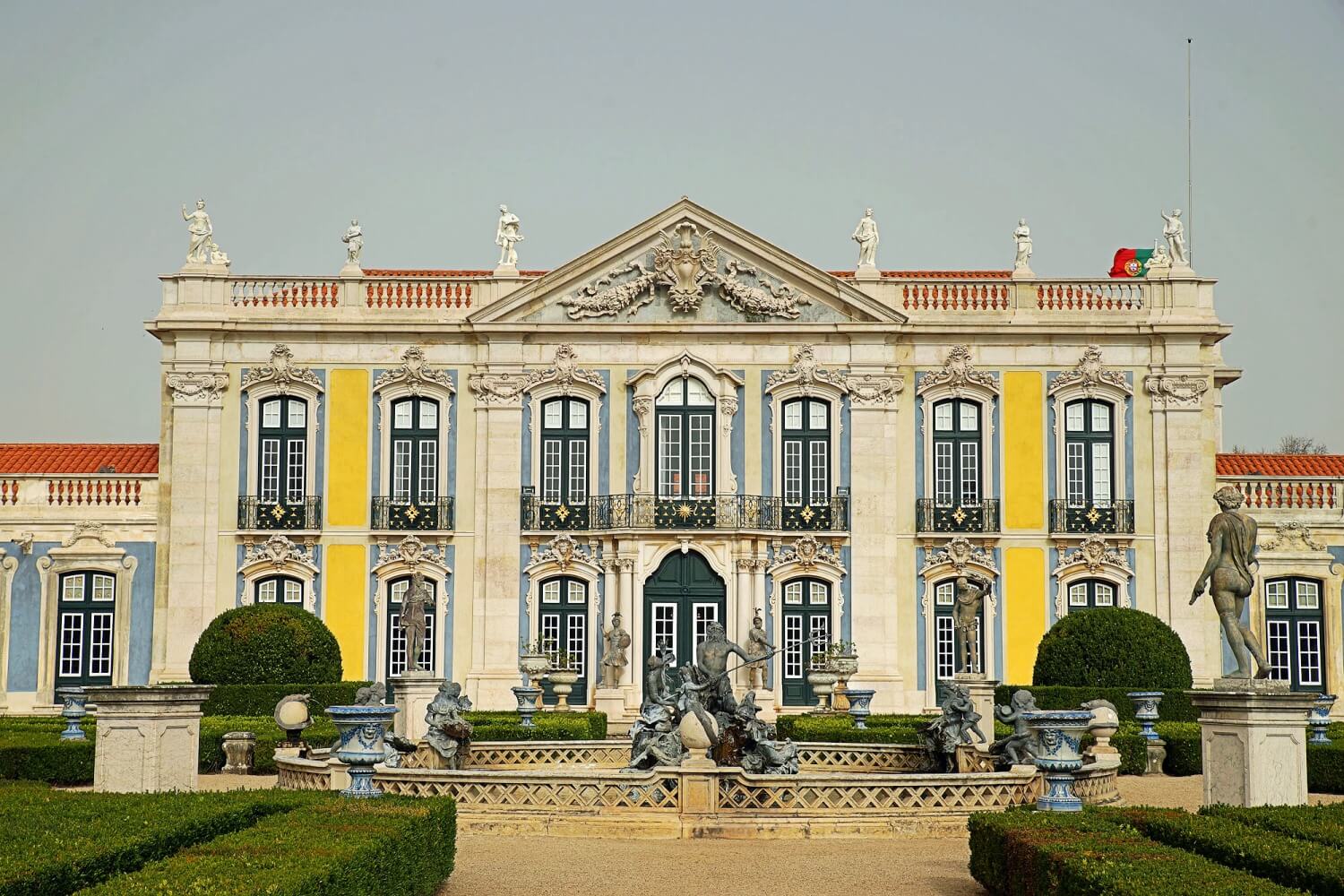
The Palace of Queluz (Portuguese: Palácio de Queluz, Portuguese pronunciation: [kɛˈɫuʃ]) is an 18th-century palace located at Queluz, a city of the Sintra Municipality, in the Lisbon District, on the Portuguese Riviera. One of the last great Rococo buildings to be designed in Europe, the palace was conceived as a summer retreat for Dom Pedro of Braganza, later to become husband and then king consort to his own niece, Queen Maria I. It served as a discreet place of incarceration for Queen Maria as her descent into madness continued in the years following Dom Pedro's death in 1786. Following the destruction by fire of the Ajuda Palace in 1794, Queluz Palace became the official residence of the Portuguese prince regent John VI, and his family and remained so until the royal family fled to the Portuguese colony of Brazil in 1807 following the French invasion of Portugal.
Work on the palace began in 1747 under Portuguese architect Mateus Vicente de Oliveira. Despite being far smaller, the palace is often referred to as the Portuguese Versailles. From 1826, the palace slowly fell from favour with the Portuguese sovereigns. In 1908, it became the property of the state. Following a serious fire in 1934, which gutted one-third of the interior, the palace was extensively restored, and today is open to the public as a major tourist attraction.
One wing of the palace, the Queen Maria I Pavilion, built by Manuel Caetano de Sousa, is currently used as Portugal's official state guest house, allocated to foreign heads of state.
Architecture and history
Queluz's architecture is representative of the final extravagant period of Portuguese culture that followed the discovery of Brazilian gold in 1690. From the beginning of the 18th century many foreign artists and architects were employed in Portugal to satisfy the needs of the newly enriched aristocracy; they brought with them classical ideas of architecture which derived from the Renaissance. In its design, Queluz is a revolt against the earlier, heavier, Italian-influenced Baroque which preceded the Rococo style throughout Europe.
Comparisons with the far larger and more Baroque Versailles are unwarranted: Versailles is referred to as having "an aura of majesty" and it was built and dedicated to exhibit in stone "all the glories of France," whereas the far smaller palace at Queluz has been described as "exquisite rather than magnificent" and looking like "a very expensive birthday cake". In its frivolity, the architecture of Queluz reflects the lifestyle led by the Portuguese royal family at the time of building: during the reign of Dom Pedro's brother, Joseph I, when Portugal was in practice governed by a valido or favourite, the Marquis of Pombal. Pombal encouraged the royal family to while away their days in the country and leave affairs of state to him. Thus the extravagant, almost whimsical architecture of Queluz, set apart from the capital city, exactly represents the politics and social events of Portugal during this era, and the carefree and flamboyant lives led by its occupants. Queluz's role as a haven for those without responsibility was, however, to be short-lived.
On the accession to the throne of Dom Pedro's wife Maria in 1777, Pombal was dismissed, and Dom Pedro and Maria ruled jointly in his place, using the partially completed Rococo palace at Queluz as a retreat from affairs of state in much the same way as Frederick the Great used Europe's other famed Rococo palace, Sanssouci.
The site chosen for this summer retreat was in a secluded hollow. It had originally been owned by the Marquis of Castelo Rodrigo. When the ruling Spanish were driven from Portugal in 1640, the Marquis was accused of having collaborated with the Spanish and the property was seized by the Portuguese Crown. The estate and its hunting lodge then became one of the many properties of the Portuguese king, João IV. He set it aside as one of the properties reserved for the second son of the reigning monarch. Thus it came into the hands of Dom Pedro, the second son of João V.
The architect, Mateus Vicente de Oliveira, had trained under Ludovice of Ratisbon and Jean-Baptiste Robillon [fr] during the construction of the royal palace and convent of Mafra. The more sombre and massive classical palace at Mafra does not appear to have influenced the design for Queluz, which is in a lighter, more airy style. Work began in 1747 and continued rapidly until 1755, when it was interrupted by the Great earthquake of 1755, after which the labourers were more urgently required for the reconstruction of the city. The earthquake proved to be a catalyst, because the urban rebuilding process stimulated the development of the arts in Portugal. The subsequent architecture of Queluz was influenced by new ideas and concepts. When work recommenced in 1758, the design was adapted for fear of another earthquake. Thus the later works take the form of low, long buildings, more structurally stable than a single high block: as a result, viewed from a distance the palace resembles long enfilades linked by higher pavilions rather than one single construction.
Exterior
The public façade of the palace faces directly onto a town square and takes the form of two low, symmetrical, quadrant wings which flank the forward-reaching wings of a small central corps de logis, thus forming a semi-circular cour d'honneur. The southern of the two quadrant wings is terminated by the onion-domed chapel, while the northern wing contained the kitchens and servants' quarters. The only decoration comes from the simple classical pediments above the windows. This façade, that most readily seen from the town, presents a decorous and impassive public face with one of the most architecturally severe elevations of the palace.
Oliveira was directly responsible for the "Ceremonial Façade" of the "corps de logis", the rectangular block which forms the nucleus of the palace, and some of the interior courtyards. His former tutor, the Frenchman Jean-Baptiste Robillon, was in charge of the gardens, many buildings, and the Rococo interiors. He in turn was assisted by Jean-Baptiste Pillement and other French and Portuguese artists. The "Ceremonial Façade" is the best-known view of the palace. With classical proportions, it is externally decorated by travertine rendering and delicately carved cartouches over the windows. It has been described as a "harmonious example of Portuguese Baroque". This façade with its single-storey flanking wings forms a three-sided courtyard containing the "Hanging Garden"—so called because like the Hanging Gardens of Babylon it is on a raised terrace.
The second major part of the palace is the great western wing, known as the Robillon wing or Robillon Pavilion, which illustrates better than any other the excesses of Baroque and Rococo architecture. Completed in 1779, it has a doric colonnade which runs the entire length of its western and southern façades, the roof of which provides a balustraded balcony accessible from the floor above. Owing to the topography of the site, the eastern side appears as a single-storey building, with only the upper floor visible above the ground in the "Hanging Garden". The balustrade on the roof of the Robillon wing is broken by heavy segmental pediments adorned with reclining statuary figures; the balustrade itself is also adorned with flambeaux, statuary and heavy armorial trophies.
The Robillon wing contains an entrance to the palace reached by flights of ingeniously designed graduated steps. Their design creates an illusion of a longer and higher perspective, centred on a corner of a terrace because of exigencies of the site, and divided mid-flight so as not to lead the eye and footstep towards an angle of the colonnade beyond. The steps are adorned with elaborate statuary. The bays of the façade are stuccoed rose-pink, contrasting with the motifs and pilasters in natural stone.
In 1760, Pombal arranged for Dom Pedro to marry the king's unstable daughter Maria, the heiress to the throne. Pombal encouraged the couple to live with their children in the unfinished palace at Queluz, away from the seat of government. It had always been a favourite retreat of the couple and was their principal home before Maria's accession. Further enlargements were made to reflect the palace's elevation from country retreat to royal palace. However, Maria had dismissed Pombal on her accession and, as a ruling monarch, she did not have time to while away her hours in the country. Dom Pedro interfered little in affairs of state, preferring to spend his time on religious matters.
By the death of Dom Pedro in 1786, all the interior work was completed. This was fortunate, as from this period his widow's mental health deteriorated, until in 1794, she and her court took up official and full-time residence at Queluz. There the now completely insane Queen could be hidden from the view of her subjects. Her eldest son, later King João VI, was appointed Regent and ruled from Lisbon and the great palace at Mafra.
In 2004, the World Monuments Fund began a program to restore the lead sculptures by British sculptor John Cheere, as well as some of the other features of the garden. The project is ongoing.
Interior
The interior of the palace received no less attention to detail and design than the exterior. French artisans were employed to decorate the rooms, many of which are small, their walls and ceilings painted to depict allegorical and historical scenes. Polished red bricks were frequently used for the floors, for a rustic appearance as well as coolness in hot weather. The many tall pavilions which link the various lower wings of the palace allow for a series of long low rooms broken by higher and lighter rooms. A predominant feature of the interiors is the azulejos: polychrome glazed tiles, often in a chinoiserie style with tones of blues and yellows contrasting with muted reds. Materials for use on the interior included stone imported from Genoa and woods from Brazil, Denmark and Sweden, while coloured marbles were imported from Italy. Many of the palace's rooms were severely damaged by fire in 1934, and much was lost.
The state apartments
The Sala das Mangas
The Sala das Mangas (the only room in the state apartments to fully survive the 1934 fire) is a long gallery lined with tiled wall panels. The gallery leads to the enfilade of state rooms, all of which have been fully restored. The formal rooms of the palace consist of three large halls: The Hall of Ambassadors, The Music Room and the Ball Room. Other smaller rooms include the Gun Room (where hunting parties would assemble), which is a frescoed salon painted with trees and foliage by Pillement.
The Music Room
The Music Room which follows the "Sala dos Embaixadores" is decorated with gilded and painted wood and was redesigned in 1768. The ceiling inset with painted cartouches is notable for the intricate ribbed scheme of its design, similar to that of the vestibule at Caserta. The Music Room is decorated in a more neoclassical style than the other state rooms, reflecting its redesign in the period following the Baroque Rococo in the final half of the 18th century. This room was the setting for the large concerts for which the palace was famous. The room still contains the Empire grand piano decorated with gilt appliques. Like many other rooms of the palace, the Music Room is lit by huge crystal chandeliers.
The Ball Room
The Ballroom, the last of the palace's three largest rooms, was designed by Robillon in 1760. To create this oval room the architect combined five smaller rooms. The ormolu Rococo ornament takes the form of heavy gilding to the walls and ceiling, of such richness that it has been compared with that of François de Cuvilliés' Amalienburg at Schloss Nymphenburg. The walls and doors are mirrored and the painted and gilded, coffered ceiling is supported by golden caryatids.
The Hall of Ambassadors
The Hall of Ambassadors ("Sala dos Embaixadores"), sometimes called the throne room or the Hall of Mirrors, was designed by Robillon in 1757 and is one of the largest reception rooms in the palace. This long low room has a ceiling painted by Francisco de Melo which depicts the Portuguese royal family attending a concert during the reign of Queen Maria I. The room is extremely wide and light, spanning the full width of the palace, with tall windows on both sides. Between each window is a semi-circular gilt console table above which are pier glasses adorned with crystal sconces. The throne dais, set in an apse, is flanked by gilded and mirrored columns, and the floor is a chequer board pattern of black and white marble tiles.
The Chapel
During the occupancy of the palace by Dom Pedro and Maria I, the chapel was central to the daily routine of their court. It was no coincidence that the chapel was the first part of the palace to be completed and was consecrated as early as 1752. Religion was one of Dom Pedro's favourite interests. During the reign of his wife he attended to matters spiritual and she to matters temporal. The Queen's interest in religion was, however, no less fevered than that of her husband—the couple attended mass several times a day. Following Dom Pedro's death, the Queen abandoned all festivities at the palace, and state receptions assumed the air of religious ceremonies. Finally the Queen's instability and religious mania degenerated into complete insanity. Queluz and its chapel then became her permanent retreat from the world until she was forced to flee from the advancing French in 1807 to Brazil. She died there in Rio de Janeiro in 1816.
The chapel beneath its large onion dome is dark and cavernous and decorated with carved giltwood, the detailing highlighted in red, green, blue and pink, by the Portuguese sculptor Silvestre Faria Lobo. The upper level has galleries for the use of royal personages who would sit apart from the congregation. One of these galleries contains a small Rococo pipe organ. A feature of the chapel is the ornate portable font, its marble basin resting in an elaborate Rococo frame surmounted by a carved wood cover.
Grounds
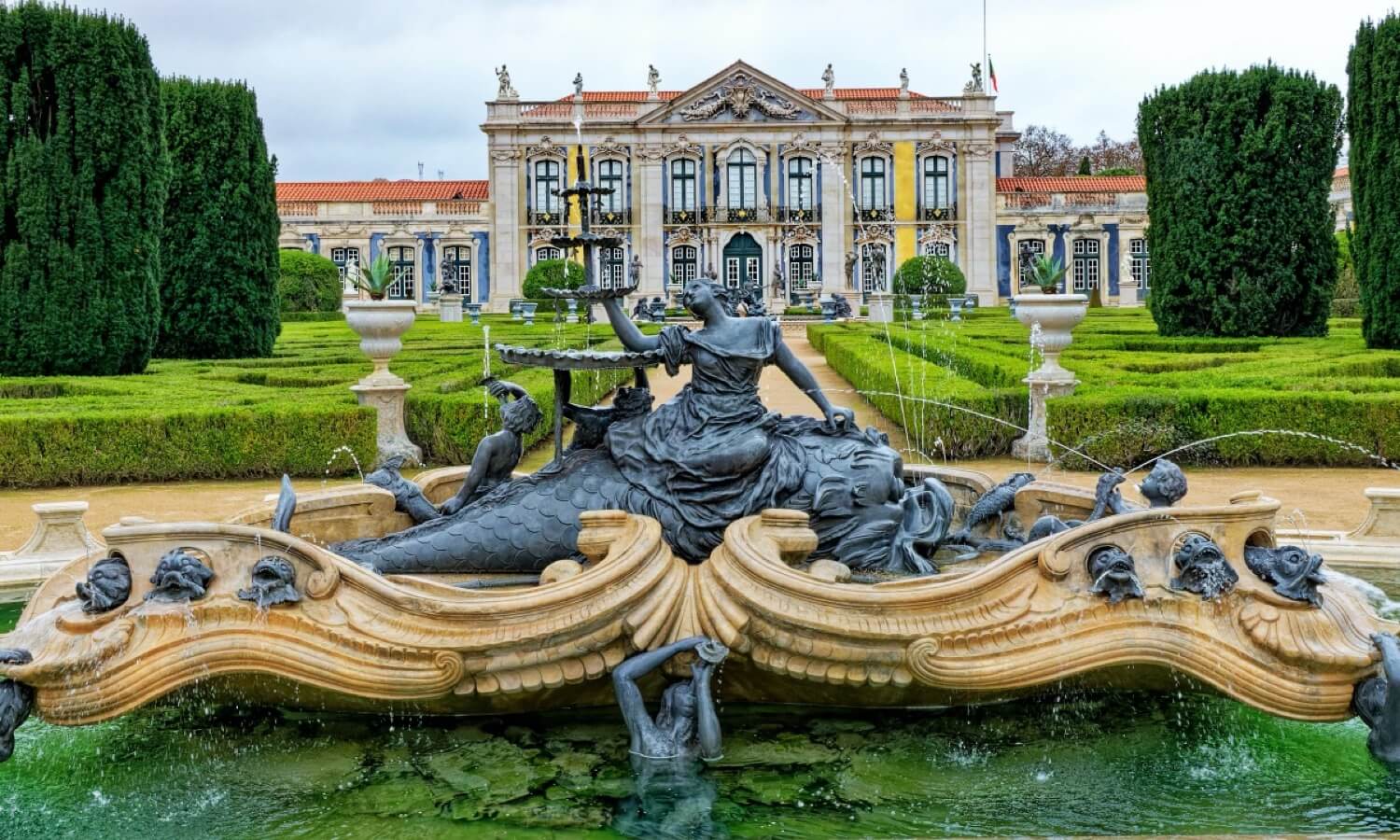
Queluz is famed for the glory of its gardens, which include a large topiary parterre laid out in the manner of Le Nôtre at the rear of the palace. The Flemish influences, including the canals, in the garden are the work of the Dutch gardener Gerald van der Kolk, who assisted Robillon from 1760. Formal terraces and walkways are given extra interest by statuary and fountains. The dominant feature of the principal parterre is the "Portico dos Cavalinhos", a garden temple flanked by two allegorical equestrian statues depicting Fames, and two sphinxes surreally dressed in 18th-century costume, combining the formal and the fantastic. This surreal theme continues elsewhere in the gardens where such motifs as the rape of the Sabines and the death of Abel alternate with statuary of donkeys dressed in human clothing. Deeper in the gardens is a grotto complete with a cascade. Later to be a popular feature in Portuguese gardens, the Queluz cascade was the first artificial waterfall to be constructed near Lisbon.
An avenue of huge magnolias forms the approach to the classical Robillon wing of the palace, while from the wing a double staircase leads to the canal. More than 100 metres (330 ft) long, the walls of the canal are decorated with tiled panels depicting seascapes and associated scenes. This is the largest of a series of canals in the gardens bordered with chinoiserie-style azulejo tiles. Fed by a stream, the sluice gates to the canals are only opened in May. During the 18th century, the canals were the setting for fêtes champêtres during which fully rigged ships would sail in processions with figures aboard in allegorical costumes.
The gardens also contain a fountain with tritons and dolphins which has been attributed to Bernini. There are further fountains and statuary in the lower gardens, including an important collection of statues by the British sculptor John Cheere (1709–1787). These gardens are set within tall hedges of yew and cypress, and magnolia and mulberry trees planted by Marshal Junot during the French occupation in the Napoleonic wars.
National Monument
In the 21st century, the palace gardens, once an irrigated oasis in the centre of parched farmland, are bounded by the "Radial de Sintra" motorway which feeds traffic towards Lisbon and away from Sintra. However, transportation and tourism have been important infrastructural catalysts for the palace's maintenance and management.
Since 1940 it has been open to the public as a museum. It houses much of the former royal collection, including furniture, Arraiolos carpets, paintings, and Chinese and European ceramics and porcelain.
The town square that the palace faces, "Largo do Palácio de Queluz", remains relatively unaltered since the 18th century. The large houses, once the homes of courtiers, and the former Royal Guard quarters with its campanile are still clustered around the palace.
In latter years, the town of Queluz has expanded considerably to become one of the suburbs of Lisbon. The Palace of Queluz is one of most notable public landmarks in the Lisbon metropolitan area.
State guest house
The Pavilhão de D. Maria I (Queen Maria I Pavilion), which makes up the palace's southernmost wing, was built during the third, and final, construction phase, executed by Manuel Caetano de Sousa, which lasted from 1786, the year of King Pedro III's death, until 1792.
In 1957, the Queen Maria I Pavilion was renovated to serve as the Portuguese Government's official state guest house, for visiting heads of state and government. The planned state tour of Queen Elizabeth II in 1957 was a principal motivating factor in the pavilion's renovation into a state guest house.
Today, the pavilion continues to house visiting dignitaries. Therefore, its state rooms are not open to the public as part of the Queluz Palace national monument, as they are used for official entertaining by state officials.
O Palácio Nacional de Queluz é um palácio do século XVIII localizado na cidade de Queluz, no concelho de Sintra, distrito de Lisboa. Um dos últimos grandes edifícios em estilo rococó erguidos na Europa, marcado também pelo barroco e o neoclassicismo ilustra nas suas divisões e jardins os ambientes e vivências da Família Real e da corte portuguesa na segunda metade do século XVIII e início do XIX, durante momentos de grande importância histórica, na transição do Antigo Regime para o Liberalismo. O palácio foi construído como um recanto de verão para D. Pedro de Bragança, que viria a ser mais tarde marido e rei consorte de sua sobrinha, a rainha D. Maria I de Portugal.
Serviu como um discreto lugar de encarceramento para a rainha D. Maria I enquanto sua loucura continuou a piorar após a morte de D. Pedro em 1786. Após o incêndio que atingiu o Palácio da Ajuda em 1794, o Palácio de Queluz tornou-se a residência oficial do príncipe regente português, o futuro D. João VI, e de sua família. Permaneceu assim até a fuga da família real para o Brasil em 1807, devido à invasão francesa de Portugal.
A construção do Palácio iniciou-se em 1747, tendo como arquiteto Mateus Vicente de Oliveira. Apesar de ser muito menor, é chamado frequentemente de "o Versalhes português". A partir de 1826, o palácio lentamente deixou de ser o predileto pelos soberanos portugueses. Em 1908, tornou-se propriedade do Estado. Após um grave incêndio em 1934, o qual destruiu o seu interior, o Palácio foi extensivamente restaurado e, hoje, está aberto ao público como um ponto turístico.
Uma das alas do Palácio de Queluz, o Pavilhão de Dona Maria, construído entre 1785 e 1792 pelo arquiteto Manuel Caetano de Sousa, é hoje um quarto de hóspedes exclusivo para chefes de Estado estrangeiros em visita a Portugal.
Foi classificado como Monumento Nacional em 1910.
Arquitetura e história
Antes da construção do palácio, a região abrigava o pavilhão de caça de Cristóvão de Moura Corte-Real, o 1.º marquês de Castelo Rodrigo. Por terem tomado o partido dos espanhóis durante a Guerra de Restauração, os marqueses tiveram sua propriedade em Queluz transferida à família Bragança.
Deve-se a D. Pedro III a iniciativa da construção, do século XVIII, em que trabalharam os arquitetos portugueses Mateus Vicente de Oliveira e Manuel Caetano de Sousa, e o arquiteto-escultor francês João Baptista Robillon. As obras começaram em 1755. No teatro real deste palácio interveio o arquiteto I. de Oliveira Benevides, vindo essa sala a ser inaugurada em 17 de Dezembro de 1778 (1.º aniversário da coroação da Rainha).
Destaca-se, para além do valor arquitetónico e patrimonial, a beleza dos jardins e larga extensão de mata que o cerca.
Foi residência sazonal real e hoje tem vocação turístico-cultural. Os traços arquitetónicos salientam os estilos barroco, rococó e neoclássico. A planta apresenta-se complexa, pois corresponde à aglutinação de vários núcleos e a fases distintas de construção. Porém, pode-se dizer que o palácio se organiza genericamente em L, enquadrando os jardins por meio de várias salas.
Do lado externo, o palácio abre dois braços curvos. No lado dos jardins, é visível a articulação das várias fachadas de aparato, nomeadamente a que enquadra o Jardim de Neptuno ou Jardim Grande. No piso térreo, merece destaque o corpo central de dois andares, firmado por portas e janelas de sacada. A fachada de cerimónia virada ao Jardim dos Azereiros ou Jardim de Malta, é constituída por três corpos.
No rio Jamor, que passa nos jardins do palácio, foi construído o Canal dos Azulejos, com cerca de 130 metros de comprimento. Quando as comportas do canal eram fechadas, criava-se um plano de água onde era possível passear de barco entre paredes azulejadas, com representações de portos, palácios e outros temas.
A chamada Quinta de Queluz, que anteriormente pertenceu ao marquês de Castelo Rodrigo, passou para posse real em 1654 e foi incorporada na Casa do Infantado. O palácio começou a ser construído em 1747. Daí até finais do século XVIII o edifício ganhou os contornos que apresenta hoje, nomeadamente com o marcado revestimento azulejar e a construção de sumptuosos jardins, a cargo de um arquitecto holandês. No jardim chegou a existir uma pequena praça de touros, que viria a desaparecer.
A primeira fase de construção do jardim terminou em 1786. A água para os lagos e repuxos dos jardins da zona sudoeste era fornecida por dois aquedutos: o aqueduto da Ponte Pedrinha, proveniente da mina do Pendão no vale do rio Jamor, e o aqueduto da Gargantada, proveniente da mina da Gargantada no vale da ribeira de Carenque. A zona noroeste era alimentada por água proveniente da bacia da ribeira das Forcadas.
Em 1794, o palácio tornou-se oficialmente residência oficial da Família Real Portuguesa. Nele nasceu D. Pedro IV de Portugal (ou Pedro I do Brasil), em 12 de outubro de 1798. Quando da partida dos reis para o Brasil, em 1807, grande parte do recheio do palácio foi despojado. D. João VI e a Corte regressaram a Portugal em 1821, mas Queluz só volta a ser habitado, pela rainha D. Carlota Joaquina.
Também D. Miguel habita o Palácio de Queluz, enquanto rei e durante o período sangrento das guerras fratricidas que o opuseram ao irmão.Em 24 de setembro de 1834, já como rei de Portugal, Pedro IV viria a falecer no mesmo quarto em que nascera (Quarto D. Quixote). A partir desta data entrou em declínio, até que em 1908 o rei D. Manuel II o cedia à Fazenda Nacional.
O desnível entre os jardins e o parque perde relevo perante a sequência de terraços e galeria praticada por pares de colunas toscanas, rematada por uma monumental escadaria. No interior, a organização dos compartimentos processa-se em linha.
Aposentos
As salas e outras divisões do palácio são: sala do trono, sala da música, sala dos embaixadores, corredor das mangas ou dos azulejos, quarto D. José, sala dos arqueiros ou corpo da guarda, sala do toucador, quarto D. Quixote, sala do Lanternim, aposentos da Princesa D. Maria Francisca Benedita, sala de fumo, sala de jantar, sala da tocha, sala dos archeiros, sala dos particulares, sala das merendas, aposentos da Rainha; pavilhão D. Maria.
Sala do Trono também denominada Casa Grande, é a maior das três salas de aparato do palácio. A sua construção teve inicio em 1768, para o casamento de D. Pedro com a sobrinha, futura rainha D. Maria I, sendo necessário a criação de um grande espaço destinado às audiências oficiais, tendo sido terminada em 1774. A sala foi concebida ao gosto regência-rococó, com os trabalhos de talha da autoria e coordenação do escultor-entalhador Silvestre de Faria Lobo e as pinturas alegóricas do teto foram executadas sob a orientação do pintor João de Freitas Leitão.
Sala da Música, uma das mais antigas salas do palácio, também denominada Sala das Serenatas, foi muitas vezes utilizada para casa de ópera e serões musicais. Projetada pelo arquiteto Mateus Vicente de Oliveira, foi concluída em 1759. Decoração em talha dourada no estilo regência-rococó, com motivos alusivos à música, tendo como autor Silvestre Faria Lobo.
Sala do Lanternim, conhecida anteriormente por Sala Escura, tem hoje uma abertura no teto mandada criar pelo general francês Junot, aquando da 1ª invasão francesa (1807). Esta sala comunica com a Capela Real, a Sala da Música e a Sala do Trono e onde antigamente, uma escada dava acesso à tribuna lateral superior do altar-mor, onde a Família Real podia assistir aos ofícios religiosos sem ser vista. A sala foi restaurada aquando do exílio de D. Miguel, pela Infanta Regente D. Isabel Maria com o objetivo de o alojar aquando do seu regresso em 1828. Apesar de D. Miguel nunca chegou a habitar esta sala, é uma pintura com o seu retrato (o maior do palácio) que domina a sala.
Sala de Escultura, Sala de Fumo e Sala de Café, estas salas pertenciam à ala original dos aposentos da princesa Maria Francisca Benedita, na atualidade devem os seus nomes às funções que tinham na segunda metade do século XIX, aquando das pequenas estadias no palácio do rei D. Luís e da rainha D. Maria Pia de Saboia, nomeadamente a sala onde foi instalado o atelier de escultura da rainha, e salas que serviam para beber café e para fumar.
Sala de Jantar trata-se de uma sala mais recente, que decorre da função que lhe foi atribuída pelos últimos monarcas que a utilizaram. A noção de sala de jantar como espaço definido é tardia, portanto a mesa era literalmente posta conforme as ocasiões, o gosto pessoal dos monarcas e a localização dos seus aposentos privados.
Sala de Porcelanas e Faianças e Pátio da Lontra, sala junto à sala de jantar, apresenta um ordenamento para exposição da coleção de faianças e porcelanas europeias e orientais com origem maioritária das coleções reais, incluindo serviços de mesa da Casa Real utilizados no palácio. Tem vista para um pequeno pátio interior com um lago, chamado de Pátio da Lontra, provavelmente relacionado com a existência deste animal, que teria habitat nas proximidades.
Corredor das Mangas ou dos Azulejos, o nome deste espaço relembra as mangas de vidro que protegiam as velas e que aqui seriam guardadas, bem como os painéis de azulejos policromos neoclássicos de grande qualidade técnica e efeito decorativo (representam as quatro estações, os quatro continentes, caricaturas, motivos chineses e orientais e cenas da mitologia clássica) que revestem as paredes e que são datados de 1784, de autoria atribuída ao pintor ceramista Francisco Jorge da Costa. O lambrim, datado de 1764, está decorado com painéis azuis e brancos que representam predominantemente cenas de caça são atribuídos ao pintor Manuel da Costa Rosado. A sala apresenta ainda decoração com vasos de faiança azul e branco, da Real Fábrica do Rato e réplicas dos mesmos, da Fábrica Viúva Lamego. Encontra-se também aqui exposto um exemplar dos vários "carrinhos" para andar na quinta, encomendados por D. Pedro em 1767 e executados sob a direção de Robillion, com decoração italiana e rodas de madeira cuidadosamente entalhadas.
A decoração de algumas salas é digna de realce, sendo constituída por frescos (Sala das Açafatas), revestimento a espelhos, estuque e talha dourada (Toucador da Rainha, Sala do Trono), parquet de madeiras exóticas (Sala D. Quixote) ou azulejos (Corredor das Mangas). Os jardins são ornamentados por estátuas.
A 4 de outubro de 1934 seria este palácio vítima de um violento incêndio que o destruiria parcialmente. À exceção do corpo central, a reconstrução da ala norte limitou-se ao piso térreo. A 19 de dezembro de 2001 reabriu ao público a Sala de Música com um recital de Christiano Holtz, no restaurado Pianoforte Muzio Clementi, pertencente à coleção de instrumentos musicais do Palácio de Queluz.
Até ao final do século XVIII foi azul esmalte. Depois foi pintado de cor de rosa. Em 2013, a equipa de conservadores pôs em marcha o plano para devolver a cor original ao edifícios.
Biblioteca de Arte Equestre D. Diogo de Bragança
Diogo de Bragança, 8.º Marquês de Marialva, falecido em 2012, foi um exímio cavaleiro e especialista em Arte Equestre que, ao longo da sua vida, adquiriu documentos sobre este tema, sendo ele próprio autor de diversas publicações. A valiosa biblioteca que deixou, centrada no núcleo essencial de Arte Equestre, inclui também obras dedicadas à tauromaquia e à caça. É constituída por cerca de um milhar e meio de obras impressas e manuscritas, do século XVI ao século XX, algumas de grande raridade. Cerca de 200 gravuras e estampas originais completam este acervo.
A Parques de Sintra – Monte da Lua, gestora da Escola Portuguesa de Arte Equestre (EPAE), sediada em Queluz, decidiu adquirir esta coleção em 2014 com o objetivo de a associar à EPAE e ao estudo da Arte Equestre prestando, assim, homenagem a D. Diogo de Bragança.
Inaugurada em 2015, com o nome do seu instituidor, a biblioteca veio enriquecer o acervo do Palácio Nacional de Queluz, residência real que, desde o século XVIII até ao presente, esteve sempre ligada à tradição equestre portuguesa. Os académicos e investigadores, passam a ter acesso a 1 400 títulos (cerca de 2 000 publicações), alguns bastante raros, relacionados com a Arte Equestre. A coleção foi inventariada pela casa leiloeira Cabral Moncada e inclui 800 títulos europeus (entre os quais 16 manuscritos), desde o século XVI ao XX; 294 livros e folhetos dos séculos XIX e XX; 322 livros ilustrados da 2ª metade do século XX; e cerca de 165 gravuras.
Useful information
Free
Park and Palace: 10.00 EUR
Park: 5.00 EUR
Park and Palace:
6 - 17 years: 8.50 EUR
Seniors: 8.50 EUR
Park:
6 - 17 years: 3.50 EUR
Seniors: 3.50 EUR
Park and Palace:
Family: 33.00 EUR
Park:
Family: 15.00 EUR
- Information tables
- Free entrance on Sundays and holidays
info@parquesdesintra.pt
Guided tours are available
-
External links
Nearby castles
Flor da Murta Palace
Paço de Arcos
5.8km
manor, mansion
Fort of São Bruno
Caxias
6.0km
fortress
Fort of Giribita
Paço de Arcos
6.3km
fortress

Palace of the Marquises of Fronteira
Lisboa
6.9km
manor, mansion
Palace of Ajuda
Lisboa
7.1km
manor, mansion
Calheta Palace
Lisboa
7.4km
manor, mansion
Belém Tower
Lisboa
7.5km
castle, chateau