Rye Castle (Ypres Tower)
East Sussex England England
castle, chateau
Rye Castle, also known as Ypres Tower, was built in 1249, and is situated in Rye, East Sussex, England
Previous names
Rye Castle (Ypres Tower)
Description
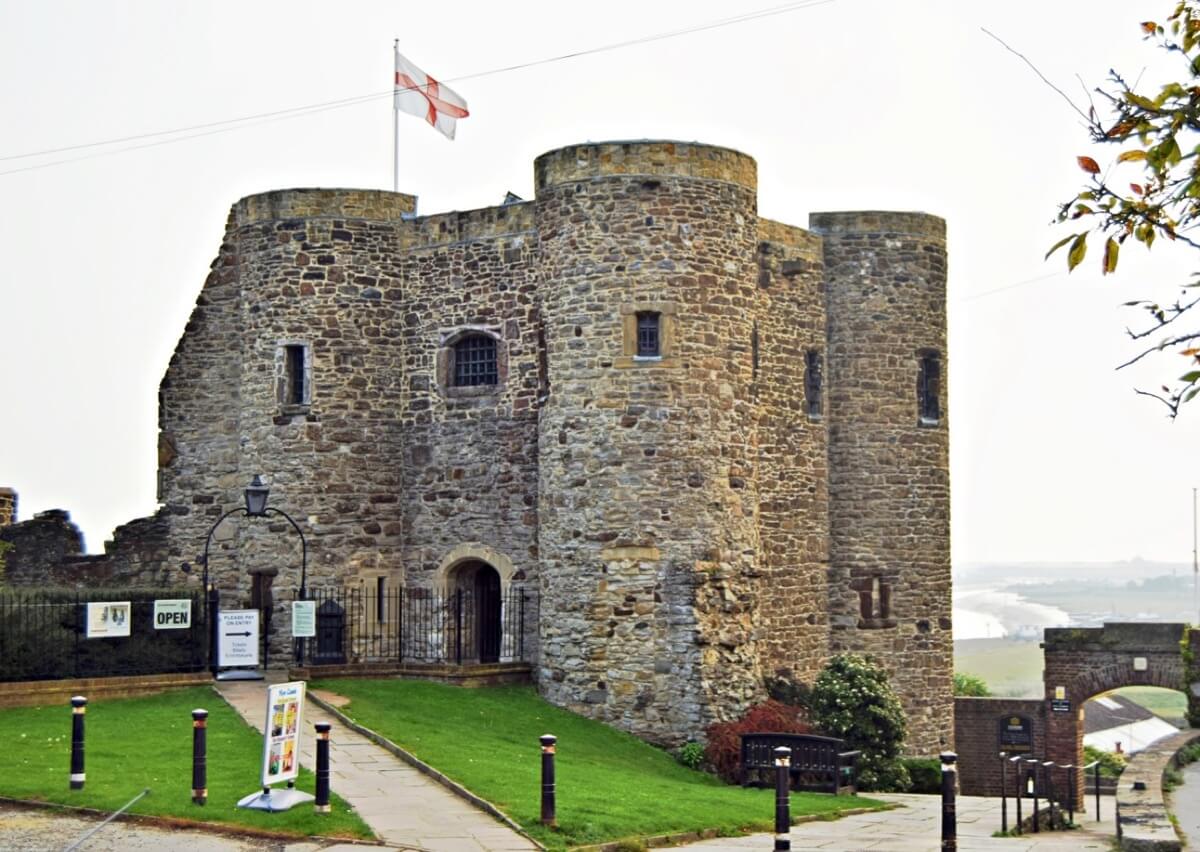
Rye Castle, also known as Ypres Tower, was built in 1249, and is situated in Rye, East Sussex, England. It was Henry III who gave permission for the castle to be built as part of the defense against the frequent raids by the French. At the time, the coast was under constant threat from the French, who were warring with England.
As one of the cinque ports towns, Rye was given privileges in exchange for its support, and the defensive structure of Ypres Tower provided this support.
Rye Castle Museum
Ypres Tower is one of two sites of Rye Castle Museum and is a grade I listed building. Exhibits in the tower include locally-made medieval pottery, an embroidery depicting many aspects of Rye life and history, medieval artifacts, activities and town maps.
The East Street Site, a former brewer's bottling factory, is the main exhibit area for the Rye Castle Museum. Opened in 1999, the local history exhibits include fire fighting equipment, trade changes caused by the sea's retreat, maritime history and shipbuilding, antique toys and games, photos, town seals, and archaeological artifacts.
When was it built?
Nobody is quite sure when Ypres Tower was built. It may have been part of a royal castle built sometime between 1230 and 1250, during the reign of Henry III. Normandy had been lost and Henry feared more attacks by the French. Certainly, in 1249, he ordered the Constable of the Cinque Ports, Peter Savoy, to build a castle at Rye but there is now some doubt whether he did.
It is now thought more likely that it was built at the same time as the town wall and gates, during the reign of Edward III or Richard II in the late 14th century. Its architecture is of that period, and some details of its construction are similar to those of the Landgate; in fact, the Tower was incorporated into the town wall.
Whichever is the case, it was called Baddings (or Baddyngs) Tower, the name of the ward in which it was situated, and the sturdy square building with three-quarter-round towers at the angles has remained essentially the same since its construction. The stone walls, some forty feet high, were originally topped by a parapet, and the remains of the corbels may still be seen on the east and west sides. A 1633 drawing by Anthony Van Dyck clearly shows the parapet. (Van Dyck did three other drawings of Rye and the Ypres Tower, presumably while awaiting passage back to the Low Countries.)
Changing uses
The enhanced defences of the town were found wanting when the French attacked and burnt the town in 1377, stealing the church bells and killing inhabitants. Only a few stone buildings survive, one being the one we known as Ypres Tower. . The Court Hall was one casualty of this raid, and while a new one was being built, the Tower was used for Corporation business and the various courts. In 1421, all offenders were ordered to attend here on pain of a fine of 12 pence which suggests that part of it was also used as a prison.
However, in 1430 the Tower was leased to one John de Ypres (hence the name), for use as a private residence, with the proviso that ‘the Mayor Jurats and Commonality’ could enter it at a time of hostility or war for the purpose of town defence. Fortunately the attack never came.
In 1484 or 1494 the Corporation rented the Tower for use as a prison, and in 1518 bought the freehold — for £26; shortly afterwards a new roof and new floors were added.
For the next three hundred years the Sergeant-at-Mace acted as Gaoler of the Ypres Tower, under the supervision of the Mayor and Jurats. (His salary in 1841 was £8.6s.4d rising to £12.12a.0d in 1808 plus fees.) He was assisted by four unpaid Petty Constables who were to summon, apprehend, search for and arrest as directed and to enforce directives such as the many times repeated one prohibiting any person whatsoever to ‘throw or fling at cocks in this town’. The Constables at first received ‘rewards’, such as a pot of beer or ‘some small matter of refreshment’, but became more productive when they received 1s. for each vagrant taken inside the town and 2s. for each taken outside.
From the 1740s capital offences were tried at Horsham or elsewhere which meant that Tower inmates were those who had committed felonies or, more often, misdemeanors; petty larceny accounted for two-thirds of all indictable offences, the others consisting mainly of ‘offenses against the person’ with a sprinkling of fraud. Fair time usually meant cells briefly filled with victims of drink.
Progress?
A full time ‘Gaol Keeper’ was appointed in 1796 (salary £3 rising to £5 in 1806), and three years later given an assistant by which time there was accommodation for twelve prisoners–stretching to twenty when necessary.
However, the Tower was by now in a bad state of repair; the Corporation even considered demolishing it. Instead, a red brick exercise yard was built on the north side and, it is thought, the stocks and whipping post removed.
Equipment at this time consisted of 4 rugs (1 old), 5 blankets (2 thin), 1 round deal table, 2 wood bottomed chairs, 2 coal boxes, 2 fire water cans, 13 padlocks, 2 pair of leg irons, 8 pair handcuffs, 1 Constable’s staff and 1 horn lantern.
While at the end of the 18th century the Gaoler was expected to provide, out of his allowance, bread, beer and soup for his prisoners, by the 1820′s this had been reduced to bread and water though the sick qualified for milk, gruel and wine. Prisoners slept on a truss of straw, though blankets were issued in the early 1800′s and sometimes washed.
More elaborate changes followed the 1830′s legislation to improve prison conditions: a new exercise yard (the present Medieval Garden), four additional cells, and a tower for housing women prisoners (the focus of the ongoing Women’s Tower Project — there’s lots about this in the category WACOR at right).
As a result of these ‘improvements’, the total number of prisoners to be housed was reduced to nine.
By this time the Gaoler received ‘a house and firing’ in addition to his salary and his wife was Matron of the Gaol at 4s. a week. The purchase of two ‘Standard Hard Labour Machines’ in 1855 and 1865 was thought to represent further ‘progress’, along with the issuing of Bibles (1858) and sheets (1861).
Other expenditure for the gaol included candles for lighting; faggots, sparingly purchased, for heating; gas, for cooking only (1864), staves, handcuffs, leg and body irons and rattles.
Lock-up, Soup Kitchen and Mortuary
As a result of the Prison Act of 1865, the gaol was downgraded to the status of a lock-up and remained as such until 1891 when the first police station was built on the southern side of Church Square (Now No. 18, a private residence).
Before this, however, the Corporation in 1870 resolved that a Soup Kitchen be built at the front of the Tower for the distribution of soup and bread to the poor during severe winter weather.
The original red brick exercise yard was provided with a roof and a chimney for this purpose. Local citizens considered this an eyesore and formed a society which provided funds for its demolition and removal to the corner of Rope Walk and Cinque Ports Street in 1895.
Meanwhile, the lower floor of the Tower was being used as a Mortuary–and continued thus until 1959 despite objections. Ex-Mayor John Neve Masters, for example, wrote this to the town clerk in 1894:
Whose business is it to keep the Mortuary clean? I found this morning that it had never been cleaned out since used, the table is dirty and stinking. Fish are lying about.
Nonetheless, in 1901, there was a request to buy it as a private residence–fortunately rejected. In 1924, though used only as a mortuary and to house the 18th century fire engine, it was scheduled as an ancient monument.
A Home for Rye Museum: Battery House
As early as 1889, Rye Literary Society had proposed the use of the Tower as a museum for the town but it was not until 1928 that a museum for the town was established–in the Battery House next door. This had been purchased by the Corporation from the War Office and was rented for use as a Museum for £26 a year. Its Curator was Leopold Vidler, who wrote A New History of Rye (1934).
With the coming of war, valuables were stored elsewhere and the museum closed. This was just as well as on 22 September 1942 Battery House and the adjoining properties were badly damaged in an air raid, and the Ypres Tower lost the pyramidal roof it had acquired at an unknown date.
At the end of the war, all the cases and exhibits which had been saved were stored in a garage and remained there until Coronation Year, 1953, when celebrations for the Coronation of Queen Elizabeth II ignited interest in re-establishing the Rye Museum.
A Museum Committee set to work and the Rye Museum opened its doors on Easter 1954 with exhibits on the ground and first floors–and the mortuary still in the basement.
The Tower Today
Today, visitors see the Tower essentially as it originally was, with the main entrance on the side facing the town.
One difference is that the door originally had a portcullis. The main door leads into the ground floor, with a basement beneath,a first floor above and a turret at each corner.
The north-east turret houses the spiral staircase which serves all three floors; the steps are deliberately uneven, to put any intruder at a disadvantage. The other three hollow turrets which originally formed guardrooms at ground and first floor levels became cells for prisoners after the tower became a prison.
The ground and first floors each had a fireplace. These are still in place, although the chimneys are now blocked.
The windows were originally designed as arrow-slits, and between them they were intended to give good all-round defence as archers in the turrets could fire on attackers trying to climb the walls.
These days there are sometimes archers too: In 1989 Rye celebrated its 700th anniversary as a town and a part of the medieval celebrations the Order of Rye Longbowmen was formed. They sometimes gives demonstrations and even lessons to youngsters.
More usually it is all-round views that are wanted by visitors to the Tower and these can be obtained by venturing out onto the first floor balcony.
https://www.ryemuseum.co.uk
Useful information
- Adults £4.00
- Concessions (Over 65’s): £3.00
Children under 16 free but must be accompanied by an adult
Children under 16 FREE
info@ryemuseum.co.uk
External links
Nearby castles