Alsbacher Schloss
Darmstadt Hessen Germany
castle, chateau
Alsbacher Schloss
Darmstadt Hessen Germany
castle, chateau
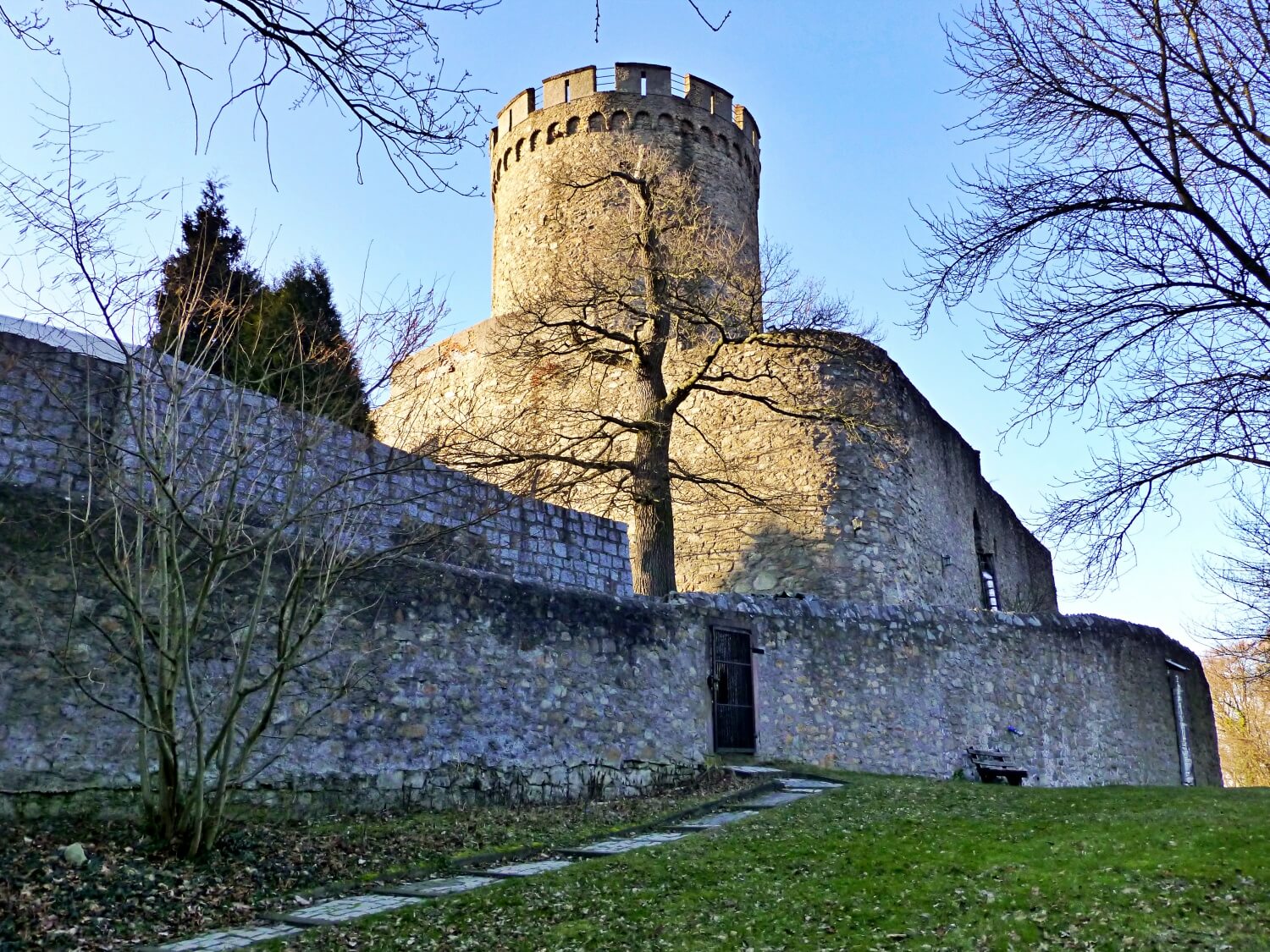
The Alsbacher Schloss near Alsbach-Hähnlein on Bergstrasse , in the Darmstadt-Dieburg district , is more of a fortress and was previously called Burg Bickenbach
Das Alsbacher Schloss bei Alsbach-Hähnlein an der Bergstraße, im Landkreis Darmstadt-Dieburg, ist eher eine Trutzburg und hieß früher Burg Bickenbach
Previous names
Alsbacher Schloss, Alsbacher Schloss
Description
The Alsbacher Schloss near Alsbach-Hähnlein on Bergstrasse , in the Darmstadt-Dieburg district , is more of a fortress and was previously called Burg Bickenbach .
History
Bickenbach Castle was built around 1235 by the Lords of Bickenbach on the 257 m high hill above the village of Alsbach, which was first mentioned in 773 in the Lorsch Codex . The predecessor was probably a moth near Alsbach, on the so-called hamlet hill . Since the 14th century, the castle was a Ganerbeburg in the joint possession of six owners. After one of the heirs, Hartmann (also Hamman ) Ulner von Dieburg , robbed merchants of the city of Frankfurt am Main , the city overran the castle in 1463 and burned it down. However, the facility was soon rebuilt.
From 1483 to 1502, one of the heirs , Erasmus Schenk von Erbach († 1503), managed to buy out almost all of the other heirs (including the Archbishop of Mainz and the Counts of Mansfeld) and to bring the castle and rule into his own possession to 5/6 , and from 1488 he called himself "Herr zu Erbach und Bickenbach".
When in the year 1504, the Landshut War of Succession , the so-called "Bavarian feud" broke out, was Rupert of the Rhine because of its Erbstreits with Duke Albrecht IV. Of Bavaria on April 23 by King Maximilian I with the outlawed occupied. Landgrave Wilhelm II of Hesse , entrusted by Maximilian with the execution of the eight, first took the Palatinate Castle Otzberg and then besieged the Alsbach Castle , since the taverns from Erbach were Palatinate vassals. The castle commandant Hans Gans von Otzberg did not let a storm come off and handed the keys of the castle to the landgrave on June 9, 1504. After the end of the War of Succession, Landgrave Wilhelm no longer gave the castle and the Bickenbach office . Wilhelm's son Philip the Magnanimous had the defense works repaired and reinforced. In his will he transferred the castle and the office of Bickenbach to his sons from his morganatic marriage with Margarete von der Saale , the Count of Diez . You seem to have had it in your hands as early as 1562. After the last of the Counts von Diez died in 1575, the property fell to Landgrave Georg I of Hesse-Darmstadt in 1577 .
In the course of the 17th century, but especially in the 18th century, the castle fell into disrepair, so that today the complex is only preserved as a ruin .
The main castle was laid out in a classic triangular shape. Parts of the outer curtain wall and a narrow kennel are also preserved. Most impressive is certainly the mighty - restored - keep , which is accessible from the defensive wall.
Historical and cultural development association Schloss Alsbach e. V.
Today, the facility is run by the Citizens' Association of Historic and Cultural Förderverein Schloss Alsbach e. V. , who has been managing the facility since 2000 on behalf of the State of Hesse. Numerous events are held to finance the maintenance of the castle. The association was founded on September 18, 1997 by the Alsbach heraldist and historian Dieter Krieger on the recommendation of the property management of the State of Hesse (state property management), the historical and cultural development association Schloss Alsbach . He has set himself the goal of promoting the castle ruins, maintaining, maintaining, beautifying and restoring them. Furthermore, the association aims to present the Hessian cultural property, Schloss Alsbach, to the visitors through cultural events and make it a popular and worth seeing excursion destination for the whole family. The association has been managing the castle independently since 2000.
Castle garden
Several herb gardens were set up in the entrance area and in the outer bailey. They are divided into a historical part with herbs from the garden of Hildegard von Bingen and the Capitular Emperor Charlemagne and a modern garden with modern herbs. There is also a rosarium with historical scented roses and a medieval grass bank, as well as a vineyard. Every year around 200 half-liter bottles of the castle wine "Barbakan" are bottled from the Regent vine .
https://de.zxc.wiki
Das Alsbacher Schloss bei Alsbach-Hähnlein an der Bergstraße, im Landkreis Darmstadt-Dieburg, ist eher eine Trutzburg und hieß früher Burg Bickenbach.
Geschichte
Burg Bickenbach wurde etwa um 1235 von den Herren von Bickenbach auf der 257 m hohen Anhöhe über dem Dorf Alsbach, das schon 773 im Lorscher Codex erstmals erwähnt wurde, erbaut. Vorgänger war wahrscheinlich eine Motte bei Alsbach, auf dem sogenannten Weilerhügel. Seit dem 14. Jahrhundert war die Burg eine Ganerbenburg im gemeinsamen Besitz von sechs Eigentümern. Nach Raubüberfällen eines der Ganerben, Hartmann (auch Hamman) Ulner von Dieburg, auf Kaufleute der Stadt Frankfurt am Main berannte die Stadt im Jahre 1463 die Burg und brannte sie nieder. Die Anlage wurde jedoch bald wieder errichtet.
Von 1483 bis 1502 gelang es einem der Ganerben, Erasmus Schenk von Erbach († 1503), nahezu alle anderen Ganerben (darunter den Erzbischof von Mainz und die Grafen von Mansfeld) auszukaufen und die Burg und Herrschaft zu 5/6 in seinen Eigenbesitz zu bringen, und schon ab 1488 nannte er sich „Herr zu Erbach und Bickenbach“.
Als im Jahre 1504 der Landshuter Erbfolgekrieg, die sogenannte „Bayrische Fehde“, ausbrach, wurde Ruprecht von der Pfalz wegen seines Erbstreits mit Herzog Albrecht IV. von Bayern am 23. April von König Maximilian I. mit der Reichsacht belegt. Landgraf Wilhelm II. von Hessen, von Maximilian mit dem Vollzug der Acht betraut, nahm zunächst die pfälzische Burg Otzberg ein und belagerte danach, da die Schenken von Erbach Pfälzer Vasallen waren, das Alsbacher Schloss. Der Burgkommandant Hans Gans von Otzberg ließ es auf einen Sturm nicht ankommen und übergab dem Landgrafen am 9. Juni 1504 die Schlüssel der Burg. Nach dem Ende des Erbfolgekriegs gab Landgraf Wilhelm die Burg und das Amt Bickenbach nicht mehr heraus. Wilhelms Sohn Philipp der Großmütige ließ die Verteidigungswerke instand setzen und verstärken. In seinem Testament übertrug er die Burg und das Amt Bickenbach seinen Söhnen aus seiner Morganatischen Ehe mit Margarete von der Saale, den Grafen zu Diez. Sie scheinen es schon um 1562 in Händen gehabt zu haben. Nachdem 1575 der letzte der Grafen von Diez gestorben war, fiel der Besitz im Jahre 1577 an Landgraf Georg I. von Hessen-Darmstadt.
Im Laufe des 17. Jahrhunderts, vor allem jedoch im 18. Jahrhundert verfiel die Burg zusehends, so dass die Anlage heute lediglich als Ruine erhalten ist.
Die Kernburg war in einer klassischen Dreiecksform angelegt worden. Teile der äußeren Ringmauer sowie ein schmaler Zwinger sind ebenfalls erhalten. Am beeindruckendsten ist mit Sicherheit der mächtige – restaurierte – Bergfried, welcher u. a. von der Wehrmauer her zugänglich ist.
Historischer und kultureller Förderverein Schloss Alsbach e. V.
Träger der Anlage ist heute der Bürgerverein Historischer und kultureller Förderverein Schloss Alsbach e. V., der die Anlage seit dem Jahr 2000 im Auftrag des Landes Hessen verwaltet. Um die Erhaltung der Burg zu finanzieren werden zahlreiche Veranstaltungen angeboten. Der Verein wurde am 18. September 1997 auf Empfehlung der Liegenschaftsverwaltung des Landes Hessen (Landesvermögensverwaltung) der historische und kulturelle Förderverein Schloss Alsbach von dem Alsbacher Heraldiker und Historiker Dieter Krieger ins Leben gerufen. Er hat sich zum Ziel gesetzt, für die Burgruine zu werben, diese instand zu halten, zu pflegen, zu verschönern und zu restaurieren. Weiter soll der Verein durch kulturelle Veranstaltungen das hessische Kulturgut Schloss Alsbach den Besuchern attraktiv darstellen und zu einem beliebten und sehenswertem Ausflugsziel für die ganze Familie machen. Seit dem Jahr 2000 verwaltet der Verein das Schloss eigenständig.
Schlossgarten
Im Eingangsbereich und in der Vorburg wurden mehrere Kräutergärten eingerichtet. Sie teilen sich in einen historischen Teil mit Kräutern aus dem Garten der Hildegard von Bingen und dem Capitulare Kaiser Karls des Großen und einen neuzeitlichen Garten mit modernen Kräutern. Außerdem gibt es ein Rosarium mit historischen Duftrosen und einer mittelalterlichen Grasbank sowie einen Weingarten. Jährlich werden etwa 200 Halbliter-Flaschen des Schlossweins „Barbakan“ aus der Rebe Regent abgefüllt.
Useful information
Gratis
Gratis
- Informationstafeln
- Burgturm
- Spielplatz
- Montag und Dienstag sind Ruhetage
- Ruinen der Burg
- Feste und Veranstaltungen
-
External links
Nearby castles

Schloss Heiligenberg (Jugenheim)
Darmstadt
2.5km
castle, chateau
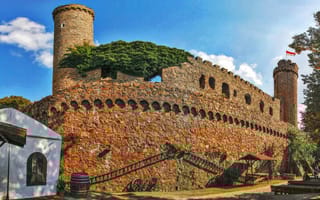
Auerbach Castle
Darmstadt
2.7km
castle, chateau
Schloss Schönberg (Bensheim)
Darmstadt
4.7km
castle, chateau
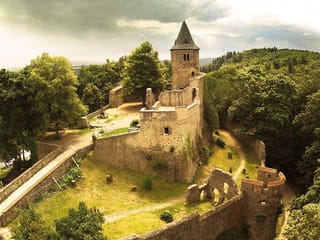
Frankenstein Castle
Darmstadt
7.3km
castle, chateau
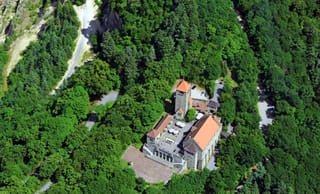
Wachenburg
Karlsruhe
20.9km
castle, chateau
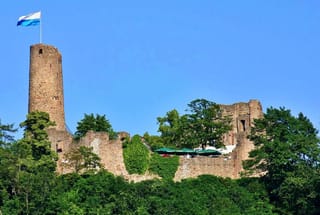
Windeck Castle (Weinheim)
Karlsruhe
21.1km
castle, chateau
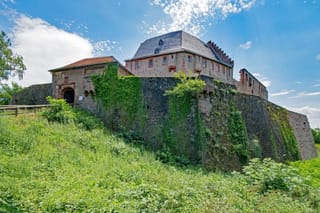
Otzberg Castle
Darmstadt
22.5km
castle, chateau