The Romanian Orthodox Bishopric
Municipiul Oradea Județul Bihor Romania
castle, chateau
Nagyváradi ortodox püspöki palota
Municipiul Oradea Județul Bihor Romania
castle, chateau
Palatul Episcopiei Ortodoxe
Municipiul Oradea Județul Bihor Romania
castle, chateau
Initially, this building was the residence of renowned architect Rimánoczy Kálmán, Jr
Az nagyváradi ortodox püspöki palota, korábban Rimanóczy-ház műemlék épület Romániában, Bihar megyében
Clădirea a fost concepută și realizată de către renumitul arhitect Kálmán Rimanóczy (fiul), cu destinația de locuință familială
Previous names
The Romanian Orthodox Bishopric, Palatul Episcopiei Ortodoxe, Nagyváradi ortodox püspöki palota
Description
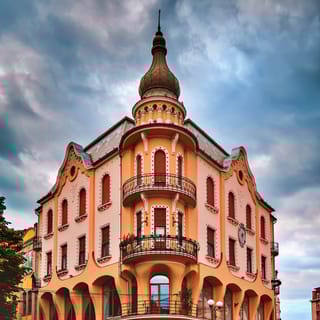
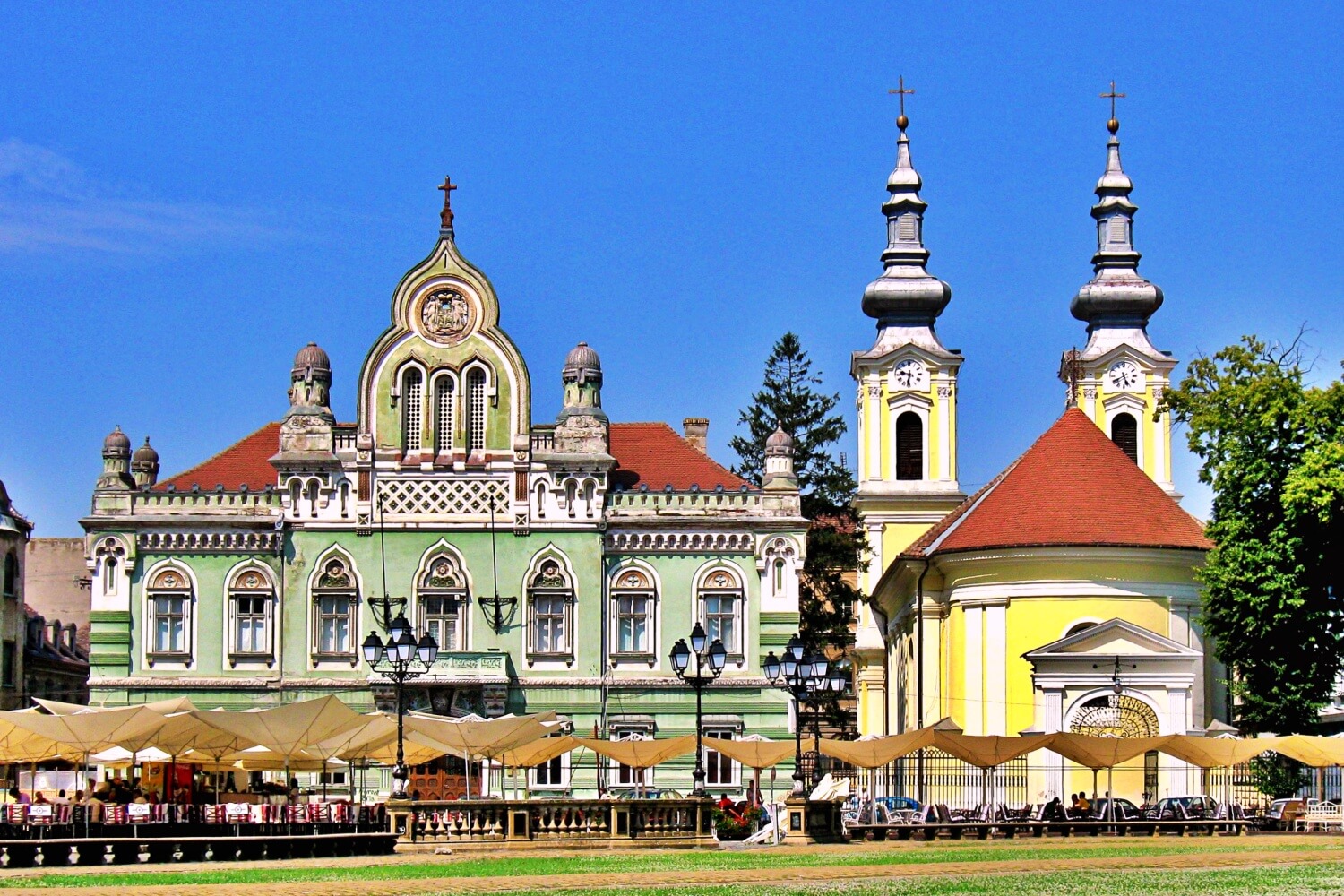
Initially, this building was the residence of renowned architect Rimánoczy Kálmán, Jr. Following his passing in 1912, the building was sold. After nearly a decade, in 1921, it was bought by the Ministry of Cults, which did so in order to turn it into what it is today, the Romanian Orthodox Bishopric.
By all estimates, the construction of this palace was carried out in 1903 – although there is no certain data to back this claim. The first owner of the building was, at the same time, both its architect and builder.
The architecture
The construction, done in the eclectic style, with neo-Gothic elements predominating on the façade, has two levels and is divided into 7 sections on the façade; two of them are delineated at the upper level, with columns featuring Ionic chapiters, and end at the level of the attic. The ground floor windows close off at the upper side with a circular arch, while the windows on the upper floor close off with an ogive.
The architect
Rimanóczy Kálmán Junior (1870-1912) was the most important architect of Oradea in between 1900 and 1912, also becoming renowned as an entrepreneur.
Born in 1870, in Oradea, and studying in Berlin and Budapest, Rimanóczy, Jr. made a name for himself in the landscape of the city’s architecture during the prosperous period of Art Nouveau.
His family owned multiple buildings in Oradea, among which the steam bath between Libertăţii (Liberty) Street and Iosif Vulcan Street, along with several sawmills, brick factories and furniture factories on Calea Clujului (Cluj Road).
He received numerous orders for public buildings, constructions that he fleshed out in various stylistic forms.
Some of his architectural creations in Oradea are:
The Palace of Public Finance, 1899-1900, Republicii Street no. 35;
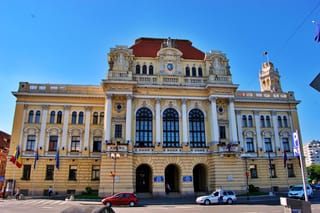
City Hall, 1902-1903, Piața Unirii (Union Square) no. 1;
The Neuro-Psychiatry Hospital, 1902-1903, Louis Pasteur Street no. 26;
The Pentecost Roman-Catholic Church, 1903-1905, Dunărea (Danube) Street no. 1;
The Rimanóczy K. Junior Palace, cca. 1903, Roman Ciorogariu Street no. 3 (the Residence of the Orthodox Bishopric starting from 1921);
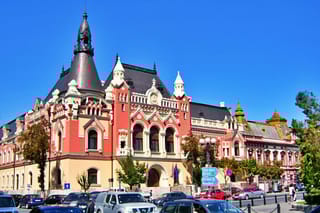
The Palace of the Greek-Catholic Bishopric, 1903-1905, Union Square no. 3;
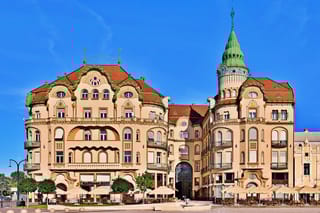
Moskovits Miksa Palace, 1904-1905, Republicii Street next to Traian (Trajan) Park no. 2;
The Rimanóczy Kalman. Sr. Palace, 1905, Republicii Street next to Trajan Park no. 1;
The former Central Savings Bank of Oradea, 1906-1907, expanded in 1912, Piața Regele Ferdinand (King Ferdinand Square) no. 4;
The Building of the Bar Association, 1908-1909, George Enescu Street no. 1;
The Apollo Palace, 1912-1914, Republicii Street no. 12.
Among the residential buildings designed by the architect, the most well-known are the great tenement buildings: the Rimanóczy Kalman. Sr. Palace, the Apollo Palace, the Moskovits Miksa Palace, and the Rimanóczy Kalman. Jr. Palace.
https://www.oradeaheritage.ro/
Az nagyváradi ortodox püspöki palota, korábban Rimanóczy-ház műemlék épület Romániában, Bihar megyében. A romániai műemlékek jegyzékében a BH-II-m-B-01038 sorszámon szerepel.
Története
Ifj. Rimanóczy Kálmán saját családjának építette ezt a házat 1905-ben. 1912-ben bekövetkezett halála után örökösei eladták Grósz Imrének, aki később az ortodox egyháznak értékesítette. 1920-ban ide költözött az I. Ferdinánd román király által újra létesített nagyváradi ortodox püspökség. A két világháború között rövid ideig az Ortodox Teológiai Akadémia is az épületben működött. 1925-től az alagsorban az egyházi nyomda kapott helyet.
Clădirea a fost concepută și realizată de către renumitul arhitect Kálmán Rimanóczy (fiul), cu destinația de locuință familială. Edificiul, construit în anul 1905, face parte din noul val de clădiri construite la începutul secolului XX.
Elementele de pe fațada palatului sunt de inspirație venețiană. Alternanța între cărămidă și tencuială și ferestrele în trei arcade de la etaj sunt reprezentative, în acest sens. Cornișa este formată în ogivă, ceea ce este caracteristic pentru goticul timpuriu. Cele trei axe centrale au pe lateral, la etaj, bovindouri specifice stilului secession, fapt care creează o anumită alternanță în ritmicitatea fațadei. Balustrada de la etaj este împodobită cu statuete de piatră.
În anul 1921, clădirea a fost cumpărată de biserica ortodoxă. La etajul I, a fost amenajată o capelă.
În perioada interbelică în această clădire și-a avut sediul, pentru o perioadă scurtă, Academia Teologică Ortodoxă. De asemenea, din 1925, la subsolul construcției funcționa o tipografie, care a permis înființarea unei edituri.
În anul 1971, clădirea a fost renovată, geamurile capelei au fost schimbate cu vitralii, picturile au fost refăcute, iar ceea ce a rămas din vechiul palat - sobe și ornamente murale - au fost restaurate de specialiști. Lângă capelă este amenajat un muzeu, unde sunt expuse obiecte de cult, cărți vechi, manuscrise, argintării, argintării aurite, icoane pe sticlă, picturi etc.
Useful information
Charge
Free
episcopiaoradiei@yahoo.com
-
-
External links
Nearby castles