Castelo de Vila Nova de Cerveira
Vila Nova de Cerveira Viana do Castelo Portugal
castle, chateau
Castelo de Vila Nova de Cerveira
Vila Nova de Cerveira Viana do Castelo Portugal
castle, chateau
The Castle of Vila Nova de Cerveira (Portuguese: Castelo de Vila Nova de Cerveira) is a medieval castle located in the civil parish of Vila Nova de Cerveira e Lovelhe, in the municipality of Vila Nova de Cerveira, Portuguese Viana do Castelo
O Castelo de Vila Nova de Cerveira localiza-se na freguesia e vila de Vila Nova de Cerveira, distrito de Viana do Castelo, em Portugal
Previous names
Castelo de Vila Nova de Cerveira, Castelo de Vila Nova de Cerveira
Description
The Castle of Vila Nova de Cerveira (Portuguese: Castelo de Vila Nova de Cerveira) is a medieval castle located in the civil parish of Vila Nova de Cerveira e Lovelhe, in the municipality of Vila Nova de Cerveira, Portuguese Viana do Castelo.
History
In the 13th century, the castle was included as part of the nuptial dowry of D. Mécia, wife of King D. Sancho II. It was also referred to in 1229 in a document referencing the village of Elvas, naming the nobles who signed the charter; Pedro Novães, the tenens of the castle of Cerveira was identified, suggesting that the castle was merely a defensive tower.
During the 1258 Inquirições (Inquiries) noted the obligations of the residents of Cerveira and its surrounding parishes. Carlos Alberto Ferreira de Almeida indicated that the castle of Cerveira, was already known in the 13th century as the vila nova (new town), owing to the original Cerveira being situated in the mountains (possibly over the hilltop of Espírito Santo, in Penafiel, parish of Roboreda), or in Cornes.
In 1320, King D. Dinis ordered that the settlement be colonized. To this end, the King issued a foral (charter), with one-third of the supported payments be used for the conservation of the castle. The courtyard, limited by the walls was too small for the 100 homes that King D. Dinis expected to settlement the village; ultimately, he accepted the construction of a settlement that was constructed outside the walls. The design if Duarte d'Armas, in his Livro das Fortalezas, indicates that at the beginning of the 16th century, the barrio outside the walls was more complete then those in the interior, including two religious buildings.
Following the outbreak of the Portuguese succession crisis, the castle alcalde and village remained loyal to Castile. In the spring of 1385, the Constable Nuno Alvares Pereira, after conquering the Castle of Neiva began a pilgrimage to Santiago de Compostela and stopped to rest in Vila Nova de Cerveira for the night.
Between the 14th and 15th century, the barbican was constructed under the reigns of King D. Fernando or King D. João I. King D. Afonso V (1438-1481) rewarded the exploits of D. Leonel de Lima, during the north Africa campaign by bestowing on him the title of 1st Viscount of Vila Nova de Cerveira (1476), and giving his possession of the lands of the village. Their successor, King D. Manuel reissued the orders to renovate the castle.
The construction of the 16th century fortress, resulted from the fear of Spanish threats from across the border during the Restoration Wars, and was included in a line of defenses along the Minho River and Atlantic coast. On 25 September 1643, forces of Cerveira resisted attacks by troops loyal to King Philip IV of Spain, with the regions defenses organized by Governor Manuel de Lima e Abreu. Following these events, in 1650, the chapel of Nossa Senhora da Ajuda was constructed over the barbican. With the continued need to defend the territory, the 7th Viscount of Vila Nova de Cerveira ordered that the settlement be circled with walls, bartizans and four interior bastions (São Miguel, Espírito Santo, Conceição and Almas). In addition a half bastian and three smaller redoubts were established along the river. The courtyard had three gates: the Campanha Gate, the Church Gate, Nova Gate and Rio Gate. These public works were complete in 1667, under the direction of Field Marshall Francisco Azevedo, supported with the royal taxation on water and fife from the settlers.
In 1718, Manuel Pinto Vilalobos measured and evaluated the lands in the interior of the fortification, for the purpose of sale in public competition.
But, by 1742, the batteries received a new piece, in order to dominate the Fort of S. Lourenço de Gaião.
In 1809, with the defense organized by the aged Colonel Gonçalo Coelho de Araújo (he was 77 years old at the time), the military square resisted Napoleon's Second Invasion during the Second Invasion Peninsular Wars, under the command of Nicolau Jean de Dieu Soult. They were successful in impeding their crossing the river.
The growth in the local economy and need to support the growing population meant that the keep tower was demolished in 1844, and the following year the Afonsino tower, were partially destroyed to build other structures. Between 1845 and 1846, the wall's gates began to slowly be destroyed. With this slow deterioration, the castle slowly lost its importance, resulting in the 1875 authorization to demolish the fortress. The earliest attempt to recover importance of the castle began in 1905, with work done to repair wall cracks.
The DGEMN Direcção Geral dos Edifícios e Monumentos Nacionais (Directorate General for Buildings and National Monuments) began work in 1969 on consolidating and treating the diverse walls, and work was planned in 1977 to continue the consolidation. But, between 1977 and 1982, the fortifications and buildings were adapted for the establishment of the hostel. On 6 September 1982, the Pousada de D. Dinis was inaugurated within the interior of the medieval castle. There were a series of projects to benefit these changes on the site, including repaving the battlements, installation of new kitchens, bar and laundry. A project to partially adapt the first and second residences for the installation of a central phone centre. Work continued to recuperate the ceilings and exterior landscaping, alter the laundry ventilation and roadways between 1982 and 1985.
Arcaheological excavations along the Rua Costa Brava along the medieval castle walls were undertaken in 2002.
In 2004, the castle was approved for the Plano Director das Fortalezas transfronteiriças do Vale do Minho (Minho Valley Transborder Fortress Directors Plan), under the Interreg III Program, which sought to inventory the built inventory, evaluate their state of conservation and determine strategies for preservation. The intent of the plan was to valorize, promote and determine the fort spaces in order to promote a cultural and tourist program for the margins of the Minho River.
On 22 September 2006, a public presentation of the Plano de Pormenor de Salvaguarda do Centro Histórico (Detail Plan for Safeguarding the Historic Centre), coordinated by members of the municipal council, architect Sandro Lopes and archaeologist Paula Ramalho.
Architecture
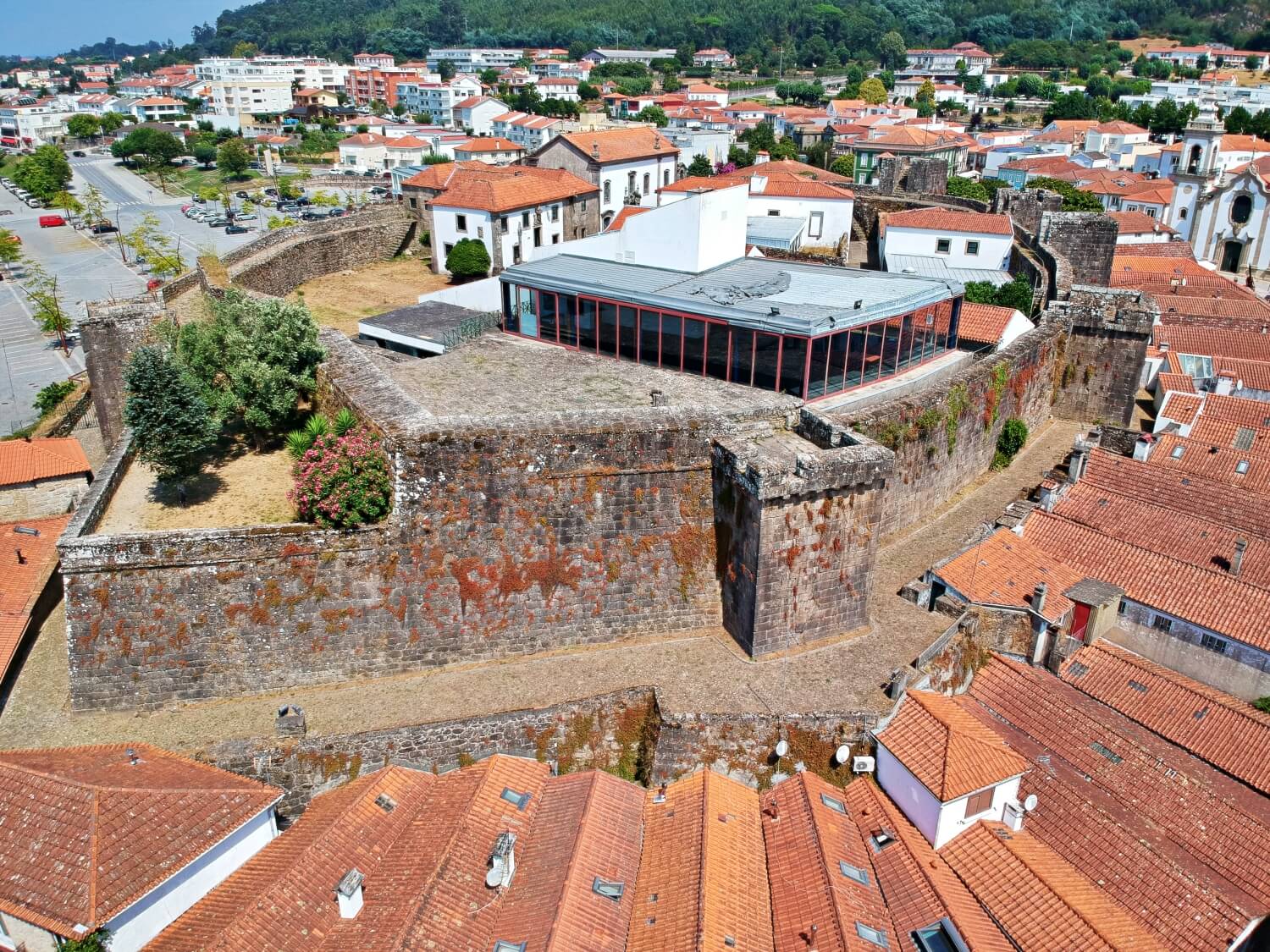
The castle is situated in an urban context, addorsed and distinct on the right bank of the Minho River, over a small portion of the wall, that extends along the border of the city. Its interiors are occupied by constructions adapted for their use as hostel, including its restaurant which is distinctly different then the surrounding classified structure.
The castle has an oval plan, formed with 8 rectangular towers and a line of walls, and integrated into the São Miguel bastion over the river and barbican oriented towards the town. Access to the rounded, barbican gate includes access to the rectangular body integrated with the chapel of Nossa Senhora da Ajuda. Below this space is the wall, creating an elbow. The frontispiece of the chapel has granite cornerstone, with rectangular pediment and a second floor doorway with interrupted frontispiece and varanda.
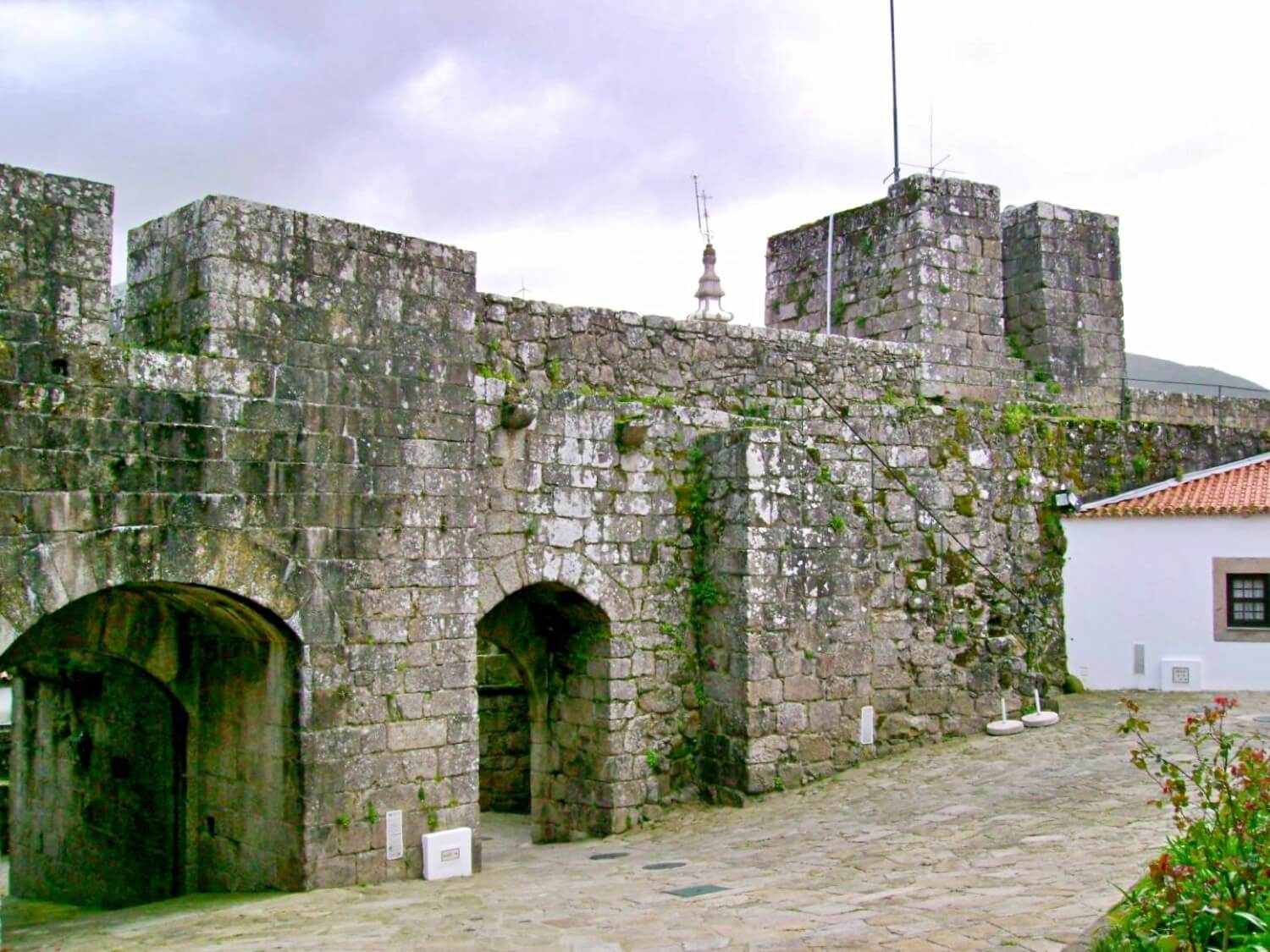
The barbican continues towards the east, with circling walls and angular extensions, then tower followed by visible wall. Entrance to the castle occurs a double gate: a wall between the Chapel of Nossa Senhora da Ajuda and tower, surmounted by coat-of-arms and sections of a former balcony; the second is above the tower, through a double vain, surmounted by the coat-of-arms of Portugal. Between this tower and the Church of the Misericórdia is a latrine encircled by two cantilevers.
The interior courtyard is encircled by battlements accessed by stone staircases. The visible towers, some with, others without crowns are of different heights, with protruding parapets to the west. The bastion, framed with exterior stone, is accessible by a small "traitors" gate alongside a cistern. Among many of the buildings constructed inside the walls are the old residence of the governor, municipal seat, pillory, jail, barracks and storerooms, along with the Church of the Misericórida.
O Castelo de Vila Nova de Cerveira localiza-se na freguesia e vila de Vila Nova de Cerveira, distrito de Viana do Castelo, em Portugal.
Sentinela da linde norte, delimitada pelo curso do rio Minho, ergue-se na sua margem esquerda, fronteiro à Espanha, cobrindo a linha defensiva do Alto Minho, no trecho compreendido entre a foz do rio, na altura de Caminha, e a vila de Melgaço.
História
Antecedentes
Não há consenso entre os estudiosos acerca da primitiva ocupação humana de seu sítio, ponto de travessia do rio para mercadores e peregrinos, e fronteira natural com o reino de Leão.
O castelo medieval
A informação mais antiga sobre a sua defesa encontra-se na Carta de Foral confirmada por D. Sancho II (1223-48) à vila de Elvas (1229), onde, entre os nomes dos nobres que a subscrevem, se encontra o de Pedro Novaes, alcaide (tenens) do Castelo de Cerveira (Domnus Petrus Novaes tenens castellum). Acredita-se que o castelo se constituísse, à época, apenas em uma torre defensiva.
Ao tempo do rei D. Afonso III (1248-79), as Inquirições de 1258 informam que os moradores de Cerveira e das freguesias vizinhas estavam sujeitos à anúduva, tributo feudal que consistia, em caso de necessidade de reparos em algum castelo, no fornecimento de materiais de construção e prestações de trabalho pela comunidade.
O seu sucessor, D. Dinis (1279-1325), visando alargar o povoamento da região, tentou atrair casais para Cerveira (1317), outorgando-lhe Carta de Foral que a transformava em vila (Vila Nova de Cerveira) com as regalias anteriormente concedidas a Caminha (1 de Outubro de 1321). Datam desse período a melhoria e ampliação das defesas, o que é documentalmente ratificado quando Rui de Pina (Crónica d’El Rei D. Diniz) inclui a Vila Nova de Cerveira entre as localidades que este monarca povoou de novo e fez castelos.
Quando da eclosão da Crise de 1383-1385, o alcaide do Castelo e a povoação mantiveram-se leais a Castela. Na Primavera de 1385, tendo o Condestável Nuno Álvares Pereira, após conquistar o Castelo de Neiva, encetado peregrinação a Santiago de Compostela à frente de seus homens, o que os conduziu adiante de Vila Nova de Cerveira, os homens-bons da vila, receosos de um ataque mandaram-lhe um pedido para que o não fizesse, pois eles portugueses eram, e queriam ser servidores del-Rei e do Reino. Desse modo, o Condestável obteve-lhe a submissão e a das demais terras da região ao rei D. João I (1385-1433).
D. Afonso V (1438-1481) recompensou os feitos de D. Leonel de Lima, nas campanhas do Norte d’África, atribuindo-lhe o título de 1º visconde de Vila Nova de Cerveira (1476) e a posse da vila. Este senhor procedeu-lhe reforços nas defesas.
Sob o reinado de D. Manuel I (1495-1521), a povoação e seu castelo encontram-se figurados por Duarte de Armas (Livro das Fortalezas, c. 1509).
Da Guerra da Restauração aos nossos dias
Durante a Guerra da Restauração da independência portuguesa, a povoação resistiu vitoriosa, sob o comando de Manuel de Souza Abreu, ao assédio das tropas espanholas (1643), feito que repetiu mais tarde, no contexto da Guerra Peninsular, quando impediu a travessia, naquele trecho do rio, às tropas napoleônicas sob o comando do general Soult (1809), forçando-as ao seu contorno.
Datam da segunda metade do século XVII as melhorias que se impuseram à defesa diante dos acontecimentos de 1643 e do crescimento da vila. Implementada de 1660 a 1665 às custas de D. Diogo de Lima, 8º visconde de Vila Nova de Cerveira, esta modernização compreendeu a construção de cinco baluartes salientes, adaptados ao tiro de artilharia, complementados por muralhamentos intermediários e fossos cobrindo o perímetro urbano.
Datam deste período as novas portas da vila: a Porta do Rio (Oeste), a Porta de Trás da Igreja (a Leste), a Porta da Campana (a Norte) e a Porta Nova (na saída para Gondarém). É também desse período a Capela de Nossa Senhora da Ajuda, erguida no interior do castelo junto ao portão principal.
Durante o século XIX, o crescimento da vila levou à absorção das suas defesas. Uma das perdas mais expressivas foi a da Torre de Menagem, parcialmente destruída (1844), ao qual se seguiu a muralha norte, com o desaparecimento da primitiva porta da traição.
No século XX, o antigo castelo foi classificado como Imóvel de Interesse Público através do Decreto publicado em 21 de Dezembro de 1974. Mediante a doação à Câmara Municipal, do recinto amuralhado (carta de 22 de Março de 1975, iniciou-se uma profunda reforma urbanística em Vila Nova de Cerveira, resgatando-se o seu centro histórico (Castelo, Igreja da Misericórdia, pelourinho, edifícios da antiga Câmara Municipal, do tribunal, da cadeia e diversas habitações) e revalorizando-se a sua vocação turística.
O castelo medieval foi requalificado, tendo as suas instalações sido parcialmente adaptadas a funções hoteleiras em 1982 (Pousada de D. Dinis), integrando a rede Pousadas de Portugal até a sua desativação em 2008.
Características
O castelo apresenta planta com a forma ovalada, típica do estilo gótico, com muralhas em aparelho de pedra coroadas por ameias, percorridas por adarve, reforçadas por oito cubelos de planta quadrangular, destacando-se os restos de um dos antigos matacães e os vestígios da antiga torre de menagem.
No seu interior erguem-se os edifícios da Casa da Câmara e Cadeia, o pelourinho, a Igreja da Misericórdia, os quartéis, paióis e a cisterna. Na entrada principal da barbacã, encontra-se a Capela de Nossa Senhora da Ajuda.
Os vestígios da modernização seiscentista do castelo - baluartes, guaritas e fossos - carecem de valorização como um todo, absorvidos parcialmente pela expansão urbana a partir do século XIX.
Useful information
Free
Free
The interior is used as an art space
-
Nearby castles
Forte de São Francisco de Lovelhe
Viana do Castelo
1.2km
fortress
Castle of Caminha
Caminha
10.6km
castle, chateau
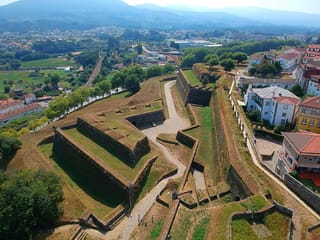
Praça-forte de Valença
Valença
12.9km
fortress
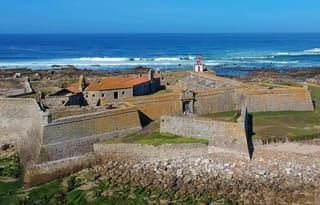
Forte da Ínsua
Caminha
14.1km
fortress
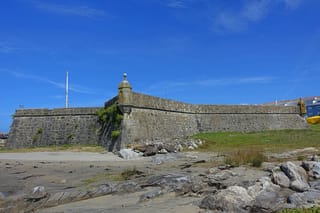
Fort of Lagarteira
Vila Praia de Âncora
17.3km
fortress

Forte do Cão
Vila Praia de Âncora
19.2km
fortress
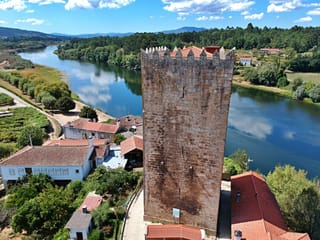
Torre of Lapela
Viana do Castelo
21.4km
castle, chateau