Castle of Elvas
Elvas Portalegre Portugal
castle, chateau
Castelo de Elvas
Elvas Portalegre Portugal
castle, chateau
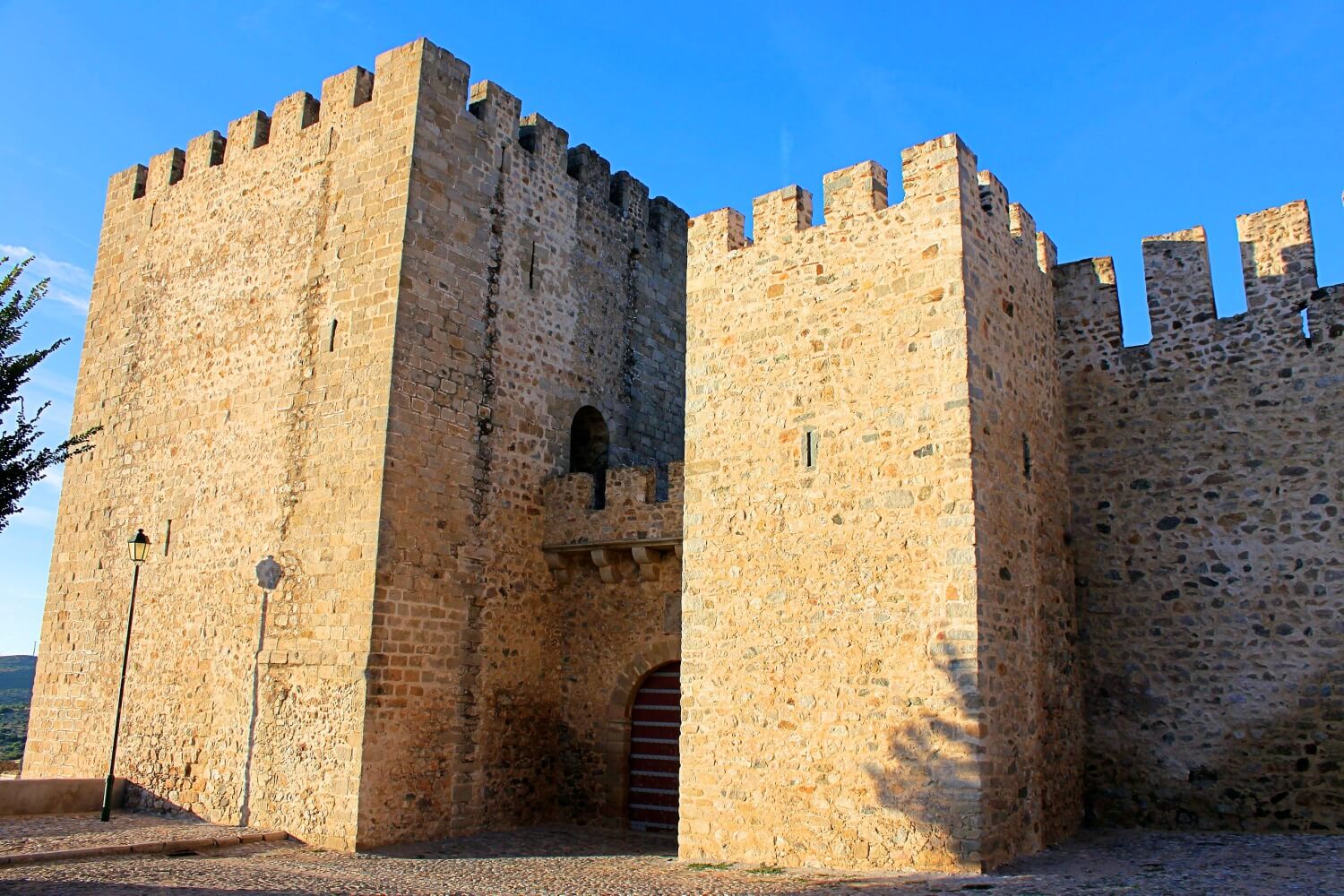
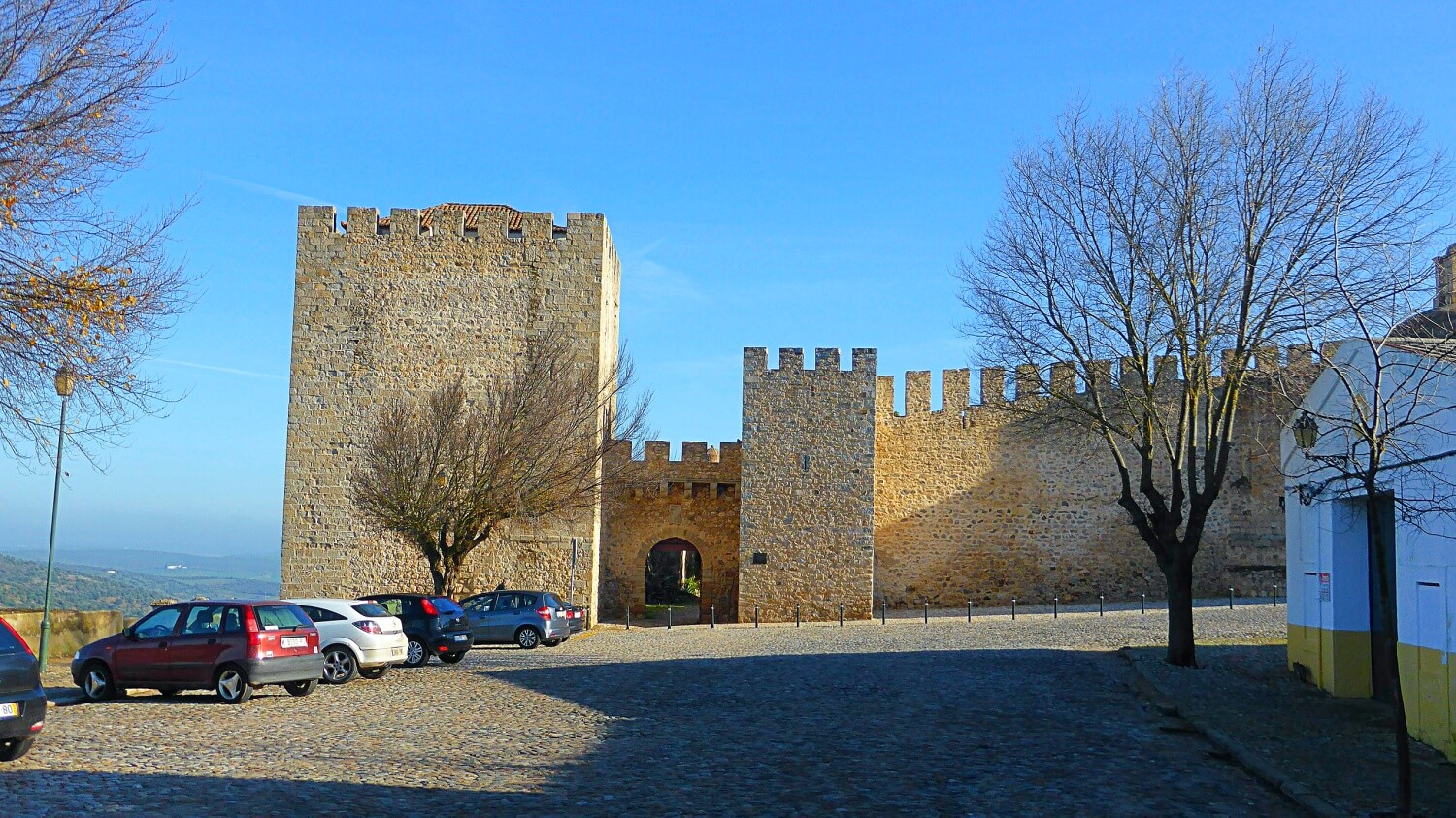
The Castle of Elvas (Portuguese: Castelo de Elvas) is a medieval military fortification in Portugal, in the civil parish of Alcáçova, municipality of Elvas, part of a first line of defense in the Portuguese Alentejo, in conjunction with the military forts of Ouguela, Campo Maior, Olivença and Juromenha
O Castelo de Elvas, no Alentejo, localiza-se na freguesia da Alcáçova, na cidade e concelho de Elvas, distrito de Portalegre, em Portugal
Previous names
Castle of Elvas, Castelo de Elvas
Description
The Castle of Elvas (Portuguese: Castelo de Elvas) is a medieval military fortification in Portugal, in the civil parish of Alcáçova, municipality of Elvas, part of a first line of defense in the Portuguese Alentejo, in conjunction with the military forts of Ouguela, Campo Maior, Olivença and Juromenha.
History
Between the 8th and 12th century Muslim forces occupied Elvas, resulting in the construction of the fortress. It was briefly conquered by forces loyal to Afonso Henriques around 1166, an action that was repeated in successive years with Moorish capture, and recapture, of the strategic point. In 1200 Sancho I encircled the citadel, and his successor, Sancho II made a tentative attempt to capture Elvas in 1226, at the same time Alfonso IX of León was trying to take Badajoz: although concerted, it was unsuccessful. This was followed in 1228 by another attempt, also unsuccessful, until 1230, after the castle and surrounding territory was abandoned by Muslim forces, who had received word that Alfonso IX had reached and was threatening Mérida.
Kingdom
The year before (1229) Sancho II had issued a foral (charter) for Elvas, which was later reaffirmed by King Afonso III in 1263. As a method of attracting further Iberian investments the concession of a fair, in 1262, helped to attract settlement to the region. This, along with further investments from the Crown resulted in the reconstruction of the castle and walled village between the 13th and 14th century, with the cerca Fernandina (walls of King Ferdinand), still under the reign of Afonso IV, that included 22 towers and 11 gates (including the important Gate of Olivença or Royal Gate).
Elvas was under siege from 1325 to 1327 from the forces of Alfonso XI of Castile, due to the continuing war during the reign of Afonso IV. This would continue for several years, first with a two-day siege in 1334; in 1337; and then in 1381, by Infante John of Portugal (son of King Peter I of Portugal and Inês de Castro) supported by Castillian forces, during the third protracted wars with Castile, during the reign of King Ferdinand (1381-1383). It was also besieged in 1385, by John II of Castille, during the Restoration Wars (1384-1387).
Following these battles, between 1488 and 1490, the castle underwent reconstruction, with alterations complete to the hexagonal tower, as well as the construction of a keep tower that was much taller and able to support artillery emplacements. Sometime during this period the alcalde's quarters were also renovated, while repairs to the walls and three towers were carried out in intervening years, following acts by Afonso Mendes de Oliveira. In this period, the town had four internal and four external gates, all without doors.
On 3 March 1507 King Manuel I confirmed the foral, already established by Afonso III. Four years later he ordered the construct of several towers along the walls and the repair of two that had already suffered damage. These acts preceded the elevation of Elvas to the status of city (Portuguese: cidade), which he did on 21 April 1513 with the promulgation of a new foral.
The settlement was also elevated to the status of bishopric in 1570.
In 1580, Elvas was occupied, without combat, by D. Sancho de Ávila.
Between 1601 and 1602, under the direction of Luís Serrão Pimentel, the walls were repaired, owing to several years of neglect.
Restoration wars
In 1641, under the administration of the Governor Matias de Albuquerque, significant repairs were begun on the castle and fortress. This completed through contributions from people of the town, equivalent to two réis, and resulted in the expansion of trenches, reinforcement of the barbicans and the opening-up of a gap for expansion. This was accomplished through the demolish of various homes near the castle to permit the war effort: in 1644, the Marquess of Torrescusa had already proven the need to reinforce Elvas, with his siege of the castle.
This was the beginning of the period of construction that resulted in the bulwarked Praça de Elvas that was completed in 1653, creating a military square and defensive ring. By the middle of this project, records document the nomination, in 1646, of Pedro Fernandes, quartermaster of the Sé of Elvas, and an accomplished expert in fortifications, to assist João Cosmander in the work on the walls.
Between 1658 and 1659, Elvas was encircled by the forces of Luis Méndez de Haro, and the castle's defenders resisted the Spanish bombardment of the town, although many died due to the Black death. This was ultimately a precursor to the 14 January 1659 Battle of the Lines of Elvas, that pitted the Haro's forces against the cobbled-together forces of António Luís de Meneses, 1st Marquis of Marialva, 3rd Count of Cantanhede.
By 1662, the walls and the city's defenses were still being rebuilt, under Luís Serrão Pimentel.
War of Spanish Succession
After Portugal joined the forces of the Grand Alliance during the War of Spanish Succession, with the Methuen Treaty, it became vulnerable from attacks from Spain. In 1706, Elvas fell under siege from a Franco-Spanish force, and yet again in 1712, when the Marquess of Bay and his forces attempted to seize the castle.
These events led to the post-war construction of a gunpowder magazine in 1735, under the direction and plans of Manuel de Azevedo Fortes.
Peninsular wars
With the intervention of French forces during the Peninsular wars Elvas, once again took on the frontlines of the battle between Spain and Portugal. Supported by French forces of Manuel de Godoy, during the campaign known as the Guerra das Laranjas (War of the Oranges), Elvas was attacked by Spanish forces in 1801 however, Godoy was unable to siege the fortress due to insufficient troops and supplies.
During fighting involved with the French campaign, Elvas was taken in 1807 by the French. The following year an Anglo-Portuguese force laid siege to Elvas, prior to the expulsion of French forces, in order to expel the French garrisoned in the castle.
In 1815, one of the towers was demolished in order to protect a warehouse that was located near the wall.
In 1823, battery emplacements were affixed to the northern and northwest towers, that included lowering of emplacements, but also the construction of barbettes.
20th century
Between 1940 and 1948, a large intervention was made on the site, that altered many of the spaces. During these renovations, an azulejo tile depicting the Sagrada Família, on the castle gate, was removed.
On 1 June 1992, the property was placed under the management of the IPPAR, under Decree 106F/92.
Architecture
The castle is found in an isolated urban context, on an elevated zone known as the Costa da Vila Fria, with many of the towers and walls extending over the landscape.
The plan of the castle is an irregular quadrilateral polygon, defined by four walls, flanked by towers in the south, west and north. The Porta da Vila (Town Gate), in the southwest, is surmounted by a capstone with the coat-of-arms of King John II of Portugal, and opened to the courtyard where there are several older buildings.
To the south is a cistern, alongside the northeast part of the fortification's wall, with spaces for the alcalde located in a two-storey structure.
Access to the battlements are made from a staircase on the northwestern wall, defended by three simple embrasures and through a doorway with broken bow (that also provides access to the Porta da Traição (Traitor's Gate). The northwestern battlements provide access to the keep tower, a rectangular structure, flanking the western angle. A Roman arched gate provides entry into the towers principal hall, with four arrowslits and a vaulted ceiling with rounded cross-beams, formed from the four corner posts. From two flights of stairs is the next floor, just before the rooftop, with tiled roof. The southwest battlements provide access to the tower alongside the town gate, with a staircase to the roof. The extreme part of the battlements provide access to the rooftop artillery point, a nine-sided position, which flanks the southern angle of the fortification. This emplacement provides two levels of gun fire, with 12 arrowslits, although the top group is covered by the posterior-constructed vaulted, semi-spherical ceiling. The southeastern battlements links to the northeast wall, interrupted by the masonry of the alcalde's residence. On the outside of this wall, a support structure, that presupposes a terrace for the residence is visible. To the extreme of the wall is circular construction, with semi-spherical cupola, protecting the entrance to a circular staircase providing access to the exterior.
Flanked along the northern extent, an almost square tower with plain parapet and running bunk in masonry. Toward the keep tower, on the left is a suspended cistern and to the right a rectangular tower, with plain parapet. All the battlements in the castle are wide.
The two-storey alcalde's residence is entered from the main floor porch, across a Roman archway. The posterior facade includes two second-floor windows, one with a truncated angular arch, while the other with a canopy-like arch. The porch includes a vaulted ceiling with spines focused on a five-pointed star. A Roman arch entrance-way leads into ample hall, with vaulted ceiling consisting of six beams and seven arches anchored by pillars. A marble exterior staircase, consisting of two flights lead to a porch decorated with eight rectangular pillars. From here two doors, with square frames, provide access to halls, covered in wood ceiling. Along the southeast, is a hall with five doors, a window and a fireplace, which connects to the kitchen (with stove and fireplace). The hall situated on the northwest has two windows and three doors, one of which is common to the interior.
O Castelo de Elvas, no Alentejo, localiza-se na freguesia da Alcáçova, na cidade e concelho de Elvas, distrito de Portalegre, em Portugal.
Insere-se num conjunto de fortificações e obras anexas, consideradas Património da Humanidade desde 2012.
Erguido na zona lindeira, no alto de um monte em posição dominante sobre a povoação e o rio Guadiana, integra um impressionante conjunto defensivo erguido ao longo dos séculos. Na Idade Média, o papel do castelo era complementar à invocação expressa no brasão de armas da cidade: Custodi nos domine, ut pupilam oculi (Guardai-nos, Senhor, como à menina dos olhos). Atualmente é considerado como um dos melhores exemplos da evolução histórica da arquitectura militar no país.
Estrategicamente, a Praça forte de Elvas virava-se para Espanha e era considerada uma das primeiras defesas do Reino de Portugal durante a Guerra da Restauração.
Atualmente integra a Cidade – Quartel Fronteiriça de Elvas e as suas Fortificações – classificado desde o dia 30 de Junho de 2012, Património Mundial da Humanidade pela UNESCO.
Em 2014, o Castelo de Elvas foi integrado num novo projeto do Ministério da Defesa Nacional, criado com o apoio do Turismo de Portugal, chamado Turismo Militar, que apresenta roteiros históricos baseados em heróis portugueses.
História
Antecedentes
A prospecção arqueológica evidenciou que a primitiva ocupação humana deste sítio remonta a um castro galo-Celta, aproveitado pelos Romanos que o urbanizaram a partir do século II a.C., tendo em vista aí se encontrarem algumas das estradas que cortavam o sul da Península Ibérica. A povoação era então conhecida pelo nome de Helvas. Alguns autores compreendem ser testemunho deste período uma porta no interior do castelo, à qual atribuem características construtivas romanas.
Posteriormente a povoação foi ocupada por Visigodos e, a partir de 714, por Muçulmanos que, denominando-a como Ielbax, levantaram-lhe as primeiras duas cinturas de muralhas, das quais subsistem vestígios até aos nossos dias.
O castelo medieval
À época da Reconquista cristã da Península, teria sido inicialmente tomada por forças cristãs sob o comando de Geraldo Sem Pavor (c. 1166), quando da conquista de Juromenha. Retomada pelos mouros, voltou às mãos portuguesas em 1220 para novamente cair na posse dos mouros. Somente em 1226 (1228 ou 1229 segundo outros autores) caiu definitivamente em mãos portuguesas, sob o reinado de D. Sancho II (1223-1248), que lhe outorgou Foral (Maio de 1229) e lhe determinou a reconstrução e reforço das defesas. Alguns autores compreendem que estas obras estariam concluídas já em 1228.
No conjunto, estes soberanos propiciaram à vila um notável sistema defensivo, que no início do século XVI ostentava uma tripla cintura de muralhas, vinte e duas torres, onze portas e barbacã, conforme o desenho de Duarte de Armas (Livro das Fortalezas, c. 1509). Estes dois últimos soberanos foram os responsáveis pela modernização do castelo para o sistema abaluartado, com linhas renascentistas, período em que passa a predominar a função residencial (paço dos alcaides).
Durante a Crise de 1383-1385, o alcaide de Elvas tomou o partido de D. Beatriz e de Castela. Entretanto, a população, liderada por Gil Fernandes, atacou o castelo e deteve o seu alcaide. Gil Fernandes jurou fidelidade a Portugal e a D. João I, provocando, no Verão de 1385, um cerco de vinte e cinco dias pelas forças castelhanas, ao qual a vila resistiu invicta.
Já o mesmo não conseguiu fazer no contexto da Crise de sucessão de 1580, quando o seu alcaide passou-se para o lado espanhol, afirma-se que a troco de ouro, voltando ao domínio português após a Restauração da independência.
Da Guerra da Restauração aos nossos dias
Proclamada a restauração, a cidade desde logo teve a sua defesa modernizada, adaptada aos tiros da artilharia. Recebeu deste modo uma nova linha de muralhas, de traçado poligonal abaluartado, cujos trabalhos só estariam concluídos na primeira década do século XVIII. Transformada em uma autêntica Praça-forte, resistiu ao cerco espanhol de 1658, permitindo que o mesmo fosse derrotado na batalha das Linhas de Elvas (14 de Janeiro de 1659).
Embora essas modernas defesas de Elvas tenham chegado até nós em relativo estado de conservação, o mesmo não sucedeu às estruturas medievais, onde os efeitos do crescimento urbano cobraram o seu preço. O castelo foi o primeiro imóvel a ser classificado como Monumento Nacional no país, por Decreto publicado desde 9 de Outubro de 1906.
As intervenções de consolidação e restauro que tem recebido por parte do poder público desde então visaram entregá-lo ao público, permitindo ao longo das décadas a melhoria da sua visitação e compreensão. Da mesma forma, a pesquisa arqueológica realizada, visou recuperar os testemunhos sobre a sua evolução, enquadrando corretamente as suas diferentes estruturas na devida linha de tempo e permitindo, também, uma melhor compreensão.
Características
O castelo medieval ergue-se na cota mais elevada do terreno, a 320 metros acima do nível do mar. Em seu conjunto apresenta elementos dos variados períodos construtivos, que, no início da Idade Moderna, encontrava-se composto por três cortinas defensivas, conservando as duas mais antigas importantes estruturas do período muçulmano.
Na linha de defesa externa, mais recente, datando do reinado de D. Fernando, reforçada por vinte e dois torreões e por uma barbacã, abriam-se originalmente onze portas - reduzidas a três pelas reformas do século XVII (respectivamente a de Évora, a de Olivença e a de São Vicente). Esta defesa foi parcialmente absorvida pela expansão urbana.
A linha intermediária de defesa também foi comprometida por essa expansão. Os seus muros eram rasgados por quatro portas: a da Ferrada, a Porta Nova ou da Encarnação, a de Santiago e a do Bispo.
A linha de defesa interna ergue-se na cota mais elevada do terreno, a nordeste, tendo chegado até nós duas das suas antigas portas: a da Alcáçova e a do Miradeiro. É constituída pelo castelo do reinado de D. Sancho II, remodelado por D. Dinis e reforçado por D. João II e por D. Manuel I, apresentando planta quadrangular. Ladeado por duas torres quadrangulares, a mais alta correspondendo à de menagem, o Portão de Armas é protegido por um balcão sustentado por mísulas, onde se exibe o brasão de armas de D. João II. Em suas muralhas ameadas inscreve-se uma torre hexagonal irregular, rasgada por aberturas de troneiras e coberta por cúpula semi-esférica. O alto desta torre é percorrido por um adarve protegido por parapeito com largos merlões. Na praça de armas os diversos fragmentos arquitetônicos, denunciam as diferentes épocas construtivas e estilísticas.
Useful information
Free
2.00 EUR
- Great view
- Free entrance on Sundays and public holidays until 14:00
- WC
info@cultura-alentejo.pt
Well-preserved remains of the castle
-
External links
Nearby castles
Praça-forte de Elvas
Elvas
0.3km
fortress
Forte de Nossa Senhora da Graça
Elvas
1.3km
fortress

Forte de Santa Luzia
Elvas
1.3km
fortress
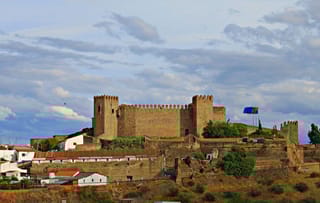
Castle of Campo Maior
Campo Maior
16.2km
castle, chateau
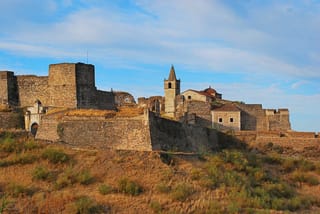
Fortaleza de Juromenha
Évora
17.5km
fortress
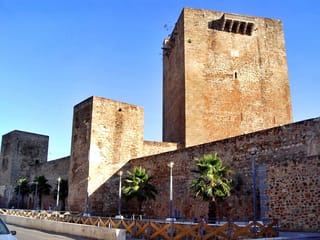
Castelo de Olivença
Badajoz
22.7km
castle, chateau
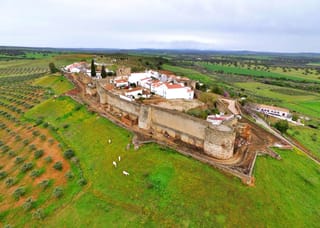
Castle of Ouguela
Portalegre
24.6km
castle, chateau