Castle of Óbidos
Óbidos Leiria Portugal
castle, chateau
Castelo de Óbidos
Óbidos Leiria Portugal
castle, chateau
The Castle of Óbidos (Portuguese: Castelo de Óbidos) is a well-preserved medieval castle located in the civil parish of Santa Maria, São Pedro e Sobral da Lagoa, in the municipality of Óbidos, Portuguese District of Leiria
O Castelo de Óbidos localiza-se na freguesia de Santa Maria, vila e concelho de Óbidos, no distrito de Leiria, em Portugal
Previous names
Castle of Óbidos, Castelo de Óbidos
Description
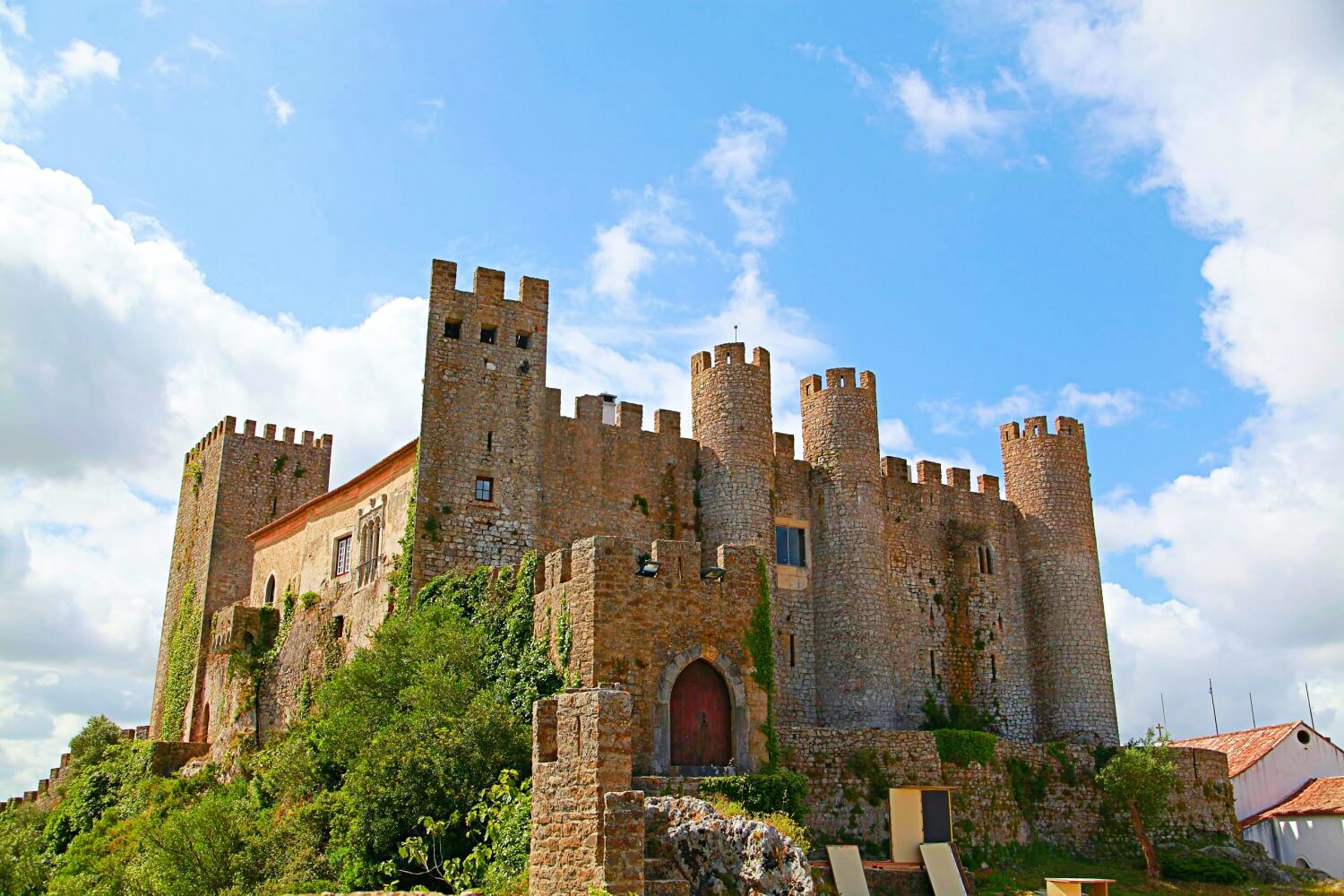
The Castle of Óbidos (Portuguese: Castelo de Óbidos) is a well-preserved medieval castle located in the civil parish of Santa Maria, São Pedro e Sobral da Lagoa, in the municipality of Óbidos, Portuguese District of Leiria.
History
Óbidos had its foundation in the existence of a fortified settlement, likely over the Luso-Roman castro and Roman oppidum (then civitas) on the hilltop, that was the mysterious Eburobrittium, once cited by Pliny the Elder as being situated between Collipo (present-day Golpilheira near Leiria) and Olisipo (Lisbon). Archeological surveys later resulted in the discovery of a forum, baths and other Roman structures near the settlement. The area was later settled by the Lusitanos (since the 4th century BC) and Romans in the first century, but later occupied by Visigoths during the 5th and 6th century and Muslims, who were responsible for fortifying the town in the 8th century.
During the Christian Reconquista, forces under the first Portuguese king Afonso I (1112–1185) defeated the settlement's defenses through a ruse, on 10 January 1148. The first surveys of the castle were undertaken in 1153, although the castle was never completely conquered until the reign of King D. Sancho I (in 1195), as documented in the epigraph Torre do Facho. Also at this time, the Albarra tower was converted into a jail, when the walls were reformulated by King Sancho I. The old dungeon was restored and expanded by King D. Denis, while the barbicans alongside the main gate was constructed.
Sancho's son and successor, King D. Afonso II (1211–23), donated the settlement and its castle to his wife, D. Urraca (in 1210). The settlement and castle maintained their loyalty to King D. Sancho II (1223–48), during the crisis, resisting victoriously the assaults of forces loyal to the Count of Bologna, future King D. Afonso III (1248–1279). This resistance resulted in the epitaph of mui nobre e sempre leal (very noble and ever loyal), that figured into the municipal coat-of-arms.
The settlement progressively expanded from this point, followed by the fortifications, integrating such structures as the Torre Atalaia (situated in the south). Donated as a wedding gift to D. Denis (1279–1325) and Queen Elizabeth during their stay, the town began to figure into the property/possessions of all successive Queens of Portugal as of 1834. The dungeons were later expanded and the keep tower ( the Torre de D. Fernando or D. Fernando Tower) constructed by the Queen. As part of the construction, a connection was made between the dungeons and the Church of Santiago gallery.
During the context of the 1383–1385 Portuguese succession crises, the alcalde (against the wishes of its residents) allied with John I of Castile, resulting in an assault by the forces loyal to the Master of Avis (future King John). Óbidos and its castle were transferred to John (following his election by the Cortes in Coimbra as King) by Vasco Gonçalves Teixeira, following the death of his father and former-alcalde, João Gonçalves, in the Battle of Aljubarrota.
A settlement started building to the west and southern part of the castle within the walls sometime in the 15th century. During the reign of King D. John II (1481–1495), Queen Leonor selected the settlement and castle to reside following the death of her son, the Infante D. Afonso, opting for the thermal waters of the region for treatments necessary during her later life. King John II's successor, Manuel I donated to the town a foral in 1513, resulting in improvements to both the town and castle. During this phase, the Paços do Alcaide (Palace of the Alcalde) was reconstructed, by then alcalde D. João de Noronha. The alcade also worked on improving the walls.
During the 1755 Lisbon earthquake the castle suffered structural damage.
During the context of the Peninsular War, the fortification in Óbidos fired the first artillery rounds in the Battle of Roliça (1808) that resulted in the first defeat of Napoleonic forces. In 1842, the Albarrã tower was transformed into a clocktower. Construction on an exterior staircase access to the D. Fernando Tower occurred in 1869.
From 1932, the town saw the first interventions of consolidation, reconstruction and restoration by the Direcção-Geral dos Edifícios e Monumentos Nacionais (Directorate-General for National Monuments and Buildings). But, after many years of abandon, in 1948, the castle was transformed into a pousada, under a project developed by João Filipe Vaz Martins. The castle and the entire urban area of Óbidos are reclassified as a National Monument by governmental decree published on 5 January 1951. It took two years to concluded the adaptation of the medieval structure into a tourist pousada, by the Direcção dos Serviços dos Monumentos Nacionais (Directorate for the National Monument Services). The spaces were decorated in order to transform it into the Pousada do Castelo, with many of the furniture designed by architects Fernando Augusto Peres de Guimarães andLuís Benavente, with the collaboration made by Leonardo Castro Freire. The Comissão para a Aquisição de Mobiliário (Furniture Acquisition Commission) was charged with acquiring furniture provided by the Fábrica de Móveis Aséta (in Porto), under concession of Paola Luísa Maria Oliva (Luísa Satanela).
Architecture
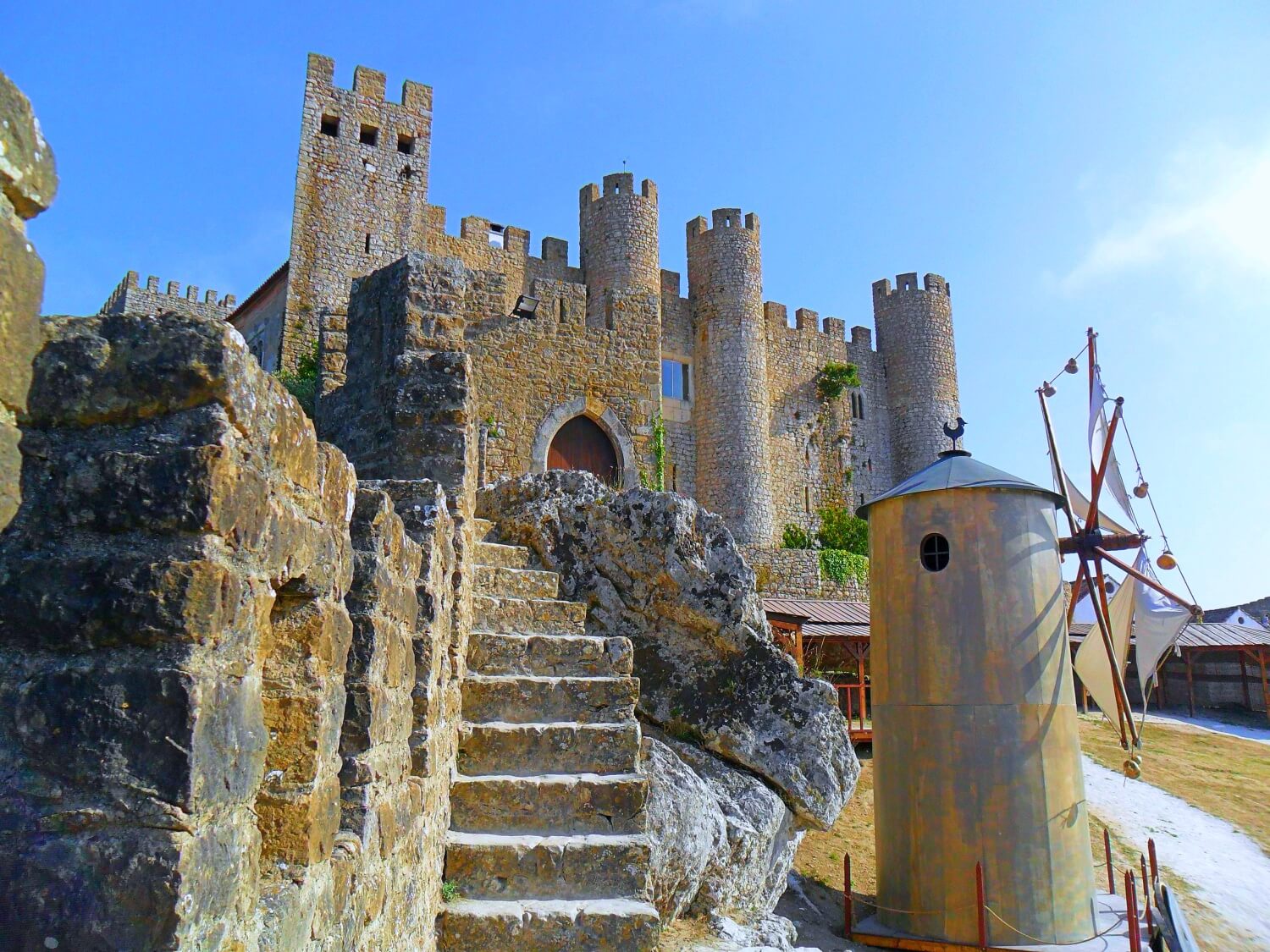
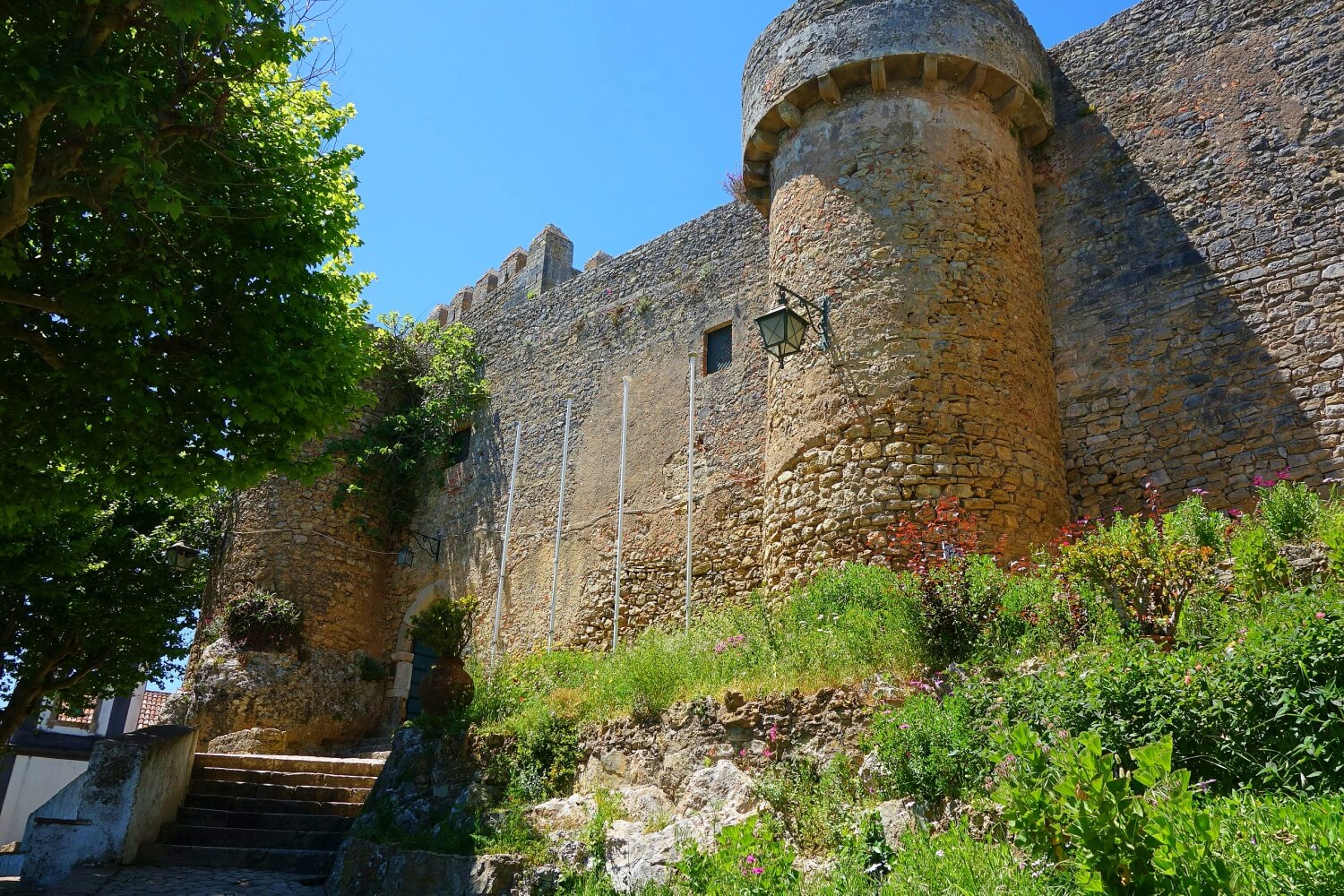
The trapezoidal castle oriented to the southeast rises 79 metres (259 ft) above sea level and is situated on the extreme northwest of the walled fortifications. It is reinforced in the north by three semi-circular and rectangular corbels; in the east and west of the wall by rectangular corbels, known as the towers of D. Dinis and D. Fernando; to the south by two semi-circular corbels, one with machillitions; and a barbican in the north and west. Along the wall dividing the two courtyards is a gentle, rectangular arch, known as the tower of Albarrã. The castle's architecture shows elements of Romanesque, Gothic, Baroque and Manueline influences spread over two main areas: the Castelejo (current Inn Castle, or Pousada de Obidos) and the intramural district.
The enclosed courtyard in the form of an irregular triangle plan, encircled by square merlons with sills and battlements. The perimeter of the walls, reinforced by square and cylindrical plant towers, extends 1,565 metres (5,135 ft) and completely covered by a battlement defended by crenellated parapet. To the west, is a line of walls that accompanies the mountainous cliffs, reinforced by large, rectangular towers. This line of walls is broken by the Cerca Gate, Talhada Gate and the watchtower of Jogo da Bola, terminating in the southwest by the Facho Tower. From here the walls are irregularly adapted to the relief of the land along the northeast, inflecting towards the north and east, and reinforced by semi-circular corbels and the minarets of the castle. In some places, the walls tower 13 metres (43 ft) high.
Built by Queen Catherine of Austria, wife of King John III (1521–1557), a 3 kilometres (1.9 mi) aqueduct was constructed to carry water from the mountains of Usseira to Óbidos, supplying the fountains of the town.
Within the citadel, along the north face of the old wall, is the Paço dos Alcaides (Palace of the Alcaldes), whose access to the enclosure is affected by a high wall, reinforced by turrets, one of which is topped by a counter with boulders. The building is designed in a "U" plan covered in tile roof, with the western wing shorter than the opposite wing. The central wing is three-stories high, with the two floors in the east over the cliffs. The doors of the palace on the first floor are surmounted by Gothic arches, on the second by rectangular friezes, with two windows with double, polycentric arches and twin panel, with iron balcony. At the top of the second floor staircase is an arched doorway surmounted by flanked armillary spheres and central coat-of-arms; the staircase connects the doorway to the eastern, second floor and the door of the 3rd central floor. The northern facade is coincident with the exterior wall, reinforced with corbels and marked by friezes and rectangular windows on the third floor, while the eastern face includes Manueline windows, similar to the southern facade.
The first floor is the service floor, the second the reception area, and a bar in the eastern corp, while the remaining wings are taken-up by bedrooms. In the third floor is the formal dining and living rooms, with the kitchen and bedrooms. The two towers that flank the southern facade, of various dimensions and heights, are finished in pentagonal merlons (the tower of D. Fernando) and pyramids (the tower of D. Dinis), and were adapted into rooms. Over the door that connects the two courtyards is a passageway that connects the palace and the Church of Santiago.
O Castelo de Óbidos localiza-se na freguesia de Santa Maria, vila e concelho de Óbidos, no distrito de Leiria, em Portugal.
História
Antecedentes
Acredita-se que a primitiva ocupação humana do seu sítio remonte à pré-história. Pela sua proximidade da costa atlântica, despertou o interesse de povos invasores da Península Ibérica, tendo sido sucessivamente ocupado por Lusitanos (século IV a.C.), Romanos (século I), Visigodos (séculos V a VI) e Muçulmanos (século VIII), atribuindo-se a estes últimos a fortificação da povoação, como se constata pela observação de determinados trechos da muralha, com feições mouriscas.
O castelo medieval
No contexto da Reconquista cristã da Península, as forças do rei D. Afonso Henriques (1112-85), após as conquistas de Santarém e de Lisboa (1147), encontraram viva resistência para conquistar a povoação e seu castelo, o que finalmente aconteceu através de um ardil (10 de Janeiro de 1148). O castelo encontra-se referido documentalmente desde 1153.
Reconquistadas definitivamente no reinado de D. Sancho I (1185-1211), foram procedidas obras no castelo (conforme inscrição epigráfica na Torre do Facho), época em que a vila recebeu a sua carta de foral (1195).
O seu filho e sucessor, D. Afonso II (1211-23), doou a povoação e o respectivo castelo a D. Urraca, sua esposa (1210).
A povoação e seu castelo mantiveram-se fiéis a D. Sancho II (1223-48), quando da crise de sua deposição, resistindo vitoriosamente, em 1246, aos assaltos das forças do Conde de Bolonha, futuro rei D. Afonso III (1248-1279). Essa resistência valeu à vila o epíteto de mui nobre e sempre leal, que figura até hoje no seu brasão de armas.
Doada como presente de casamento por D. Dinis (1279-1325) à rainha Santa Isabel durante as núpcias ali passadas, a vila passou a integrar o dote de todas as rainhas de Portugal até 1834. Este monarca fez erigir a torre de Menagem (c. 1325).
Sob o reinado de D. Fernando (1367-1383), uma inscrição epigráfica assinala a ereção, em 1375, de uma torre, por alguns considerada de menagem, embora lhe faltem as características da base maciça com entrada a nível do pavimento elevado, presentes na de D. Dinis.
Durante o contexto da crise de 1383-1385, o seu alcaide, contra a vontade dos moradores, tomou o partido de João I de Castela e de Dna. Beatriz, tendo resistido às forças do Mestre de Avis. Óbidos e o seu castelo foram entregues a João I de Portugal, eleito nas Cortes de Coimbra, por Vasco Gonçalves Teixeira após o falecimento em combate do seu pai e alcaide do castelo, João Gonçalves, na batalha de Aljubarrota (1385).
Sob o reinado de D. João II (1481-1495), a rainha Dna. Leonor escolheu a povoação e seu castelo para residir após o falecimento por acidente de seu filho único, o príncipe D. Afonso, optando ainda (1494) pelas águas termais da região para tratamento da enfermidade que viria a vitimar aquele monarca.
O seu sucessor, Manuel I de Portugal doou um novo foral a Óbidos (1513), procedendo a importantes melhoramentos na vila e em seu castelo. É dessa fase, no século XVI, a reconstrução dos Paços do Alcaide pelo alcaide-mor D. João de Noronha.
Do século XVIII aos nossos dias
O terramoto de 1755 causou sérios danos na estrutura, por falta de dinheiro não pode ser reconstruído. No contexto da Guerra Peninsular, a fortificação de Óbidos disparou os primeiros tiros de artilharia na batalha de Roliça (1808), primeira derrota das tropas de Napoleão. Posteriormente registou-se a adaptação da torre albarrã a Torre do Relógio (1842) e a construção de escada exterior de acesso à Torre de D. Fernando (1869).
O castelo e todo o conjunto urbano da vila de Óbidos encontram-se classificados como monumento nacional.
A partir de 1932, o conjunto sofreu as primeiras intervenções de consolidação, reconstrução e restauro a cargo da Direcção-Geral dos Edifícios e Monumentos Nacionais, que se estenderam pelas décadas seguintes até aos nossos dias, sendo o espaço do castelejo requalificado como Pousada do Castelo (1948-1950).
Características
O castelo ergue-se na cota de 79 metros acima do nível do mar, com planta no formato retangular irregular (orgânica), misturando elementos dos estilos românico, gótico, manuelino e barroco, distribuídos por duas zonas principais: a do castelejo (atual Pousada do Castelo, ou Pousada de Óbidos) e o bairro intra-muros.
O perímetro das muralhas, reforçadas por torres de planta quadrada e cilíndrica, alcança 1.565 metros, totalmente percorrido por um adarve defendido por parapeito ameado. Em alguns trechos, as muralhas elevam-se a 13 metros de altura.
O troço este da muralha constitui o núcleo do muralhamento mais amplo que envolve o castelo e a vila, e que, prolongando-se por ambos os lados em direção ao sul por 500 metros, fecha o perímetro em ponta, na chamada Torre do Facho.
O acesso é feito por quatro portas e dois postigos, destacando-se a Porta da Vila ou Porta de Nossa Senhora da Piedade, encimada por uma inscrição, ali colocada pelo rei D.João IV (1640-1656), e que reza: A Virgem Nossa Senhora foi concebida sem pecado original. No seu interior encontra-se uma capela com varanda, revestida de azulejos do século XVIII.
Useful information
Free
Free
- WiFi
- WC
It is partly used as a restaurant
-
External links
Nearby castles