Soncino's Castle
Provincia di Cremona Lombardia Italy
castle, chateau
Castello di Soncino
Provincia di Cremona Lombardia Italy
castle, chateau
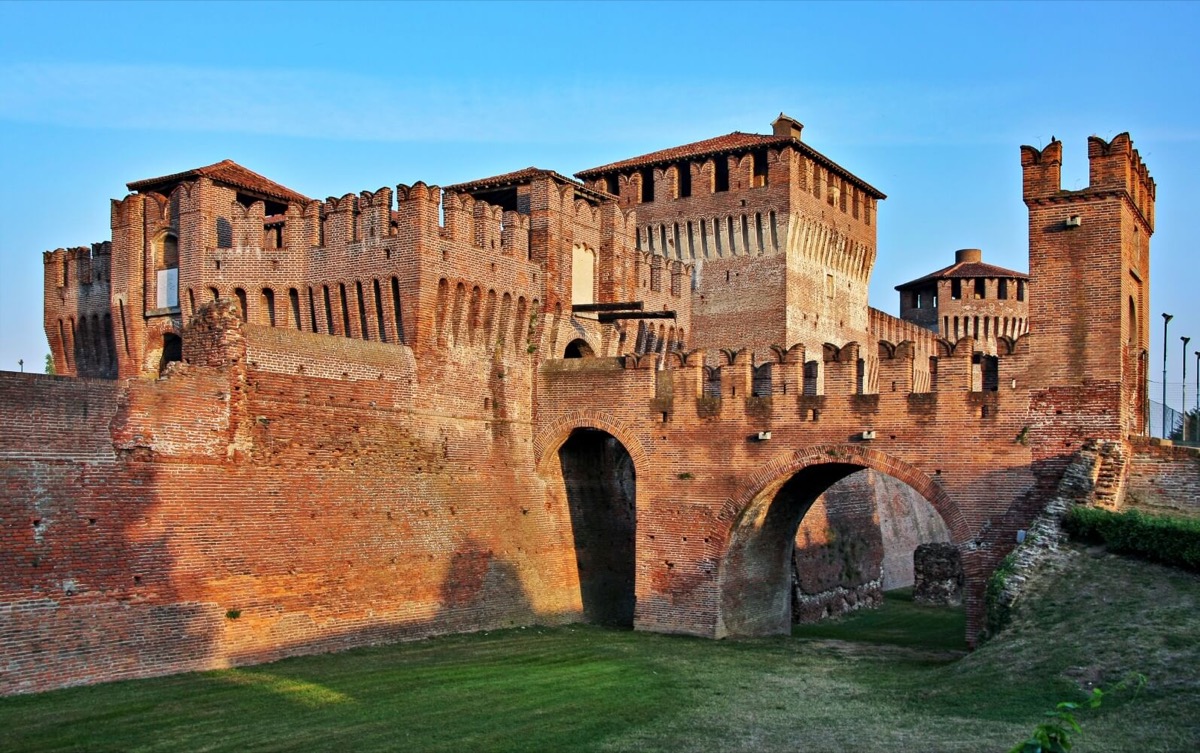
Soncino Castle (Italian: Rocca di Soncino) is a military fortress in Soncino, northern Italy
La Rocca Sforzesca di Soncino, situata a Soncino, in Lombardia, è uno delle più tipiche rocche lombarde dell'area del cremonese, eretto tra il 1473 e il 1475 ed avente un ruolo fondamentale nella difesa dell'area sino al 1536
Previous names
Soncino's Castle, Castello di Soncino
Description
Soncino Castle (Italian: Rocca di Soncino) is a military fortress in Soncino, northern Italy. It was built in the 10th century, and it was active since the years around 1500.
History
A set of walls around a defensive structure were built in the 10th century, in order defend the borough from the marauding Hungarians. In 1200 it was besieged several times by the armies of Milan and Brescia, and in 1283, after being destroyed by the attacks of those armies, the commune of Soncino decided to rebuild the castle. In 1312 the castle was occupied by the Cremonese army, and in 1391 by the Milanese army, using it during the war against the Venetian Republic. In the year 1426 new walls were added to raise the previous ones.
The actual building
When the "peace of Lodi" was declared in 1454, the borders between the Venetian Republic and Duchy of Milan were established, and the Castle passed to the Duchy of Milan. The Duke of Milan, Francesco Sforza, reinforced the walls of and around the castle,[1] which led to the request for construction in 1468 to Soncino people's desire requested by letter to the Duke of Milan, although he chose to erect just a new tower with the characteristic circular shape. Further reconstruction took place from 1471 by Benedetto Ferrini and Danese Maineri, engineers responsible for the fortresses of Soncino and Romanengo. and in 1473, Bartolomeo Gadio also contributed. From 1499 to 1509, the castle was held by the Venetians, until with French aid, the fortress was again held by the Milanese.
The assignment to the noble Family Stampa
In 1536 the Holy Roman Emperor Charles V assigned the Milanese Stampa family the Marquisate of Soncino. This family transformed the castle into a residence commissioning frescoes by Bernardino Gatti and Vincenzo Campi for internal rooms of the castle and the chapel. In 1876 Massimiliano Stampa, last Marquis of Soncino, bequeathed the castle to the town, and the town hall in 1883, in collaboration with Luca Beltrami, began the restoration of the castle.
The structure
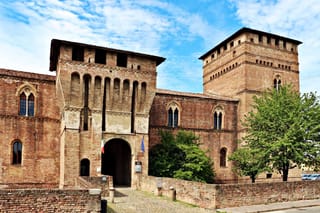
The Soncino Castle is strategically positioned near the town, although the four centuries it has been used as a residency has given it a harmony with the external sides, starting from the entrance that today is positioned into urban square. The entrance of the castle, a portal, that once a time was limited by a drawbridge, it was replaced at the end of 1800 by a ravelin that give access to a first courtyard used in the past as disengagement for the troops and provided of stairs to access the battlements of the external walls. The fortress entrance was permitted by two different drawbridges, one carriageable and one pedestrian. Passing through the disengagement, after the second entrance, there is the real courtyard, and in the center of that there is a well able to guarantee the necessary water in case of siege, and from this courtyard it is possible to access to the secret's underground.
Among the four towers, the most interesting is the Castellan's tower (Torre del Castellano), called in this way because once a time it was the official residence of the Castle's Governor, and for this reason it was possible to isolate it from the rest of the castle in case of sieges. That tower was connected directly to the secret's underground and from here, through a secret passage, was possible to pass through the castle's ditch and run on the fields around. Is this one of the renaissance's decoration areas, with frescos and fireplaces with pyramidal hood.
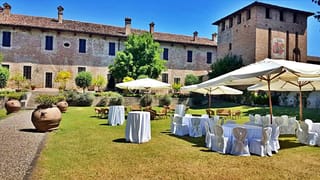
The internal courtyard of the castle
The chapel built by the Marquis of Stampa is located in the 16th-century south-east tower. Here is possible, still today, to see traces of frescoes including the most ancient of that (dating at the end of the 15th century), depicting the Madonna with the child Jesus Christ.
Still here, it is possible to find a fresco from an anonymous painter representing the Duchy of Milan's coat-of-arms flanked by torches and water buckets, symbols the personal motto of Francesco Sforza "Accendo e spengo" (I light up and I turn off), together with others heraldic enterprises. The ceiling is painted with an arbour drawing as in the Milan's Sforza Castle.
The round tower, unique on its particular shape, at the battlements level presents a round room with a circular canopy in the center that has a cylindrical column that lead to the top of the bastion that is in conical shape and significantly higher respect to the others just to give a higher watch point. This tower, built in the 1500, has traces of several coat-of-arms paintings and of a crucifixion, today in a deep degradation status. This last painting means that the chapel was placed here, in the past, and moved eventually in the other tower.
La Rocca Sforzesca di Soncino, situata a Soncino, in Lombardia, è uno delle più tipiche rocche lombarde dell'area del cremonese, eretto tra il 1473 e il 1475 ed avente un ruolo fondamentale nella difesa dell'area sino al 1536.
Quando la pace di Lodi del 1454 stabilì definitivamente i confini tra la Repubblica di Venezia e il Ducato di Milano, Soncino e la rocca passarono a quest'ultima entità territoriale.
Fu in quest'occasione che Francesco Sforza fece rafforzare le mura attorno al castello e la rocca stessa, che fu oggetto di richiesta di costruzione nel 1468 da parte dei soncinesi, che espressero il loro desiderio con una lettera indirizzata al duca. Quest'ultimo preferì tuttavia erigervi solamente un nuovo torrione dalla caratteristica forma circolare. Opere significative di manutenzione vennero poi intraprese dal 1471 ad opera di Benedetto Ferrini e Danese Maineri, ingegneri responsabili delle fortezze di Soncino e Romanengo, i quali dal 1473 iniziarono anche i lavori per la costruzione della rocca, sotto la direzione di Bartolomeo Gadio. Dal 1499 la rocca passò ai veneziani ai quali rimase sino al 1509 per poi passare ai francesi e nuovamente agli Sforza. Dal 1535, il ducato di Milano diverrà dominio spagnolo e con esso anche la Rocca di Soncino.
Il passaggio ai Marchesi Stampa
Nel 1536 l'imperatore Carlo V d'Asburgo elevò Soncino a marchesato e lo passò in feudo alla famiglia milanese degli Stampa che lo trasformarono nei secoli successivi sempre più in una residenza e non in un fortilizio militare.
Fu sotto gli Stampa che vennero chiamati i pittori del calibro di Bernardino Gatti e Vincenzo Campi a decorare alcune sale interne del castello, oltre alla cappella che vi venne eretta.
Nel 1876 Massimiliano Stampa, ultimo marchese di Soncino, morì trasmettendo il castello al comune per testamento. Dal 1883, con l'ausilio di Luca Beltrami, il comune iniziò i lavori di restauro al fine di portare la rocca al suo originario splendore, terminando il tutto nel 1895.
La struttura
Il castello di Soncino è posto in posizione strategica nei pressi dell'abitato, anche se i quattro secoli nei quali è stato usato perlopiù come abitazione l'hanno di molto armonizzato a partire dal suo ingresso che dall'Ottocento si trova inserito in una piazza.
Il portale del castello, un tempo reso accessibile da un ponte levatoio in legno, è stato sostituito dalla fine dell'Ottocento con un rivellino, dà accesso ad una prima corte utilizzata per il movimento delle truppe e pertanto dotata di scale che consentono di avere accesso agli spalti delle mura esterne. L'accesso alla rocca era permesso attraverso due diversi ponti levatoi, uno carrabile e l'altro pedonale. Passato anche il secondo ingresso si giunge al cortile vero e proprio del castello, al centro del quale si trovava un pozzo per garantire il rifornimento d'acqua in caso di assedio e sempre da questo cortile si ha l'accesso alle segrete dei sotterranei.
Tra le torri più rilevanti del complesso (quattro in tutto), vi è indubbiamente la Torre del castellano, così chiamata perché un tempo era la residenza ufficiale del governatore della fortezza e come tale essa poteva essere isolata a sua volta dal resto del complesso in caso di attacco. Essa era collegata al suo interno direttamente con i sotterranei e da qui, attraverso un passaggio segreto, si poteva giungere al fossato e quindi fuggire verso le campagne circostanti. È questa una delle aree decorate in maniera rinascimentale con affreschi e camini a cappa piramidale.
La Torre sud-orientale accoglie la cappella del palazzo che venne realizzata come si è detto sotto i marchesi Stampa. Qui si possono ammirare ancora oggi tracce di affreschi di cui il più antico di essi (risalente alla fine del XV secolo), raffigura la Madonna con il Bambino. Sempre qui si trova anche un frammento di affresco rappresentante il leone di San Marco dipinto a ricordo della breve dominazione veneziana della rocca. Opera di rilievo è anche un affresco anonimo rappresentante lo stemma del ducato di Milano affiancato da torce e secchi d'acqua, a simboleggiare il motto personale di Francesco Sforza, "Accendo e spengo" unitamente ad altre imprese araldiche. Il soffitto è decorato con un motivo a pergolato come nel castello sforzesco di Milano.
La Torre circolare è l'unica ad avere questa caratteristica forma. Al livello dei camminamenti presenta una sala rotonda con calotta circolare, al centro della quale si trova un befredo (torretta di vedetta) di forma cilindrica che conduce sul tetto della torre. Sopraelevato rispetto alle altre torri consentiva di essere usato come punto di avvistamento.
Useful information
GRATUITO
C`è un bellissimo mulino ad acqua vicino al castello
turismo@comune.soncino.cr.it
Museo Civico Archeologico Aquaria
-
External links
Nearby castles
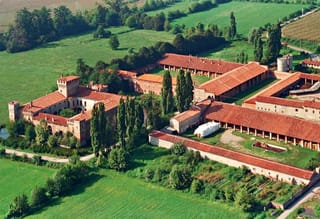
The Castle of Padernello
Provincia di Brescia
10.4km
castle, chateau
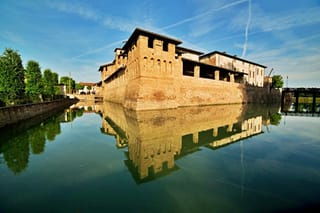
Castello Visconteo (Pagazzano)
Provincia di Bergamo
21.6km
castle, chateau
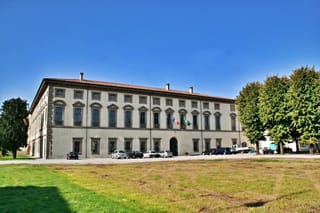
Palazzo Visconti (Brignano Gera d'Adda)
Provincia di Bergamo
23.8km
castle, chateau
Castello di Camairago
Provincia di Lodi
24.0km
castle, chateau
Castello Visconteo (Pandino)
Provincia di Cremona
24.9km
castle, chateau