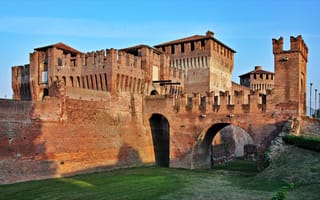
The Castle of Padernello
Provincia di Brescia Lombardia Italy
castle, chateau
Castello di Padernello
Provincia di Brescia Lombardia Italy
castle, chateau
Once upon a time there was a castle, beautiful and austere, around which a rural village was born
Il castello di Padernello è un castello risalente al XV secolo di Padernello, antico borgo nei pressi di Borgo San Giacomo, in provincia di Brescia
Previous names
The Castle of Padernello, Castello di Padernello
Description
Once upon a time there was a castle, beautiful and austere, around which a rural village was born ... It ran the year 1391 in the lower lower part of the Lower Brescia. We are in Padernello in the ancient gabianesei lands, now Borgo San Giacomo, exactly halfway between Brescia and Cremona. After the first fortifications the manor, which belonged to the noble family of the Martinengo branch of the Counts of Padernello or of the Fabbrica up to 1834, was brought to completion. In the eighteenth century, according to the fashion of the time, it was transformed into a stately villa and took the form we admire today, from the 1861 family Salvadego Molin Ugoni.
In the 1965 the Castle of Padernello was abandoned by its last inhabitant, Count Filippo Molin Ugoni Salvadego. The Castle was covered in brambles, exposed to looting and human negligence, although in the 1912 it was defined as a high architectural merit and of national interest by the Ministry of Education.
Everyone forgot about the Castle, except for a handful of visionaries - the Friends of the Castle - that in the eighties they restored the ancient posteria - grocery store, now become an inn - the Aquila Rossa, imperial symbol of the Martinengo, with the intent to save the manor and enhance the village of Padernello.
In the 2002 a big snowfall brought down a part of the manor, the old kitchens. Popular wisdom says that not all evil comes to harm, and perhaps nature wanted to awaken the collective consciousness. And so it was that since then, thanks to the passion and good will of women and men, with a daring public-private operation, the thread has been taken to rekindle the history of a territory. Thanks to them the Castle was born to new life.
History
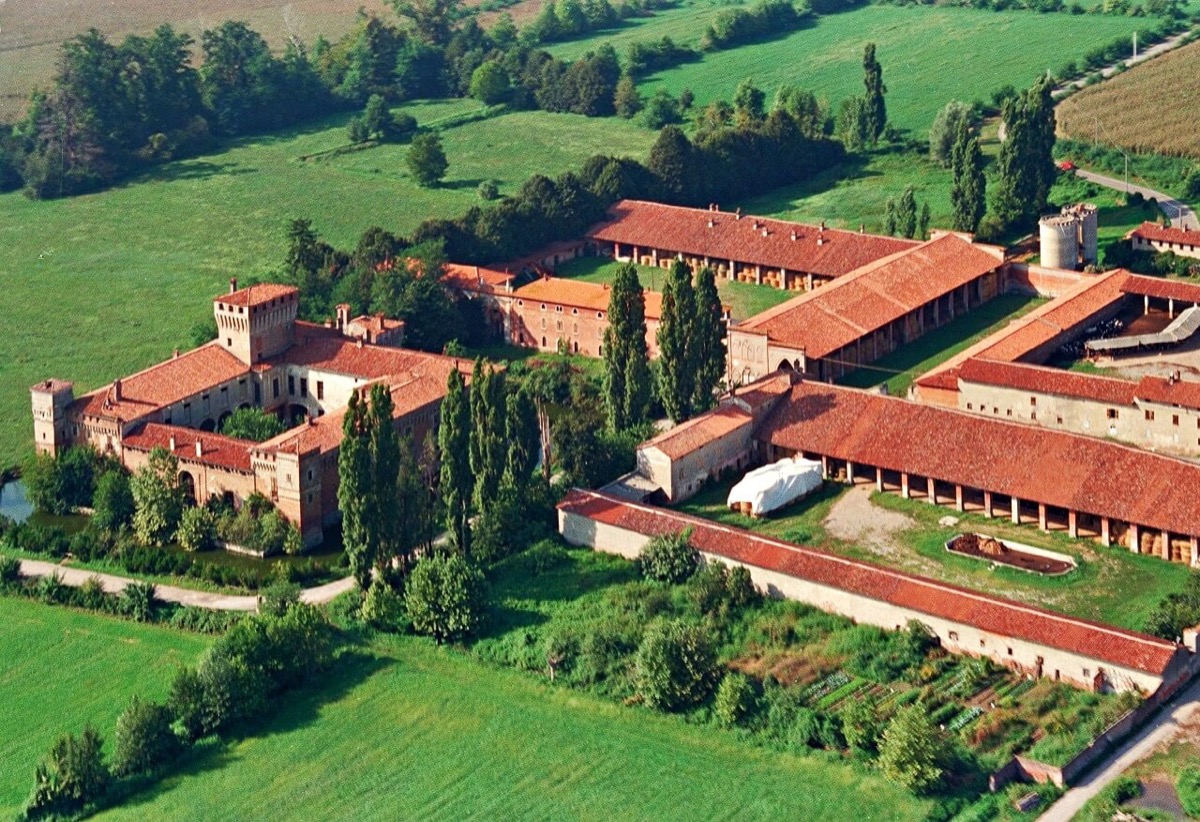
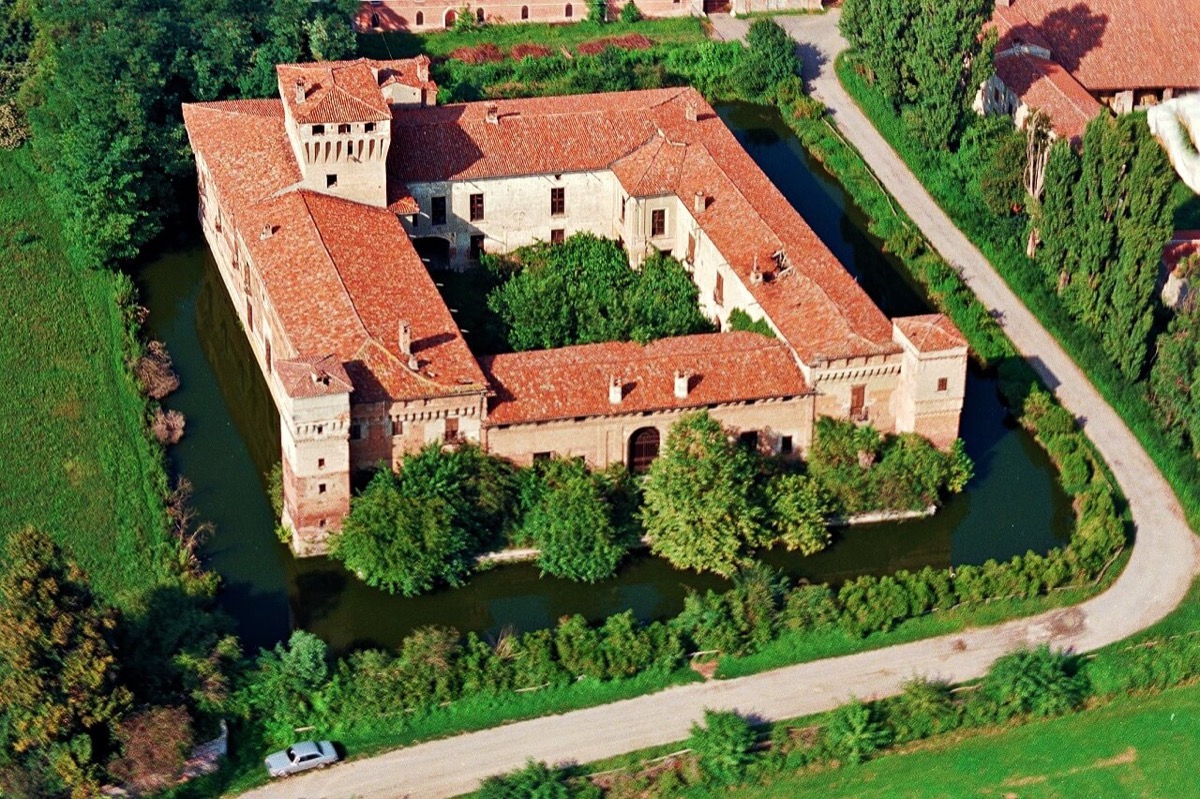
The structure, surrounded by a moat with a working drawbridge and a ravelin, stands isolated in the Brescia plain. The castle, which dominates the small town, consists of 130 rooms on a surface of 4000 m².
The construction of the castle was done by the Martinengo family, from Bergamo, faithful to the Venetian Republic, originally called the "Giselbertini", who from the tenth to the eleventh century began to name the nickname "da Martinengo" because resident in the castle of Martinengo, in the Bergamo plain. The presence of the noble house in Gabiano (ancient name of the present Borgo San Giacomo) is attested starting from the XI century. The noble family of the Martinengo remained in Padernello until the 1834; from the 1861 the possessions passed to the Salvadego Molin Ugoni family.
The castle, built at the end of the fourteenth century by Bernardino Martinengo, has a square plan with four defense towers. The first evidence of the presence of a fortification in Padernello dates back to 1391: a tower-house surrounded by a double moat, which overlooks a territory of vines, woods and pastures.
The construction of the castle began in the first half of the fifteenth century by two branches of the Martinengo family: the Martinengo di Padernello or "della Fabbrica" and the Martinengo "delle Palle".
Towards the 1470 the manor is already provided with a keep equipped with corbels and drains with functions of control and sighting of the surrounding territory, equipped with loopholes and Guelph battlements. The elegant portico on the north side dates back to the same period, characterized by stone columns with capitals bearing shields with the imperial eagle, the heraldic symbol of the family.
In the inner courtyard there is a loggia on the west side with typically 16th century pillars on which the coats of arms of the Martinengo and Colleoni families stand, family that was related to the Martinengo family. Of the sixteenth century are the large living room on the East side and the portico on the South side and, on the inside, the sail or barrel ceilings and the richly decorated wooden coffered ceilings.
The structure has undergone significant changes over time. In the eighteenth century the castle underwent an important architectural and functional renewal. The then Count Gerolamo Silvio converted the manor into an elegant villa according to the style of the time. At this time we owe the construction of the eighteenth-century staircase, the work of the famous architect Giovan Battista Marchetti (1686-1758), from the 1758 director of the construction of the new cathedral of Brescia. There was also a splendid ballroom, the chapel dedicated to Saints Faustino and Giovita.
The external façade on the north and east sides was softened with stone balconies and wrought iron railings, while on the south side a large central portal was opened, which gives access to the garden on the moat.
In 1834, after more than four centuries, the Martinengo family of Padernello, with the death of Girolamo Silvio II Martinengo, became extinct due to the absence of male heirs. At the death of the last Martinengo the Venetian properties were entrusted to his wife Countess Elisabetta Michiel, while those of the province of Brescia passed to his cousin Alessandro Molin. At the death of the latter the properties were inherited by the sisters Maria and Alba, married respectively to the Count Panciera di Zoppola and to the nobleman Pietro Salvadego.
Padernello, the castle and other properties were assigned, following the subdivision of the properties of the 1861, to the noble Salvadego. The last count to reside in the castle was Filippo Molin Ugoni Salvedego, who, for health reasons, preferred to move to the 1961 in his palace in Brescia, where he died in 1965.
https://www.dimorestoricheitaliane.it
Il castello di Padernello è un castello risalente al XV secolo di Padernello, antico borgo nei pressi di Borgo San Giacomo, in provincia di Brescia.
Dal XIV al XVII secolo
La struttura, circondata da fossato con ponte levatoio funzionante e rivellino, si erge isolata nella pianura bresciana. Il castello, che domina il piccolo paese, è composto da 130 stanze su una superficie di 4000 m².
La costruzione del castello avvenne per opera dei Martinengo, famiglia di provenienza bergamasca, fedeli alla Repubblica di Venezia, in origine chiamata dei “Giselbertini”, che dal X e l'XI secolo si cominciò a nominare con l'appellativo “da Martinengo” poiché residente nel castello di Martinengo, nella pianura bergamasca.
La presenza della nobile casata a Gabiano (antico nome dell'attuale Borgo San Giacomo) è attestata a partire dall'XI secolo.
La nobile casata dei Martinengo rimase a Padernello fino al 1834; dal 1861 i possedimenti passarono alla famiglia Salvadego Molin Ugoni.
Il castello, edificato alla fine del XIV secolo da Bernardino Martinengo è a pianta quadrata con quattro torri angolari di difesa.
La prima testimonianza sulla presenza di una fortificazione a Padernello risale al 1391: una casa-torre circondata da un doppio fossato, che sovrasta un territorio di vitigni, boschi e pascoli.
La costruzione del castello vero e proprio iniziò nella prima metà del XV secolo ad opera di due rami della famiglia Martinengo: i Martinengo di Padernello o “della Fabbrica” e i Martinengo “delle Palle”.
Verso il 1470 il maniero è già provvisto di mastio dotato di mensoloni e caditoie con funzioni di controllo e avvistamento del territorio limitrofo, munito di feritoie e merlature guelfe, altresì dotato di mensoloni e caditoie. Dello stesso periodo risale l'elegante porticato sul lato Nord, caratterizzato da colonne in pietra con capitelli recanti scudi con l'aquila imperiale, simbolo araldico della casata.
Nel cortile interno sorge un loggiato sul lato Ovest a pilastri tipicamente cinquecentesco sui quali campeggiano gli stemmi delle famiglie Martinengo e Colleoni, famiglia quest'ultima imparentata coi Martinengo. Del Cinquecento sono il grande salone del lato Est e il porticato del lato Sud e, dell'interno, i soffitti a vela o a botte e i soffitti lignei a cassettoni riccamente decorati.
La struttura ha subito notevoli rimaneggiamenti nel tempo. Nel Settecento il castello subì un importante rinnovamento architettonico e di funzione. L'allora conte Gerolamo Silvio convertì il maniero in un'elegante villa signorile secondo lo stile dell'epoca. A questo periodo si deve la realizzazione dello scalone settecentesco, opera del celebre architetto Giovanni Battista Marchetti (1686-1758), dal 1758 direttore della costruzione del duomo nuovo di Brescia. Si realizzarono inoltre una splendida sala da ballo, la cappella dedicata a San Faustino e Giovita. Il prospetto esterno sui lati Nord e Est venne ingentilito con balconcini in pietra e ringhiere in ferro battuto, mentre sul lato Sud venne aperto un ampio portale centrale da cui si accede l'accesso al giardino sul fossato.
Dal XVIII al XXI secolo
Nel 1834, dopo più di quattro secoli la casata dei Martinengo di Padernello, con la morte di Girolamo Silvio II Martinengo, si estinse per l'assenza di eredi maschi. Alla morte dell'ultimo Martinengo le proprietà venete vennero affidate alla moglie contessa Elisabetta Michiel, mentre quelle della provincia di Brescia passarono al cugino Alessandro Molin. Alla morte di quest’ultimo le proprietà vennero ereditate dalle sorelle Maria e Alba, sposate rispettivamente al conte Panciera di Zoppola e al nobile Pietro Salvadego. Padernello, il castello e altre proprietà vennero assegnate, in seguito alla suddivisione delle proprietà del 1861, ai nobili Salvadego. Ultimo conte a risiedere al castello fu Filippo Molin Ugoni Salvedego, il quale, per motivi di salute, preferì trasferirsi nel 1961 nel suo palazzo di Brescia, dove morì nel 1965.
Da allora il castello di Padernello venne abbandonato, lasciandolo esposto alle intemperie, all'incuria e allo sciacallaggio, nonostante nel 1912 fosse stato definito di alto pregio architettonico e di interesse nazionale da parte del Ministero della Pubblica Istruzione.
Negli anni Ottanta l'unica realtà impegnata nella difesa del castello e del suo borgo era l'"Associazione Amici del Castello", la quale restaurò l'antica posteria l'Aquila Rossa, simbolo imperiale dei Martinengo, con l'intento di salvare il maniero e valorizzare il borgo di Padernello. Grande ispiratore dell'associazione fu Monsignore Don Antonio Fappani, autore dell'Enciclopedia Bresciana.
Nel 2016 viene conferita la targa di segnalazione dell'Istituto Italiano dei Castelli per l'ottimo restauro strutturale, architettonico, ambientale e l'ottima manutenzione e la consentita l'accessibilità.
Useful information
GRATUITO
7.00 EUR
info@castellodipadernello.it
- Ospita fiere
- Ospita eventi speciali
-
External links
Nearby castles