Forte di Gavi
Provincia di Alessandria Piemonte Italy
fortress
Forte di Gavi
Provincia di Alessandria Piemonte Italy
fortress
Forte di Gavi: Historical Overview
The Origins of the Castle
The origins of the Gavi Castle are difficult to establish reliably, due not only to the lack of supporting documentation but also to the countless legends that inevitably arise around such structures and are handed down over the centuries
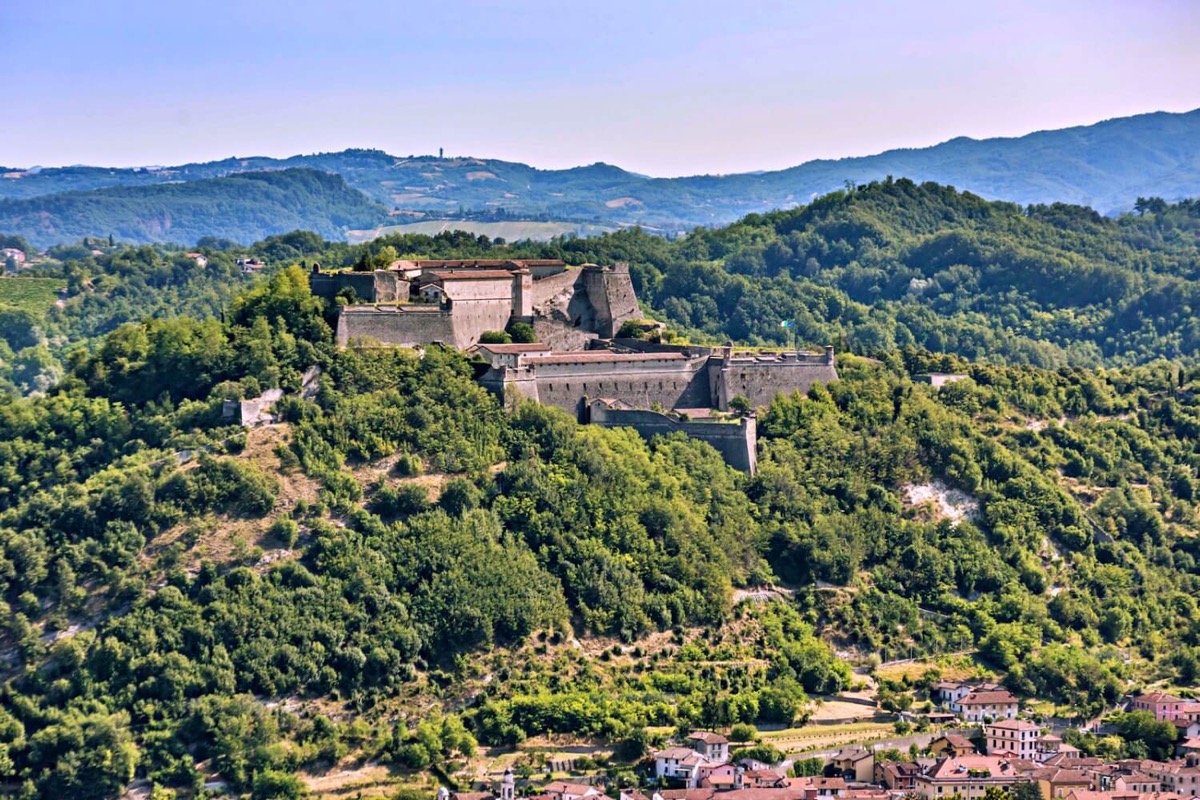
Il forte di Gavi è una fortezza storica di tipo prettamente difensivo costruita dai genovesi su un preesistente castello di origine medioevale
Previous names
Forte di Gavi, Forte di Gavi
Description
Forte di Gavi: Historical Overview
The Origins of the Castle
The origins of the Gavi Castle are difficult to establish reliably, due not only to the lack of supporting documentation but also to the countless legends that inevitably arise around such structures and are handed down over the centuries. Nevertheless, we can reasonably assume that fortifications must have been built, possibly in the pre-Roman era, on the prehistoric natural "stronghold" that overlooks the town of Gavi even today.
The Earliest Documents
The existence of Gavi Castle is proven by a document from the year 973 and, subsequently, by an imperial diploma signed by Henry VI, son of Frederick I, better known as Frederick Barbarossa. With this deed dated 30 May 1191, the ruler enfeoffed the castle and hamlet of Gavi, and its annexes, to the Republic of Genoa. Gavi Castle was ruled by the Genoese – albeit with alternating fortunes – until 1418, when it was taken over by the Seigniory of the Visconti family of Milan following a war. The Visconti invested the Fregoso family with the fief of Gavi and the old castle, and the Sforzas then transferred the investiture to the noble Guasco family of Alessandria. The Guasco family, also the lords of Francavilla, continued to be the feudatories of the village and castle of Gavi until 1528.
The Return of the Genoes
On 14 November 1528 Count Antonio Guasco sold the Republic of Genoa all existing rights over Gavi Castle (along with the village and surrounding area) for "a thousand positions" in the Banco di San Giorgio. Consequently, the Republic of Genoa regained possession of Gavi Castle, owning it uninterruptedly from 1528 to 1815 when, following Napoleon's defeat, the ancient Genoese republic was also abolished and was annexed to the new kingdom ruled by the House of Savoy.
The Castle Becomes a Fort
Over the centuries extensive architectural work was done on the castle, transforming the ancient structure into a powerful fortress. The first radical changes to the old castle were implemented in 1540 by Giovanni Maria Olgiati, military engineer in the service of the Republic of Genoa.
Olgiati designed and completely reconstructed all the walls surrounding the old castle, building new bastions and consolidating the original structure. Olgiati's work transformed the original structure of the castle into a true fort.
The Fort Becomes a Fortress
During the 17th century the castle – a fort at this point – was radically transformed yet again into the fortress we can admire today. The Republic of Genoa entrusted the plans to enlarge the structure to a Dominican friar, Vincenzo da Fiorenzuola (born Gaspare Maculano). Famous also as the inquisitor in the trial of Galileo, Vincenzo da Fiorenzuola was not only a religious but also one of the era's great experts on military architecture. The work to transform the fort into a great fortress commenced in the spring of 1626 and was completed – at least formally – in the summer of 1629.
The 18th Century
In reality, work to enlarge both the interior and exterior of the structure continued until the early 19th century. The redoubt of Monte Moro, connected to the fort by a fortified gallery, was built on the east side. Lodgings for soldiers and officers, wells, a powder magazine, guardhouses and parade grounds were constructed inside. This work was planned by the most famous military engineers of the era, such as Stefano Scaniglia, Domenico Orsolino, Pietro Morettini and Pierre De Cotte – to name just a few of the architects who, in turn, helped complete this imposing fortress.
The King of Sardinia
In 1859, during the reign of Vittorio Emanuele II, the ancient Genoese fortress was disarmed and transformed into a civilian prison, depriving it of its historical identity. During World War I it was turned into a military prison for Austrian prisoners of war and Italian deserters. Between the two world wars, the Anti-Phylloxera Association planted experimental vineyards on some of its earthworks. With the advent of World War II, the fortress was used as a detention centre again, initially housing English prisoners, followed by Italian soldiers after 8 September 1943.
In 1946 the fort was entrusted to the Piedmont Superintendence of Environmental and Architectural Heritage, which in 1978 undertook constant and ongoing work to restore and protect this rare example of military architecture. The Amici del Forte di Gavi Association was founded recently under the auspices of the Superintendence. and it has taken on the responsibility of promoting and enhancing this extraordinary Genoese military structure.
http://www.fortedigavi.it
Il forte di Gavi è una fortezza storica di tipo prettamente difensivo costruita dai genovesi su un preesistente castello di origine medioevale. È di proprietà demaniale ed è adibito a struttura museale.
Si trova nella cittadina piemontese di Gavi, lungo la via Postumia che nell'antichità collegava la Repubblica di Genova al Basso Piemonte (Monferrato) e alla Lombardia.
Dal 1946 è in consegna al Ministero dei beni culturali che ne cura la manutenzione e la promozione attraverso la Soprintendenza per i Beni Architettonici e Paesaggistici del Piemonte. Dal 2007 l'Associazione Amici del Forte di Gavi collabora nella promozione e valorizzazione con la suddetta Soprintendenza.
All'interno della fortezza, che è inserita nel circuito "Castelli Aperti", si tengono periodicamente rievocazioni storiche in costume, cicli di conferenze, dibattiti e mostre fotografiche e pittoriche. È in fase di definizione il progetto per l'utilizzo della struttura per spettacoli di arte varia, musica e teatro.
Nel 2016 ha fatto registrare 9 177 visitatori.
Storia
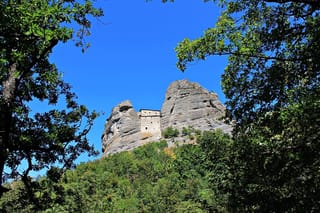
La fortezza si erge su una rocca naturale a strapiombo sul borgo antico di Gavi.
È stata realizzata inglobando un preesistente castello fatto erigere, secondo la leggenda, al tempo delle occupazioni saracene e ungare dalla principessa Gavia (o Gavina) che in quella località aveva stabilito la sua residenza. Secondo la leggenda, la principessa era di origine francese, tanto che ancor oggi il viottolo che conduce al forte, salendo dal borgo, porta il nome di Monserito (da mon cheri).
Fuor di leggenda, è difficile stabilire con certezza - a causa della mancanza di riscontri documentari - la data di costruzione dell'originario castello anche se gli studiosi non escludono che vi fosse nell'antichità in quel luogo una fortificazione di epoca pre-romana.
Federico Barbarossa
Il primo atto che testimonia dell'esistenza del castello è un documento notarile risalente all'anno 973. Un successivo diploma imperiale firmato da Enrico VI di Svevia, figlio di Federico Barbarossa, conferma - alla data del 30 maggio 1191 -la donazione in feudo alla Repubblica di Genova sia del castello che del vicino borgo di Gavi.
Il castello rimase in mano ai genovesi, sia pure con alterne vicende, almeno fino al 1418 quando passò dapprima alla Signoria milanese dei Visconti, poi ai Fregoso e infine agli alessandrini Guasco, signori di Francavilla. I Guasco rimasero signori di Gavi fino al 1528: in quell'anno il castello fu venduto nuovamente alla Repubblica di Genova per moneta coniata dal Banco di San Giorgio (mille luoghi la cifra pattuita). Solo in epoca napoleonica, Genova - cui l'avamposto dell'oltregiogo serviva come difesa avanzata al di là dell'Appennino ligure - fu costretta a rinunciare a quella che era diventata la fortezza gaviese.
Da castello a fortezza
Nel corso dei secoli la trasformazione da castello a forte è stata lenta ma costante: i primi interventi radicali sulla struttura originaria vennero compiuti nel 1540 dall'ingegnere militare al servizio della Repubblica Giovanni Maria Olgiati.
Il successivo progetto avviato nel 1626 (e portato a termine tre anni dopo) dal frate Vincenzo Maculani (Gaspare Maculano detto fra Fiorenzuola) poi divenuto cardinale, che operava in collaborazione con l'architetto genovese Bartolomeo Bianco, dotò la struttura di sei inespugnabili bastioni detti di Santa Maria, di San Giovanni Evangelista, di Mezzaluna, di San Bernardo, di San Tommaso (o di Passaparola) e di Sant'Antonio (o dello Stendardo), uniti fra di loro da robuste cortine munite di cannoniere. Risalgono al 1673, le fortificazioni sul colle accanto (Ridotta di Monte Moro).
Gli assedi e la vita nel forte
Oggetto delle mire espansionistiche dei sovrani sabaudi, il forte di Gavi subì diversi assedi: fu assalito ed espugnato una prima volta nel 1625 dalle forze franco-savoiarde. Riconquistato dai genovesi dopo soli ventuno giorni, ne fu decisa al termine della guerra la trasformazione in fortezza, più adeguata a resistere alle artiglierie dell'epoca (progetto di fra Fiorenzuola).
Attaccato nuovamente nel 1746 dagli austriaci (vedi Portoria e Giovan Battista Perasso), si arrese su sollecitazione della stessa Genova. Nel 1799, dopo la battaglia di Novi, restò uno dei pochi capisaldi ancora in mano ai francesi. Passato alla Francia nel 1804, fu infine attribuito al Regno di Sardegna dal Congresso di Vienna del 1815.
Disarmato nel 1859, il forte fu trasformato in penitenziario civile. Durante la prima guerra mondiale fu utilizzato come campo di prigionia per gli Austro-Ungarici, i resti di alcuni dei quali, periti in cattività nel corso del conflitto, riposano nel locale cimitero; mentre durante la seconda guerra mondiale fu utilizzato come campo di prigionia per gli ufficiali Anglo-Americani.
La vita condotta dai soldati all'interno della fortificazione è sempre stata piuttosto spartana[3] e scandita da duri turni di guardia. A presiederne il controllo erano due figure fondamentali: il castellano, cui spettavano le decisioni di maggiore importanza, e il munizioniere, preposto al rifornimento di armi e di cibo.
Per il riposo dei militari era sufficiente un semplice sacco. Ugualmente spartano era l'abbigliamento che prevedeva però l'uso di scarpe a tre suole con tacco a cinque strati, sostituite una volta all'anno poiché sottoposte all'usura dovuta a lunghe marce e al clima rigido della zona in cui la fortezza sorge. Le uniformi erano dapprima di colore rosso e verde con bottoni d'argento (i colori di Novi), poi passarono al grigio, allo scarlatto e al bianco che contrassegnavano i cromatismi della Repubblica di Genova.
Useful information
No
5.00 EUR
18 - 25 anni: 2.50 EUR
0 - 18 anni: gratuito
5.00 EUR
- La prima domenica di ogni mese è gratuito
- Audioguide in lingua inglese e russa
info@fortedigavi.it
- La visita è guidata
- Le visite secondo il programma
-
External links
Nearby castles