Warkworth Castle
Northumberland England England
castle, chateau
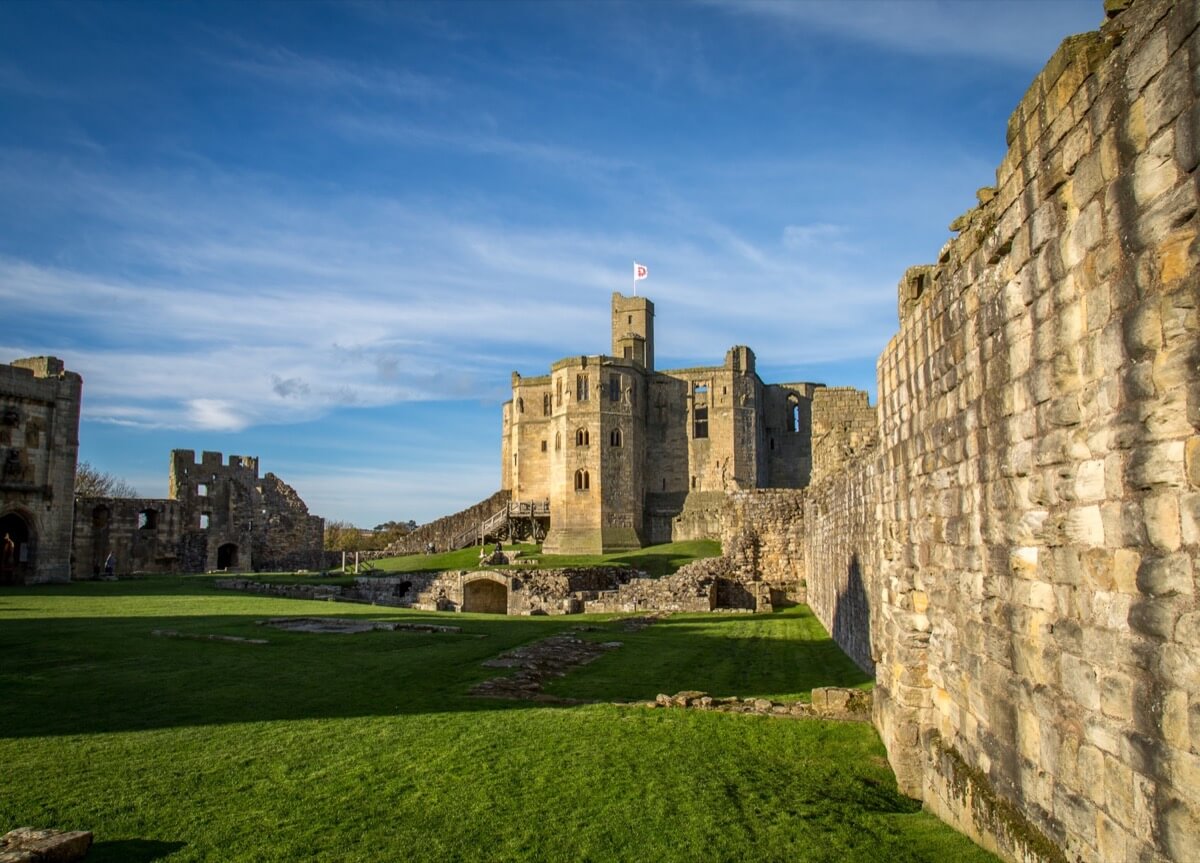
Warkworth Castle is a ruined medieval building in the village of the same name in the English county of Northumberland
Previous names
Warkworth Castle
Description
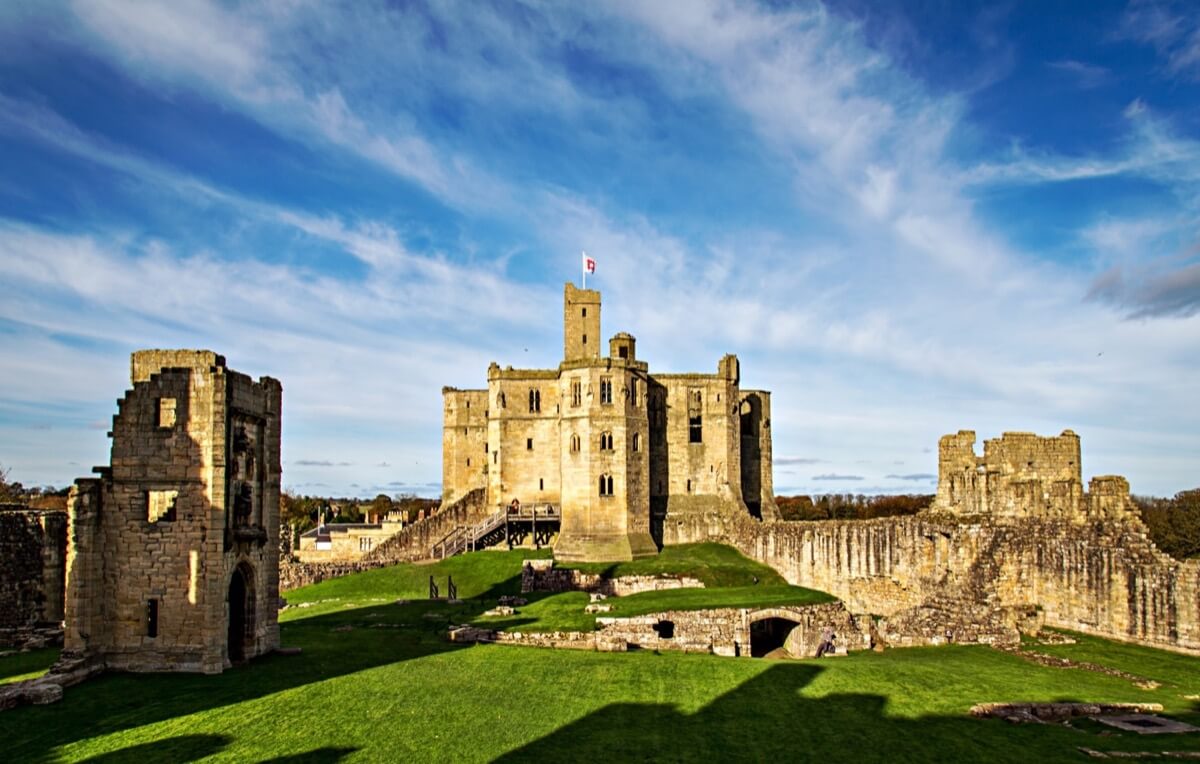
Warkworth Castle is a ruined medieval building in the village of the same name in the English county of Northumberland. The village and castle occupy a loop of the River Coquet, less than a mile from England's north-east coast. When the castle was founded is uncertain: traditionally its construction has been ascribed to Prince Henry of Scotland in the mid-12th century, but it may have been built by King Henry II of England when he took control of England's northern counties. Warkworth Castle was first documented in a charter of 1157–1164 when Henry II granted it to Roger fitz Richard. The timber castle was considered "feeble", and was left undefended when the Scots invaded in 1173.
Roger's son Robert inherited and improved the castle. Robert was a favourite of King John, and hosted him at Warkworth Castle in 1213. The castle remained in the family line, with periods of guardianship when heirs were too young to control their estates. King Edward I stayed overnight in 1292 and John de Clavering, descendant of Roger fitz Richard, made the Crown his inheritor. With the outbreak of the Anglo-Scottish Wars, Edward II invested in castles including Warkworth where he funded the strengthening of the garrison in 1319. Twice in 1327 the Scots besieged the castle without success.
John de Clavering died in 1332 and his widow in 1345, at which point Henry de Percy, 2nd Baron Percy, took control of Warkworth Castle, having been promised Clavering's property by Edward III. Henry Percy, 1st Earl of Northumberland, added the imposing keep overlooking the village of Warkworth in the late 14th century. The fourth earl remodelled the buildings in the bailey and began the construction of a collegiate church within the castle, but work on the latter was abandoned after his death. Though Algernon Percy, 10th Earl of Northumberland, supported Parliament during the English Civil War, the castle was damaged during the conflict. The last Percy earl died in 1670. In the mid-18th century the castle found its way into the hands of Hugh Smithson, who married the indirect Percy heiress. He adopted the name "Percy" and founded the dynasty of the Dukes of Northumberland, through whom possession of the castle descended.
In the late 19th century, the dukes refurbished Warkworth Castle and Anthony Salvin was commissioned to restore the keep. Alan Percy, 8th Duke of Northumberland, gave custody of the castle to the Office of Works in 1922. Since 1984 English Heritage has cared for the site, which is a Grade I listed building and a Scheduled Ancient Monument.
Layout
Warkworth Castle is an irregular enclosure. The keep is at the north end, overlooking the town, with the bailey to the south. The current keep was built on an earlier mound, known as a motte. The curtain wall of the bailey dates from the early 13th century. There are four towers: Carrickfergus Tower in the south-west corner, Montagu Tower in the south-east, a postern tower in the west wall (north of the kitchen), and Grey Mare's Tail Tower attached to the east wall. Against the east curtain wall was a stable. In the northern half of the bailey, aligned east–west, was an unfinished 15th-century collegiate church; it was cleared away in the early 16th century. Immediately west of the church was the kitchen, situated in the angle of the curtain wall as it changes from its north–south alignment and turns towards the keep. Along the west curtain wall, south of the kitchen, were the pantry, great hall, and withdrawing chambers. In the south-west was a chapel. Apart from the north side, the castle was surrounded by a moat.
Gatehouse
The gatehouse in the centre of the south curtain wall mostly dates from the 13th century. It was originally accessed via a drawbridge and visitors had to pass through two gates, one at either end of the passage, and a portcullis. The semi-octagonal projections on either side of the gate passage are considered ornamental. Between the projections and above the gate were machicolations, openings for missiles to be hurled at attackers. The rooms on either side of the passage were guardrooms. The only remaining openings on the front are slits at ground level. Slits on the other sides of the gatehouse, and along the entrance passage, allowed the gatekeeper to watch people approaching and entering the castle. The structure underwent later alterations in the 19th and 20th centuries when it housed the castle's custodian; slits in the gatehouse's front may have been filled in.
West range
Tall tower with an arched passageway through the bottom. Above the archway are heraldic symbols.
The range along the western curtain wall dates from about 1480, when the fourth earl remodelled the bailey. The great hall was the social hub of the castle, where the household gathered to eat. The now-ruined 15th-century building replaced an earlier hall on the same site, dating from about 1200, although some of the stone dates from the mid 12th century. The earl would have entered from the south from his connecting private chambers, and people of lower status through the Lion Tower. Internally, it was split into two aisles of differing width. Both halls were heated by open hearths, two of which survive from the earlier hall. Opposite ends of the hall were for opposite ends of the social scale within the castle. The high end (next to the withdrawing chamber) was for the earl and his family, and the low end (next to the kitchen and other service rooms) for the rest of the household. In the medieval period, the great hall was richly decorated with tapestries.
The Lion Tower was the entrance to the north end of the great hall. Above the archway through the tower were displayed heraldic items, symbolic of the Percy earls' power. The lion at the bottom was the emblem of the earls. Though now much damaged, above the lion were the ancient arms of the family and the arms of the Lucy family, whose property the Percys had inherited in the 1380s. As the tower was entered from the bailey, on the right was a doorway leading to the incomplete collegiate church. To the left was the great hall, and beyond that, withdrawing chambers; to the right were the buttery, pantry, larder, and kitchen. Immediately north of the kitchen was a postern tower. Built around 1200, its upper floors were later reused for accommodation. An entrance of lesser status than the main gatehouse, the gate's position next to the kitchen suggests it was a tradesmen's entrance, used for conveying supplies to the castle.
A half ruined tower, effectively showing a cross-section of the interior.
The square Little Stair Tower was the entrance from the bailey to the withdrawing rooms south of the great hall. At ground floor level there was a doorway in each of the tower's faces. Directly south of the east side of the tower was the castle's chapel. The northern door led to the great hall, and the western door to a cellar under the great chamber. There are only fragmentary remains of the spiral staircase. Above the passageway was a single room, of uncertain purpose: it may have been used as another chapel, a guest room, or an antechamber where guests would wait before being admitted into the earl's presence.
South of the great hall was a two-storey building containing withdrawing chambers, dating from around 1200. Narrow windows opening onto the bailey were original but have since been filled in. The first floor was entirely occupied by the great chamber, furnished with a fireplace. In the south-west corner of the room was a door to a small room which was perhaps used as a safe. The ground floor was used as a cellar, through which the Carrickfergus Tower could be accessed. The polygonal tower was also accessible through the great chamber at first floor level. Fitted with latrines and a fireplace, it was an extension of the lordly accommodation provided by the great chamber.
South and east
Montagu Tower in the south-east corner was probably built by John Neville, Lord Montagu, in the 15th century. Fitted with latrines and fireplaces, the upper floors provided accommodation, most likely for the more important members of the household. By the 16th century, the ground floor was used as a stable. The buildings against the south curtain wall between Montagu Tower and the gatehouse are of unknown purpose. North of Montagu Tower, against the east curtain wall, are the ruins of stables which stood two storeys high. West of the stables was a wellhouse containing a stone-lined well some 18 metres (59 ft) deep. The Grey Mare's Tail Tower, probably built in the 1290s, has a slit in each of its five faces, offering views along the curtain wall.
Keep
See caption; numbering runs anti-clockwise from the south.
Goodall described Warkworth's keep as "a masterpiece of medieval English architecture". Built in the last quarter of the 14th century, it was probably designed by John Lewyn. It was laid out in the form of a Greek cross and originally it was crested with a battlement, and perhaps decorative statues. Around the top of the building survive carvings of angels carrying shields. A large lion representing the Percy's coat of arms overlooked the town from the north side of the keep. The lion and sculptures were probably originally painted and would have stood out from the rest of the building. Archaeologist Oliver Creighton suggests that the rebuilding of the keep and other reconstruction work were meant to suggest the enduring lordship of the owners. On top of the keep is a lookout tower, which would have been less prominent before the keep's roof was removed.
Goodall suggests that the keep was used only for short periods, and the west range, including the great hall, was the lord's preferred residence for prolonged visits to Warkworth Castle. The ground floor was used predominantly for storage of food and wine, but there was also a room with access to a basement chamber roughly 9 feet (2.7 m) square. This has variously been interpreted as an accounting room with a floor safe, or guardroom with a dungeon dug into the floor. In the keep's west wall was a postern through which stores would pass into the building. Kitchens occupied the west side of the first floor and were connected via staircases to the stores immediately below. In the south-east corner was a great hall, originally heated by a central hearth and spanning the height of the first and second floors. A chapel off the great hall led to a large formal room where the lord would meet guests. The second floor was entirely domestic in nature, with bedrooms and withdrawing chambers. In the 19th century, while the rest of Warkworth Castle was in ruins, the rooms of the second floor were re-roofed and occasionally used by the duke on visits. At the centre of the keep was a lightwell with interior windows; at its foot was a tank for collecting rainwater used for cleaning.
Useful information
Parking £3.10
http://www.english-heritage.org.uk/visit/places/warkworth-castle-and-hermitage/prices-and-opening-times
http://www.english-heritage.org.uk/visit/places/warkworth-castle-and-hermitage/prices-and-opening-times
http://www.english-heritage.org.uk/visit/places/warkworth-castle-and-hermitage/prices-and-opening-times
External links
Nearby castles