Upnor Castle
Medway England England
castle, chateau
Upnor Castle is an Elizabethan artillery fort located on the west bank of the River Medway in Kent
Previous names
Upnor Castle
Description
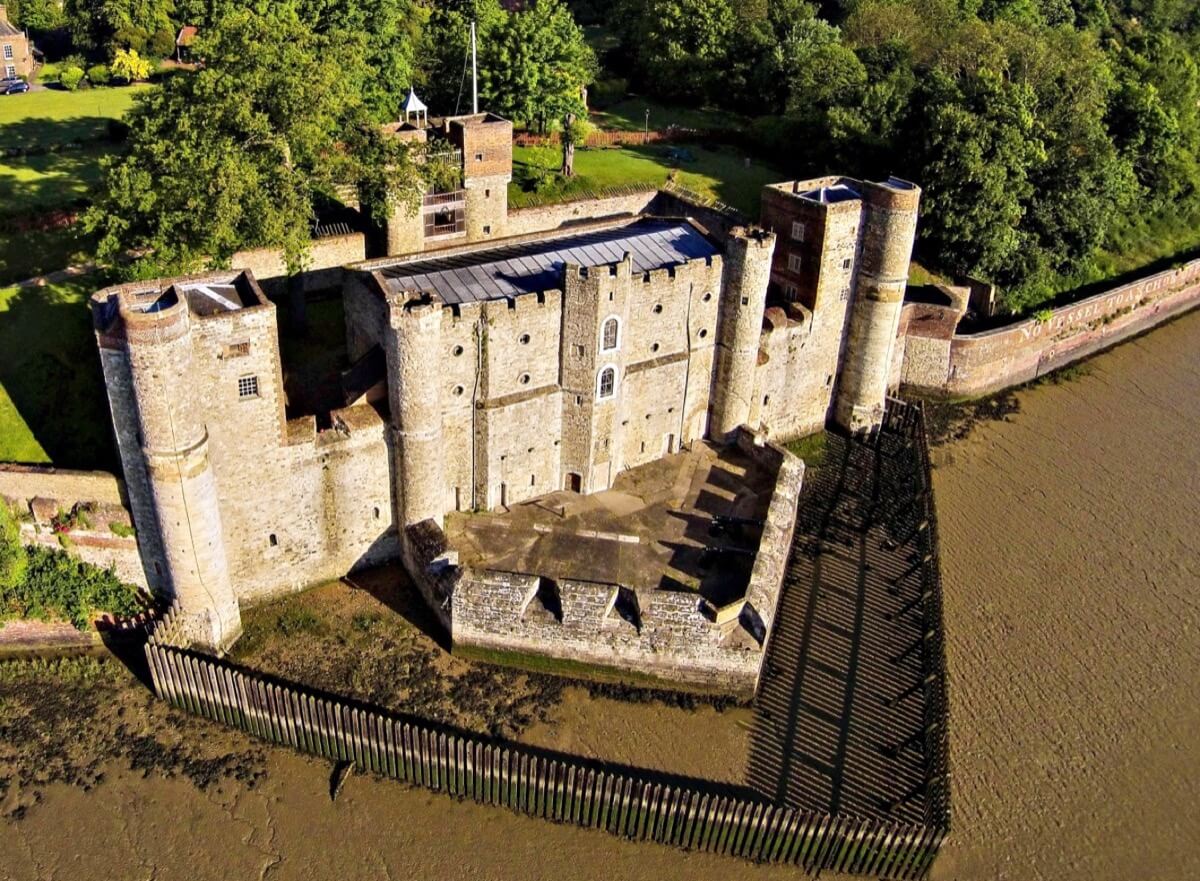
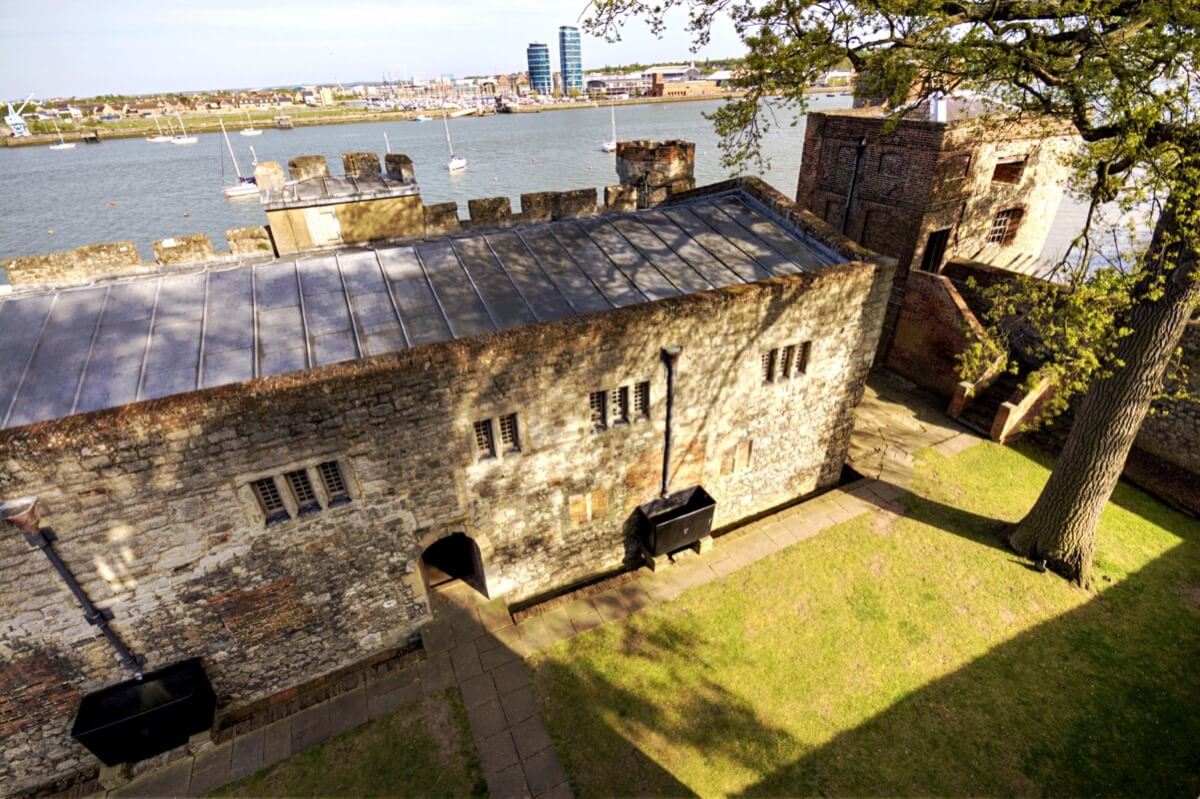
Upnor Castle is an Elizabethan artillery fort located on the west bank of the River Medway in Kent. It is in the village of Upnor, opposite and a short distance downriver from the Chatham Dockyard, at one time a key naval facility. The fort was intended to protect both the dockyard and ships of the Royal Navy anchored in the Medway. It was constructed between 1559–67 on the orders of Elizabeth I, during a period of tension with Spain and other European powers. The castle consists of a two-storeyed main building protected by a curtain wall and towers, with a triangular gun platform projecting into the river. It was garrisoned by about 80 men with a peak armament of around 20 cannon of various calibres.
Despite its strategic importance, the castle and the defences of the Thames and Medway were badly neglected during the 17th century. The Dutch Republic mounted an unexpected naval raid in June 1667, and the Dutch fleet was able to breach the defences, capturing two warships and burning others at anchor in the river at Chatham, in one of the worst defeats suffered by the Royal Navy. Upnor Castle acquitted itself better than many of the other defensive sites along the upper Medway, despite its lack of provisioning. Gun fire from the fort and from adjoining emplacements forced a Dutch retreat after a couple of days, before they were able to burn the dockyard itself.
The raid exposed the weaknesses of the Medway defences and led to the castle losing its role as an artillery fortification. New and stronger forts were built further downriver over the following two centuries, culminating in the construction of massive casemated forts such as Garrison Point Fort, Hoo, and Darnet Forts. Upnor Castle became a naval ammunition depot, storing great quantities of gunpowder, ammunition, and cannon to replenish the warships that came to Chatham for repair and resupply. It remained in military use until as late as 1945. The castle was subsequently opened to the public and is now an English Heritage property.
Description
Upnor Castle's buildings were constructed from a combination of Kentish ragstone and ashlar blocks, plus red bricks and timber. Its main building is a two-storeyed rectangular block that measures 41 m (135 ft) by 21 m (69 ft), aligned in a north-east/south-west direction on the west bank of the Medway. Later known as the Magazine, it has been changed considerably since its original construction. It would have included limited barrack accommodation, possibly in a small second storey placed behind gun platforms on the roof. After the building was converted into a magazine in 1668 many changes were made which have obscured the earlier design. The second storey appears to have been extended across the full length of the building, covering over the earlier rooftop gun platforms. This gave more room for storage in the interior. The ground floor was divided into three compartments with a woodblock floor and copper-sheeted doors to reduce the risk of sparks. Further stores were housed on the first floor, with a windlass to raise stores from the waterside.
A circular staircase within the building gives access to the castle's main gun platform or water bastion, a low triangular structure projecting into the river. The castle's main armament was mounted here in the open air; this is now represented by six mid-19th century guns that are still on their original carriages. There are nine embrasures in the bastion, six facing downstream and three upstream, with a rounded parapet designed to deflect shot. The water bastion was additionally protected by a wooden palisade that follows its triangular course a few metres further out in the river. The present palisade is a modern recreation of the original structure.
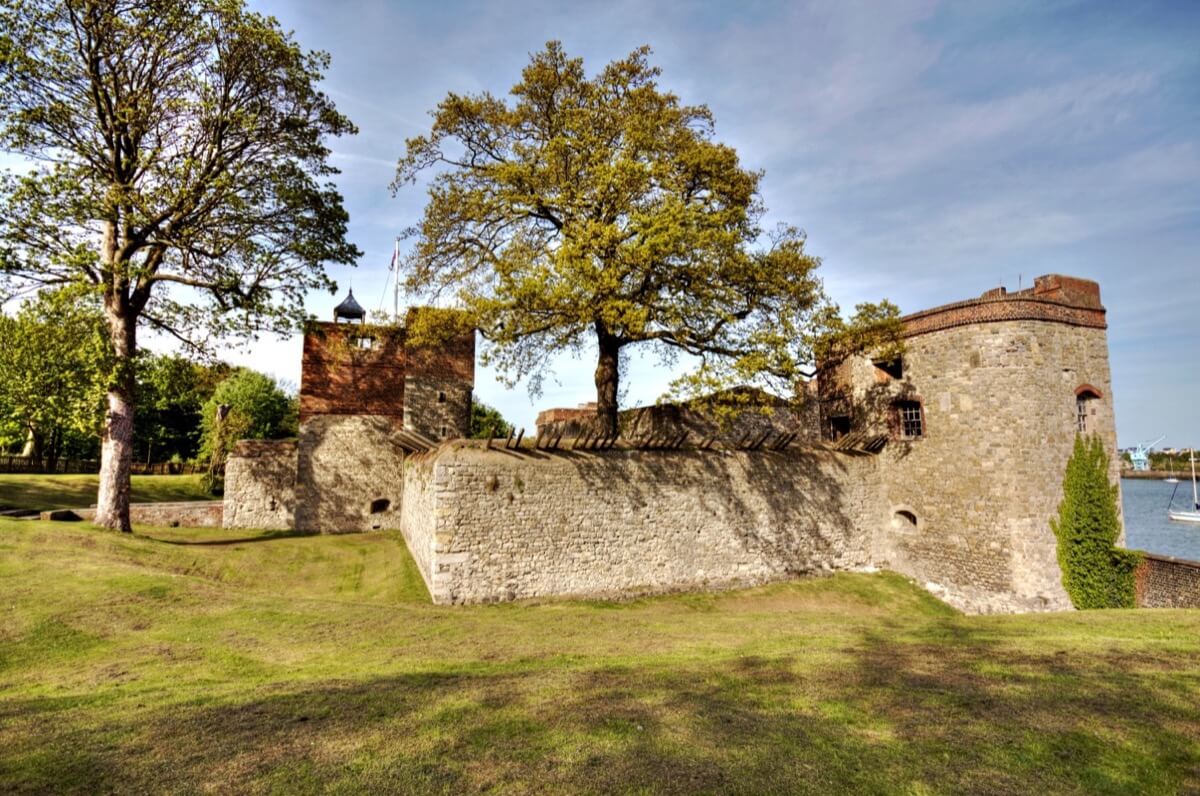
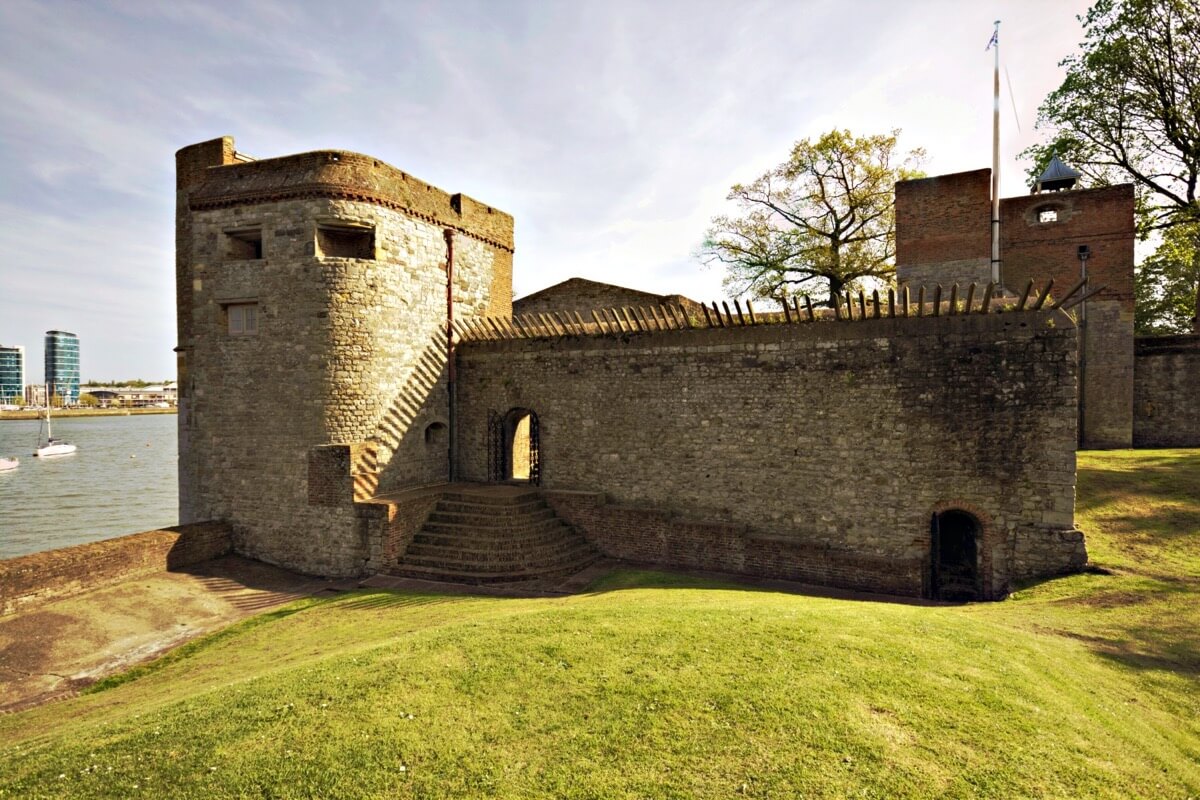
A pair of towers stand on the river's edge a short distance on either side from the main building. They were originally two-storyed open-backed structures with gun platforms situated on their first floors, providing flanking fire down the line of the ditch around the castle's perimeter. They were later adapted for use as accommodation, with their backs closed with bricks and the towers increased in height to provide a third storey. Traces of the gun embrasures can still be seen at the point where the original roofline was. The South Tower was said to have been for the use of the castle's governor, though their lack of comfort meant that successive governors declined to live there. The two towers are linked to the main building by a crenallated curtain wall where additional cannon were emplaced in two embrasures on the north parapet and one on the south.
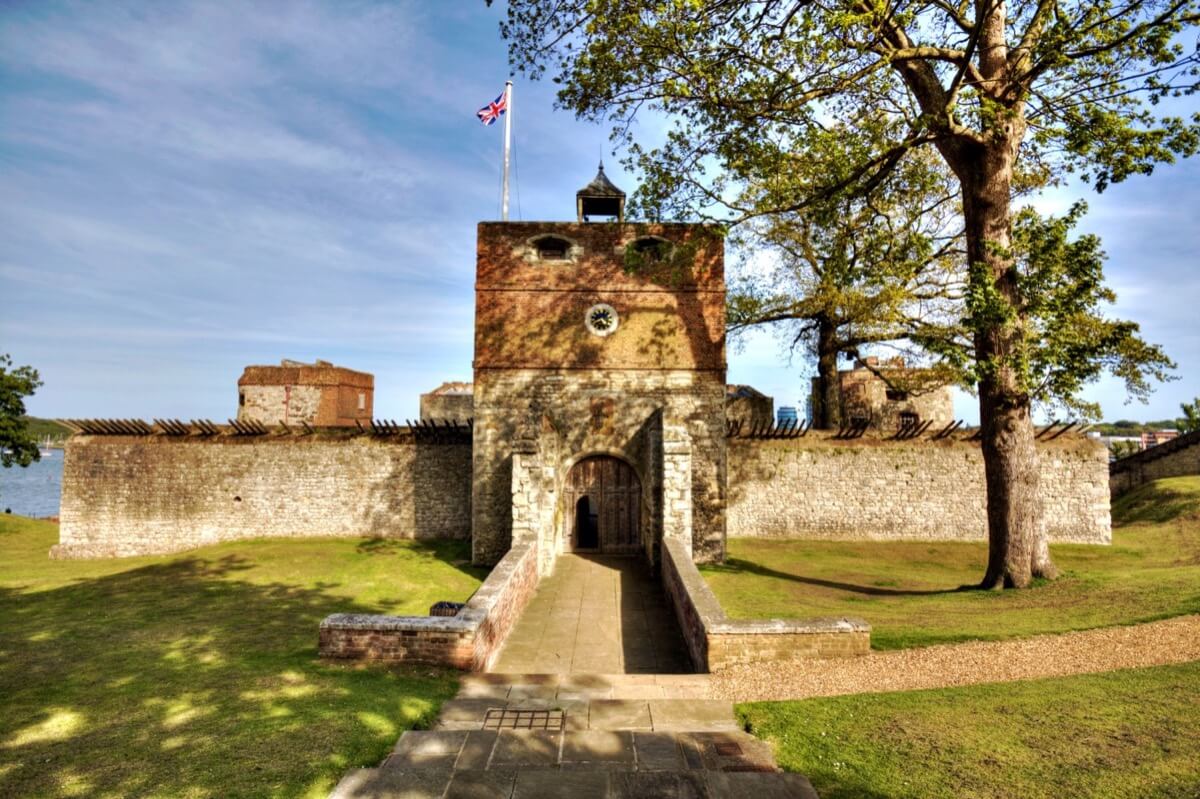
The castle's principal buildings are situated on the east side of a rectangular courtyard within which stand two large Turkey oaks, said to have been grown from acorns brought from Crimea after the Crimean War. A stone curtain wall topped with brick surrounds the courtyard, standing about 1 m (3.3 ft) thick and 4 m (13 ft) high. The courtyard is entered on the north-western side through a four-storeyed gatehouse with gun embasures for additional defensive strength. It was substantially rebuilt in the 1650s after being badly damaged in a 1653 fire, traces of which can still be seen in the form of scorched stones on the first-floor walls. A central gateway with a round arch leads into a passage that gives access to the courtyard. Above the gateway is a late 18th-century clock that was inserted into the existing structure. A wooden bellcote was added in the early 19th century, and a modern flagpole surmounts the building.
The curtain wall is surrounded by a dry ditch which was originally nearly 10 m (33 ft) wide by 5.5 m (18 ft) deep, though it has since been partially infilled. Visitors to the castle crossed a drawbridge, which is no longer extant, to reach the gatehouse. A secondary entrance to the castle is provided by a sally port in the north wall. On the inside of the curtain wall the brick foundations of buildings can still be seen. These were originally lean-to structures, constructed in the 17th century to provide storage facilities for the garrison.
Other associated buildings
Standing to the west of the castle, Upnor Castle House was built in the mid-17th century as accommodation for the Storekeeper, the officer in charge of the magazine. Expanded in the 18th century, it is now a private residence.
A short distance to the south-west of the castle is a barracks block and associated storage buildings, constructed soon after 1718. Built to replace the original barrack accommodation within the castle when it was redeveloped to convert it into a magazine, it has changed little externally in the last 300 years. It is a rare surviving example of an 18th-century building of this type and was one of the first distinct barracks to be built in England.
Depot buildings formerly associated with the castle still survive in the area immediately to the north-east. The earliest is a gunpowder magazine of 1857 (built to the same design as the 1810 magazine, which formerly stood alongside to the south but was demolished in the 1960s; these buildings had space for 33,000 barrels of powder between them). Between the magazines and the castle a Shifting House (for examining powder) had been built in 1811; both it and an adjacent shell store of 1857 were likewise demolished in 1964. They were constructed on top of earlier gun emplacements, of which earthwork traces can still be seen in the form of a broad bank running north-east from the castle towards the depot. A further four shell stores were built further to the north, together with other munitions stores, several of which remain. The Depot compound continued in Ministry of Defence hands until 2014, after which the area was due to be redeveloped as housing (with the surviving military buildings refurbished for light industrial use).
Useful information
Parking FREE
ENTRY TITLE (WITHOUT GIFT AID):
- Member Free
- Adult £6.40
- Concession tool-tip £4.00
ENTRY TITLE (WITHOUT GIFT AID):
Child (5-17 years) £4.00
ENTRY TITLE (WITHOUT GIFT AID):
Family (2 adults, 3 children) £16.80
No dogs are allowed (although assistance dogs are welcome)
External links
Nearby castles
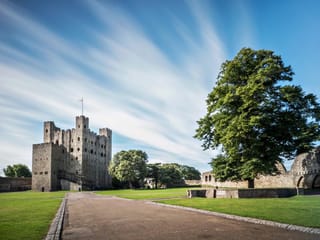
Rochester Castle
Rochester
2.6km
castle, chateau
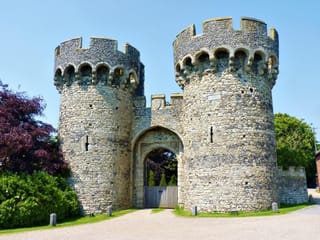
Cooling Castle
Medway
5.4km
castle, chateau
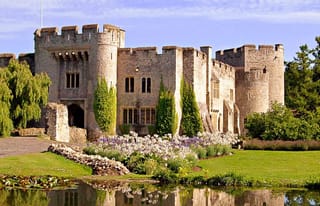
Allington Castle
Kent
12.7km
castle, chateau
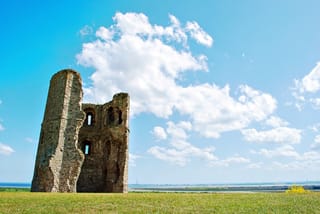
Hadleigh Castle
Essex
16.2km
castle, chateau
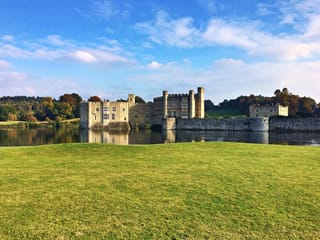
Leeds Castle
Kent
19.0km
castle, chateau
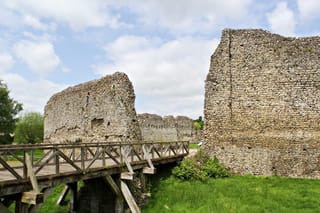
Eynsford Castle
Kent
22.1km
castle, chateau
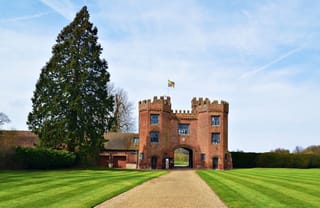
Lullingstone Castle
Kent
23.6km
castle, chateau