Cooling Castle
Medway England England
castle, chateau
Cooling Castle is a 14th-century quadrangular castle in the village of Cooling, Kent on the Hoo Peninsula about 6 miles (9
Previous names
Cooling Castle
Description
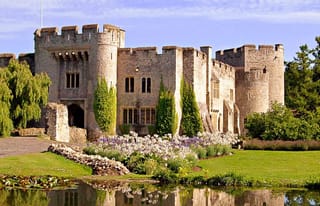
Cooling Castle is a 14th-century quadrangular castle in the village of Cooling, Kent on the Hoo Peninsula about 6 miles (9.7 km) north of Rochester. It was built in the 1380s by the Cobham family, the local lords of the manor, to guard the area against French raids into the Thames Estuary. The castle has an unusual layout, comprising two walled wards of unequal size next to each other, surrounded by moats and ditches. It was the earliest English castle designed for the use of gunpowder weapons by its defenders.
Despite this distinction, the use of gunpowder weapons against the castle proved devastating. It was captured after only eight hours when Sir Thomas Wyatt besieged it in January 1554 during his unsuccessful rebellion against Queen Mary. His attack badly damaged the castle, and it was subsequently abandoned and allowed to fall into disrepair. A farmhouse and outbuildings were constructed among the ruins a century later. Today the farmhouse is the home of the musician Jools Holland, while the nearby barn is used as a wedding venue.
History
Construction
The castle was originally built on the south bank of the Thames, although the shoreline has since receded as a result of land reclamation; the river is now about 2 miles (3.2 km) north of the castle, separated from it by marshes. It was constructed by John Cobham, whose family had acquired the manor of Cooling in the mid-13th century. In 1379, during the second phase of the Hundred Years' War, a French raid devastated towns and villages along the Thames Estuary. Cobham appealed to the Crown for licence to fortify his manor and received permission in February 1380. The building work was completed by 1385.
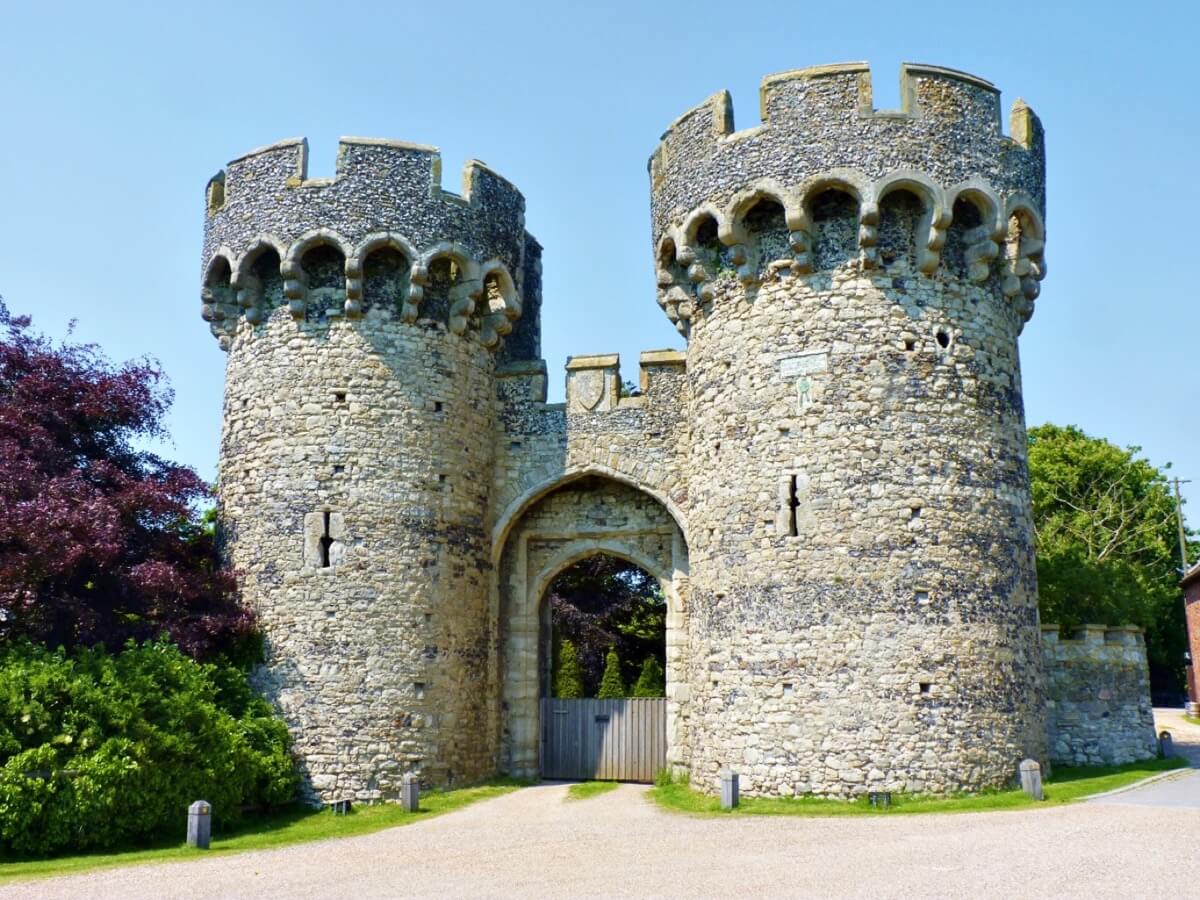
Surviving records indicate that the prominent gatehouse was built by local labour under several master masons, including Thomas Crompe, William Sharnall and Thomas Wrek, with the king's master mason Henry Yevele taking a supervisory role. The castle is of particular importance as the earliest English castle designed for the use of gunpowder weapons. Lord Cobham's instructions to his masons include his requirement for "x arket holes de iii peez longour et tout saunz croys
Cobham fell out of the king's favour shortly after the castle was completed and he was exiled for a while, but was eventually able to return and died at Cooling in 1408. His granddaughter Joan inherited his estates and married four times. Her last husband, Sir John Oldcastle, was executed in 1417 for his role in the Lollard heresy. The Cobham title remained intact but the castle passed to other families down the female line.
Wyatt's Rebellion
Cooling Castle saw action only once, in 1554, when it was attacked by the forces of the Kentish landowner Sir Thomas Wyatt during his rebellion against Queen Mary's engagement to King Philip II of Spain. In an unsuccessful bid to overthrow the unpopular queen and place Princess (later Queen) Elizabeth on the throne, he raised an army of some 4,000 men and captured two cannons from the army of Thomas Howard, 3rd Duke of Norfolk, in an encounter at Strood, a few miles south of Cooling. It is unclear why, while ostensibly marching on London, he attacked Cooling as the detour gave Mary more time to prepare her own defences. There may have been a personal motive for Wyatt; the castle's occupant by this time was his own brother-in-law, Lord George Cobham.
The defenders were forced to surrender on 30 January 1554 after only eight hours of siege and bombardment which badly damaged the castle. According to contemporary reports, Cobham had just eight men armed with "only four or five handguns, four pikes and some blakbylls" to defend the castle. Wyatt proceeded to London but was defeated and executed for his treason. Cobham and his son were imprisoned in the Tower of London on suspicion of having deliberately failed to defend the castle, but were soon released and allowed to return to their estates. The castle was never rebuilt after being ruined by Wyatt's bombardment; the Cobhams abandoned it and subsequently lived at Cobham Hall, and the castle was allowed to fall into disrepair.
Current status
The castle remained in the Cobhams' ownership until the 18th century. Between 1650 and 1670, Sir Thomas Whitmore built a farmhouse within the castle's outer ward, which has undergone many alterations over the years. Its facade dates from the 19th century and was reworked in the 20th century. An L-shaped range of outbuildings was also constructed in the outer ward, including a timber-framed barn that was built in the 17th century. At some point in the 18th or 19th centuries, part of the inner ward was landscaped, possibly to create a garden incorporating the ruins. The ownership of the castle is split three ways; the barn is used as a party and wedding venue, the inner ward was owned for many years by the Rochester Bridge Wardens, and the house's current occupant is the musician Jools Holland. The castle was listed Grade I in 1946, while the barn was separately Grade II listed in 1986. Cooling Castle is listed on English Heritage's "Heritage at Risk" register due to the very poor condition of its fabric. The castle can be viewed from the road, but sits on private property and is not open to the public.
Description
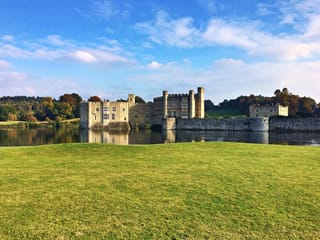
Cooling Castle has an unusual layout that was perhaps dictated by the marshy ground on which it was constructed. Most quadrangular castles were constructed on a single moated island within which was a system of inner wards or courtyards. Cooling Castle differed in that within its 8 acre (3.2 ha) perimeter it had two wards of different sizes arranged side by side. Each stood on a mound within a figure of eight-shaped system of moats and ditches. The inner ward, in the western part of the castle, appears to have been surrounded by a moat that may have been up to 20 metres (66 ft) wide. The larger outer ward, in the eastern part of the castle, was flanked on its western side by the moat, and a dry ditch up to 6 metres (20 ft) deep flanked the other three sides of the ward. A causeway on the northern side separated the ditch from the moat.
Wards
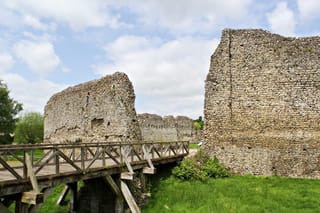
The outer ward had a roughly rectangular shape measuring about 134 x 88 metres (440 x 290 ft). It was completely walled, with horseshoe-shaped towers on three corners, and was accessed via the outer gatehouse at its south-west corner. The corner towers are advanced about 5 metres (16 ft) in front of the curtain wall and still stand to a height of 12 metres (39 ft). Parts of the curtain wall also remain. Much of the outer ward is now occupied by the 17th-century farmhouse and its outbuildings.
Useful information
Parking available
External links
Nearby castles