Pendennis Castle
Cornwall England England
castle, chateau
Pendennis Castle is an artillery fort constructed by Henry VIII near Falmouth, Cornwall, England between 1540 and 1542
Previous names
Pendennis Castle
Description
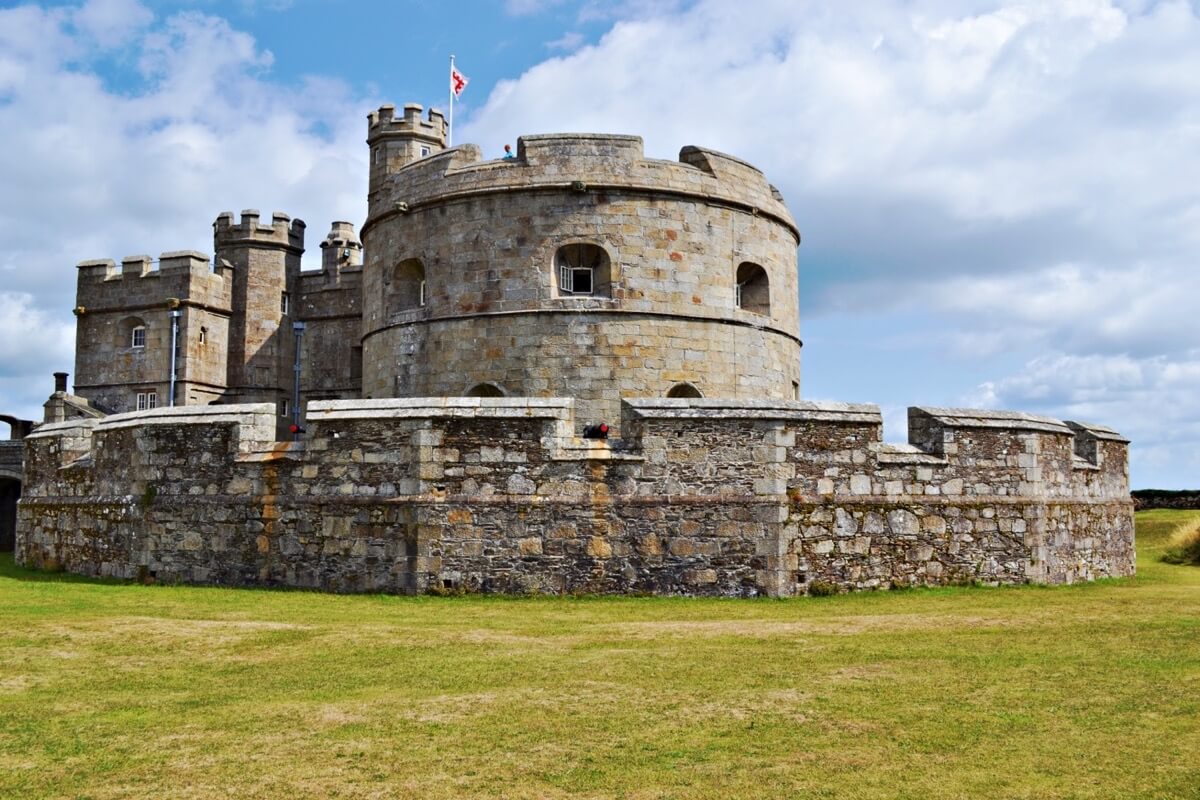
Pendennis Castle is an artillery fort constructed by Henry VIII near Falmouth, Cornwall, England between 1540 and 1542. It formed part of the King's Device programme to protect against invasion from France and the Holy Roman Empire, and defended the Carrick Roads waterway at the mouth of the River Fal. The original, circular keep and gun platform was expanded at the end of the century to cope with the increasing Spanish threat, with a ring of extensive stone ramparts and bastions built around the older castle. Pendennis saw service during the English Civil War, when it was held by the Royalists, and was only taken by Parliament after a long siege in 1646. It survived the interregnum and Charles II renovated the fortress after his restoration to the throne in 1660.
Ongoing concerns about a possible French invasion resulted in Pendennis's defences being modernised and upgraded in the 1730s and again during the 1790s; during the Napoleonic Wars, the castle held up to 48 guns. In the 1880s and 1890s an electrically operated minefield was laid across the River Fal, operated from Pendennis and St Mawes, and new, quick-firing guns were installed to support these defences. The castle saw service during both the First and Second World Wars, but in 1956, by now obsolete, it was decommissioned. It passed into the control of the Ministry of Works, who cleared away many of the more modern military buildings and opened the site to visitors. In the 21st century, the castle is managed by English Heritage as a tourist attraction, receiving 74,230 visitors in 2011–12. The heritage agency Historic England considers Pendennis to be "one of the finest examples of a post-medieval defensive promontory fort in the country".
Architecture
Pendennis Castle is located at the end of a peninsula, overlooking Carrick Roads and the sea. It includes the original 16th-century Device Fort, surrounded by a ring of outer defences, based on the Elizabethan ramparts and later adapted during the 18th, 19th and 20th centuries. Further gun batteries and a blockhouse are located closer to the shore. The heritage agency Historic England considers Pendennis to be "one of the finest examples of a post-medieval defensive promontory fort in the country", demonstrating a long history of different defensive approaches, and English Heritage describes the site as "one of the finest surviving examples of a coast fortress in England".
Ramparts
The gatehouse to the castle is located on the western side of the ramparts and dates from around 1700.It has a classical facade, with a mid-19th century stone bridge reaching across the external ditch.The ramparts are built from stone with protective ditches, and have angular bastions to provide overlapping fire, an innovative design in England when they were first constructed in 1600.North of the gatehouse are the Smithwick and Carrick Mount bastions, the latter holding a quick-firing gun battery from 1903. Further around the ramparts, the East Bastion also has two emplacements for quick-firing guns, dating from 1902, and underground magazines, which were converted into a battery plotting room in the Second World War. Just to the south, the Nine-Gun Battery was built in the 1730s and comprises a fixed line of nine gun embrasures.
In the south-east corner of the ramparts is the One-Gun Battery, which originally held a "disappearing gun", designed to pivot back under a steel shield when fired. Built in 1895, the approach proved unsuccessful and the gun was removed in 1913, but the emplacement still remains and is a rare survival of this type of weapon. The Bell Bastion, the Ravelin, the Pig's Pound Bastion and the Horse Pool Bastion protect the southern and western parts of the ramparts. A range of artillery and anti-aircraft guns are on show around the defences, including 19th-century carronades, and 20th-century pieces such as a 155 mm (6.1 in) Long Tom field gun, a Quick Firing 3-inch 20 cwt (76 mm 102 kg) anti-aircraft gun and two Ordnance Quick-Firing 25-pounder (11 kg) howitzers.
Inner castle
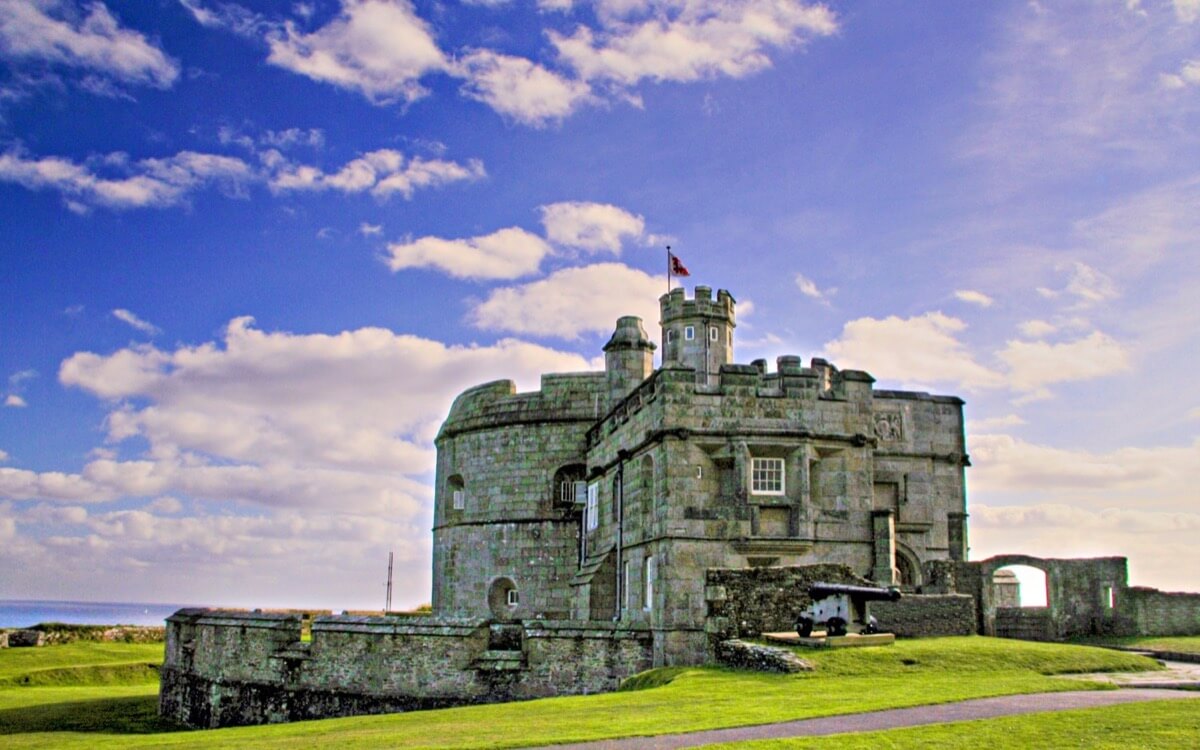
At the heart of the castle is the 16th-century Henrician fortification.[ Built of a combination of granite ashlar and rubble, it comprises a circular keep surrounded by a gun platform, entered through a bridge and a forebuilding. The keep has 3.36-metre (11.0 ft) thick walls and on in the inside is octagonal. The basement was originally a kitchen, cellar and larder for the castle. The ground floor was initially designed to be a gun room, complete with gun embrasures, but was altered during the initial construction project to form living accommodation for the garrison instead. Another gun room occupies the first floor, with seven gun embrasures, and is dressed to appear as it would have done in the 16th century. The roof has seven gun embrasures and a lookout turret.
The polygonal gun platform around the keep has 16 sides, with a total of 14 gun embrasures. The two-storey forebuilding dates from the second half of the 16th century, with three rooms on each level linked by a spiral-staircase, and was originally used to house the captain of the castle. Its entrance was guarded with a portcullis, and the roof was designed to be defendable with handguns. The stone bridge that stretches across the ditch that protects the castle dates from 1902; it would originally have been protected at the front by a rectangular gatehouse, but this was demolished at the start of the 20th century.
The rest of the interior of the fortress was, at various times, occupied by a range of different military buildings, but they have mostly been demolished and grassed over to form a large parade ground. Among the surviving buildings are the Royal Garrison Artillery barracks, located to the north of the parade ground. Built between 1900 and 1902, it could hold 140 soldiers in 12 man barrack-rooms. Alongside the barracks are bungalows, originally for the use of senior non-commissioned officers, a storehouse dating from the Napoleonic Wars, and two guard barracks from 1700, which form a very early example of this form of military architecture in England. Other buildings that have survived include a 19th-century field train shed, and an 18th-century gunpowder magazine, since converted into a shelter for gunners.
External defences
Three defensive positions are positioned outside the main ramparts of the castle. To the south, reached by an underground passage, is the Half-Moon Battery, constructed in 1793 and redesigned in 1895 and 1941. This has two camouflaged gun houses and 6-inch guns dating from the Second World War, when it held a team of 99 soldiers. Further south, near the waterline, is the Little Dennis Blockhouse, a D-shaped gun position dating from 1539, altered in the 1540s and then adapted to form part of a larger fortification covering the whole of Pendennis Point in the late 16th century. Built from Killas rubble, the exterior of the blockhouse and its lookout turret still survive intact. Just along the shoreline to the north-east is the Crab Quay Battery, a set of defences originating in the 16th century, intended to prevent an amphibious landing on the headland, and modernised extensively in 1902.
Useful information
No parking
http://www.english-heritage.org.uk/visit/places/pendennis-castle/prices-and-opening-times
http://www.english-heritage.org.uk/visit/places/pendennis-castle/prices-and-opening-times
http://www.english-heritage.org.uk/visit/places/pendennis-castle/prices-and-opening-times
External links
Nearby castles