Kauzenburg
Bad Kreuznach Rheinland-Pfalz Germany
castle, chateau
Kauzenburg
Bad Kreuznach Rheinland-Pfalz Germany
castle, chateau
The Kauzenburg is the ruin of a hilltop castle in Bad Kreuznach in the Bad Kreuznach district in Rhineland-Palatinate
Die Kauzenburg ist die Ruine einer Höhenburg in Bad Kreuznach im Landkreis Bad Kreuznach in Rheinland-Pfalz
Previous names
Kauzenburg, Kauzenburg
Description
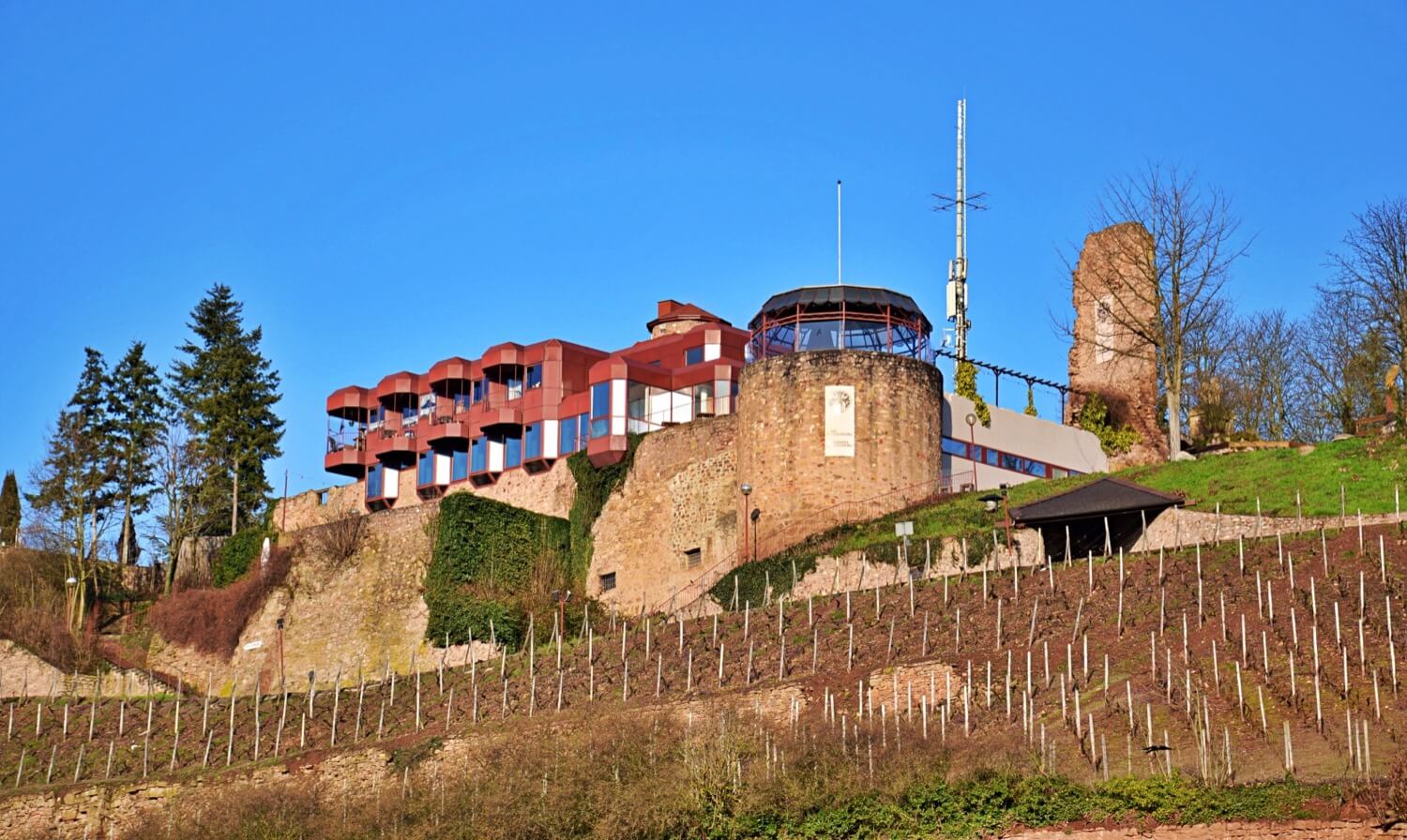
The Kauzenburg is the ruin of a hilltop castle in Bad Kreuznach in the Bad Kreuznach district in Rhineland-Palatinate .
History
The Kauzenburg was the residence of the front county of Sponheim . In 1206 the castle was first mentioned in a document in which King Philip of Swabia forbade the building of a castle. From 1206 to 1230 the first castle was built by Count Gottfried III. († 1218) and Johann I. von Sponheim († 1266).
In 1417 the castle was divided between the Counts of Sponheim and the Elector and Count Palatine Ludwig III. In 1437 another division followed under the Heidelberg Count Palatine Ludwig IV , Friedrich III. von Veldenz and the Margrave of Baden. 1444 followed Stefan von Pfalz-Simmern-Zweibrücken as heir of the Veldenz share. In the Palatinate War between 1450 and 1470 the margrave lost his share. Elector Philipp expanded the castle. In 1503 Baden became co-owner again.
In 1620 the Spanish marquis Spinola captured Kreuznach and the castle, which he fortified until 1632. In 1632, during the Thirty Years' War , the Swedish king captured the castle. In 1635 the imperial troops took over the town and castle. In 1639 the French recaptured the castle under General Duc Henri II. D'Orléans-Longueville (1595–1663) and in 1641 the imperial under Gil de Haes took over the fortress .
After the Peace of Westphalia , the castle fell to Baden and the Palatinate. For the first time the castle was called "Veste Kauzenburg". The French under General Louis-François de Boufflers (1644–1711) captured the castle in 1688, blew it up and burned the building down.
Commercial use
In 1803 Andreas van Recum (later ennobled as Baron von Recum) acquired the ruins on the Kauzenberg. This fell to the Bangert manor . Large vaults and cellars were later found in the foundations of the destroyed castle and cleared out again. These were probably intended for the loss of weapons, but were then used to store the well-known Schloss Kanzenburger wine.
It remained in the family's possession until 1881 and finally belonged to Otto von Recum, then passed to the Kreuznach families Puricelli and Gräff. It was owned by the widow Werren when the wine merchant Elmar Pieroth bought Layen Castle , the property and the Kauzenburg in 1969 .
Pieroth wanted to give new impetus to tourism in the region and in 1970 had the building fabric that had been built up over the past few years removed. The architect Gottfried Böhm was commissioned to build the new building in 1970 and 1971 .
The architect crowned the brickwork of the Kauzenburg ruins, which can still be seen from the outside, with cubist oriels. He used glass, metal and the color wine red in abundance.
The Kauzenburg Foundation, responsible for the use of the historically valuable castle cellars in a way that makes sense in terms of local history, and the Kauzenburg Betriebsgesellschaft (later Kauzenburg Gaststätten GmbH ), responsible for running restaurants and hotels, took over the property.
The large feast at the knight's table is part of the gastronomic program . Today the property is managed by Kauzenburg Gaststätten GmbH .
https://second.wiki
Die Kauzenburg ist die Ruine einer Höhenburg in Bad Kreuznach im Landkreis Bad Kreuznach in Rheinland-Pfalz.
Geschichte
Die Kauzenburg war Residenz der vorderen Grafschaft Sponheim. 1206 erfolgte die erstmalige Erwähnung der Burg in einer Urkunde, in der König Philipp von Schwaben den Bau eines Schlosses verbot. Von 1206 bis 1230 entstand eine erste Burganlage durch die Grafen Gottfried III. († 1218) und Johann I. von Sponheim († 1266).
1417 erfolgte eine Teilung der Burg zwischen den Sponheimer Grafen und dem Kurfürsten und Pfalzgrafen Ludwig III. 1437 folgte eine erneute Teilung unter dem Heidelberger Pfalzgrafen Ludwig IV, Friedrich III. von Veldenz und dem Markgrafen von Baden. 1444 folgte Stefan von Pfalz-Simmern-Zweibrücken als Erbe des Veldenzer Anteils. Im Pfälzer Krieg zwischen 1450 und 1470 verlor der Markgraf seinen Anteil. Kurfürst Philipp baute die Burg aus. 1503 wurde Baden wieder Mitbesitzer.
1620 eroberte der spanische Marquis Spinola Kreuznach und die Burg, die er bis 1632 befestigte. 1632 während des Dreißigjährigen Krieges eroberte der schwedische König das Schloss. 1635 übernahmen die kaiserlichen Truppen Stadt und Burg. 1639 eroberten die Franzosen unter General Duc Henri II. d’Orléans-Longueville (1595–1663) das Schloss zurück und 1641 übernahmen die Kaiserlichen unter Gil de Haes die Veste.
Nach dem Westfälischen Frieden fiel die Burg an Baden und die Pfalz. Erstmals wurde dabei das Schloss als „Veste Kauzenburg“ bezeichnet. Die Franzosen unter General Louis-François de Boufflers (1644–1711) eroberten 1688 die Burg, sprengten sie und brannten das Gebäude nieder.
Privatwirtschaftliche Nutzung
1803 erwarb Andreas van Recum (später geadelt als Freiherr von Recum) die Ruine auf dem Kauzenberg. Diese fiel damit an das Rittergut Bangert. In den Fundamenten der zerstörten Burg sind später große Gewölbe und Keller aufgefunden und wieder ausgeräumt worden. Diese waren wahrscheinlich zu Waffenniederlagen bestimmt, dienten dann aber zur Aufbewahrung des wohlbekannten Schloss Kanzenburger Weines.
Sie blieb bis 1881 im Besitz der Familie und gehörte zuletzt Otto von Recum, ging dann an die Kreuznacher Familien Puricelli und Gräff über. Es war im Besitz der Witwe Werren, als 1969 der Weinhändler Elmar Pieroth Burg Layen, das Grundstück und die Kauzenburg erwarb.
Pieroth wollte dem Tourismus der Region neue Impulse geben und ließ 1970 die in den zurückliegenden Jahren entstandene Bausubstanz beseitigen. Für den Neubau in den Jahren 1970 und 1971 wurde der Architekt Gottfried Böhm beauftragt.
Der Architekt krönte das außen noch sichtbare Mauerwerk der Ruine Kauzenburg mit kubistischen Erkern. Er verwendete reichlich Glas, Metall und die Farbe Weinrot.
Die Kauzenburg Stiftung, verantwortlich für die Nutzung der historisch wertvollen Burgkeller in heimatgeschichtlich sinnvoller Weise, und die Kauzenburg Betriebsgesellschaft (später Kauzenburg Gaststätten GmbH), zuständig für Betrieb von Restaurants und Hotellerie, übernahmen das Anwesen.
Zum gastronomischen Programm gehört das Große Gelage an der Rittertafel. Heute wird das Anwesen von der Kauzenburg Gaststätten GmbH bewirtschaftet.
Useful information
Gratis
Gratis
Gratis
Gratis
Schöne Aussicht
Privateigentum (Restaurant)
-
Nearby castles
Altenbaumburg
Bad Kreuznach
6.7km
castle, chateau
Klopp Castle
Landkreis Mainz-Bingen
13.8km
castle, chateau
Ehrenfels Castle (Hesse)
Darmstadt
14.6km
castle, chateau
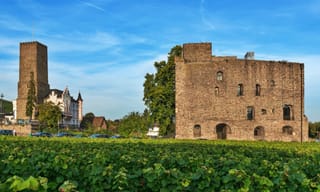
Bromserburg
Darmstadt
15.5km
castle, chateau
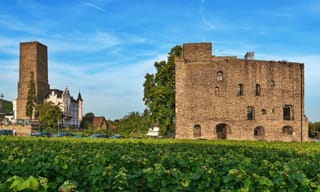
Boosenburg
Darmstadt
15.5km
castle, chateau

Rheinstein Castle
Landkreis Mainz-Bingen
16.6km
castle, chateau
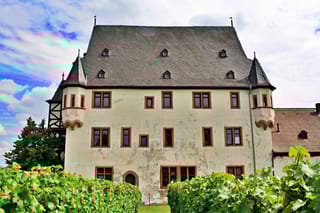
Schloss Schonborn (Geisenheim)
Darmstadt
17.6km
castle, chateau