Burg Grafenstein
Südwestpfalz Rhineland-Palatinate Germany
castle, chateau
Burg Grafenstein
Südwestpfalz Rhineland-Palatinate Germany
castle, chateau
Gräfenstein Castle (German: Burg Gräfenstein) is a ruined rock castle about 2 kilometres (1
Burg Gräfenstein ist die Ruine einer Felsenburg bei Merzalben im rheinland-pfälzischen Landkreis Südwestpfalz

Previous names
Burg Grafenstein, Burg Grafenstein
Description
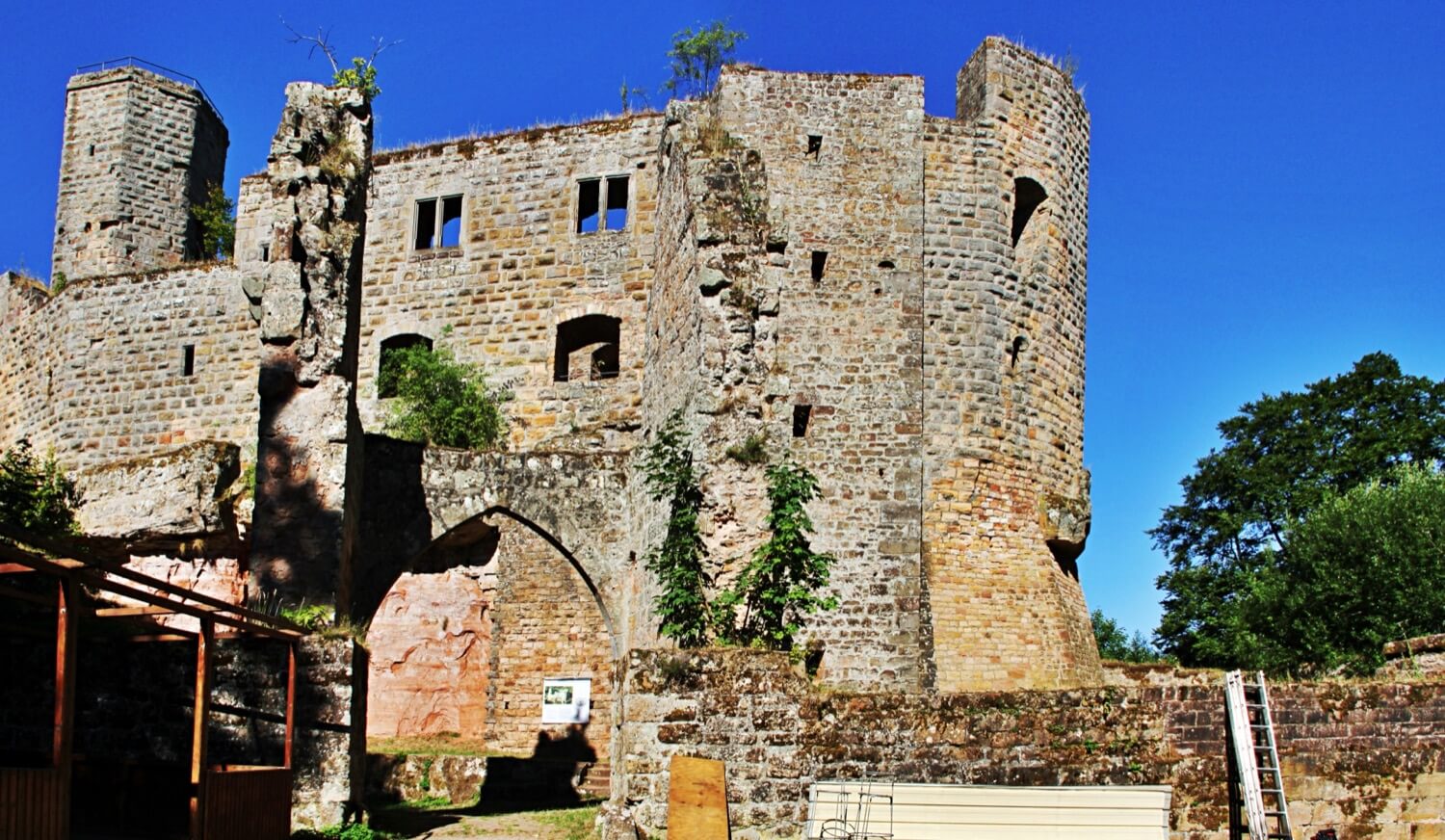
Gräfenstein Castle (German: Burg Gräfenstein) is a ruined rock castle about 2 kilometres (1.2 mi) east of the village of Merzalben in the German state of Rhineland-Palatinate. It is in the county of Südwestpfalz within the Palatine Forest and is often called Merzalber Schloss ("Merzalben Castle"). It is built on a rock plateau 12 metres (39 ft) high at an elevation of 447 metres (1,467 ft) above sea level.
History
Gräfenstein Castle was built by the Saarbrücken counts, who had lost their fortress and were in need of a new one. Evidence for the exact date of the castle's building does not exist although the earliest record dates to a 1237 deed of partition by the counts of Leiningen. But from the castle's design and materials it can be deduced that it was built sometime between 1150 and 1200. Another clue is in the date of the restoration of the stone fortress, which took place in 1168, and coincides with first construction work on Gräfenstein Castle. The central element of the site, with its bergfried and palas probably dates to the 12th century and thus goes back to the Hohenstaufen era. The upper part of the castle was built on a rock shelf 12 metres high. The building's highlight is the peculiar seven-sided tower.
Possession of Gräfenstein was first given to the younger counts of the von Leiningen family. The House of Leiningen was related to the von Saarbrücken counts. The castle was built primarily for protection. It lies on the intersection of the Diocese of Worms, Speyer and Metz. The boundaries of these places were contiguous with that of Gräfenstein's, so the castle's main function was to maintain a hold on the uncertain borders. So was the protection of the surrounding forests and villages.
In 1317 the castle went into the possession of the collateral Leiningen-Dagsburg line. By 1367 they had to sell 7/8 of the estate to Prince Elector, Rupert I of the Palatinate. Through marriage, Gräfenstein went in 1421 to the Counts of Leiningen-Hardenburg. They had the castle expanded, particularly the lower ward.
The castle was first destroyed in 1525 during the German Peasants' War. Rebuilding work began in 1535 and, in 1540, the castle was sold by its owner, Count Palatine Johann von Simmern to the Count Palatine, Rupert, who used it from then on as his new residence and also introduced the Reformation locally. Rupert had been born in 1506 in Zweibrücken and died at Gräfenstein Castle on 28 July 1544.
Thereafter the castle continued to change hands, until in 1570 it was transferred, together with its associated villages, to Badenese ownership (Margraviate of Baden-Baden and Baden-Durlach). In 1635, during the Thirty Years' War, the castle was razed by fire (due to "carelessness on the part of the imperial forces...") and became unusable for a long time. In 1771, when the rule of the Counts of Baden-Baden ended, ownership of the castle passed into the hands of the government of Baden-Durlach. They held the castle until the French Revolution. The castle had at this point reached the crest of its glory, and after that it fell into dereliction.
In spite of that the fortification is relatively well preserved. The first conservation measures on the ruins were carried out in 1909/10 and 1936/37. And from 1978 to 1986 the state of Rhineland-Palatinate had the ruins comprehensively restored at some cost.
Burg Gräfenstein ist die Ruine einer Felsenburg bei Merzalben im rheinland-pfälzischen Landkreis Südwestpfalz. Sie ist eine der bedeutendsten stauferzeitlichen Burganlagen in Rheinland-Pfalz. Ihre Länge beträgt etwa 80 m, ihre Breite etwa 60 m.
Geschichte
Die zentrale Anlage mit Bergfried und Palas stammt vermutlich aus dem 12. Jahrhundert und geht somit auf die Stauferzeit zurück. Erstmals erwähnt wurde Gräfenstein 1237 in einer Teilungsurkunde der Grafen von Leiningen.
1317 kam die Burg in den Besitz der Seitenlinie Leiningen-Dagsburg. Bereits 1367 musste diese 7/8 an Kurfürst Ruprecht I. von der Pfalz verkaufen. Durch Heirat gelangte Gräfenstein 1421 an die Grafen von Leiningen-Hardenburg; diese ließen besonders die Unterburg erweitern.
Die erste Zerstörung erfolgte 1525 im Bauernkrieg; ab 1535 fand der Wiederaufbau statt. 1540 wurde die Burg vom damaligen Besitzer Pfalzgraf Johann von Simmern an den Pfalzgrafen Ruprecht von Pfalz-Veldenz verkauft, der sie fortan als seinen neuen Wohnsitz nutzte und in seinem Hoheitsgebiet auch die Reformation einführte. Ruprecht, der 1506 in Zweibrücken geboren wurde, starb am 28. Juli 1544 auf Burg Gräfenstein.
Danach wechselten die Eigentümer, bis die Burg samt den dazugehörigen Dörfern als Gräfensteiner Land 1570 in badischen Besitz (Markgrafschaft Baden-Baden bzw. Markgrafschaft Baden-Durlach) überging. 1635, während des Dreißigjährigen Kriegs, wurde die Burg bei einem Brand („durch Ohnvorsichtigkeit der kayserlichen Parrtheyen, so darin Posto gefasst“) zur Ruine und war auf Dauer unbewohnbar.
Trotzdem war die Wehranlage noch recht gut erhalten. Erste Sicherungsmaßnahmen an der Ruine fanden 1909/10 und 1936/37 statt. Das Land Rheinland-Pfalz ließ die Burgruine von 1978 bis 1986 umfassend und aufwendig restaurier
Useful information
Gratis
Gratis
- Informationstafeln
- Schöne Aussicht
- Ruinen der Burg
- Für Rollstühle nicht zugänglich
-
Nearby castles
Neudahn Castle
Südwestpfalz
8.7km
castle, chateau
Lemberg Castle
Südwestpfalz
10.2km
castle, chateau
Altdahn Castle
Südwestpfalz
10.6km
castle, chateau
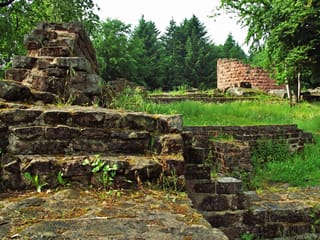
Burg Steinenschloss
Südwestpfalz
11.3km
castle, chateau
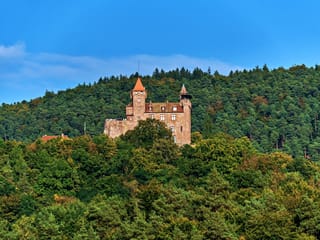
Berwartstein Castle
Südwestpfalz
16.7km
castle, chateau
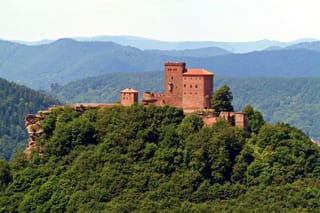
Trifels Castle
Südliche Weinstraße
16.9km
castle, chateau
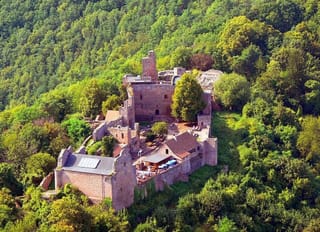
Madenburg Castle
Südliche Weinstraße
20.0km
castle, chateau