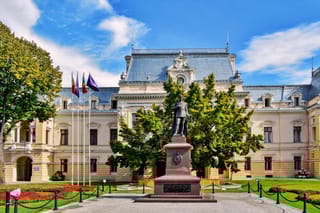
Palace of Culture (Iași)
Zona Metropolitană Iași Județul Iași Romania
manor, mansion
Palatul Culturii din Iași
Zona Metropolitană Iași Județul Iași Romania
manor, mansion
Kultúrpalota (Jászvásár)
Zona Metropolitană Iași Județul Iași Romania
manor, mansion
The Palace of Culture (Romanian: Palatul Culturii) is an edifice located in Iași, Romania
Palatul Culturii din Iași este o clădire emblematică, construită, în perioada 1906 - 1925, în perimetrul fostei curți domnești medievale moldovenești, pe locul fostului palat domnesc
A Kultúrpalota Jászvásár emblematikus épülete
Previous names
Palace of Culture (Iași), Palatul Culturii din Iași, Kultúrpalota (Jászvásár)
Description
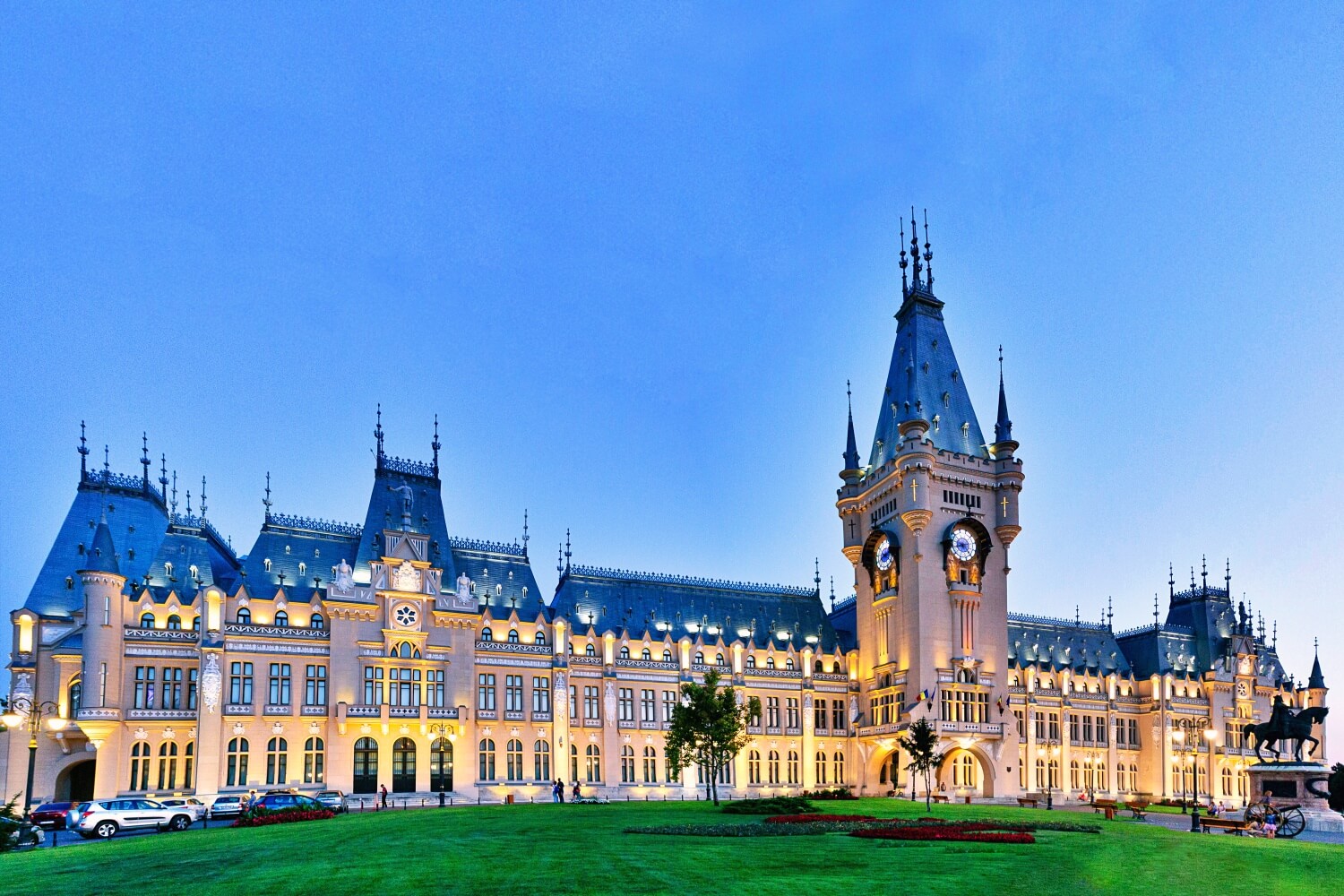
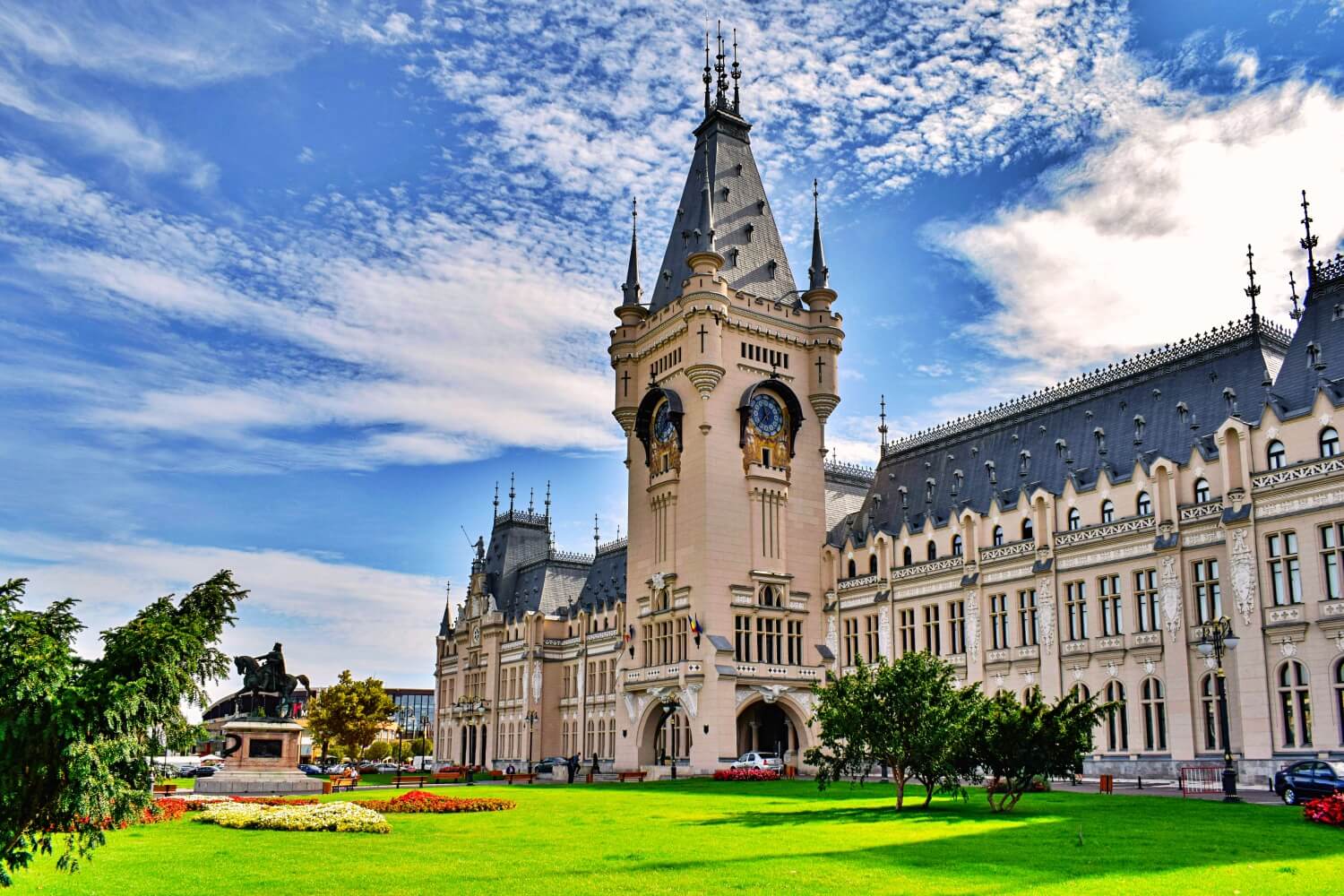
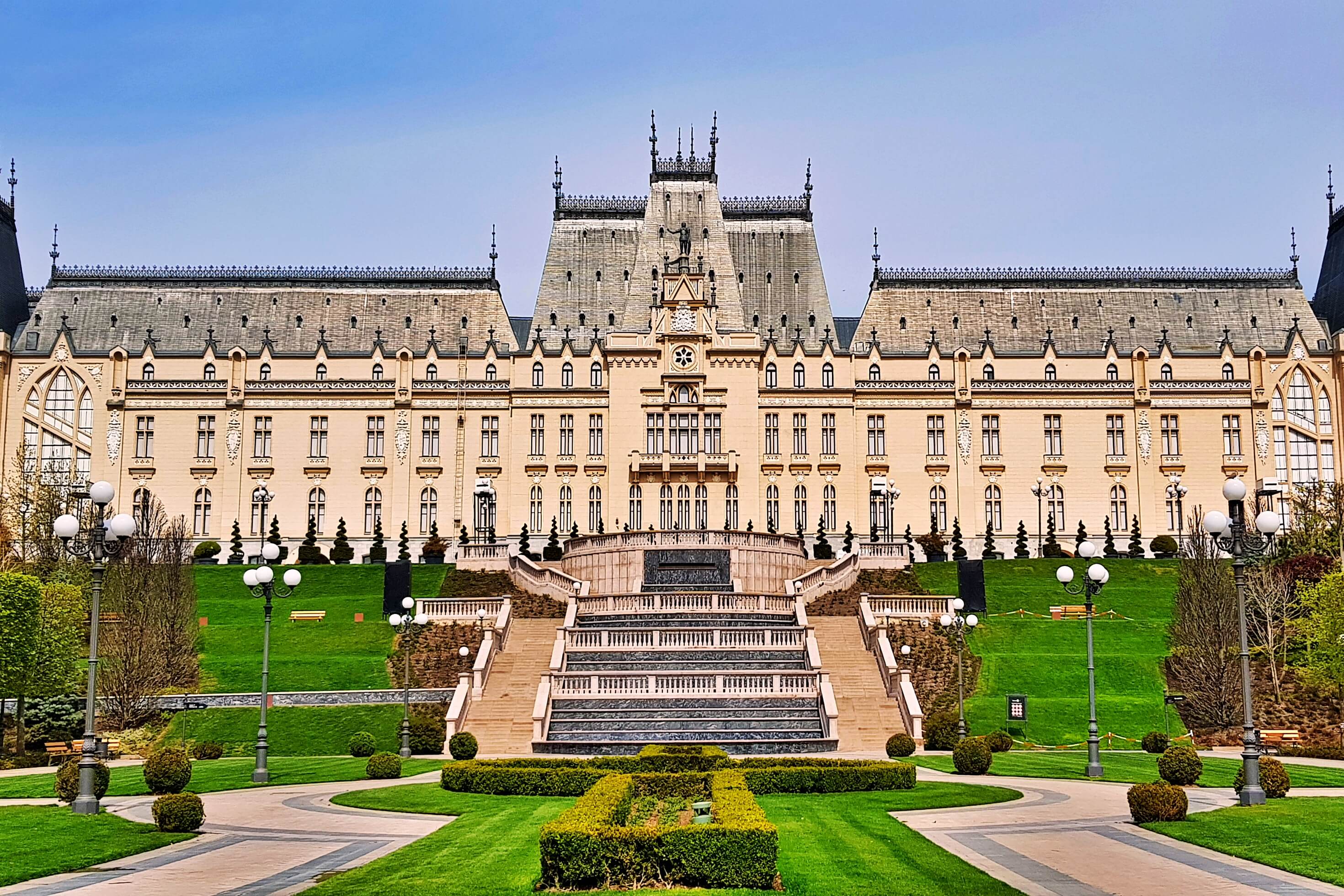
The Palace of Culture (Romanian: Palatul Culturii) is an edifice located in Iași, Romania. The building served as Administrative and Justice Palace until 1955, when its destination was changed, being assigned to the four museums nowadays united under the name of Moldavia National Museum Complex. Also, the building houses the Cultural Heritage Conservation-Restoration Centre, and hosts various exhibitions and other events.
The Palace of Culture is listed in the National Register of Historic Monuments.
History
Located in the perimeter of the mediaeval Princely Court of Moldavia (from 1434), the construction was conceived as a rebuilding and expansion project of the former Princely Palace of Moldavia, dated to the time of Prince Alexandru Moruzi (1803–1806, architect Johan Freywald), and renovated by Prince Mihail Sturdza (1841–1843, architect Nicolae Singurov), from which it preserved the foundations and first two floors. It was from this latter building that the Palace inherited the legend of the 365 rooms, as many as the days within one year.
The Romanian architect I.D. Berindei was assigned to plan and conduct the rebuilding process. Unlike the old palace, built in a neoclassical style, Berindei chose to design it in a flamboyant Neo-Gothic style.
Started in 1906–1907, the reconstruction works were halted during World War I, due to the limitation of resources, but the unfinished building sheltered Romanian and Russian troops, and different public institutions and military hospitals. The monument was finally completed on 11 October 1925, and officially inaugurated one year later, by King Ferdinand I of Romania.
The building housed the County Law Court and other public institutions until 1955, when it received an exclusive cultural function. During World War II, the Palace sheltered German troops, and then, Soviet troops.
In 1975–1977, the wood bridging from the last floor was replaced with a cement one, fixed with steel netting. The new bridging sustained the monument during the earthquake of 1977, but the bridging from the first floor, the walls, the ornaments and the relief works were affected. A large-scale restoration project, considered one of the most complex in Romania since 1990, began in 2008. The main works were completed in April 2016.
Between 1955 and 2010, the Palace of Culture also hosted the main branch of the Iași County Library.
Architecture
The Palace has 298 large rooms with a total area of 34,236 m2 (368,510 sq ft), 92 windows in the front part of the building and another 36 inside the building.
Decoratively, the central hall shows a figurative mosaic including various representations of a gothic bestiary, concentrically arranged: two-headed eagles, dragons, griffons, lions. The hall is superposed by a glass ceiling room, where initially a greenhouse was arranged.
In spite of its archaic-looking design, the Palace was designed so to integrate modern materials and technologies. Thus, the stone blocks were replaced with light and much cheaper materials. Besides, some rooms were decorated using a special material licensed by Henri Coandă, under the name of bois-ciment and imitating the oak wood. Decorative ironmongery elements are also remarkable and they can be admired for instance on the doors of the Voivodes’ Hall. The building was also equipped with high-tech facilities for those times, such as electric lighting, (pneumatic) heating, ventilation system, thermostat, vacuum cleaners, which were all directed from the machinery room, at the underground level. Taking also into account the 14 fires that affected the previous buildings, Berindei (the main architect) treated the wooden structure of the attic with an ignifugeous product called orniton, while for the roof he used a special material, named eternite.
Clock Tower
The entrance of the palace is through a great donjon tower, with crenels and alcoves dominated by an eagle with open wings. The tower is the central architectural piece of the palace. On each of the three exposed sides there is a face of the clock with a diameter of 3.25 m (11 ft). The clock faces are decorated with stained glass representing the 12 astrological signs. Two young men dressed in national costumes, are painted on the sides of the clock faces guarding the clock (design element inspired from the Peleș Castle). The stained glass windows and the cross shaped crenelations are electrically illuminated during the night. The Carillon in the tower has 8 bells that are singing each hour the song "Hora Unirii" with the help of a drum with 69 pins.
Moldova National Museum Complex
The "Moldova" National Museum Complex (Romanian: Complexul Muzeal Național "Moldova") hosts four museums located in the Palace of Culture: Art Museum, Moldavia's History Museum, Ethnographic Museum of Moldavia, and "Ștefan Procopiu" Science and Technique Museum. The Museums also comprise their own stores and libraries, as well as halls for temporary exhibitions.
Art Museum
The Art Museum, founded in 1860, is the oldest and has the largest art collection in Romania, with more than 8,700 works, out of which 1,000 belong to the national and universal patrimony. Located at the first floor of the palace, it has 24 rooms for permanent exhibitions, arranged in three galleries (Universal Art Gallery, Romanian Modern Art Gallery and Contemporary Art Gallery). The galleries contain works by artists such as Caravaggio, Paolo Veronese, Pietro Liberi, Carlo Dolci, Salvator Rosa, Francesco Solimena, Bartolomé Esteban Murillo, Anthony van Dyck, Jan Both, Bartholomeus van der Helst, Egbert van Heemskerk II, Nicolas Poussin, Philippe de Champaigne, Eustache Le Sueur, Guillaume Coustou, François Boucher, and many others.
Moldavia's History Museum
The Moldavia's History Museum was founded in 1916 and offers more than 48,000 objects from various fields: archaeology, numismatics, decorative art, ancient books, documents, etc. One of the oldest items, a 70,000-year-old mammoth skull, is from the Middle Palaeolithic Era. Among other items of significance are pottery from the Cucuteni culture, Dacian, Sarmatian, Gothic, and Roman artifacts, and armory and other items of the Middle Ages. The History Museum is located inside the palace on the ground floor, in the West side, being the continue of the Antiquity Museum founded by Orest Tafrali in 1916. It has four sections, prehistory and ancient history, medieval history, modern history and contemporary history, presenting the main aspects of the development of the communities in the area from the Paleolithic time to the World War II.
The "Union Museum" and "Mihail Kogălniceanu Memorial Museum", in Iași, "Al. I. Cuza Memorial Palace" in Ruginoasa, and the "Archaeological Reserve of Cucuteni", are also coordinated by the Moldavia's History Museum.
Ethnographic Museum of Moldavia
The Ethnographic Museum of Moldavia, founded in 1943, owns more than 13,000 objects depicting the Romanian advance through the ages. The Moldavian Museum of Ethnography is located in the West side of the Palace, at the first and the second floor. One can admire here the objects used by the inhabitants of Moldavia in their every day activities: in agriculture, viticulture, raising animals, fishing, hunting, apiculture. One can also see interiors of peasant houses, devices used for pottery, weaving, wood processing, mask collections, traditional costumes. Many of these exhibits are more than 100 years old.
The museum, also, coordinates the Wine and Vineyard Museum in Hârlău.
Science and Technology Museum
The "Ștefan Procopiu" Science and Technique Museum, with a collection of more than 8,500 objects, was founded in 1955 as the "Polytechnical Museum" and renamed, in 1994, after the physicist Ștefan Procopiu. It is home to Energetics, Sound Recording and Playback (unique within Romania), Telecommunications, Mineralogy - Cristalography, and Computers sections.
The "Poni-Cernătescu" Memorial Museum in Iași, is also under the direct coordination of the Science and Technique Museum.
Other attractions
Besides the four museums, The Palace of Culture presents some other attraction points. One of them is the Gothic Room, where can be admired the mosaic that presents a medieval bestiarum (gryphons, bicephalous eagles, lions). There is also the Voivodes' Room, located at first floor, where there are the portraits of Moldavia's rulers and Romania's kings, starting with Decebalus and Trajan, paintings made by Ștefan Dimitrescu and his students. Then there is "Henri Coandă" Room, which was named after the carvings and relief works made by the famous Romanian inventor of a cement invented by him. On the right there is the Turnul de Strajă (the Watch Tower), reminiscence of the old Princely Court of Iași, along with the galleries underneath the court of the palace. On the left there is a collection of capitals and other stone architectonic elements grouped in a lapidarium. The hall is superposed by a glass ceiling room, where initially a greenhouse was arranged. In front of the palace there is the equestrian statue of Stephen the Great, framed by two Krupp cannons, trophies from the Romanian War of Independence.
Palatul Culturii din Iași este o clădire emblematică, construită, în perioada 1906 - 1925, în perimetrul fostei curți domnești medievale moldovenești, pe locul fostului palat domnesc. Clădirea este înscrisă în Lista monumentelor istorice, având cod LMI IS-II-m-A-03957.01, și din ansamblu mai fac parte și ruinele curții domnești (cod LMI IS-II-m-A-03957.02).
Edificiul a servit inițial drept Palat Administrativ și de Justiție. În anul 1955, destinația clădirii a fost schimbată într-una culturală, devenind gazda unor instituții culturale din Iași.
Astăzi, Palatul Culturii este sediul Complexului Muzeal Național „Moldova”, ce cuprinde Muzeul de Istorie a Moldovei (1916), Muzeul Etnografic al Moldovei (1943), Muzeul de Artă (1860), Muzeul Științei și Tehnicii „Ștefan Procopiu” (1955), precum și Centrul de Conservare-Restaurare a Patrimoniului Cultural (1975). Până la începerea lucrărilor de renovare, în aripa de nord-est a palatului se afla sediul Bibliotecii Județene „Gheorghe Asachi” (1920).
Istorie
De-a lungul timpului, în zona respectivă a orașului s-a dezvoltat ansamblul curții domnești (atestată documentar începând cu 1434). În 1804 - 1806, prințul Alexandru Moruzi a construit un impunător palat domnesc, în stil neoclasic (arhitect Johan Freywald). Afectat de incendii, palatul avea să fie refăcut de prințul Mihail Sturdza, în 1841 - 1843 (arhitect Nicolae Singurov). După Unirea de la 1859 și mutarea capitalei la București (1862), clădirea devine palat administrativ. Un incendiu din 1880 afectează din nou clădirea, aceasta fiind refăcută între 1880-1883. La începutul secolului al XX-lea se ia decizia refacerii în stil nou a întregului palat după un plan care prevede și mărirea suprafeței prin adăugarea de corpuri noi, în scopul creșterii funcționalității clădirii. Primele lucrări ce presupun demantelarea vechiului palat au loc în 1906.
Lucrările de reconstruire și extindere au început în 1907, păstrându-se din vechiul palat principalele temelii, parterul și o parte din zidurile etajului. Noul edificiu a fost realizat în stilul neogotic, după planurile arhitectului Ion D. Berindey, ajutat de arhitecții Filip Xenopol și Grigore Cerchez. Întreruptă în timpul Primului Război Mondial, construcția palatului s-a prelungit pe durata a două decenii. Edificiul, finalizat pe 11 octombrie 1925, a fost inaugurat în anul 1926 de către regele Ferdinand al României.
Descriere
Stilul palatului este neogotic, cu detalii ornamentale, cu elemente heraldice în exterior. Aripile cu ieșindurile semicirculare au fost retrase și împodobite la fronton cu statui de arcași ce stau de strajă, iar pe laterale s-au construit două intrări sub forma unor turnuri boltite. Intrarea în palat se face printr-un turn donjon mare, cu creneluri și firide dominate de o acvilă cu aripile desfăcute. Elemente de interes turistic sunt: „Sala gotică”, unde se poate admira mozaicul ce reprezintă un „bestiarum” medieval (grifoni, acvile bicefale și lei). „Sala Voievozilor” se află la etaj și conține, în medalioane, portretele domnilor Moldovei și ale regilor României. Tot la etajul I se află „Sala Henri Coandă”. La faima Palatului Culturii a contribuit si ceasul cu trei cadrane din turnul cladirii. Avand diametrul de 3,25 m, acestea erau decorate cu mici vitralii, reprezentand cele 12 zodii. Cate doi plaiesi, in costume nationale, zugraviti pe zidul turnului, stau de straja, incadrand ceasornicul, dupa modelul ostenilor pictati la castelul Peles. Atat vitraliile, cat si crenelurile, in forma de cruce ale turnului, erau luminate electric in cursul noptii. Carillonul ceasului este un sistem de clopote acordate, o replica moderna a mecanismelor similare din Evul Mediu Occidental. Cele 8 clopote din turnul palatului reproduc, la fiecare ora exacta, "Hora Unirii", amintind acum nu doar "Unirea cea mica" din 1859, ci si "Unirea cea mare" din 1918. Melodia este inregistrata pe un tambur cu 69 stifturi.
Legenda spune că în proiectul inițial erau prevăzute 365 de camere, dar construcția are 298 încăperi cu o suprafață de aproximativ 36.000 m2. La fațadă sunt 92 ferestre, iar la mansardă alte 36 în ogivă și două rânduri de baghete.
La etajul I, la fațada centrală, se află „Sala Voievozilor”, cu picturi în stilul frescelor medievale din ctitoriile Moldovei, așezate în chenare de epocă. Picturile au fost executate de Ștefan Dimitrescu și de elevii săi. Tot la etajul I se află sala „Henri Coandă”, ale cărei lambriuri au fost executate după un proiect al marelui savant. În amintirea anilor petrecuți la Iași ca elev al Liceului Militar, Coandă a dăruit orașului proiectul „Monumentului Eroilor Români” din cartierul Galata și rețeta unui ciment special, care imită perfect culoarea și sunetul lemnului de stejar.
Până în 1955, aici a fost sediul Tribunalului Județean, dotat cu mobilier confecționat la „Casa Maple” din Londra. Afectat de cutremurul din 1940, Palatul a slujit în timpul celui de-al doilea război mondial drept cazarmă a trupelor germane și ulterior, sovietice. Începând din anul 1975, planșeul de lemn al ultimului etaj a fost înlocuit cu unul de ciment, turnat în plase de oțel, lucrare parțial terminată în martie 1977, când a avut loc cutremurul cel mare. Ca o cheie de boltă, noul planșeu a susținut monumentul, fiind afectate în schimb, planșeele de la etajul I, zidăria, ornamentele și stucaturile.
A Kultúrpalota Jászvásár emblematikus épülete. Ezen a helyen valamikor uradalmi udvarok voltak. Ezek romjaira épült fel 1804-1806 között az Alexandru Moruzi herceg által építetett Uradalmi Palota. A Johan Freywald által tervezett épület 1862-től közigazgatási palotaként működött.
Több tűzvészt és földrengést követően a palotát újjáépítették. Egyes falakat megőrizve I.D. Berindey tervei alapján, 19 évig folytak (1906-1925), és az I. Világháború alatt meg is szakadtak a munkálatok. Az átadást követően megnyílt a Közigazgatási és Igazságügyi Palota.
A kor divatja szerint gondosan, jó ízléssel felépített Bírósági termek mellett a palotában voltak az alkalmazottak lakásai, de még a bírósági elnöké is. Sajnos minden eltűnt 1977 után, amikor az épületből Állami Múzeum lett. A palota főbejárata az 55m magas órás torony alatt van.
A boltíves díszhall pompáját tovább emelik az ólomüveg berakások, A díszítések két periódusban készültek. A kezdeti, 1914-ig jellegzetesen neoklasszikus, I Carolnak nevezik (1866-1914), az I Ferdinand kort (1914-1927) pedig főként a barokk és Art Nouveau stílus jellemzi.
Jelenleg a 298 termes épületben a Moldva Nemzeti Múzeum komplexum működik.
https://www.welcometoromania.eu/
Useful information
3.00 RON/h
52.00 RON
Children, students: 13.00 RON
Seniors: 26.00 RON
0 - 6 years: free
- WC
- Information tables
contact@palatulculturii.ro
- Accessible for wheelchairs
- The Palace includes four museums
- Closed on Mondays
-
-
External links
Nearby castles