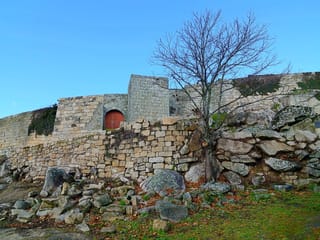
Castle of Penedono
Penedono Viseu Portugal
castle, chateau
Castelo de Penedono
Penedono Viseu Portugal
castle, chateau
The Castle of Penedono (Portuguese: Castelo de Penedono) is a medieval castle located in the civil parish of Penedono e Granja, in the municipality of Penedono, Portuguese district of Viseu
O Castelo de Penedono, também referido como Castelo do Magriço, na Beira Alta, localiza-se na povoação, freguesia e concelho de Penedono, no distrito de Viseu, em Portugal
Previous names
Castle of Penedono, Castelo de Penedono
Description
The Castle of Penedono (Portuguese: Castelo de Penedono) is a medieval castle located in the civil parish of Penedono e Granja, in the municipality of Penedono, Portuguese district of Viseu.
History
The castle of Penedono was one fortresses referred in the donation of D. Flâmula (or Chamôa Rodrigues) to the Monastery of Guimarães (on 11 June 960); it was mentioned part of the properties inherited from her mother, D. Leodegúndia Dias, the daughter of Count Diogo Fernandes and his wife D. Oreca. At the time of testament, the document had recommended the sale of the structure, in order for its monies to be used to help pay the ransom of captives, support pilgrims and assist monasteries. The donation had the effect of securing an important strategic point and organizational linchpin of the Beira Alta Interior region. Nothing is recorded of the original configuration of the redoubt.
The oldest documented records date from the early Christian Reconquest of the area from the Moors; there is a reference to the area being repopulated after the victory of Ramiro II of León over the Moorish forces at the Battle of Simancas, in 939 AD. Penedono remained a border castle for several years, but in 987, it was reconquered by armies of Almanzor. The castle was retaken from the Moors by forces loyal to Ferdinand I of León between 1055 and 1057. The defense of the territory was then entrusted to Rodrigo Tedoniz, who set about the reconstruction of the castle. By 1059, though, it was already in the possession of the Monastery of São Salvador de Guimarães.
In 1195, in order to improve the strategic position of the border territory, King D. Sancho I conceded the region's first Foral (charter) to Pena de Domus, the medieval designation for the burgh. This foral was confirmed in 1217, by King D. Afonso II.
By the end of the 14th century, D. Fernando donated Penedono to Trancoso, whose signeurs wanted to tear down the castle. The senior residents of Penedono petitioned the King to stop this intention and to return the municipality to its status. At that time, Penedono disputed with Trancoso being the birthplace of the legendary knight Magriço.
The castle was partially rebuilt over the existing structures, under the initiative of D. Vasco Fernandes Coutinho, to whom D. Fernando donated the castle. Many of the great men of the town petitioned D. John I to confirm his son, Gonçalo Vasques Coutinho, as the master of the lands, owing to Gonçalo's repeatedly placing his shield men and soldiers in the defence of the castle. The castle was the supposed birthplace of D. Álvaro Gonçalves Coutinho, celebrated by Luís de Camões as o Magriço, one of the legendary twelve knights that went to England to defend the honour of twelve damsels in the Corte of the Lancasters. Between 1471 and 1530, under the authority of D. Francisco Coutinho, Count of Marialva, and responsible for the public works in the Comarca of Beira, the castle was transformed into a residence. A new foral was the issue on 27 November 1512. Through the alcalde, the settlement paid to the Crown 2$970 cruzeiros annually. By 1527, the cadastre for the kingdom indicated that this population included 486 homes.
The 1758 Memórias Paroquiais, included a description of the castle, that was constructed of small stone and mortar.
Visited by Alexandre Herculano, the fortress of Penedono was encountered in ruins at the time and remained until the 20th century. In the 1940s, as part of the commemorations of the 300th anniversary of the Portuguese Restoration, promoted by the Portuguese Estado Novo government, the castle was recuperated and renovated. Between 1940 and 1941, the DGEMN (General Directorate of National Buildings and Monuments) was responsible for excavations and debris involved in the construction of the mixed masonry walls, with lime mortar and sand. In addition, the stairs, landings and pavements were replaced with slabs of masonry. Further work in 1949, the third-floor plan and tower were repaved, there were repairs of the ceilings, installation of new doors and re-landscaping the accessways. Consolidation of the joints and consolidation of the parapets proceeded in 1953, along with arranging the stairs, false ceilings, construction of a granite staircase to connect the adarves and installation of ironwork grades to protect the battlements.
In 1959 the spaces were cleaned and the doors were repaired. It was only in 1966 that the castle was illuminated. Further work was begun in 1969, that included the installation of oak ceilings, passage to the tower, cleaning and removal of weeds along the battlements, walls, merlons, staircases, pavements and accesses, leveling of the floors and substitution of the locks.
In 1972, there was a study of the castle and its surroundings.
Various projects began in 1983, to consolidate and repair the barbican and walls of the castle, that included covering holes in the granite, mortaring cracks and joints, repairing the pyramidal merlons, support beams, the iron staircase and complimentary handrail. The spaces were also repainted.
A risk analysis by the DGEMN was undertaken at the castle in October 2005.
Architecture
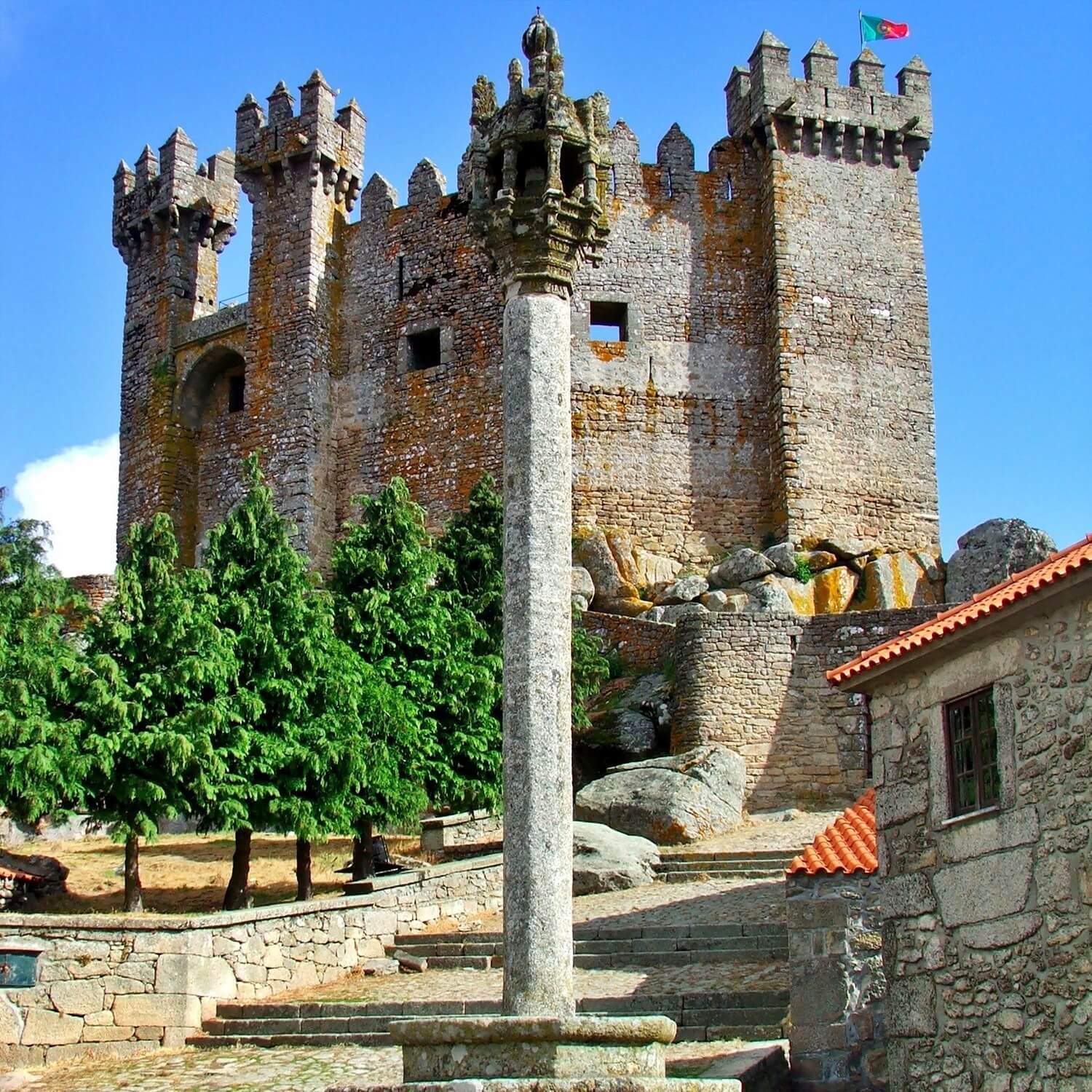
The castle is situated in an isolate, urban area, implanted on a 930 metres (3,050 ft) rocky, hilltop and granite range that is part of the Serra de Serigo. The landscape is accessible by a frontal square by large granite landings and staircase and urbanized portions of Penedono that extend to the south and west. The square allows access to the town pillory and the old building of the municipal council (Portuguese: Antiga Casa da Câmara).
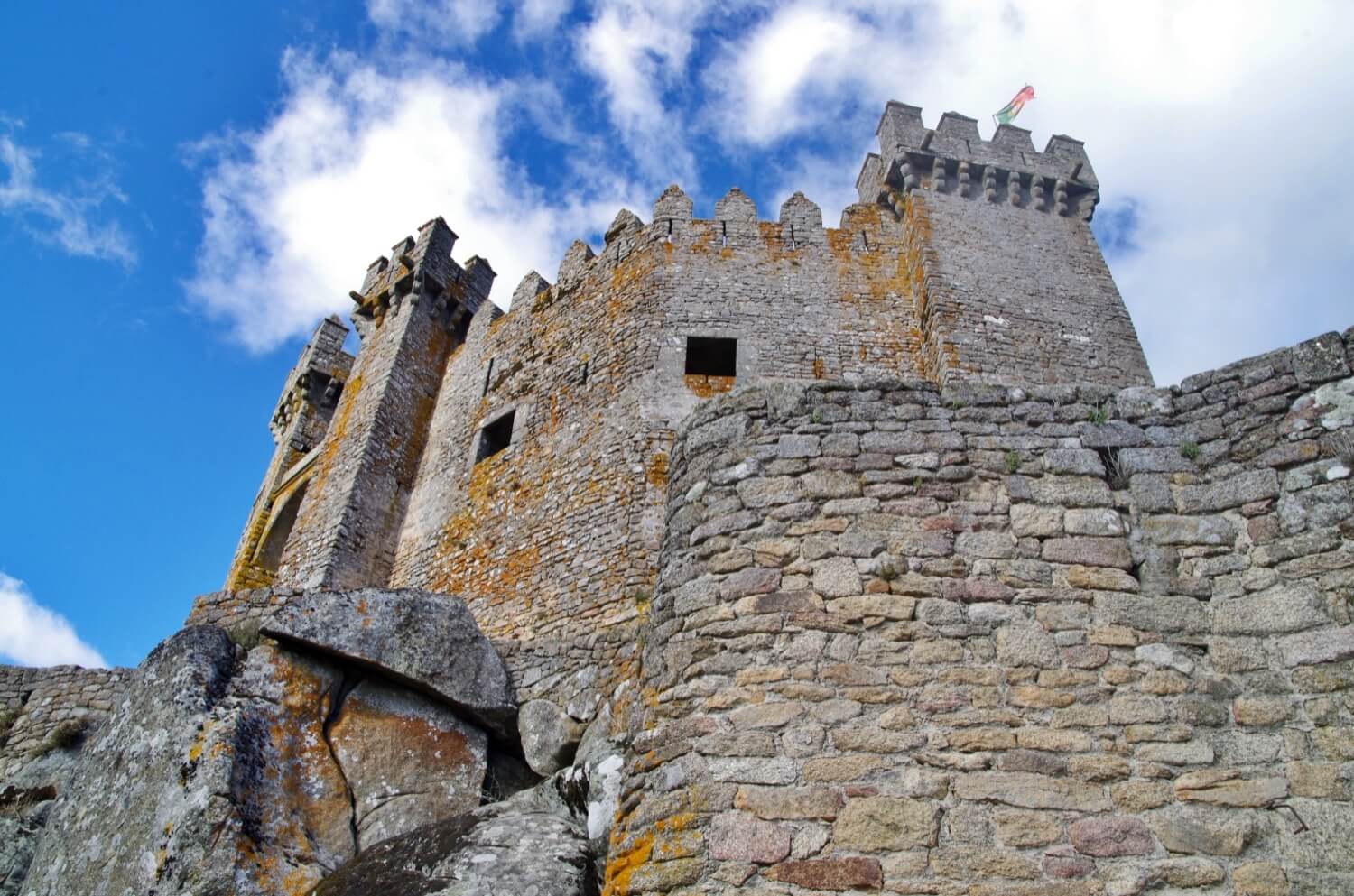
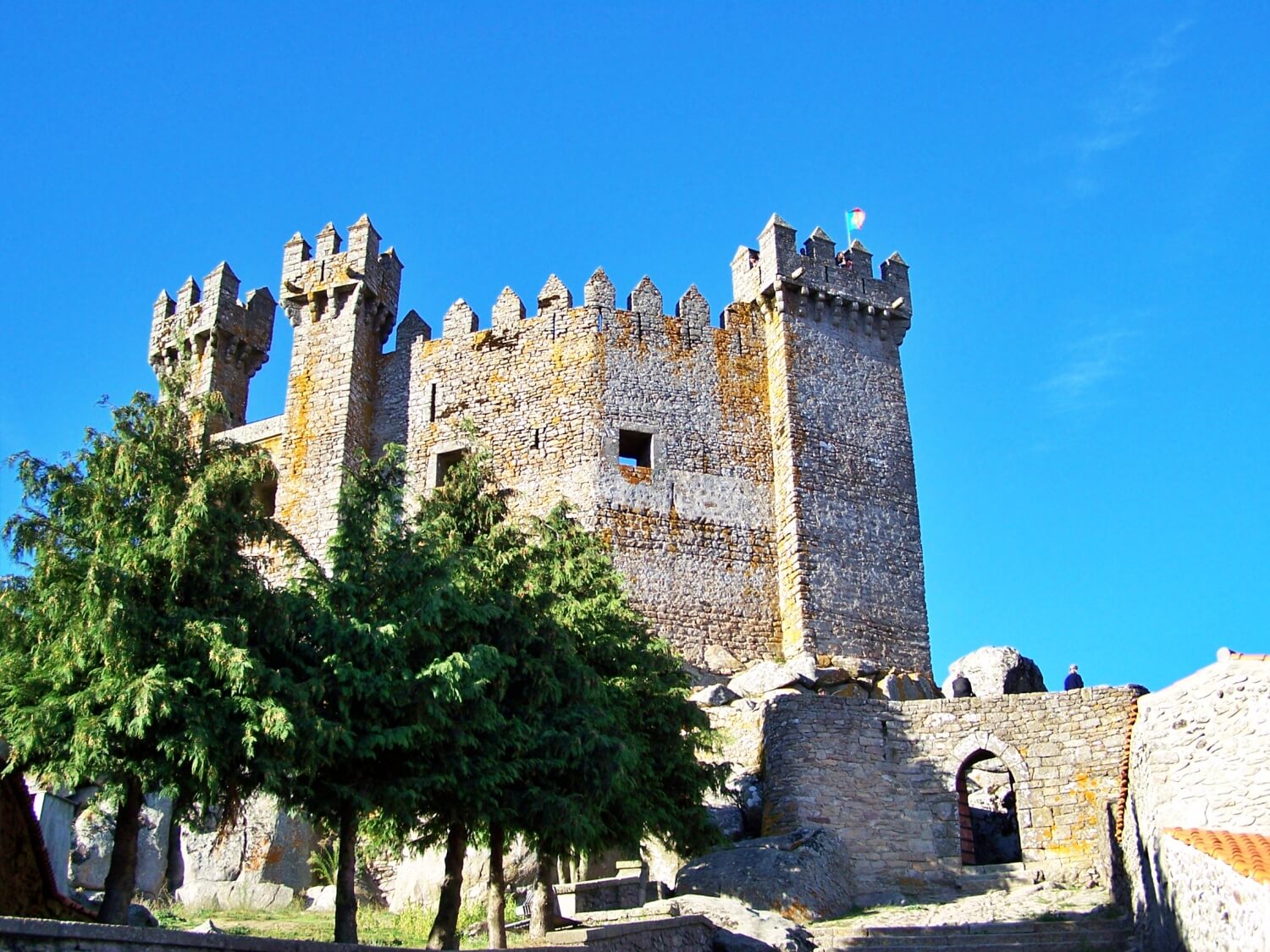
The polygonal plan forms an irregular heptagon, with a 70 metres (230 ft) perimeter, encircled by an undecorated, low barbican that accompanies the same elevation of the rocky hilltop. It is only broken to the southwest, by the irregular staircase and landing leading to the two slender towers at its entrance. To the right of the gate is a small, isolated line of walls. The castle's walls are crowned along its perimeter by parallelpetic merlons with pyramidal tops, some with the arrowslits, and reinforced on its corners by five rectangular corners. Situated along irregular intervals are balconies with micholletes and gargoyles, in addition to arrowslits.Between the two towers to the southwest, is a walkway with guardrail over the cornice, supporting a large arch over which is a rounded doorway (accessible by a flight of curved staircase) surmounted by a framed tympanum. The remaining walls are broken by rectangular arrowslits and fenestrations.
Within the walls are vestiges of the Alcazaba that include stairs that lead to the battlements that encircle the walls and tower landings. Some of the windows, with different cutouts, that suggests the existence of an intermediate floor. In the largest tower is a domed vault with rectangular window, in front of which is a polygonal cistern with a covered cross vault. At the beginning of the battlements are vestiges of primitive constructions.
O Castelo de Penedono, também referido como Castelo do Magriço, na Beira Alta, localiza-se na povoação, freguesia e concelho de Penedono, no distrito de Viseu, em Portugal.
Em posição dominante sobre a povoação, esta pequena estrutura medieval constitui-se em um misto de fortificação defensiva e residência senhorial.
História
Antecedentes
A ocupação humana do seu sítio certamente remonta a época pré-romana, embora não seja possível afirmá-lo com exatidão.
O castelo medieval
As fontes documentais mais antigas mencionam esta área apenas à época da Reconquista cristã da Península Ibérica aos mouros, a propósito do repovoamento da região após a vitória das forças de Ramiro II de Leão na batalha de Simancas (939). A defesa desta parte do território foi confiada a Rodrigo Tedoniz, marido de Leodegúndia (irmã de Mumadona Dias) com quem gerou D. Flâmula (ou Chamoa Rodrigues). Rodrigo viria a ser alcaide dos castelos do soberano e, nessa função, teria determinado a reedificação do Castelo de Penedono. Posteriormente, em 998 da Era Hispânica (960 da Era Cristã), Chamoa Rodrigues, achando-se gravemente enferma, fez-se conduzir ao Mosteiro de Guimarães, instituindo como testamenteira a sua tia Mumadona, com o encargo de dispor de seus bens para fins de beneficência. Entre eles, incluía-se uma série de castelos e respectivas gentes (penellas et populaturas) na fronteira da Beira Alta, entre os quais este, de Penela.
Durante o século XI, ao sabor dos avanços e recuos das fronteiras cristãs, Penedono e o seu castelo mudaram de mãos em diversas ocasiões. A sua reconquista definitiva deveu-se à ação do rei leonês Fernando Magno (1064). Um inventário dos bens do Mosteiro de Guimarães, lavrado em 1095, relaciona o Castelo de Penedono entre outros bens anteriormente legados por D. Chamoa. Com a emancipação política de Portugal, os seus domínios passaram a integrar os da jovem nação. D. Sancho I (1185-1211), ante a situação estratégica de Penedono, próxima à linha fronteiriça, incentivou o repovoamento dessas terras através de Foral (1195), ao mesmo tempo em que determinava a reconstrução das suas defesas. O seu sucessor, D. Afonso II (1211-1223) confirmou-lhe o foral em 1217. A povoação e o seu castelo também tiveram a atenção de D. Dinis (1279-1325), que lhe determinou reforços na defesa.
A atual configuração do castelo remonta aos fins do século XIV, quando D. Fernando (1367-1383) incluiu a povoação no termo de Trancoso. Diante da intenção da edilidade de arrasar o Castelo de Penedono, os homens-bons desta vila insurgiram-se, logrando a sua autonomia. Esses domínios foram então doados a D. Vasco Fernandes Coutinho (Marialva), senhor do couto de Leomil, que fez reconstruir o castelo.
No contexto da crise de 1383-1385, tendo falecido na Primavera de 1384 o alcaide de Penedono, Vasco Fernandes Coutinho, sucedeu-o na função o seu filho, Gonçalo Vasques Coutinho. Leal ao partido do Mestre de Avis, foi-lhe confiado, no início de 1385 o encargo de chefiar as forças do Porto que conquistaram o Castelo da Feira. Posteriormente, distinguiu-se, por mérito, na batalha de Trancoso (Maio de 1385), o que lhe valeu a promoção ao posto de marechal. Acredita-se que, no Castelo de Penedono.
Os descendente do conde de Marialva mantiveram interesses no Castelo de Penedono, a saber: D. Gonçalo Coutinho, que herdou o título condal, e D. Fernando Coutinho, ambos integrantes da segunda expedição a Tânger (1464), onde o primeiro perdeu a vida; os seus netos, D. João Coutinho, 3º conde de Marialva, e D. Francisco Coutinho, 4º Conde de Marialva por sucessão de seu irmão, falecido sem descendência, ambos integrantes da expedição que conquistou Arzila (1471), que ao primeiro custou a vida.
Sob o reinado de D. Manuel I (1495-1521), a vila recebeu o Foral Novo (1512), o que atesta a sua importância à época. Foram realizadas, nesta conjuntura, novas obras no castelo, para o que terá contribuído a influência do 4º conde de Marialva, vedor das obras reais na Beira, cuja filha única, D. Guiomar Coutinho, desposou o infante D. Fernando. Falecendo o conde sem descendência, e sua filha, dois anos depois, também sem descendência, extinguiu-se a família Coutinho.
Do século XVII aos nossos dias
Os domínios de Penedono e seu castelo são referidos, no século XVII, associados aos Lacerda, que então usavam honoríficamente o título de seus alcaides-mores.
O castelo foi visitado por Alexandre Herculano em 1812, que o descreve, à época, como já em ruínas.
No século XX, foi classificado como Monumento Nacional por Decreto publicado em 23 de Junho de 1910.
Em 1940, no âmbito das comemorações dos Centenários, promovidas pelo Estado Novo português, o castelo foi alvo de intervenções de consolidação e restauro de panos de muralhas e de torres, parcialmente reconstruídos, a cargo da Direcção Geral dos Edifícios e Monumentos Nacionais. Novos trabalhos tiveram lugar em 1943 e em 1953, permitindo que o conjunto chegasse até aos nossos dias relativamente bem conservado, mas ainda carecendo de obras em seu interior.
Características
Na cota de 930 metros acima do nível do mar, nada sabemos de suas primitivas configurações. O atual castelo, de pequenas dimensões (com perímetro externo de cerca de 70 metros), data do final do século XIV, com complementos datando da passagem do século XV para o XVI.
Com a função de Solar, apresenta planta hexagonal irregular, com os panos laterais de muralhas ressaltados e protegidos por ameias piramidais. Em pedra de granito e xisto, no setor noroeste, a muralha é reforçada por um cubelo defensivo. Dois outros robustos torreões prismáticos, com contrafortes e mísulas, são coroados por ameias piramidais. No setor sudoeste da muralha destacam-se dois torreões esguios, coroados de ameias piramidais reentrantes, ladeando e protegendo a porta principal do castelo, encimada por um arco pleno que une ambos os torreões defensivos. Por esta acede-se a praça de armas, de pequenas dimensões. Nas suas paredes, observam-se os vestígios das bases do travejamento de madeira dos pisos residenciais, sendo as paredes rasgadas por janelas quadradas ladeadas por bancos de pedra. Num dos ângulos da praças de armas, sob a torre de menagem, inscreve-se a cisterna, de seção poligonal, recoberta por abóbada em cruzaria de ogivas.
O conjunto é completado por uma pequena barbacã, cuja cortina é rasgada por uma porta em arco ogival e pelo adarve.
Useful information
Free
Free
- Great view
- Information tables
geral@cm-penedono.pt
Restored ruins of the castle
-
External links
Nearby castles
Torre do Relógio (Mêda)
Mêda
11.3km
castle, chateau
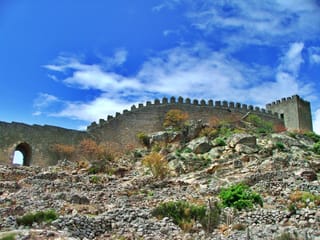
Castle of Numão
Guarda
14.9km
castle, chateau
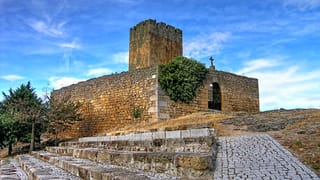
Castelo de Longroiva
Santa Comba
15.8km
castle, chateau
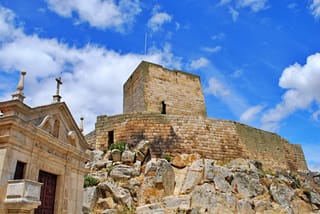
Castelo de Marialva
Santa Comba
16.0km
castle, chateau
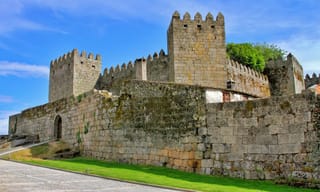
Castelo de Trancoso
Trancoso
23.8km
castle, chateau
Castle of Carrazeda de Ansiães
Lavandeira
24.8km
castle, chateau