Castle of Mogadouro
Mogadouro Bragança Portugal
castle, chateau
Castelo de Mogadouro
Mogadouro Bragança Portugal
castle, chateau
The Castle of Mogadouro (Portuguese: Castelo de Mogadouro) is a medieval castle located in the civil parish of Mogadouro, Valverde, Vale de Porco e Vilar de Rei, in the municipality of Mogadouro, Portuguese district of Bragança
O Castelo de Mogadouro, em Trás-os-Montes, localiza-se na freguesia, povoação e concelho de Mogadouro, no distrito de Bragança, em Portugal
Previous names
Castle of Mogadouro, Castelo de Mogadouro
Description
The Castle of Mogadouro (Portuguese: Castelo de Mogadouro) is a medieval castle located in the civil parish of Mogadouro, Valverde, Vale de Porco e Vilar de Rei, in the municipality of Mogadouro, Portuguese district of Bragança.
History
The castle was constructed between 1160 and 1165, in an area then occupied by a small residential nucleus.
Mogadouro was referred in documents associated with its donation by the Braganção (resident from Bragança) Fernão Mendes to the Knights Templars in 1186. During this period of the Iberian Peninsula Reconquista, the region of Miranda was the scene of numerous battles, that involved settlements in Mogadouro, Algoso, Miranda do Douro, Outeiro de Miranda and Vimioso (which marked the Christian defensive line in northeastern Portugal).
In 1197, the region was traded by King D. Sancho I (along with Penas Róias) for Idanha: the monarch became the principal patron of the region's churches by 1199. Yet, the region transferred back to the Knights Templar in 1223, although patronage of the ecclesiastical orders continued to come from the monarch.
On 27 December 1272, King D. Afonso III conceded a foral (charter) to the settlements of Mogadouro and Penas Róias (which was updated a year later), aiming to increase the settlement and defense of the region. São Mamede de Mogadouro continued to function as signeurial fiefdom of the Templars, which transformed it into a commandery, and subsequently elevated it to priory. Consolidation of the religious orders resulted in the 1319 transfer of settlement to the Order of Christ. Throughout this century the castle was expanded and walls reinforced.
During the Dynastic Crisis in 1383, Mogadouro aligned with Castile.
By 1433, it was donated to Álvaro Pires de Távora, whose father had been the alcaide of the castle.
King D. John II visited the settlement in the autumn of 1483 (as referred in the Crónica de Rui de Pina). Transiting the region during a trip between Lamego to Vila Real (en route to Bragança), he stopped in Port and visited places along the Trás-os-Montes and Resende (as recorded by Rui de Pina), when he ordered repairs to the site.
In 1507, the O Tombo da Comenda of the Order of Christ described the residence as a "house that was once the resting place for the prior and now Álvaro Pires de Távora's stable, while to the east and west are houses of said Álvaro Pires, to the north the wall and to the south part of the courtyard of the said castle. It is one-storey and from four-and-a-half long varas to measure the cloth and other so many of wide."
Between 1509 and 1510, Duarte D'Armas designed the castle in his Book of Fortresses, which he represented with an elliptical irregular barbican, crowned with merlons, except "a barrier without crenels toppled to the ground and the inside wall", addorsed in the corner by a small rectangular tower. This tower was only in the early stages of construction. At the time, the castle was an irregular polygon, with two towers in the north, one pentagonal and the other rectangular, with a semi-circular corbel. Within the structure was a military square with two ruined buildings and 11 chambers, rectangular and trapezoidal, a few with roof and cylindrical chimneys. In addition, there was a rectangular keep tower, with arrow-slits, that was built over cliffs, addorsed by residence of the Paço dos Távoras (consisting of three rectangular spaces of different heights). The one alongside the keep was the shortest, and included a full arch and four rectangular windows; the space, taller, included two-floors illuminated by arched windows with wooden balcony and topped by merlons; and the final, slightly shorter, included full-arch windows on the first floor and rectangular windows on the second-floor, surmounted by merlons. Access to the fortress was made by means of stairs at right angle, under which is a passage military square, with a circular well. Outside the walls, to addorsed to the east is a rabbit shed attached to the barbican, and from the same location extended the town, with its pillory. Opposite the houses on the outskirts of the village, was a church with steeple next to the barbican, and further away, a cross and five houses with cultivated lands.
A new foral was issued in 1512 by D. Manuel (1495-1521), as the Távoras expanded their role in the defense of the Trás-os-Montes Province, until the end of the 17th century (at the time of the Portuguese Restoration War). In the 17th century a clock tower was constructed.
Engravings and sketches from the 18th century, described the "Palace, that they call a castle". But, in the second half of the 18th century, following the tragic fate of the Távoras, and the loss of its defensive role, the castle was gradually abandoned, falling into ruins.
The first major work to repair the site began in 1950 that concentrated on the walls and tower under the direction of the DGMEN Direcção Geral dos Edifícios e Monumentos Nacionais (General-Directorate on Buildings and National Monuments). In the following years there was work leveling the ground, re-construction of the tower wall. During this period, there was surveys of the land around the site. Subsequent years (1957-1959) included restoration of the walls, the keep tower and consolidation of the foundations, that included cleaning and landscaping.
During the 1990s, the tower was vandalized, resulting in the destruction of the handrail and the entranceway, as well as the archaeological artefacts warehoused onsite. As a consequence, the property began to be administered by the Instituto Português do Património Arquitetónico on 1 June 1992, (under Decree 106F/92, Diário da República, Série 1A, 126). In 1993, during one of the worst winters, the clock tower was damaged.
Architecture
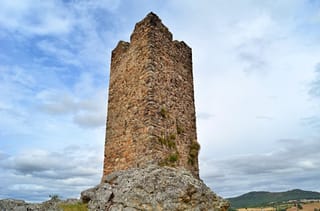
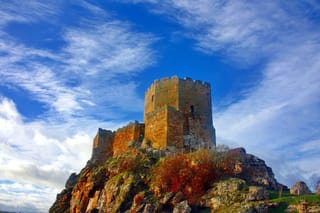
The remnants of the castle are implanted on a hilltop of rocks and cliff, with a view of the Serra de Mogadouro to the south. Alongside are the Torre do Relógio (Clock tower of Mogadouro), a palace/residence in ruins, the Chapel of the Misericórdia, pillory and section of the stations of the cross.
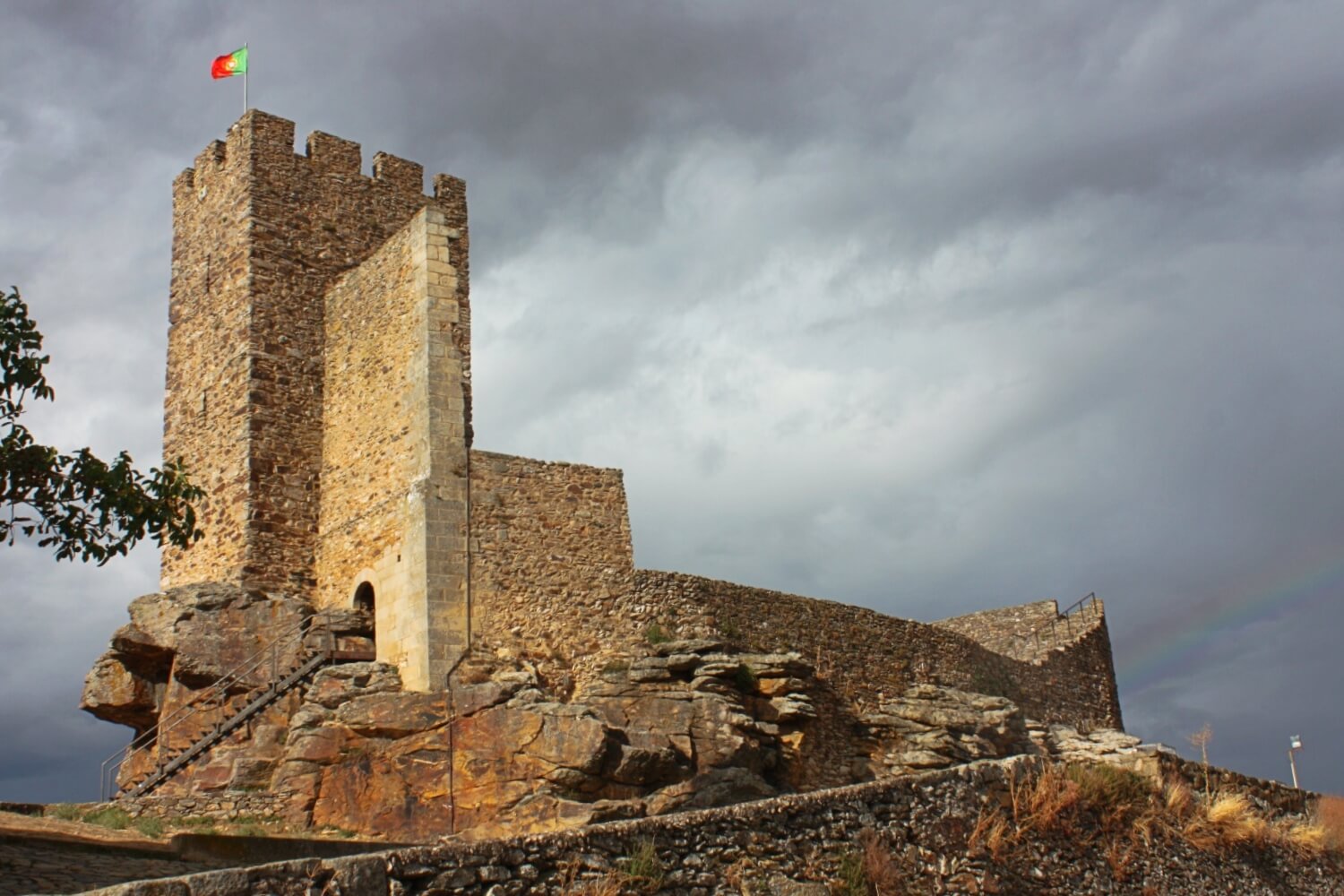
The castle structure includes a few lines of walls, the rectangular keep tower addorsed in the southeast by a line of walls, the former-castle residence and corner wall, accessed from an arch, and another line of walls that connects the residence to a small trapezoidal tower.
The keep tower was erected over a rocky hilltop, and included two arched doors in the northeast and southeast, accessible from two flights of stairs and landing. In the northwest, is a rectangular window with grade, surmounted by an arrow-slit and in the southwest by two slits on both registers. Along the western part of the tower is a rectangular cistern, while to the southeast are remnants of the former-barbican.
O Castelo de Mogadouro, em Trás-os-Montes, localiza-se na freguesia, povoação e concelho de Mogadouro, no distrito de Bragança, em Portugal.
Na vertente norte da serra de Mogadouro, a antiga vila e seu castelo constituíram, nos alvores da nacionalidade, um importante ponto estratégico sobre a linha lindeira. Comenda da Ordem dos Templários, posteriormente sucedida pela Ordem de Cristo, atualmente inclui-se na Área Turístico-Promocional das Montanhas.
História
Antecedentes
A primitiva ocupação de seu sítio remonta a um castro pré-histórico, que se acredita posteriormente romanizado. A região apresenta ainda vestígios da ocupação dos Visigodos, sucedidos, a partir do século VIII pelos Muçulmanos, que, na opinião de alguns estudiosos, lhe legaram a toponímia. Por aqui passava então uma via secundária, cruzando a região de Norte a Sul, ligando-a à atual Astorga (a chamada Estrada Mourisca).
O castelo medieval
A época da Reconquista cristã da Península Ibérica, e desde a fundação da nacionalidade portuguesa, a região de Miranda do Douro foi palco de numerosas batalhas, vindo os castelos de Mogadouro e Penas Róias, juntamente com os de Algoso, Miranda do Douro, Outeiro de Miranda e Vimioso a integrar a primeira linha de defesa do Nordeste de Portugal, controlando a antiga Estrada Mourisca.
A constituição do reino de Portugal havia determinado a defesa ativa da capital, Coimbra. Para essa tarefa, D. Afonso Henriques (1112-1185) recorreu aos cavaleiros da Ordem dos Templários, a quem incumbiu da proteção dos acessos a Sul e a Leste do rio Mondego. Para esse fim, em 1145, a Ordem recebeu os domínios de várias localidades transmontanas, como Mogadouro e Penas Róias. Anos depois, o seu património fundiário estendeu-se à Beira Baixa, com a doação de Idanha-a-Velha e Monsanto.
O Castelo de Mogadouro foi erguido neste contexto, de 1160 a 1165. Visando incrementar o povoamento e defesa da região, o rei D. Afonso III (1248-1279) passou Carta de Foral à vila (27 de Dezembro de 1272), título confirmado no ano seguinte (Santarém, 18 de Dezembro de 1273), ampliado com algumas disposições e então comum a Penas Róias.
São Mamede de Mogadouro constituía-se numa comenda dos Templários e, nessa época, foi elevada à categoria de priorado da Ordem. Em 1311, diante da extinção da Ordem, os seus domínios (e esta comenda) passaram para a Ordem de Cristo.
Acredita-se que tenha sido objeto de reparos no reinado de D. João II (1481-1495), que o pode ter conhecido de passagem, no Outono de 1483, em trânsito de Lamego a Vila Real e Bragança, recolhendo ao Porto após ter visitado alguns outros lugares de Trás-os-Montes, como registrado por Rui de Pina e por Resende; sendo assim, o Castelo de Mogadouro não deixaria de ser um daqueles cujo reparo o mesmo monarca fez anos depois encomendado a Cristóvão de Baião, cavaleiro da Casa Real.
A vila e seu castelo encontram-se figurados por Duarte de Armas (Livro das Fortalezas, c. 1509), quando se encontrava bem conservado. Data desse período, em 1512, o Foral Novo, concedido por D. Manuel (1495-1521), sendo alcaides-mores a Casa Távora, que desde o século XV fizeram edificar um soberbo palácio, vindo a assumir importante papel na defesa de Trás-os-Montes ao final do século XVII, durante a Guerra da Restauração de independência portuguesa.
Na segunda metade do século XVIII, diante do trágico destino dos Távoras, que eram os seus senhores e alcaides, e com a perda da função defensiva, o castelo foi progressivamente abandonado, caindo em ruínas.
Do século XX aos nossos dias
O castelo foi classificado como Monumento Nacional por Decreto publicado em 2 de Janeiro de 1946. A intervenção do poder público fez-se sentir a partir de 1950, pela ação da DGEMN, na consolidação e reparos da torre de menagem e dos restos das muralhas, além de diversos serviços de limpeza, restauração, reconstrução, conservação e beneficiação. Em nossos dias, um ataque de vandalismo acarretou a destruição do corrimão de acesso à torre, sua porta, e material arqueológico em exposição em seu interior.
Características
Exemplo característico da arquitectura militar medieval, em xisto argamassado com barro, conservam-se dois panos de muralha, ligando um deles a torre de menagem a um cubelo.
A torre apresenta planta quadrangular, em aparelho incertum. Vizinha a esta, uma outra torre de construção mais recente, também de planta quadrada, a torre do relógio, ergue-se apresentando cantaria nos vértices e aparelho incertum a meio. No alçado Sul está gravado um relógio de Sol. É dividida internamente em três pavimentos, o último preparado para receber sinos, rematado em pirâmide. É encimada, nos vértices, por quatro pináculos de granito.
Um pouco mais abaixo vêm-se os restos da cintura de muralhas da vila.
Useful information
Free
Free
- Panoramic view
- Walking trails
Ruins of the castle
-
Nearby castles