Castle of Algoso
Izeda Bragança District Portugal
castle, chateau
Castelo de Algoso
Izeda Bragança District Portugal
castle, chateau
The Castle of Algoso (Portuguese: Castelo de Algoso) is a medieval castle in the civil parish of Algoso, Campo de Víboras e Uva, municipality of Vimioso, in the Portuguese district of Bragança
O Castelo de Algoso localiza-se ao sul da freguesia e povoação de Algoso, no concelho de Vimioso, distrito de Bragança, em Portugal
Previous names
Castle of Algoso, Castelo de Algoso
Description
The Castle of Algoso (Portuguese: Castelo de Algoso) is a medieval castle in the civil parish of Algoso, Campo de Víboras e Uva, municipality of Vimioso, in the Portuguese district of Bragança. The castle of Algoso is one of the most important medieval fortifications in the eastern Trás-os-montes, related with the battles of Leonese succession, the tentative policies of the independent Portuguese monarch and the important religious commandery of the Knights Hospitaller that established their roots in 1224.
History
Archaeological excavations permit conclusions associated with early settlement before the Middle Ages, there existed a castle on the current site, that supported various settlements, identified with the Chalcolithic period (that include Bronze Age moulds), proto-historic and Roman (such as the discovery of ceramics associated with a period of non-military settlement).
Medieval
During the Christian Reconquista, the primitive frontier of the County of Portugal with the Kingdom of León extended along the left bank of the Sabor River, to its confluence with the Angueira River. This link was watched by various sentinel outposts: the Castle of Milhão, the Castle of Santulhão (both today long disappeared), the Castle of Outeiro de Miranda (in ruins) and in the eastern edge, the Castle of Algoso. The remainder of the principal defense occurred in the northwest, across the protector of the Castles of Penas Róias, Mogadouro and Bragança. Sometime during the 12th century, D. Mendo Rufino (or Bofino), master of the lands of "Ulgoso" by donation of D. Afonso Henriques, ordered the construction of a fortress, in order to watch and guard the frontier with the Kingdom of León. From information during the 1258 Inquirições, Mendo Rufino (who was one of the supporters of Afonso Henriques against D. Teresa) constructed the castle in exchange for the village of Vimioso. During this period of uncertainty that is the transition between Afonso Henriques reign as first Portuguese monarch, and the exercise of regal power by Sancho I, the castle became an important link with loyal nobility, which had ties to the corte of León, but harboured loyalties with the Portuguese. As the "head" of the Terra da Miranda, Algoso was an important fortress; a "nuclear point of support with the regal authority" in this peripheric region.
Unfortunately, little remains of the early construction, although it assumed that the castle was built on the Romanesque principals of the time, that included a keep tower surrounded by a walled fortification and battlements. Yet, little remains to suggest that was the case, since no archaeological surveys are related with this period, and that many of the 12th century fragments may have been swept away by events in the subsequent years. Between the 12th and 13th century, the alcaide offered the castle to King D. Sancho I, who compensated his captain, by offering him the title of master of Vimioso, which was conferred on Mendo Rufino. The King planned of transforming Algoso into the centre of his vast territory, encompassing the area of Miranda do Douro and Penas Róias. But, between 1212 and 1213, the lands were invaded by troops loyal to the King of León, Alfonso IX, as a reprisal for the contestation of the Portuguese King against the donations of his sisters. Following a period of turmoil, in 1219, peace was brokered between the Kingdoms of León and Portugal.
In April 1224, the primitive structure was radically altered. That year (or just before it) the castle was donated by King Sancho II to the Knights Hospitaller, after a long period of war with the Kingdom of León. At that time, the expansion of regal authority in the Trás-os-Montes Province privileged the creation of new towns, of an urban character, and relegating the existing castles into defensive military structures that expressed regal authority in the lands of Miranda and Pena Roias. The castle with "all its terms and belongings" were extended, therefore, to prior D. Rui Pais and his "successors, brother monks". The town and municipality of Ylgoso, Ulgoso ou São Sebastião de Algoso, was part of the bishopric and district of Bragança. In 1230, the Knights Templar and the Knights Hospitaller came to a concordat in Coimbra, over various lands held between them, including Ylgoso (Algoso), Vila Chã, Atenor, Penas Róias, Paradela and others, outside the bishopric of Bragança. On 22 June 1239, D. Pedro Costem, commander of the Order of the Temple established his commandery of Mogadouro and Pena Roias, that included Algoso. But, later, on 13 February 1291, King D. Dinis (1279-1325) reestablished in Coimbra, that D. Fernão Peres (o Mossejo), would hold the commandery of Algoso and other lands within its range. These changes had an effect on the annual rents paid by their commander: between 7000 and 8000 cruzados, including products from the abbeys of Travanca, Sendim, Vilar Seco, Duas Igrejas and Guide. The castle, therefore, became a focus of a primitive church, dedicated to Nossa Senhora da Assunção(Our Lady of the Assumption), but became known as Our Lady of the Castle by peasantry and gentry.
In the hands of the Hospitaller monks, the castle was transformed into a Gothic fortress, characterized by an active defense policy. During this period the heptagonal keep tower was constructed, in order to better resist attacks and providing a more adequate availability of angles to inflict damage on aggressors. This included vertical attacks, with the existence of machicolations over the entranceway and that served as the residence of the commander.
During the 1258 Inquirições, the castle was referenced as in a donation to the Knights Hospitaller, by name of D. Afonso Henriques or D. Sancho II.
The commander of the Order, Father Pedro Lourenço, in 1291, appeared in a dispute between the King (then D. Dinis) and the Knights Hospitaller; in this dispute the Knights Hospitaller and Command of Ulgoso were united in their afront of the King, and included the villages of Serapicos, Vila Chã da Beira, Uva, Mora, Saldanha, Sendim, Picote, Vilar Seco, Vinhão and couples of Cerceo.
Seven years later, D. Dinis ordered the reconstruction of the fortress.
In August 1341, a sentence from King D. Afonso IV informed that, in that year, Father D. Álvaro Gonçalves Pereira was the "Prior of Hospital in his kingdoms, that he pertained to the Castle of Ulgoso with its term since time in memorial".
In 1480, King D. Afonso V signed a foral (charter) for the settlement, which was later conceded by King D. Manuel I in 1510. By 1530, the castle included cisterns and residences, but that only the alcaide resided in the building.
During the Portuguese succession crisis of 1580, Diogo Fernandes de Almeida (the alcaide of the castle) took sides with the António, Prior of Crato. On his accession to the throne of Portugal, Philip I favoured and conceded privileges on municipality of Algoso (1 January 1592), putting the castle authority and noble's allegiance into question. In 1588, though, Friar Gonçalo de Azevedo, a Knight Hospitaller, and son of Diogo Almeida, was nominated by King Philip I, to act as alcaide and commander at the castle. But, this period of interrupted authority would have an effect on the importance of the fortification. It is unclear of the state of the fortifications during the intervening years, such that by the 17th century, the castle was already abandoned, and the settlement of Algoso took on a larger role in regional authority. On 22 June 1684, the archive of the commandery of Algoso included a description of the furniture and state of conservation of the castle, but the structures were abandoned and in a state of ruin.
By 1684, there were many military structures abandoned or ruined within the kingdom. At the end of the Seven Years' War, following the sack of Miranda do Douro in 1762, the Spanish plundered many of the villages and buildings of Vimioso. Garrisoned by a small contingent, under the command of an ensign, the town of Algoso resisted Spanish troops. Much later, the military government was exercised by a captain, sergeant and four ordenanças captains. During that time, between 1689 and 1690, the municipality of Vimioso attempted work to consolidate and restore the structure.
The last occupation by military forces occurred in 1710, during the War of Spanish Succession.
During the Peninsular War, the judge of Algoso, Jacinto de Oliveira Castelo Branco, refused to accept French sovereignty and, even after the Transfer of the Portuguese Court to Brazil, following the French declaration of the extinction of the Bragança Dynasty, continued to use the titles of privilege conferred on his family. By the middle of the 19th century, Algoso was integrated into the municipality of Vimioso (1855).
20th century
In June 1944, the municipality requested the DGEMN perform work on the property.
In June 1974 it was necessary to unobstruct the tower, consolidate the masonry walls and reinforce the vaulted ceilings. The principal tower and cistern were cleared and renovated during this time, but further work on the walls was needed in the intervening years, that included the consolidation of various points with schist masonry and clay cement and sand. At this time, there was an effort to raise the battlements along the southern and eastern walls. This was followed in 1977 by conservation of the walls and battlements, including consolidation of the access stairs to the castle. The battlements along various points (eastern, near the cistern and southeast) were carried out to prevent landslides. Excess vegetation was cleared from within the walls, opening up the spaces for future observation.
On 1 June 1992, the property became the responsibility of the Instituto Português do Património Arquitetónico (Portuguese Institute for Architectural Patrimony), by decree law 106F/92 (Diário da República, Série 1A, 126). From 1999 the IPPAR began refurbishing and upkeep on the castle, including requalifying the zone around the castle, with repaving, the addition of stone bunks along the south wall, exterior illumination, resurfacing the roadway to the castle, installation of metal rails for the staircase, cleaning of the cistern and correcting irregularities in the structure. Similar projects were carried out in 2000 (such as weather treatment, consolidation of tower and ceilings), while excavations were carried out within the structure beginning in 2001.
A protocol was signed in 2002 between the municipality of Vimioso and the IPPAR to transform the property into a museum, resulting in the construction of an interpretative centre in 2006 by the IPPAR.
Architecture
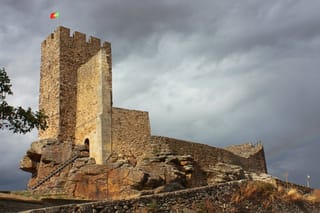
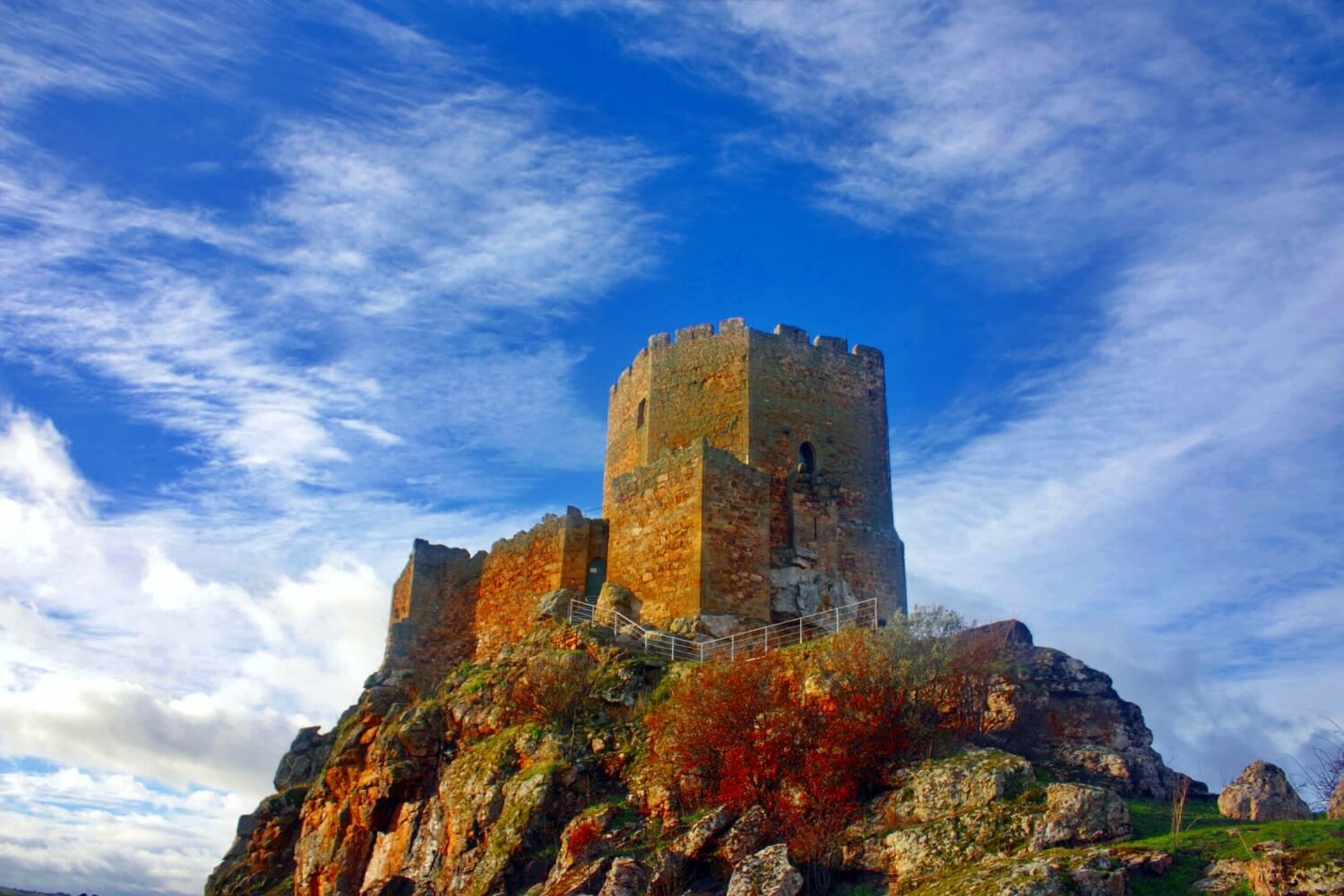
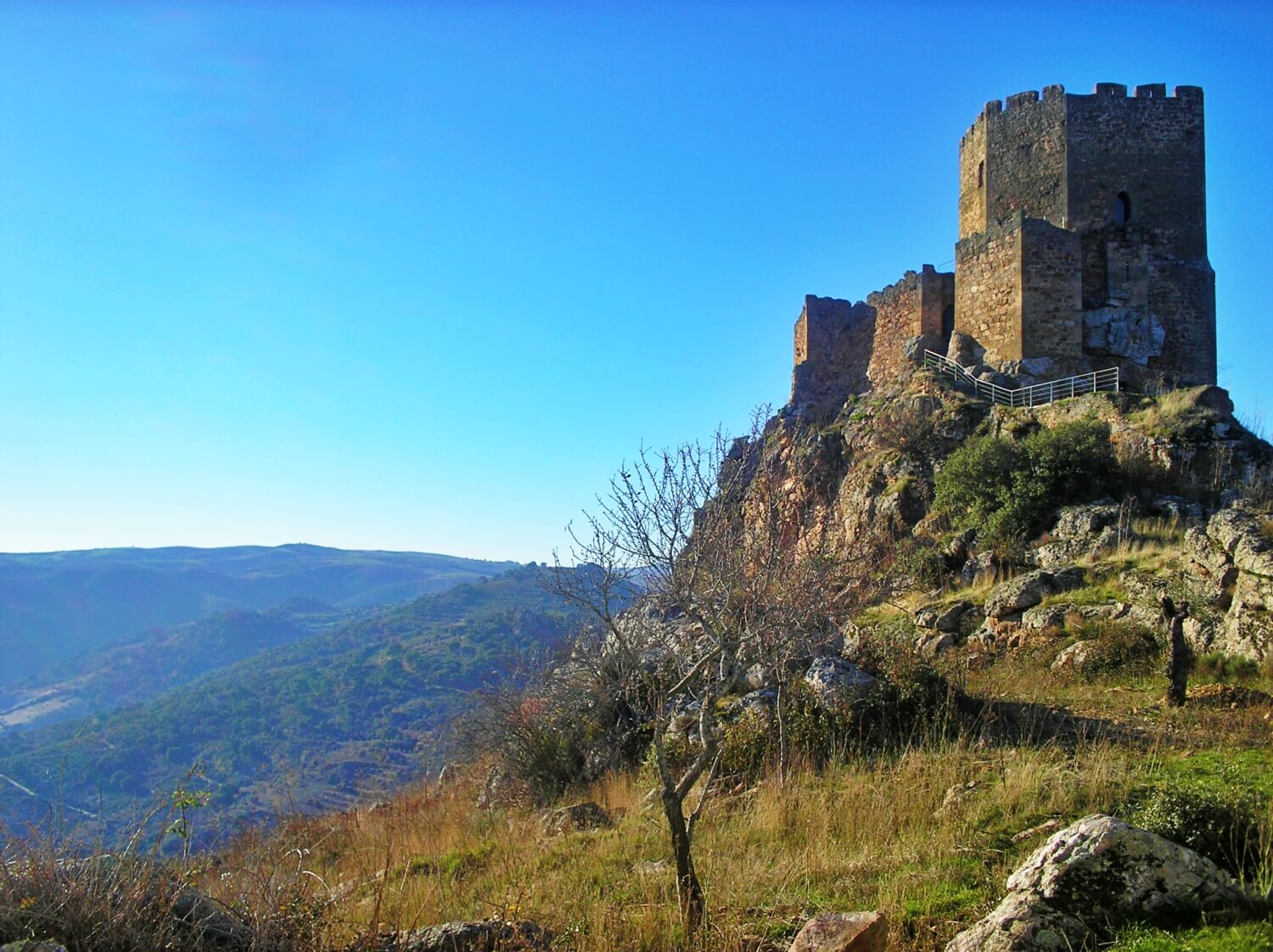
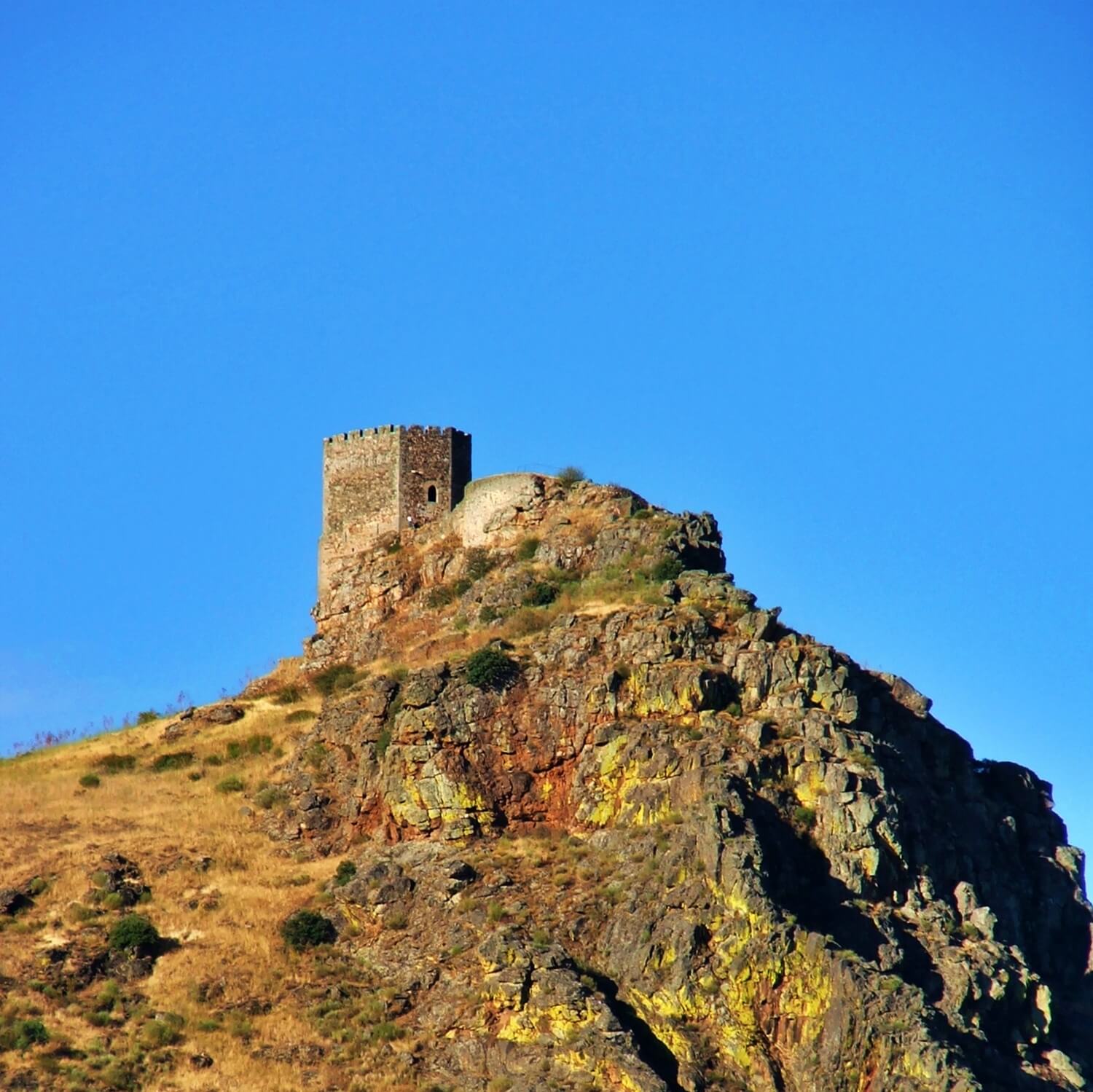
The castle is situated in a rural countryside, isolated on a soft escarpment 690 metres (2,260 ft) above sea level, called the Cabeço da Penenciada overlooking the right margin of the Angueira River. The stone castle is designed in a rectangular layout, with corbel walls and a three-story square keep tower with a Gothic access doorway; the superior accessway in similar pointed arch and machicolations, is crowned by merlons with arrowslits. In addition to rectangular cistern, with vaulted interior, the castle includes a primitive military square.
The remnants of the small rock castle and few lines of wall fortifications are interrupted by stones and cliff faces, approximately 12 metres (39 ft) tall. In addition to its keep tower, the walls include a few cubelos (circular towers) and small "patio" area that functioned as a small military square. On the wall is a square cubelo and in the north, a doorway with frame of arches protected by barbican with similar cubelos lacking bastions.
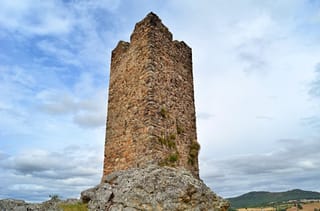
The keep tower, constructed in an irregular polygonal shape, includes large stone corners, and was constructed three-floors high. The Gothic second floor doorway includes a frame and remnants of machicolations. Within the tower are vestiges of the three floors, with the first two used as residences and the last for defense (as evidenced by the merlons and arrowslits): both areas include vaulted ceilings. Sometime during its period of use, the medieval architects constructed a wall that divided the two floors into two dependencies.
In front of the tower, are remnants of smaller buildings, that correspond to the primitive stables and kitchen. Generally, the area within the walls are cramped and dominated by large stones of various dimensions. A primitive irregular cistern is also situated within the walls of the fortification; 30 by 30 metres (98 ft × 98 ft) and 3 metres (9.8 ft) high, the vaulted cistern has a capacity to store 90,000 litres (20,000 imp gal) of water.
O Castelo de Algoso localiza-se ao sul da freguesia e povoação de Algoso, no concelho de Vimioso, distrito de Bragança, em Portugal.
Em posição dominante sobre o cabeço da Penenciada, domina a planície envolvente e a confluência da ribeira de Angueira com o rio Maçãs. Na região de Trás-os-Montes, enquadrado na Área Turístico-Promocional das Montanhas, do alto dos seus muros avistam-se a serra da Sanábria, a de Bornes e a de Nogueira.
História
Antecedentes
Embora os autores mais antigos acreditem que a primitiva ocupação humana de seu sítio remonte a um castro pré-histórico, a recente pesquisa arqueológica confirmou que a mesma ocorreu em diversas fases desde o período Calcolítico até à ocupação romana, embora não necessariamente em termos militares.
O castelo medieval
À época da Reconquista cristã da Península Ibérica, a primitiva linha de limites do condado portucalense com o reino de Leão desenvolvia-se ao longo da margem esquerda do rio Sabor até à sua confluência com a ribeira de Angueira. Esta raia era vigiada por quatro sentinelas principais: o Castelo de Milhão, o Castelo de Santulhão (ambos já desaparecidos), o Castelo de Outeiro de Miranda (em ruínas) e este Castelo de Algoso. Complementavam essa defesa principal do setor nordeste transmontano os castelos de Penas Roias, de Mogadouro e, embora mais distante, o de Bragança.
Os estudos mais recentes indicam que a edificação da primitiva estrutura do castelo remonta a algum momento no final do reinado de D. Afonso Henriques (1112-1185), quando seu filho Sancho já exercia o poder régio. Conforme registado nas Inquirições de 1258, o seu construtor foi um senhor local, Mendo Bofino (ou Mendo Rufino), que em troca recebeu o senhorio da vila de Vimioso.
A partir de 1224 a sua estrutura foi radicalmente alterada, momento em que o castelo foi doado por D. Sancho II (1223-1248) à Ordem dos Hospitalários (denominada, a partir do século XVI, como Ordem de Malta), após um período relativamente longo de guerra com o reino de Leão. À época, este castelo constituía-se no expoente máximo do poder local, residência do representante real encarregado da arrecadação dos direitos reais em terras de Miranda e Penas Roias.
A antiga vila e concelho de Ylgoso, Ulgoso ou São Sebastião de Algoso, integrava o bispado e distrito de Bragança. No ano de 1230 a Ordem do Templo e a de São João do Hospital fizeram concordata, em Coimbra, sobre várias terras em litígio entre as quais entrava Ylgoso (Algoso), Vila Chã, Atenor, Penas Roias, Paradela e outras, fora do bispado de Bragança.
Em 22 de junho de 1239 D. Pedro Costem, comendador da Ordem do Templo em Portugal, fez uma composição entre as comendas do Mogadouro e Penas Roias, pertencentes à sua ordem, e a de Algoso.
Posteriormente, a 13 de fevereiro de 1291, D. Dinis (1279-1325) fez nova composição, em Coimbra, com o Grão-Comendador de São João do Hospital, D. Fernão Peres (o Mossejo), acerca da comenda de Algoso e de outras terras próximas. A importância desta decorria dos rendimentos auferidos anualmente pelo seu comendador: de sete a oito mil cruzados, incluindo-se neste montante a de duas partes dos frutos das abadias de Travanca, Sendim, Vilar Seco, Duas Igrejas e Guide. Este soberano terá determinado ainda a realização de obras de reparo e melhorias no castelo.
Na posse dos Hospitalários, o castelo foi transformado numa fortificação em estilo gótico, destacando-se a construção da sólida torre de menagem, com a função de residência do comendador, e de um torreão na muralha a sul.
Em 1480 Algoso recebeu foral de D. Afonso V (1438-1481), confirmado por D. Manuel I (1495-1521) em 1 de junho de 1510 (Foral Novo). Nesse período, a povoação e seu castelo encontram-se figurados por Duarte de Armas (Livro das Fortalezas, c. 1509). O Numeramento de 1530, refere que, no castelo, só vivia o alcaide.
Do século XVI ao século XVIII
Quando da crise de sucessão de 1580, Diogo Fernandes de Almeida,[desambiguação necessária] pai de do frei Gonçalo de Azevedo, cavaleiro da Ordem dos Hospitalários, comendador e alcaide-mor do Castelo de Algoso (1588-1610), tomou partido pelo prior do Crato. À época da Dinastia Filipina, D. Filipe I concedeu carta de privilégios à Câmara Municipal de Algoso (1 de Janeiro de 1592).
Em 1684, encontrava-se entre as muitas estruturas abandonadas e em ruínas no reino. Quando da Guerra dos Sete Anos, pouco depois da queda de Miranda do Douro em 1762, os espanhóis empreenderam diversas surtidas saqueando as terras de Vimioso. Guarnecida por um pequeno efetivo, sob o comando de um alferes, a vila de Algoso conseguiu resistir sem ser ocupada.
Mais tarde, o governo militar da praça foi exercido por um capitão-mor, um sargento-mor e quatro capitães de Ordenanças.
Do século XIX aos nossos dias
Durante a Guerra Peninsular, o juiz de fora de Algoso, Jacinto de Oliveira Castelo Branco, recusou-se a reconhecer a soberania francesa e, mesmo após a partida da Família Real para o Brasil, tendo os franceses declarado abolida a dinastia de Bragança, continuou a usar o nome de Sua Alteza Real nos processos sob sua responsabilidade.
Em meados do século XIX, o concelho de Algoso foi extinto, passando a integrar o concelho de Vimioso (1855).
No século XX, a partir de 1944, o castelo recebeu pequenas obras de beneficiação por parte da Direcção-Geral dos Edifícios e Monumentos Nacionais (DGEMN), sendo classificado como Imóvel de Interesse Público pelo Decreto nº 40.361 de 20 de outubro de 1955. Posteriormente, entre 1974 e 1977 foram promovidos trabalhos de conservação das muralhas e muros de acesso, bem como a consolidação dos degraus do acesso ao portão do monumento.
Recentemente, em 2004 novas etapas de intervenção tiveram lugar, sob a responsabilidade do IGESPAR em parceria com a autarquia de Vimioso, reforçando a importância do castelo no circuito turístico da região.
Características
De pequenas dimensões, apresenta planta orgânica (adaptada ao terreno), com o formato retangular. Foi erguido em alvenaria de xisto quártzico e granito, sobre um afloramento rochoso, na cota de 681 metros acima do nível do mar.
Na muralha, a norte, rasga-se o portão de entrada em arco pleno, acedido por uma escada em degraus talhados na rocha. Este portão é defendido por um cubelo, hoje sem os seus merlões, onde se destacava um balcão com matacães. Franqueando-se o portão, abre-se uma reduzida praça de armas de onde, por sua vez, se acede a torre de menagem. Esta apresenta planta heptagonal, dividida internamente em três pavimentos. Os dois primeiros destinavam-se a habitação e o último, à defesa.
Num torreão, na face leste dos muros, abriram-se espaços destinados a peças de artilharia.
Useful information
Free
Free
Great view
Ruins of the castle
-
Nearby castles