Castle of Alegrete
Alegrete Portalegre Portugal
castle, chateau
Castelo de Alegrete
Alegrete Portalegre Portugal
castle, chateau
The Castle of Alegrete (Portuguese: Castelo de Alegrete), is a Portuguese medieval castle in the civil parish of Alegrete, in the municipality of Portalegre, in the district of the same name
El Castillo de Alegrete está situado en la parroquia de Alegrete, municipio de Portalegre, en el distrito del mismo nombre, en Portugal
Previous names
Castle of Alegrete, Castelo de Alegrete
Description
The Castle of Alegrete (Portuguese: Castelo de Alegrete), is a Portuguese medieval castle in the civil parish of Alegrete, in the municipality of Portalegre, in the district of the same name.
History
Just 10 kilometres (6.2 mi) from Portalegre, the castle of Alegrete is one of the more important fortress in the Alto Alentejo, assuming since the Middle Age, a fundamental position in regional defense. Most of the references to its origins are obscure. Traditional literature suggest that its history extends to the primordials of the Portuguese kingdom. Legend suggests that Alegrete was reconquered from the Moors in 1160 by D. Afonso Henriques.
The first documents suggest it dated from the 13th century, during the reign of King D. Afonso III, when the fortifications were either constructed or reconstructed.
On 16 February 1267, the settlement was effectively incorporated into the possessions of the Portuguese Crown, in the Treaty of Badajoz, celebrated between King D. Afonso III and his father-in-law King D. Alfonso X of Castile.
The reconstruction of the fortifications are attributed to the foral (charter) of King D. Dinis in 1319. Most of the building on the site occurred between the 13th and 14th century, but likely began immediately after the accord at Badajoz. The perimeter of the fortification was quite irregular, and did not adopt the oval plan generally used during the Portuguese Gothic period. The keep tower was erected alongside the eastern walls and located near a cistern, that supported the community within the walls and military garrison. The main gateway was in the south (today concealed) and crowned by small tower with machicolations towards the interior. Complementing the military garrison was a curtain of walls connected to the castle. In the following centuries, Alegrete took on an important role in the wars with Castile.
On 8 April 1384, D. Nuno Alvares Pereira visited Alegrete as part of his defense of Portugal.
A new foral was issued on 14 February 1516 by King D. Manuel I. The transition between medieval warfare and pyroballistic warfare determined the slow decline of the castle. Meanwhile, though, the dynastic crisis resulting from the death of King Sebastian at Alcácer Quibir, revitalized the importance of the medieval castle, owing to its frontier position along the Spanish border. Under the influence of the Marquess of Marialva, the walls were repaired and updated, during a rapid reconstruction process. The work resulted in a fortress with bastions, but little today remains to identify its limits.
At the end of the 17th century, King D. John IV compensated General Matias de Albuquerque by making him the Count of Alegrete, and putting the castle on the first line of defense during the Portuguese Restoration War. By 1662, the garrison of Alegrete was composed of two infantry companies, under the command of La Costé. As legend suggests, the Governor dissuaded John of Austria (whose forces had encircled the settlement) from attacking, offering him two bottles of wine and suggesting that the Portuguese garrison would resist until the last of the wine produced in Alegrete. Work on the walls were carried out by Luís Serrão Pimentel following their damage.
On 12 July 1664, there is record of repairs and rehabilitation of the fortifications under the direction of the Marquess of Marialva.
On 19 August 1687, the Marquess of Alegrete was instituted, in the name of its first Marquess, D. Manuel Teles da Silva.
In 1704, Portuguese forces situated in Alegrete resisted the siege by Phillip V of Spain.
During the course of the War of the Oranges at the beginning of the Peninsular Wars, forces stationed in Alegrete resisted Spanish bombardment in 1801. But, the castle was already irreversibly in decline. Within twenty years, the conflict between Absolutists and Liberals erupted within Portugal, leading to combat within the castle's proximity, between troops of the Count of Vila Flor and royalist forces.
As part of political reforms the municipality and magisterial courts in Alegrete were extinguished on 26 June 1855.
Architecture
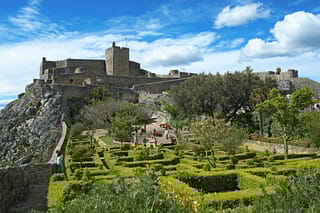
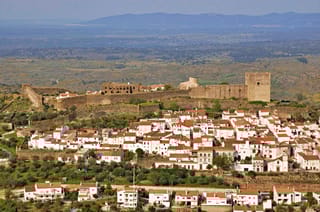
The urban fortifications, with castle to the south, delimits the primitive settlement on top of the mountain, at about 502.9 metres (1,650 ft) altitude. On the northern flank supported the town, called the Arrabalde, and rest of the flanks are occupied by agricultural fields, with olive orchards, broken by the Ribeira de São Pedro (also called Ribeira do Ninho d'Açor) in the west. The location of the fortifications, at the top of the mountain, makes it an ideal lookout over the vast landscape below.
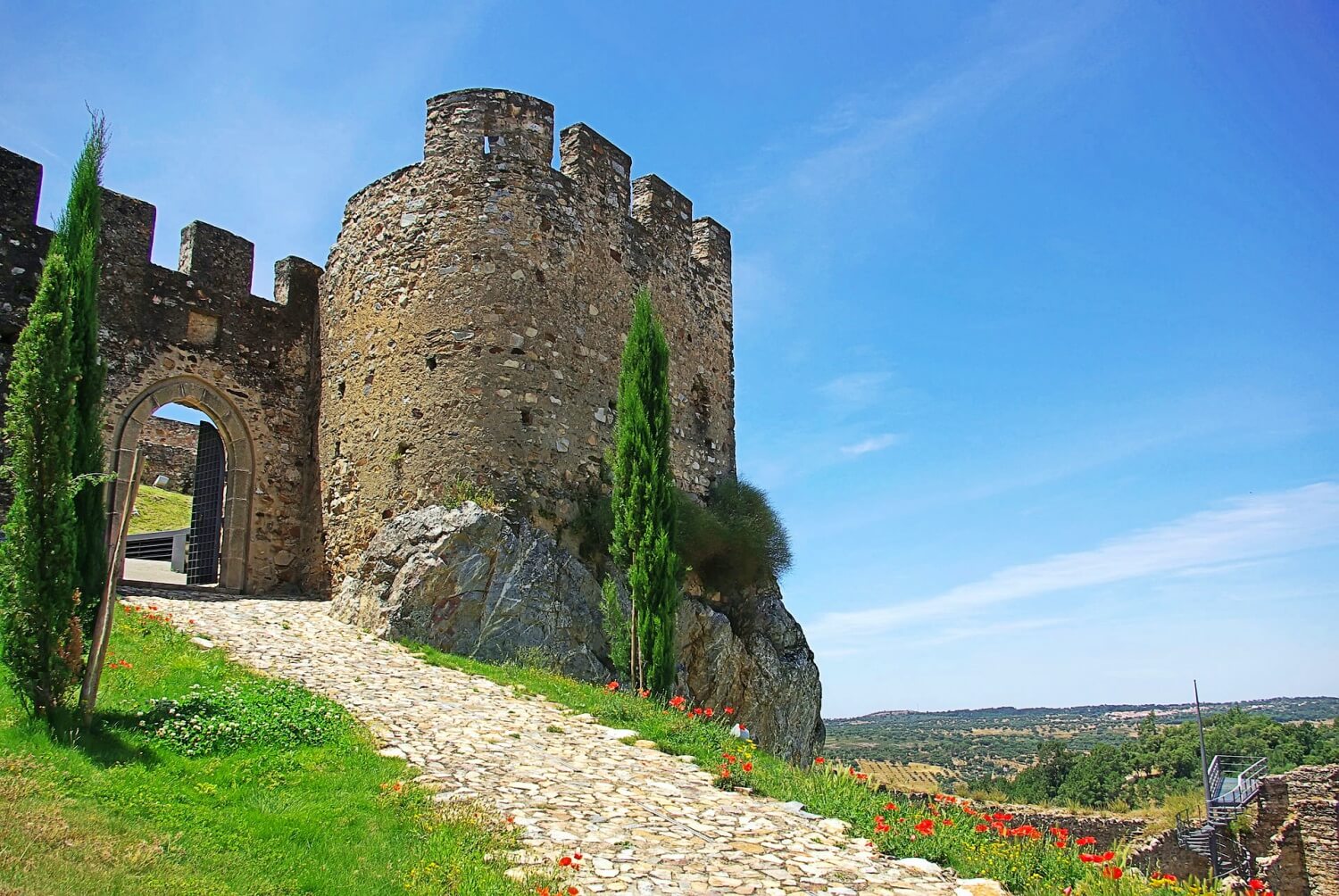
Much of the walls are in a state of ruin; yet, there are several trenches still conserved, including the "Vila" Gate, a prototype of typical Gothic gates. The castle comprises an irregular plan, delimited by the "Vila" Gate in the north and along the east the "Traitors'" Gate (also called the "Sun" Gate). At this point there are ruins in east that could have been the keep tower, with cistern and pavement with door to the south. Over the cistern is another pavement above the stairs the extend from the patio. The tower appears to have been divided in two from the cistern. To the west of the tower is a small tower and terrace that opens to a patio. In the south/southwest of the castle are the remains of a cubel/watchtower, with a rectangular surface, that accessible from a staircase addorsed from the southern wall. Much of the interior of the castle is occupied by rocks and unlevel ground.
The urban walls, extend from the cardinal directions from the castle: two walls to the southwest (extending from the "Santana" Gate); west from a cubel, that continues to the north; the wall, then, inflects towards the east-southeast (at the Rua do Forno Gate); connects to the "Villa" Gate between two corbels, continues along to the a cubel in the east (with only minor interruption); before inflecting to the south, connecting the castle and terminating in the southwest.
El Castillo de Alegrete está situado en la parroquia de Alegrete, municipio de Portalegre, en el distrito del mismo nombre, en Portugal.
Estratégicamente situada, fue una de las más importantes fortificaciones del Alto Alentejo rayano—fronterizo—, pieza clave en el sistema defensivo de la región en la Edad Media. Actualmente, tiene el potencial de convertirse en una importante atracción turística para una región que se resiente de su interioridad.
Historia
Antecedentes
Aunque la primitiva ocupación humana de su sitio es oscura, se cree que se remonta a la época de los lusitanos, sucedidos por los romanos, los vándalos, los alanos hasta la conquista musulmana de la península ibérica a partir del siglo VIII.
El castillo medieval
En la época de la Reconquista Cristiana de la península ibérica, el asentamiento y su defensa fueron conquistados por las fuerzas del Rey Afonso Henriques (1112-1185), según la tradición, en 1160. Sin embargo, las primeras informaciones documentales sobre ella datan del siglo XIII, ya que, en virtud del Convenio de Badajoz (16 de febrero de 1267), firmado entre Alfonso III de Portugal (1248-1279) y su suegro, Alfonso X de Castilla, la villa de Alegrete y su castillo se incorporaron definitivamente al territorio de Portugal. El soberano portugués le hizo reparaciones y refuerzos, obras que se prolongaron hasta el reinado del rey don Dinis (1279-1325), cuando la villa recibió su carta de constitución (1319).
En el contexto de la crisis de 1383-1385, la villa y su castillo tomaron partido por el Maestre de Avis, y fue un campamento de las fuerzas portuguesas bajo el mando del condestable Nuno Álvares Pereira (8 de abril de 1384), victorioso contra Castilla en la batalla de los Atoleiros.
En el reinado de Alfonso V (1438-1481), fue conquistada por las tropas de Castilla (1475).
De vuelta a la posesión portuguesa, el pueblo recibió, el 14 de febrero de 1516, el Nuevo Foral de D. Manuel I (1495-1521).
Desde el siglo XVI hasta el XVIII
Durante la crisis de sucesión de 1580, la posición del antiguo castillo medieval recuperó importancia estratégica, en la primera línea de defensa rayana o fronteriza. Más tarde, durante la Guerra de Restauración de la independencia portuguesa, el rey Juan IV de Portugal(1640-1656) recompensó a Matías de Albuquerque por sus servicios concediéndole el título de Conde de Alegrete. En el mismo contexto, se dice que en 1662, con la plaza de Alegretuan de Ause guarnecida por dos compañías de infantería bajo el mando de La Coste, rodeada por tropas españolas bajo el mando de D.Juan de Austria, ese gobernador de la plaza envió al comandante invasor dos botellas del vino generoso de la región, con una nota que decía que la guarnición portuguesa resistiría hasta la última gota de esa bebida que allí se producía. Frente a este gesto de galantería, se dice que el invasor levantó el asedio a la plaza, retirándose. A partir de 1664 sus defensas se modernizaron y reforzaron en puntos específicos, bajo la dirección del Marqués de Marialva. En ese momento, se erigió una campaña fortificada, ahora desaparecida, probablemente en la limpieza, ya que hoy en día no es posible identificar sus rastros. Todavía en ese siglo se creó el Marquesado de Alegrete (19 de agosto de 1687), siendo su primer titular D. Manuel Teles da Silva.
El siglo XIX: la Guerra Peninsular y las Guerras Liberales
A principios del siglo XVIII, el asentamiento y su fortificación resistió el asedio de las tropas de Felipe V de España (1704), para sumergirse en una paz de la que sólo despertaría a principios del siglo siguiente, cuando acuarteló un número considerable de tropas en el momento de la llamada Guerra de las Naranjas (1801). Para entonces sus defensas ya estaban en considerable declive, no habiendo tenido ningún papel en las batallas de las Guerras liberales que tuvieron lugar en su vecindad entre las tropas del Conde de Vila Flor y los Realistas (1826).
La Alcaidaria-Mor de Alegrete con responsabilidad sobre el Castillo fue entregada a los Condes de Vila-Flor y a los Señores-Donatários da Zibreira, siendo el último señor del castillo Cristóvão Manoel de Vilhena, Senhor de Pancas e da Zibreira, hijo de la Condesa de Alpedrinha, que se incorporó a la Alcaidaria-Mor de Alegrete en 1860, habiendo muerto en 1877, cuando la Alcaidaria-Mor y el Castillo de Alegrete pasaron al Tesoro Nacional.
Desde el siglo XX hasta nuestros días
Desde que el Concejo y Julgado de Alegrete fueron abolidos (26 de junio de 1855), su castillo se hundió en el abandono y el olvido.
En el siglo XX fue clasificado como Monumento Nacional por el Decreto Ley N.º 35.443 del 2 de enero de 1946 hasta que se iniciaron los trabajos de consolidación y restauración en 1965, bajo la responsabilidad de la Dirección General de Edificios y Monumentos Nacionales (DGEMN). A partir de 1977 se realizaron trabajos de consolidación en la torre del castillo y se demolieron las mamposterías que cubrían las aberturas y las almenas. Más tarde, a partir de 1984, se promovieron obras para consolidar los muros y aislar la entrada del castillo.
A pesar de la importancia de las intervenciones realizadas, el monumento esperaba un programa de valorización más amplio, ya que se encontraba en un estado de conservación precario. Recientemente, se han estudiado los planes para su recuperación.
Características
Ejemplar de la arquitectura militar gótica, tiene una planta rectangular e irregular. En su muralla, al sur, la puerta está desgarrada, defendida por una pequeña torre. En los muros, al este, se encuentra la torre del homenaje, de planta rectangular con dos pisos, asociada a una cisterna, parte del conjunto. El adarve, al que se accede por una escalera de piedra, se basa en el suelo y está dispuesto transversalmente al paño de la pared.
La defensa se complementaba con una muralla que rodeaba la ciudad y la conectaba con el castillo. En precarias condiciones de conservación, entre los pocos tramos conservados destaca la Puerta de la Ciudad, flanqueada por dos cubos defensivos, ejemplo de las puertas góticas de las murallas urbanas de la época.
Useful information
Free
Free
Great view
Ruins of the castle
-
Nearby castles