Castello Svevo Rocca Imperiale
Provincia di Cosenza Calabria Italy
castle, chateau
Castello svevo (Rocca Imperiale)
Provincia di Cosenza Calabria Italy
castle, chateau
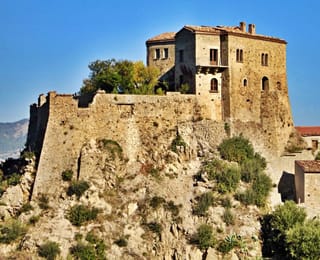
History The imposing and sumptuous castle is placed on top of the hill on which lies the town of Rocca Imperiale, with its houses arranged in tiers, about 200 meters above sea level
Il castello svevo di Rocca Imperiale è un castello
Storia e descrizione
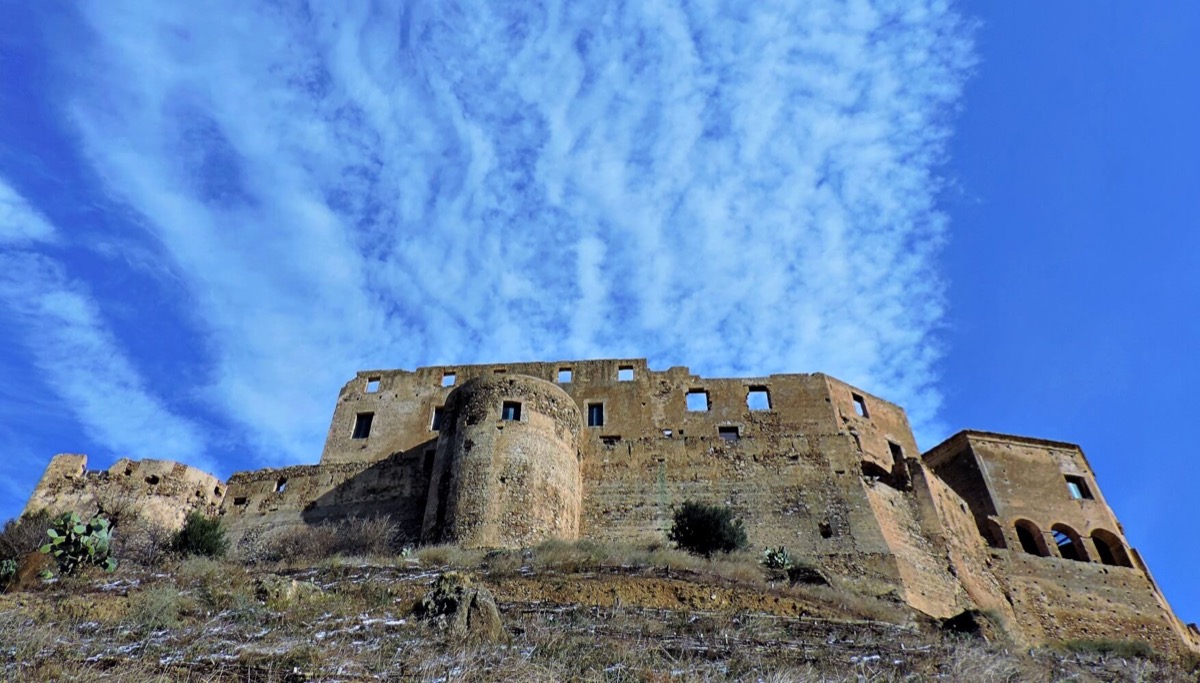
Il castello è dotato di un cassero, un mastio poligonale a scarpa i cui lati più brevi, a sud, si innalzano su un profondo burrone e i rimanenti, e pianta quasi rettangolare, sono rafforzati da due torri cilindrico–tronco–coniche a est, da una a sperone allo spigolo nord-ovest e da un'altra cilindrica, a sezione costante, al centro del lato posteriore, a ovest; il mastio, tranne nei lati meno accessibili, è circondato da un muro di cinta provvisto di parapetto, che forma il fossato largo e profondo circa 8 metri; di un ponte levatoio esterno, di una via sopraelevata racchiusa in un bastione merlato anch'esso a sperone, alto 20 metri e di un secondo ponte levatoio più grande, interno, che chiudeva il portale di ingresso
Previous names
Castello Svevo Rocca Imperiale, Castello svevo (Rocca Imperiale)
Description
History The imposing and sumptuous castle is placed on top of the hill on which lies the town of Rocca Imperiale, with its houses arranged in tiers, about 200 meters above sea level. The fortress was built by Frederick II of Swabia in 1225 in a place of great military and strategic importance: a control of the ancient Appia-Traiana road which, starting from Reggio Calabria and following the sea was going to join the Appia in Brindisi. In addition, the main defensive end, Federico joined the task of giving asylum to the Court in the movements and scrimmages hunting to which the territory was very suitable. The construction of the castle followed the development of a thriving town center where convogliarono the people of a number of fortified settlements in the area (Murgie of Santa Caterina, Monte Soprano, Presinace Nocara). After the death of Frederick II fortress was entrusted to the Knights of St. John of Jerusalem by Charles I of Anjou, who in 1271 stayed in the castle, from Roccadaspide welcomed as a liberator. Once the Angevin, in 1487, Alfonso II of Aragon, Duke of Calabria was not limited only to strengthen the fortress with the addition of walls and crenellated towers, but extended it to cover in many parts of the old monument Swabian . In the following two centuries many were the feudal lords who took turns in the government of the territory, constantly battered by barbarian invasions. In 1664 the castle ruled on proc of 4000 Saracen pirates who devastated Rocca, destroying the ancient thirteenth-century church of which remains today only the beautiful Romanesque bell tower with mullioned windows and frames. In 1717 the estate passed to the Dukes Crivelli to which must be the last major alterations of the manor, with the addition of large overhanging factories, which made the fortress a small palace. But, abolished feudalism, the last lord of the Crivelli family, who resided in Naples, got rid of the furniture and furnishings, and around 1835 he sold even roofing and window frames, thus beginning the time of devastation that over the years abandonment reduced the enormous size of the castle in the building material quarry, subject to all sorts of vandalism. This period of neglect is now finally over thanks to the restoration work, which are still in progress, strongly desired by the Municipality. The castle The Castle shows a quadrangular form, consisting of a polygonal male to the shoe. Bordered on the south by a rocky outcrop that juts up to the edge of the hill. It features a cylindrical section to the west tower without escarpment of certain attribution Frederick. On the side of a NO amygdaloidal tower (called Windbreak tower) Aragonese manufacturing. A NE stands the tower "Powder", based conical and cylindrical upper section, conforms to the beautiful tower SE finely decorated with corbels and surrounded by battlements and machicolations. The keep is surrounded by a wall, parapet provided, which limits a wide and deep ditch about eight meters. The first bridge, a drawbridge time introduces the visitor to an elevated via enclosed in a crenellated ramparts (The Citadel), to the second drawbridge and Federico portal, which offers a breathtaking view of the sea and towards the hills south . Crossed the entrance, an impressive staircase decorated by great rounded arches typical of the baroque scenario, it offers to the visitor's view. On the right, a sentry box with vaulted ceiling and entrance to the bunker of the SE tower, which preserves intact all its mystery. In this small dark room, it can earn as the main access to the manor were strategically controlled. At the top of the staircase, ornate columns with valuable capitals, the first environment that offers guests of the castle are the kitchens, even with tanks, sinks, stoves of different sizes and for baking ovens. From here you can access the crenellated wall of the SE tower and upper floors of the palace of the Dukes Crivelli, still showing traces of frescoes that made the opulent palace. In these environments it is possible to recognize the signs that still characterize our daily lives, as beliefs formed in the walls. Continuing the visit you come on the parade ground, adorned with the beautiful Aragonese battlements, with the arches of the drains from which was launched the boiling pitch, resurfaced after restoration. On the west wall you can see the lancet-arched, the only medieval window survived the eighteenth-century modernization. From the parade you can access some of rooms whose intended use and the reception rooms of the palace Crivelli, located on the first floor. The visit to the castle therefore offers the attentive visitatatore the possibility of recounts six centuries of history, not only the local, but also of the experience often complex and troubled southern Italy.
https://www.itinari.com
Il castello svevo di Rocca Imperiale è un castello
Storia e descrizione
Il castello è dotato di un cassero, un mastio poligonale a scarpa i cui lati più brevi, a sud, si innalzano su un profondo burrone e i rimanenti, e pianta quasi rettangolare, sono rafforzati da due torri cilindrico–tronco–coniche a est, da una a sperone allo spigolo nord-ovest e da un'altra cilindrica, a sezione costante, al centro del lato posteriore, a ovest; il mastio, tranne nei lati meno accessibili, è circondato da un muro di cinta provvisto di parapetto, che forma il fossato largo e profondo circa 8 metri; di un ponte levatoio esterno, di una via sopraelevata racchiusa in un bastione merlato anch'esso a sperone, alto 20 metri e di un secondo ponte levatoio più grande, interno, che chiudeva il portale di ingresso.
All'interno ci sono gli accorgimenti per rendere l'edificio inespugnabile mediante l'assicurazione dei rifornimenti logistici con locali per deposito di olio e di grano, cinque cisterne a decantazione d'acqua e una finestra che dà sulla costa scoscesa a ovest, nonché le sporgenze delle torri, un triplice ordine orizzontale di feritoie e una lunga serie di merli per battere efficacemente da ogni punto e con pochi uomini il suolo circostante.
Sono presenti scuderie per i cavalli, casematte, sotterranei, corridoi intercomunicanti e trombe per l'aerazione nelle torri; diverse gallerie furono interrate e si dice che ve ne fosse una, ora non rintracciabile, di uscita segreta all'esterno.
Uno stanzone custodiva i prigionieri e più giù, dopo una serie di ambienti vari, vi era la sala dei supplizi.
A tutto questo complesso architettonico erano poi collegate le mura del paese che svolgendosi dal “Murorotto”, sul fianco di casa Giannattasio, dove si notano i resti di una torre quattrocentesca, raggiungevano “la Croce”, indi “l'Ospedale” e casa Moliterni dove avevano termine sull'orlo del precipizio di “Scalella”.
Quale parte abbia avuto Federico II di Svevia nella fortificazione del castello oggi non è possibile precisare perché, se si eccettuano una finestra ogivale disadorna, di arenaria, il portale del massimo ponte, la torre cilindrica posteriore e qualche feritoia che non risponde più allo scopo cui era stata precedentemente destinata, nessun elemento artistico è riferibile al secolo XIII, e invece l'aspetto esterno del castello, il toro longitudinale, gli archetti pensili arabo – siculi della torre di sud-est e la merlatura guelfa sono aragonesi, mentre gli alloggi, settecenteschi.
Alfonso d'Aragona non si limitò, nel 1487, a rafforzare la rocca, ma la ampliò e rifece in modo da coprire il vecchio monumento svevo, forse più piccolo e con torre centrale quadrata.
Nel Medioevo è risaputo che una consuetudine imponeva alle popolazioni locali e limitrofe l'obbligo della prestazione gratuita d'opera, per tutto il tempo necessario alla costruzione e alla riparazione dei palazzi reali e degli edifici militari, di maniera che solo gli operai provenienti da zone non comprese negli obblighi erano ricompensati. Senza la partecipazione dei Rocchesi ai lavori non sarebbe altrimenti spiegabile la tradizione della fornitura a passamano, a mezzo di una catena di uomini, all'uso romano, dal torrente “Salso” alla cima del colle da fortificare, dell'ingente materiale litico occorrente, perché ad un'opera tanto grande dovettero collaborare centinaia di muratori e migliaia di manovali.
Ultime modificazioni ed aggiunte murarie furono quelle apportate ai vani abitabili, nel 1700 dai duchi Crivelli, che vollero fare della fortezza una piccola reggia. Ma, abolito il feudalesimo, l'ultimo Signore che risiedeva a Napoli, si sbarazzò dei mobili e degli arredi ed attorno al 1835 vendette persino le coperture dei tetti e gli infissi, iniziando così quel periodo di devastazione che negli anni di abbandono ridusse l'enorme mole a cava di materiale edile, soggetta ad ogni sorta di vandalismo.
Useful information
GRATUITO
3.00 EUR
GRATUITO
3.00 EUR
- Eventi e festival
- Visita guidata
castellosvevo@roccaimperiale.info
-
External links
Nearby castles