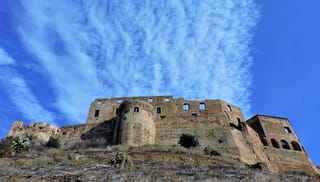
Castrum Petrae Roseti
Provincia di Cosenza Calabria Italy
castle, chateau
Castrum Petrae Roseti
Provincia di Cosenza Calabria Italy
castle, chateau
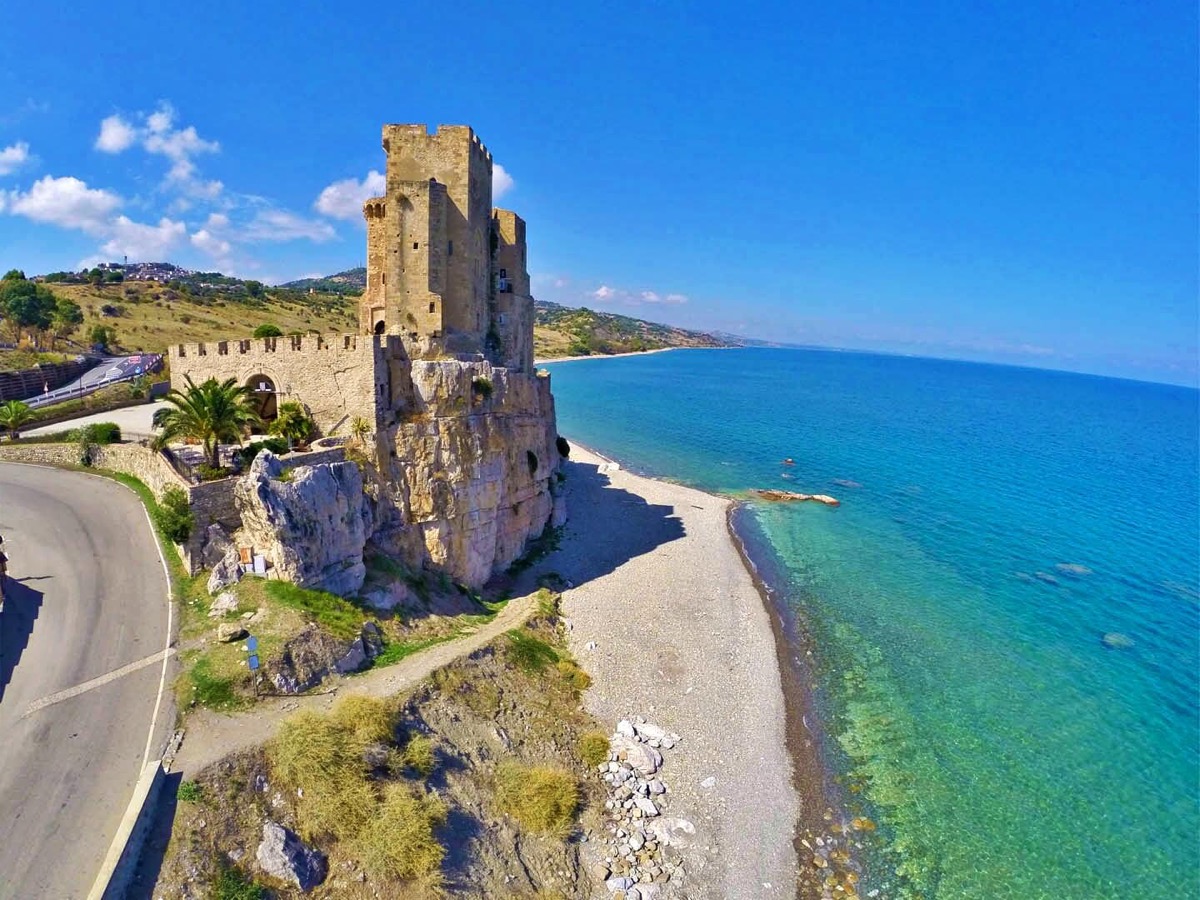
The anvil stone Roseto Capo Spulico castle rises in an incomparable landscape position, on a rock slightly raised above the surrounding sand, in contemplation of the Ionian Sea clear waters
Il Castrum Petrae Roseti (Castello della Pietra di Roseto) è un castello fortificato a difesa della costa dell'Alto Ionio Cosentino, risalente ad epoca normanna, ricostruito nel Duecento per volontà dell'imperatore e re di Sicilia Federico II di Svevia, rimaneggiato più volte fino al secolo XVI
Previous names
Castrum Petrae Roseti, Castrum Petrae Roseti
Description
The anvil stone Roseto Capo Spulico castle rises in an incomparable landscape position, on a rock slightly raised above the surrounding sand, in contemplation of the Ionian Sea clear waters. Just opposite, at sea, stands a uniquely shaped rock called ‘castle mushroom’ or ” anvil stone”. San Vitale Castronuovo and the faith of stone The Castle of Roseto Capo Spulico, firmly perched on a rock, dates from the tenth century. As recalled by San Vitale da Castronuovo: it is on the “Petrae Roseti” that the Saint founded a monastery. On the ruins of the sacred building arose the “Castrum Petrae Roseti” in the eleventh century thanks to the Normans.
Roseto favourite among the possessions of Frederick At that time the castle was the border between the lands of Robert Guiscard and his brother Ruggero II, father of Costanza d’Altavilla, heir to the Kingdom of Sicily and mother of Frederick II Hoheustaufen. In the thirteenth century (1229), already Temple of the Order, it was requisitioned by Frederick II from the Knights Templar, in retaliation for their betrayal during the sixth crusade to the Holy Land (1228). It was restored and converted into a military fortress; in fact, from the Angevin Registers we know the extent of the garrison assigned to the fortress, which in 1275 was composed of the castle, a squire and twelve guards. Frederick himself, who had the castle close to his heart, took care of it in his will, as shown in the “Da Monumenta Germaniae Historia, Legu, Sectio IV: Tomus II, n. 274″, assigning the territory of Porta Roseti to his natural son Manfred, and all the castles and especially the “Templar Petrae Roseti” to the legitimate children who would also be the Kings of Jerusalem. At the time of the Hoenstaufen the castle was decorated with magnificent paintings, presumably of a profane nature, which today have unfortunately disappeared. A thirteenth century’s document recalls in fact as, in his office, the Swabian emperor supported conservative intervention, in order to ward off the dangers on the woodwork and paintings from the infiltration of rain. The spirit of Frederick and the Templars is still alive today in the stones of the castle Today, after careful restoration works by the owner company, it shines as a classic example of fridericianum architecture of Templar derivation. The large courtyard surrounded by crenellated walls is closed by an arch that has alchemical-Templar emblems such as the “Rose” and the “Lilies” that make the “Castrum Petrae Roseti” a Temple of the Order. On its derivation from alchemical-esoteric Templar models a recent hypothesis has arisen, which would derive the forms from the Temple of Jerusalem. Furthermore, according to the same recent studies, there would even have been kept the Holy Shroud, episode to be related to a number of Rosicrucian and Templar symbols scattered around the castle.
The castle structure The shape of the castle fortress of Roseto Capo Spulico is set on an irregular trapezoidal shape, following the trend of the lithological layer below and lets recognize the oldest parts in the highest of the towers. The general architecture is apparently centred on the size of a square tower, against which leans a factory body of rather detailed and complex manifacture. The entrance is formed in the wall of a circular curtain with jutting, while a square turret on the opposite side and a crenellated wall on the side of the sea contribute to complete the construction set. The presence of the jutting betrays successive modifications of Frederick’s time, perhaps during the Angevin rule. Of great interest are the well-shaped limestone refinements of the windows, which open with their elegant arches to illuminate the dark shadow of the wall texture.
http://www.federicoitineraridellostupore.it
Il Castrum Petrae Roseti (Castello della Pietra di Roseto) è un castello fortificato a difesa della costa dell'Alto Ionio Cosentino, risalente ad epoca normanna, ricostruito nel Duecento per volontà dell'imperatore e re di Sicilia Federico II di Svevia, rimaneggiato più volte fino al secolo XVI. È sito in Roseto Capo Spulico, a picco sul mare sul Promontorio di Cardone.
Il maniero era di importanza strategica nel periodo dei Normanni in quanto segnava la divisione della Contea di Sicilia tra Roberto il Guiscardo e Ruggero, suo fratello. Sorge su un avito monastero basiliano-normanno. Non lontano vi era il piccolo borgo di pietra di Roseto, oggi Roseto Capo Spulico.
Il castello è di forma trapezoidale ed ha tre torri, di cui una merlata e più alta rispetto alle altre. Vi sono ampi saloni di rappresentanza all'interno (visitabili), ed all'esterno si possono vedere cisterne e scuderie. La struttura attuale non è, però, interamente medioevale : numerosi sono stati i rifacimenti che hanno completato e modificato l'aspetto originale della fortezza. La struttura attuale non è antecedente al secolo XVI, pur conservando alcune antiche tracce rinvenute nei recenti restauri.
È un piccolo faraglione caratteristico che si trova in mare, sotto il Castrum Petrae Roseti. È detto anche "pietra dell'incudine".
La tradizione vuole che, tra il 1204 e il 1253, durante il regno di Federico II, il castello custodì la Sacra Sindone.
Useful information
No
GRATUITO
GRATUITO
GRATUITO
Ci sono le spiaggie e docce gratuite
- Si trova in mare
- Le attività ricreative
- È possibile acquistare prodotti locali
-
Nearby castles