Castello di Reschio
Provincia di Perugia Umbria Italy
castle, chateau
Castello di Reschio
Provincia di Perugia Umbria Italy
castle, chateau
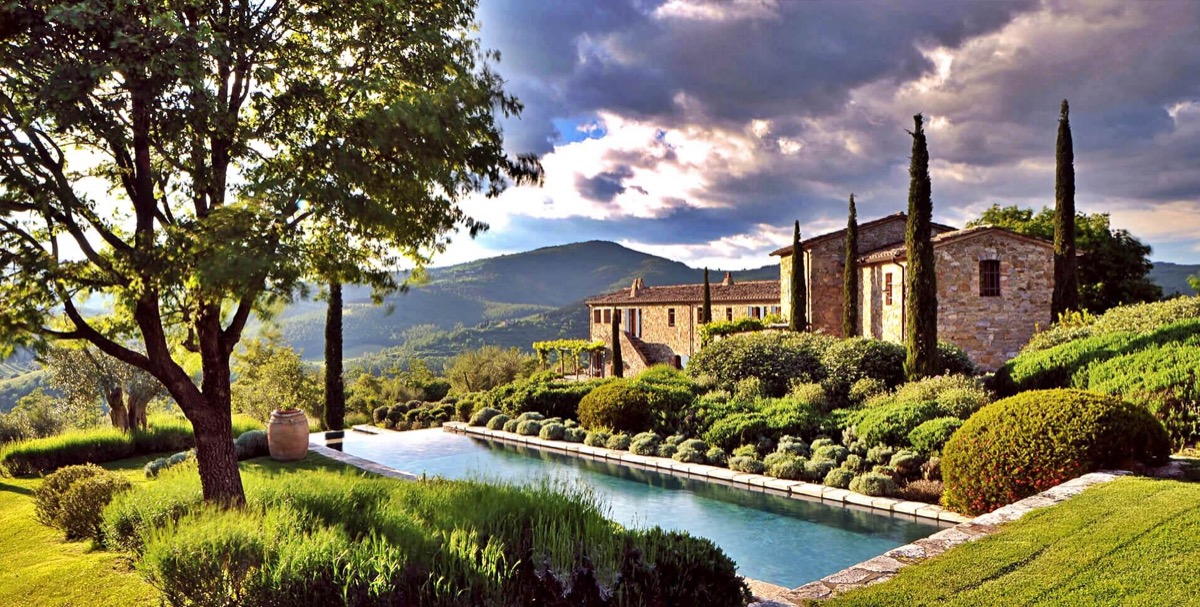
Castello di Reschio forms part of a chain of walled settlements in proximity of the Tuscan boundaries
Il castello di Reschio fa parte della catena di insediamenti murati posti in Umbria (Stato Pontificio) al confine con il Granducato di Toscana
Previous names
Castello di Reschio, Castello di Reschio
Description
Castello di Reschio forms part of a chain of walled settlements in proximity of the Tuscan boundaries. It belonged to the county of Porta Sant’Angelo of the commune of Perugia, perched on a hillock above the valley of Pierle, along the right riverbank of the Niccone stream. Today it is part of the communal territory of Lisciano Niccone, province of Perugia.
Origins of Castle till mid-14th century
The name Reschio, derived from Resculum, suggests a fortification at the site dates to the late Roman Empire. The present structure was likely begun at some time between the 9th and 11th centuries. Historians from the 17th and 18th centuries (Muratori and Gamurrini respectively) refer to land grants by Charlemagne and other emperors wrote prior to the 11th centuries. These certificates, emitted for the Bourbon of Monte Santa Maria family(originally the Lords of Colle), possibly represent the first records referring to the Castle of Reschio. However, no such documentary evidence is still extant.
The first documentation of the castle is from 3rd of May, 1202, when Uguccione di Ranieri of the Vagliana branch of the Family of the Marchesi del Monte S. Maria, marchese di Colle e di Vagliana, submitted to the town of Perugia this castle and its properties along with those of Monte Gualandro, Castel Nuovo, Santa Maria di Pierle, Lisciano, and Tisciano. A treatise for protection was signed with the consuls of Perugia. The historian Litta, understands this to mean Uguccione was in possession of those sites by a grant from Federico Barbarossa, and, as the imperial power diminished, the obligation arose to keep them by vassalage treatise.
Reschio, Imperial Feud
The Emperor Charles IV, by a certificate of May 14, 1355, invests Ugolino and his nephews Angelo, Guiduccio and Pietro Marchesi del Monte Santa Maria, with the castles of Marzana, Lippiano and Reschio, confirming their privileges (Mariotti 1835). Ugolino requested this deed from the Emperor, by which all Feuds are freed from protection bonds, of which investiture was given or confirmed (amongst which the curia of Reschio is expressly mentioned). The family of the Marchesi del Monte S. Maria therefore depends directly from the Sacred Roman Empire, thus freed from the Umbrian towns, where the various factions were always in conflict with each other. The marquisate hereby became an imperial “sovereign” feud.Ranieri di Ugolino was the only member of the Bourbon del Monte family who, after the investiture by Charles IV, did not have the title of marquis of Monte S. Maria, but was the first one to take on the title marquis of Reschio, most probably his place of residence.
The Montemelini Family of Perugia
In 1364 the castle of Reschio still belonged to the Marquis of Monte S. Maria (Ranieri, the son of Ugolino di Berarda, used the title of Marquis of Reschio, likewise his son Antonio). The handing over to the Montemelini family took place in 1365 when Antonia (Ranieri’s granddaughter) inherits a part of the marquisate of Reschio (including the Castle). Antonia was married to Ranieri di Tiberio Montemelini di Perugia, but had to defend the Castle from the pitfalls of her relatives (amongst which the toughest one her cousin Cerbone, who had many relatives killed in order to be sole proprietor of the marquisate). In 1593 Montemelini Lord of Reschio put his feud under the protection of the Grand Duke of Tuscany and was condemned by the Pope for having placed the coat of arms of the Medici on the gateway of the Castle.
The bishop of Todi, Angiolo Cesi
In 1601 Count Niccolò, son of Napoleone Montemelini, sold this feud, through the Congregation of the Barons, to Mons. Angelo Cesi, bishop of Todi, who made a present of this to his nephew Venanzio Chiappino (as can be read in the inscription placed above the entrance to the Castle). The Notary Francesco Torelli drew up the sales deed in Perugia.
Prospero Cimarra
On December 5, 1678 the County of Reschio was purchased by the Duke of Acquasparta for the sum of 25000 scudi. Cimarra, contractor of the Gabella del Macinato (grain and flour taxes) of the Towns, Countryside and Castles of the District of Rome, was indebted with the Apostolic Chamber by the sum of approximately 30000 scutes and therefore forced to sell the propriety of Reschio.
The noble family Bichi Ruspoli Forteguerri di Siena
On May 27, 1692 Cardinal Carlo Bichi (May 6, 1638 – November 7, 1718; nominated cardinal by Alexander VIII in 1690), offered to purchase the County of Reschio for the sum of 23000 scutes on behalf of his nephew Marquis Galgano Bichi, of the noble family Bichi of Siena. The notary Francesco Antamoro drew up the sales deed, confirmed by Pope Innocenzo XII on October 11, on October 20, 1692.
This important family from Siena contributed decisively to the development of the community of Reschio, right up to the 1920s, when the inauguration of the first (and only) elementary school of Reschio took place, thanks to the determination of the teacher Nazareno Carnevali.
The Castle in the Twentieth Century
In 1932, after 240 years, the marquis Ridolfo Bichi Ruspoli Forteguerri sold the estate of Reschio, including a number of farmhouses still part of the propriety to this day, to Professor Angiolo Maria Cenciarini. The sale took place “per aversionem” or, as one would say today, “with closed gates” meaning including all the contents of the Castle, of the houses and farms on the estate. In the deed, drawn up by the notary Zati of Florence, one can read that the entire sum paid for the purchase corresponded to a total price of 800,000 lire. Under the Cenciarini, the property was dedicated to cultivation and processing of tobacco.
In 1970s, the property belonged to the counts of Bosca di Roveto, who renovated the castle.
In 1994, the Bolza Family (aristocratic Austro-Hungarian family of Italian origins) purchased the estate. The present owners have started a process of requalification of the entire real estate heritage, and recovery of the Castle.
Il castello di Reschio fa parte della catena di insediamenti murati posti in Umbria (Stato Pontificio) al confine con il Granducato di Toscana. Sopraelevato su un poggio della val di Pierle, lungo la sponda destra del torrente Niccone, rientrava nel contado di Porta Sant'Angelo del comune di Perugia. Oggi è compreso nel territorio comunale di Lisciano Niccone in provincia di Perugia. Il maniero è composto da un'unica porta di ingresso, una cinta muraria, torri e una dimora signorile all'interno.
Le origini
Il castello trae le sue origini nel mondo Tardo antico (come viene indicato dal toponimo Resculum tipicamente romano), fu costruito probabilmente intorno all'anno 1050 e deriva da quell'evento noto come “incastellamento” che inizia nell'Umbria settentrionale tra i secoli X-XI per far fronte alla necessità delle popolazioni e dei domini loci di difesa da un lato, e di organizzazione economica ed amministrativa dall'altro.
Non è noto con esattezza l'anno in cui sia stata eretta la fortificazione del borgo di Reschio, alcuni accreditati scrittori della critica diplomatica (Muratori, Gamurrini) riferiscono di antichi diplomi che Carlo Magno e altri importanti imperatori, nei secoli IX, X e XI, redigono in favore della nobilissima famiglia Bourbon del Monte Santa Maria (in origine signori di Colle) che potrebbero rappresentare i primi atti ufficiali riguardanti il castello, “però quando in Italia per motivo di storia, si deve parlar sul serio, non si china il capo alle pergamene false, e di fatto anche il diploma di Carlo Magno in favore de' marchesi del Monte fu all'occasione trattato senza complimenti per una solenne impostura.” (Litta 1819‐1883) Certo è che il 3 maggio 1202 Uguccione di Ranieri del ramo di Vagliana della famiglia dei marchesi del Monte Santa Maria, marchese di Colle e di Vagliana, diede e sottomise alla città di Perugia i suoi castelli di Monte Gualandro, Castel Nuovo, Santa Maria di Pierle, Lisciano, Tisciano e Reschio con tutte le loro corti e territori, firmando un trattato di accomandigia con i consoli di Perugia. “Questo trattato fa supporre ad alcuni, che Uguccione possedesse que' luoghi in forza di una donazione di Federico Barbarossa, e che diminuita la potenza imperiale, fosse obbligato per conservarli ad un trattato di vassallaggio.” (Litta 1819‐1883)
Reschio feudo imperiale
L'imperatore Carlo IV di Lussemburgo, con un diploma del 14 maggio 1355, investì Ugolino e i suoi nipoti, Angelo, Guiduccio e Pietro, marchesi del Monte Santa Maria, dei castelli di Marzana, di Lippiano e Reschio, confermando i loro privilegi (Mariotti 1835). Con questo atto, richiesto all'imperatore da Ugolino, vengono liberati dai legami di accomandigia tutti i feudi di cui si dà o si conferma l'investitura ai suddetti marchesi (tra i quali è espressamente ancora nominata la curia di Reschio) rendendo così la famiglia dei marchesi del Monte direttamente dipendente dal Sacro Romano Impero, svincolandola dalle città umbre dove le diverse fazioni erano sempre in lotta tra loro; il marchesato divenne un feudo imperiale sovrano. Ranieri di Ugolino fu il solo della casata dei Bourbon del Monte che, dopo l'investitura di Carlo IV, non portò il titolo di marchese del Monte Santa Maria, ma assunse per primo il rango di marchese di Reschio, probabilmente luogo della sua residenza.
La famiglia Montemelini di Perugia
Il castello di Reschio, nel 1364, apparteneva ancora ai marchesi del Monte Santa Maria. Il passaggio alla famiglia Montemelini avviene nel 1365 quando Antonia (nipote di Ranieri) eredita una parte del marchesato di Reschio (compreso il castello). Antonia era sposata a Ranieri di Tiberio Montemelini di Perugia, ma dovette difendere la rocca dalle insidie dei suoi parenti (tra i più agguerriti Cerbone suo cugino, che fece uccidere molti congiunti pur di restare unico padrone del marchesato). Nel 1593 Fulvio Montemelini, signore di Reschio, pose questo suo feudo sotto la protezione del granduca di Toscana e venne condannato dal Papa per avere innalzato lo stemma dei Medici sopra la porta del castello.
Il vescovo di Todi Angelo Cesi
Nel 1601 il conte Niccolò figlio di Napoleone Montemelini vendette il feudo, mediante la Congregazione dei baroni, al vescovo di Todi Angelo Cesi, che ne fece dono a suo nipote Venanzio Chiappino (come è possibile leggere nell'iscrizione posta sopra la porta d'ingresso del fortilizio). L'atto di tale vendita fu rogato a Perugia dal notaio Francesco Torelli.
Prospero Cimarra
Il 5 dicembre 1678 il conte Prospero Cimarra acquistò la contea di Reschio dal duca di Acquasparta per la somma di 25000 scudi. Il Cimarra, appaltatore della gabella sul macinato delle città, terre e castelli del distretto di Roma, era debitore della Camera Apostolica per la somma di circa 30000 scudi e si trovò costretto a vendere la proprietà di Reschio.
La nobile famiglia Bichi Ruspoli Forteguerri Pannilini di Siena
Il 27 maggio 1692 Carlo Bichi, nominato cardinale dal papa Alessandro VIII nel 1690, a nome del nipote marchese Galgano Bichi, della nobile famiglia Bichi di Siena, offre per l'acquisto della contea di Reschio la somma di 23000 scudi. L'atto di compravendita viene ratificato da Innocenzo XII l'11 ottobre e rogato dal notaio Francesco Antamoro il 20 ottobre 1692. Questa importante famiglia senese ha contribuito in modo incisivo allo sviluppo della comunità di Reschio arrivando, negli anni venti del Novecento, ad inaugurare la prima (ed unica) scuola elementare del borgo, voluta dalla determinazione e dalla passione del maestro Nazareno Carnevali.
Useful information
GRATUITO
- WiFi
- WC
- E possibile affittare una villa
- Passeggiate a cavallo
-
External links
Nearby castles
Rocca di Pierle
Provincia di Arezzo
7.4km
castle, chateau
Castello il Borgia
Provincia di Perugia
11.6km
castle, chateau
Castello di Antognolla
Province of Perugia
12.9km
castle, chateau
Guglielmi castle
Province of Perugia
14.3km
castle, chateau
Castello di Murlo
Province of Perugia
15.2km
castle, chateau
Castello di Procoio o Procopio
Provincia di Perugia
16.8km
castle, chateau
Montecchio Vesponi
Provincia di Arezzo
22.7km
castle, chateau