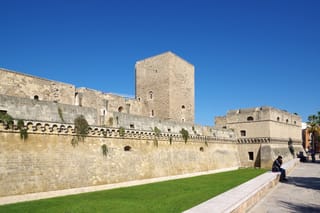
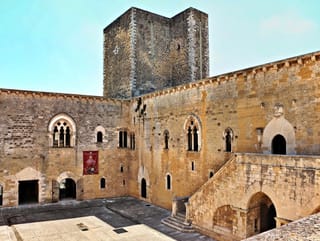
Norman-Hohenstaufen Castle (Sannicandro di Bari)
Città Metropolitana di Bari Puglia Italy
castle, chateau
Castello normanno-svevo (Sannicandro di Bari)
Città Metropolitana di Bari Puglia Italy
castle, chateau
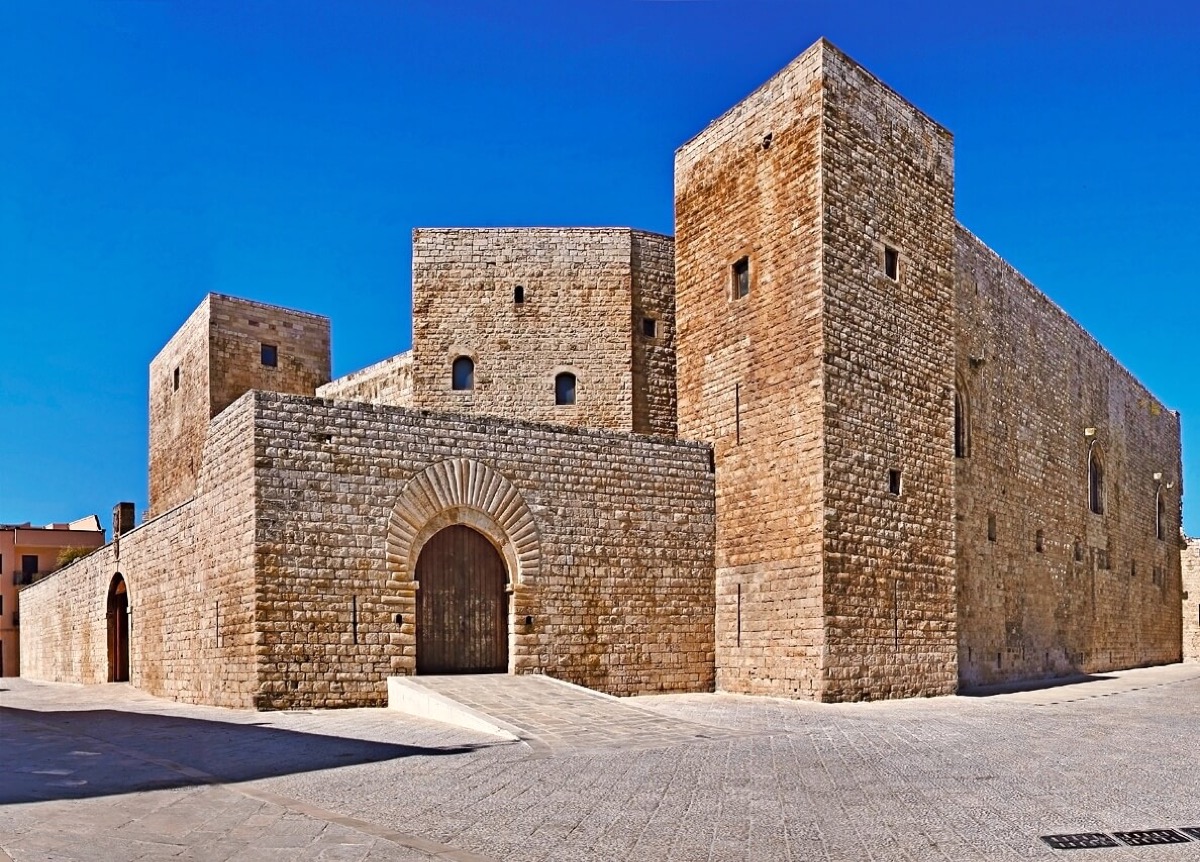
The Norman-Hohenstaufen Castle is a medieval building in Sannicandro di Bari, in Southern Italy
Il Castello Normanno-Svevo è una fortificazione che sorge nella zona medievale di Sannicandro di Bari, tra le caratteristiche case a scalinata esterna, ed era circondato da un antico fossato di epoca sveva, colmato e trasformato in strada solo nel 1836
Previous names
Norman-Hohenstaufen Castle (Sannicandro di Bari), Castello normanno-svevo (Sannicandro di Bari)
Description
The Norman-Hohenstaufen Castle is a medieval building in Sannicandro di Bari, in Southern Italy. It is located in the medieval part of town, between the characteristics houses with external staircases, surrounded by a moat, filled and turned into a street in 1836. It is composed of two distinct parts, put into each other, built in separate periods by the Byzantines and the Hohenstaufens. Its construction dates back to 916, the initiative of the Byzantine general Niccolò Piccingli, who had ordered the construction of a fortress for the defence of Apulia against the Saracens. It was located north of the small township of Sannicandro that, just in a century and a half, developed at the edge of the ruins of the ancient castle Mezardo. The original core of the castle, of Byzantine origin, consists of a sturdy brick wall of stone that runs along the trapezoidal layout, equipped with six four-sided towers distributed in the four vertices and the midpoint of the two bases of the trapezoid.
History
Norman period
In 1071, after three years of siege, Bari fell into the hands of the Norman Robert Guiscard, Duke of Apulia, and Sannicandro was proclaimed Barony and part of the County of Montescaglioso. The Castle of Sannicandro was at this point completely restored with Norman architecture. The four corner towers were rebuilt on the Byzantine ruins and connected by a solid curtain to four central towers. Eastward a wide moat and a drawbridge were built alongside the main tower, isolating and protecting the castle. The baronial palace was built behind the north curtain, with a rescue tunnel leading to the church of S. John outside the walls, built by the Normans themselves. When, finally, in 1087, the sacred relics of St. Nicholas arrived in Bari, in the Castle was built a chapel dedicated to the saint.
The last Norman Baron was William De Tot, who ruled the fief of Sannicandro presumably between 1150 and 1170, after a brief period, between 1131 and 1134, during which the barony was held by Count Guido da Venosa.
Hohenstaufen period
Evidence of the events that took place during the years of Hohenstaufen domination in southern Italy is lacking. The policy of centralization of power begun by Emperor Frederick II of Hohenstaufen and his intolerance towards the barons suggest that in that period the house of Sannicandro was not granted to any feudal lord.
In 1242 original Byzantine structure was completed by the Houhenstaufen emperor, who added the outside section in order to transform it into a fortified residential castle. An outer wall, 1.58 meters wide, surrounded, in fact, the perimeter of the manor, which was protected by a new moat. The north central Norman tower was demolished to allow the building of the great baronial palace, with three large mullioned windows, flanked and guarded by two massive towers. Into the wall, next to one of the towers, were hidden spaces for falconry, inaccessible and devoid of light, as the emperor had prescribed in his treatise De arte venandi cum avibus. Finally a rescue underground tunnel was built, which reached the open countryside to Bitetto.
During the years of Hohenstaufen domination the castle consisted of nine towers.
Angevin period
The advent of the Angevin domination was decisive for the history of the country. It is said that Prince Charles I of Anjou, imprisoned in Sicily, had asked for the protection of St. Nicholas of Bari, who, appearing, would have secured his release. After being freed and taking over the throne in Naples, Charles II of Anjou wanted to remunerate the shrine of the saint, whose intercession he attributed its salvation, with broad incomes and the richest gifts. In 1304, by permission of the Angevin kings, the fief of Sannicandro passed, therefore, to the Basilica of Saint Nicholas of Bari and began a period of relative stability.
In those years, the castle was never occupied by Prior-Baron because they resided at the Royal Court of Naples. Was therefore used as a seat for the farm administration of the Barony and in some ground floor rooms were planted a grain mill and an oil mill.
The authority of the Prior-Barons of the Chapter of St. Nicholas of Bari lasted five centuries, until 1806, when the law of King Joseph Bonaparte that abolished the feudal system was issued.
The feud was, therefore, subject to a common private property and the Chapter of the Real Chapter of Saint Nicholas came in the role of a simple user of real property.
The castle, which during the years of administration by the Basilica had maintained its original lines, lived a period of decay between 1806 and 1875. In fact, it emerged the problem of filling the void produced by the loss of feudal rights, and finding new sources of revenue for the maintenance of the Basilica of San Nicola and the Chapter. Therefore, the outer ring was opened with more doors and gates to obtain windows to be used as workshops, houses, barns and shops that provide income to the Nicholas Chapter. The gap was bridged, the underground tunnel blocked, the mullioned windows were defaced and turned into balconies. In 1951, the title passed by from the Prior of St. Nicholas of Bari to the Archbishop of Bari, and, with a public act of the 12 December 1967, the Municipality of Sannicandro di Bari bought the castle for the sum of 10,500,000 lire.
Il Castello Normanno-Svevo è una fortificazione che sorge nella zona medievale di Sannicandro di Bari, tra le caratteristiche case a scalinata esterna, ed era circondato da un antico fossato di epoca sveva, colmato e trasformato in strada solo nel 1836.
È composto di due parti distinte messe l'una nell'altra, costruite in epoche distanti tra loro, quella Normanna e quella Sveva. La sua edificazione risale alla prima dominazione normanna dei duchi d'Altavilla.
Storia
Il nucleo originario era stato realizzato su un'antica struttura muraria a pianta irregolare con quattro torri d'angolo circolari. Su questa originaria architettura sono oggi condotte delle ricerche per assegnarne la fondazione: longobarda, bizantina o saracena.
Periodo normanno
Sui ruderi di una preesistente struttura fortificata, i Normanni realizzarono un presidio militare, con quattro torri d'angolo e una cortina di collegamento. In seguito, nel periodo del Regno di Ruggero II di Sicilia il Castello venne ampliato con la costruzione del Palazzo, le quattro torri centrali rompitratta, il fossato e il portale a Levante. Il Signore del Castello nel periodo regnicolo è Guido Da Venosa, che ne prende possesso nel 1133 in occasione della creazione della Contea sperimentale di Conversano. Nel 1155 ritroviamo lo stesso Guido Da Venosa come Signore di Casamassima e a Sannicandro di Bari interviene un nuovo castellano, un certo Guglielmo De Tot. Il Castello era censito per 10 cavalieri alla pesante e 20 in caso di guerra secondo il Catalogo dei Baroni, dunque un maniero demaniale e di rilevante importanza.
Periodo svevo
Nel periodo Svevo il Castello venne ulteriormente modificato ed ingrandito, in quanto doveva rispondere a nuove funzioni: il passaggio dei convogli per il trasferimento di uomini e vettovaglie dirette in Terra Santa. La documentazione offre un preciso riferimento, a cominciare dal censimento del 1168, il cosiddetto "Catalogus Baronum" o meglio "Quaternus magnae expeditionis", che contiene il registro delle forze militari straordinarie mobilitate negli anni dal 1150 al 1168 dai re Normanni nel Ducatus Apuliae e nel Principatus Capue.
1) Dalla attenta lettura ci si rende conto che Guido Da Venosa, custode del Castello di Sannicandro di Bari nella prima edizione del 1150 è stato sostituito da Guglielmo de Tot nella seconda edizione del 1168. Il cambio della guardia sarà certamente avvenuto prima del 1155, in quanto un documento di questa data denuncia Guido Da Venosa come Signore di Casamassima.
2) Chi è Guglielmo De Tot che "Tenet in balio Sanctum Nicandrum, quod tenet in capite a domino Rege, quod sicut dixit Robbertus de Beneth et sicut est inventum in quaternionibus Curie, est pheudum decem militum et cum augmento debet dare milites viginti"?? Questa figura ha da sempre portato un alone di mistero nella Storia del Castello sannicandrese. Lo stesso prof. Errico Cuozzo, nel suo Commentario, non riesce a trovarne l'identità e il parentado e la provenienza.
3) Un ultimo documento, conservato presso l'Archivio di San Nicola di Bari ne rivela il ruolo e l'importanza: si tratta di un Magister di un ordine cavalleresco, che non solo conduce il Castello di Sannicandro di Bari ma da qui organizza e dispone anche per altre realtà castellari sull'intero territorio. Ed è a Guglielmo de Tot che si deve l'ampliamento castellare, intervenuto dagli anni a cominciare dal suo primo insediamento, intorno al 1155, fino alla ultimazione della intera impiantistica alla fine del XII secolo. Da un documento successivo del periodo angioino nel 1272 si rileva che l'ordine cavalleresco è quello dei Templari.
4) La politica d'accentramento del potere, intrapresa dall'imperatore Federico II di Svevia e la sua insofferenza nei confronti dei feudatari, soprattutto quelli che gli facevano concorrenza sulle rotte dei traffici verso la Terrasanta e l'Oriente, fanno supporre un intervento dell'Imperatore ad eliminare i Templari dal Castello. Al suo ritorno dalla crociata del 1229 infatti la persecuzione nei confronti dell'Ordine Templare si realizza e con l'accusa di eresia ne sequestra Beni e Mag
Negli anni del Baliaggio Templare il castello era costituito da nove torri.
Periodo angioino
L'avvento della dominazione angioina fu decisivo per la storia del paese. Si racconta che il principe Carlo d'Angiò, imprigionato in Sicilia, avesse domandato la protezione di san Nicola di Bari, il quale, apparendogli, gli avrebbe assicurato la liberazione. Ottenuta la libertà e tornato a Napoli col titolo regale, Carlo II d'Angiò volle rimunerare il Santuario del santo, alla cui intercessione attribuiva la salvezza, di ampie rendite e ricchissime donazioni. Nel 1304, per concessione dei re angioino, il feudo di Sannicandro passò, dunque, alla Basilica di S.Nicola di Bari e incominciò per esso un periodo di relativa stabilità.
In quegli anni, il Castello non fu mai abitato dal Priore-Barone perché questi risiedeva presso la Corte Reale di Napoli. Fu perciò adibito a sede dell'Amministrazione dell'azienda agricola della Baronia ed in alcuni locali a pianterreno furono impiantati un mulino ed un frantoio per la produzione di olio.
L'autorità dei Baroni-Priori del Capitolo di San Nicola di Bari durò cinque secoli, fino al 1806, anno in cui fu pubblicata la legge del Re Giuseppe Bonaparte che abolì il feudalesimo. Il feudo fu, dunque, assoggettato al regime di una comune proprietà privata ed il Real Capitolo di San Nicola entrò nel ruolo di un semplice usufruttario di beni immobili.
Il Castello, che durante gli anni dell'amministrazione nicolaiana aveva mantenuto la sua linea originaria, tra il 1806 ed il 1875 fu barbaramente rovinato. Per colmare il vuoto prodotto dalla perdita dei diritti feudali, infatti, sorse il problema del reperimento di nuove fonti di entrata per il mantenimento della Basilica e del Capitolo di San Nicola: la cinta esterna fu, dunque, aperta in più varchi per ricavarne porte e finestre da adibire a botteghe, abitazioni, stalle, negozi che assicurassero una rendita al Capitolo nicolaiano; il fossato fu colmato, la galleria sotterranea ostruita, le finestre bifore furono deturpate e trasformate in balconi.
Useful information
GRATUITO
Visita solo su prenotazione
-
External links
Nearby castles