Palais des Rohan
Bas-Rhin Grand Est France
castle, chateau
Palais des Rohan
Bas-Rhin Grand Est France
castle, chateau
The Palais Rohan (Rohan Palace) in Strasbourg is the former residence of the prince-bishops and cardinals of the House of Rohan, an ancient French noble family originally from Brittany
Le palais Rohan se situe dans le centre-ville de Strasbourg, Bas-Rhin, à côté de la cathédrale
Previous names
Palais des Rohan, Palais des Rohan
Description
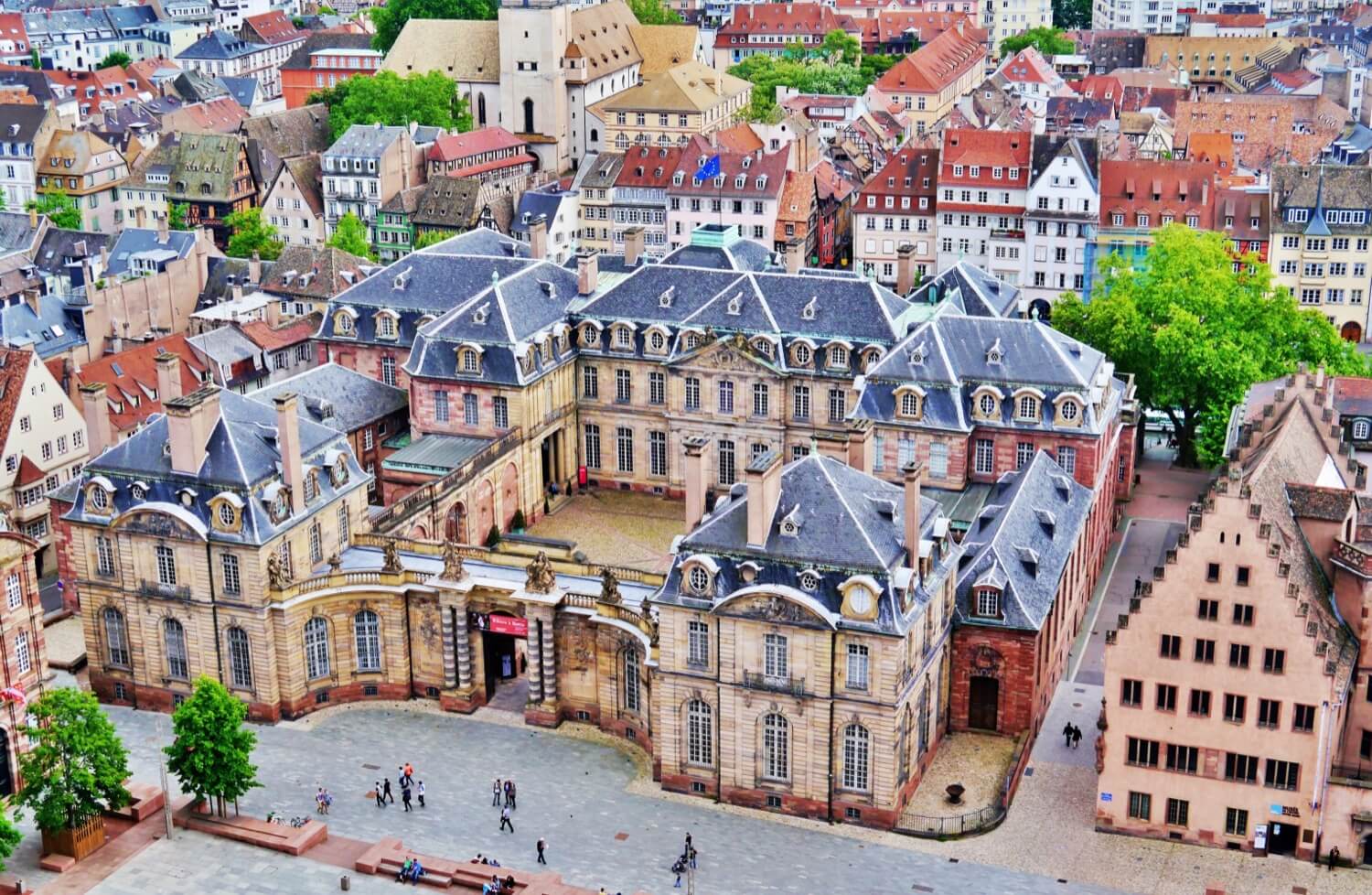
The Palais Rohan (Rohan Palace) in Strasbourg is the former residence of the prince-bishops and cardinals of the House of Rohan, an ancient French noble family originally from Brittany. It is a major architectural, historical, and cultural landmark in the city. It was built next to Strasbourg Cathedral in the 1730s, from designs by Robert de Cotte, and is considered a masterpiece of French Baroque architecture. Since its completion in 1742, the palace has hosted a number of French monarchs such as Louis XV, Marie Antoinette, Napoleon and Joséphine, and Charles X.
Reflecting the history of Strasbourg and of France, the palace has been owned successively by the nobility, the municipality, the monarchy, the state, the university, and the municipality again. Its architectural conception and its iconography were intended to indicate the return of Roman Catholicism to the city, which had been dominated by Protestantism for the previous two centuries. Thus the prelate's apartments face the cathedral, to the north, and many of the statues, reliefs and paintings reflect the Catholic dogma.
Since the end of the 19th century the palace has been home to three of Strasbourg's most important museums: the Archaeological Museum (Musée archéologique, basement), the Museum of Decorative Arts (Musée des arts décoratifs, ground floor) and the Museum of Fine Arts (Musée des beaux-arts, first and second floor). The municipal art gallery, Galerie Robert Heitz, in a lateral wing of the palace, is used for temporary exhibitions. The Palais Rohan has been listed since 1920 as a Monument historique by the French Ministry of Culture.
History
Up to 1871
In 1727 Armand Gaston Maximilien de Rohan, bishop of Strasbourg since 1704 and cardinal since 1712, commissioned the architect Robert de Cotte to design the palace; de Cotte provided initial plans the same year. Seven years prior, in 1720, Cardinal de Rohan had already charged de Cotte with renovation and embellishment works on his castle in Saverne, the predecessor of the current Rohan Castle. De Cotte had also previously designed the Hôtel du grand Doyenné, the first hôtel particulier in Louis Quinze style built in Strasbourg. The Palais Rohan was built on the site of the former residence of the bishop, the "bishop's demesne", which is recorded since at least 1262. The area itself is near the heart of the ancient Argentoratum, first mentioned in 12 BC. Diverse archaeological excavations on Place du Château, the square facing the palace, have unearthed many remains of the Roman camp.
Building work on the Palais Rohan took place from 1732 until 1742 under the supervision of the municipal architect Joseph Massol, who also worked on the Hôtel de Hanau and the Hôtel de Klinglin during the early years of the project. Massol was assisted by the architects Laurent Gourlade and Étienne Le Chevalier. The sculptures, including statues as well as reliefs, were provided by Robert Le Lorrain, assisted by Johann August Nahl, Gaspard Pollet, and Laurent Leprince, and the paintings by Pierre Ignace Parrocel (it) and Robert de Séry (fr). The ébéniste Bernard Kocke and the ironworkers and locksmiths Jean-François Agon and his son Antoine Agon worked on the furnishings of the apartments, while the stucco was the work of the Italians Castelli and Morsegno. A budget of 344,000 French livres had been established for the construction – 200,000 livres lent from the Cathedral chapter (Grand Chapitre) and 144,000 raised as local taxes over a period of twelve years – but the final cost is estimated at one million French livres. The palace is mostly built in yellow sandstone from Wasselonne, with pink sandstone for the less visible parts.
The House of Rohan owned the palace until the French Revolution, when it was confiscated, declared bien national ("state owned"), and finally auctioned off on 8 August 1791. Bought by the municipality, it became the new town hall (hôtel de ville) the same year, succeeding the Neubau. Much of the furniture and many of the works of art in the Palais were sold, and in 1793 the eight life-sized mural portraits of prince-bishops decorating the Salle des évêques (Bishops' Hall) were destroyed. They were replaced in 1796 by allegories of civic virtues painted by Joseph Melling. Only the portrait of Armand Gaston, the builder of the palace, was later restored to its original place with a 1982 replica of Hyacinthe Rigaud's lost painting. Melling also replaced the overdoor portraits of kings of France, decorating the same room with paintings of vases.
The Palais Rohan remained the hôtel de ville until 1805. That year, the municipality presented it to Napoleon, who returned the Hôtel de Hanau in exchange. Like the palace, the hôtel had been state-owned since the Revolution. The 1805 arrangement proved favourable for the municipality: the maintenance of the Hôtel de Hanau was less costly than that of the larger Palais Rohan. It pleased Napoleon, for whom the palace was the more conspicuous display of grandeur. As for the palace, imperial ownership meant renewed splendour. The present to Napoleon was officially accepted by decree on 21 January 1806; the interiors were then refurbished by the architect Pierre-François-Léonard Fontaine. In the years before the Franco-Prussian War and the return of Alsace to Germany, the Palais Rohan was the property of the French state, which was in turn an empire, a kingdom, a monarchy, a republic, and again an empire.
Since 1871
The year 1871 signified the end of French rule and the beginning of German rule over Alsace, which had until 1681 been linked to Germany through the Holy Roman Empire. Having lost the Franco-Prussian War, France had to cede the departments of Bas-Rhin, Haut-Rhin, and Moselle (the territory also known as Alsace-Lorraine, or Elsass-Lothringen in German) to the newly created German Empire. Now under new administration and having lost its residential purpose, the Palais Rohan had to be assigned a new role. Between 1872 and 1884, until the opening of the Palais universitaire, it was used by the newly established Kaiser-Wilhelms-Universität, the Imperial German version of the University of Strasbourg, as the seat of the faculties of law, philosophy, and sciences. The palace then served as the university's library until the opening of the National and University Library in 1895. After this, the palace again became the property of the city and was adapted to receive the municipal art collections that were being built up again by director Wilhelm von Bode after their total destruction during the Siege of Strasbourg (see below, Musée des beaux-arts). The first section of the new Kunstmuseum der Stadt Strassburg, established in 1898, was inaugurated in 1899.
After the return of Alsace to French rule in 1918, the new director of the Musée des beaux-arts and the Musée des arts décoratifs, Hans Haug (1890–1965), put major efforts into presenting the Palais Rohan as a coherent whole again. Strasbourg suffered during World War II, and on 11 August 1944 the palace was damaged by British and American bombs. After the war, restoration measures were soon undertaken under the supervision of the architects Robert Danis (1879–1949) and Bertrand Monnet (1910–1989), but in 1947 a fire broke out and devastated a significant part of the collections of the Museum of Fine Arts. This fire was an indirect consequence of the bombing raids: because of the destruction inflicted on the palace, the building had suffered from damp, which was treated with welding torches, and poor handling of these caused the fire.
Rebuilding and refurbishing the palace took until well into the 1950s, with full restoration not completed until the 1990s. In 1989 a large trompe-l'œil fresco depicting the Roman goddess Ceres was rediscovered behind layers of plaster and white paint in the former dining hall, the eastern wing of the Synod Hall (see below, Apartments). It is thought to have been concealed under Napoleonic ownership, and had been forgotten since.
Le palais Rohan se situe dans le centre-ville de Strasbourg, Bas-Rhin, à côté de la cathédrale. Il abrite aujourd'hui trois musées, le musée des arts décoratifs, le musée des beaux-arts et le musée archéologique.
Il fait l’objet d’un classement au titre des monuments historiques depuis le 20 janvier 1920.
Histoire
Ce bâtiment du xviiie siècle a été construit entre 1732 et 1742 par l'architecte Robert de Cotte pour le prince-évêque Armand Gaston Maximilien de Rohan pour remplacer le précédent palais épiscopal. Il est bâti dans le style classique, devenu à la mode après la conquête française de Strasbourg.
Dès 1704, Armand Gaston de Rohan fait acheter plusieurs immeubles proches de la cathédrale. En 1727, il fait démolir les vieux bâtiments sur les bords de l'Ill et fait construire le palais. Robert de Cotte élabore les plans, Laurent Gourlade conduit les travaux. Il sera remplacé plus tard par Joseph Massol. Les bâtiments commencés en 1732 furent finis dix ans plus tard.
Pendant la Révolution française, le bâtiment sert de lieu de détention. Le 21 décembre 1794 consacre l’ouverture solennelle de l’École impériale du Service de santé militaire de Strasbourg destinée à former des Officiers de Santé. Les cours ont lieu au Palais Rohan. Après la défaite de 1870, l’école est transférée à Lyon.
Le 3 avril 2009, en marge du sommet de l'OTAN Strasbourg-Kehl 2009, la première rencontre du président de la République française Nicolas Sarkozy et du président américain Barack Obama, nouvellement élu, a eu lieu au palais Rohan.
En 2015, du 26 juin au 29 novembre, la Terrasse du Palais Rohan accueille les œuvres des lauréats du concours Verre et Architecture, organisé dans le cadre de la Biennale Internationale du Verre.
Origine du nom actuel
Le palais a pris le nom de « palais Rohan » car quatre prince-évêques issus de la famille de Rohan, se sont succédé au xviiie siècle au diocèse de Strasbourg :
Le cardinal Armand Gaston Maximilien de Rohan
Armand de Rohan-Soubise (petit-neveu du précédent)
Le cardinal Louis Constantin de Rohan-Guéméné (cousin du premier)
Le cardinal Louis René Édouard de Rohan (neveu du précédent, compromis dans l'affaire du collier de la reine)
Architecture
Le visiteur pénètre dans la cour d’honneur en passant par un portail monumental en arc de triomphe surmonté de statues représentant la Clémence et la Religion. La cour d’honneur donne à gauche et à droite sur les bâtiments administratifs et utilitaires du palais. Le corps principal est à deux étages, le rez-de-chaussée était réservé à l’évêque, l’étage à son personnel.
La façade principale (côté Ill) est à dix-sept axes (fenêtres), entourant un corps central à quatre colonnes engagées et coiffé d'un fronton triangulaire. À l'ouest se trouve une grande bibliothèque à grande baie appareillée qui atténue la symétrie de l'ensemble. La façade sur cour est plus intime et s'anime de pilastres. Deux ailes courtes en retour abritent les vestibules d'entrée. Au nord, face à la cathédrale, le monumental portail à colonnes s'ouvre entre deux somptueux pavillons d'angle. On estime le coût de l'ensemble à un million de livres, le mobilier à trois cents mille.
Intérieurs
Grands appartements
Ce sont les appartements de parade réservés au roi ou aux hôtes de marque que le cardinal recevait en son nom. Ils sont orientés au sud, vers la terrasse donnant sur l'Ill.
Salle du Synode
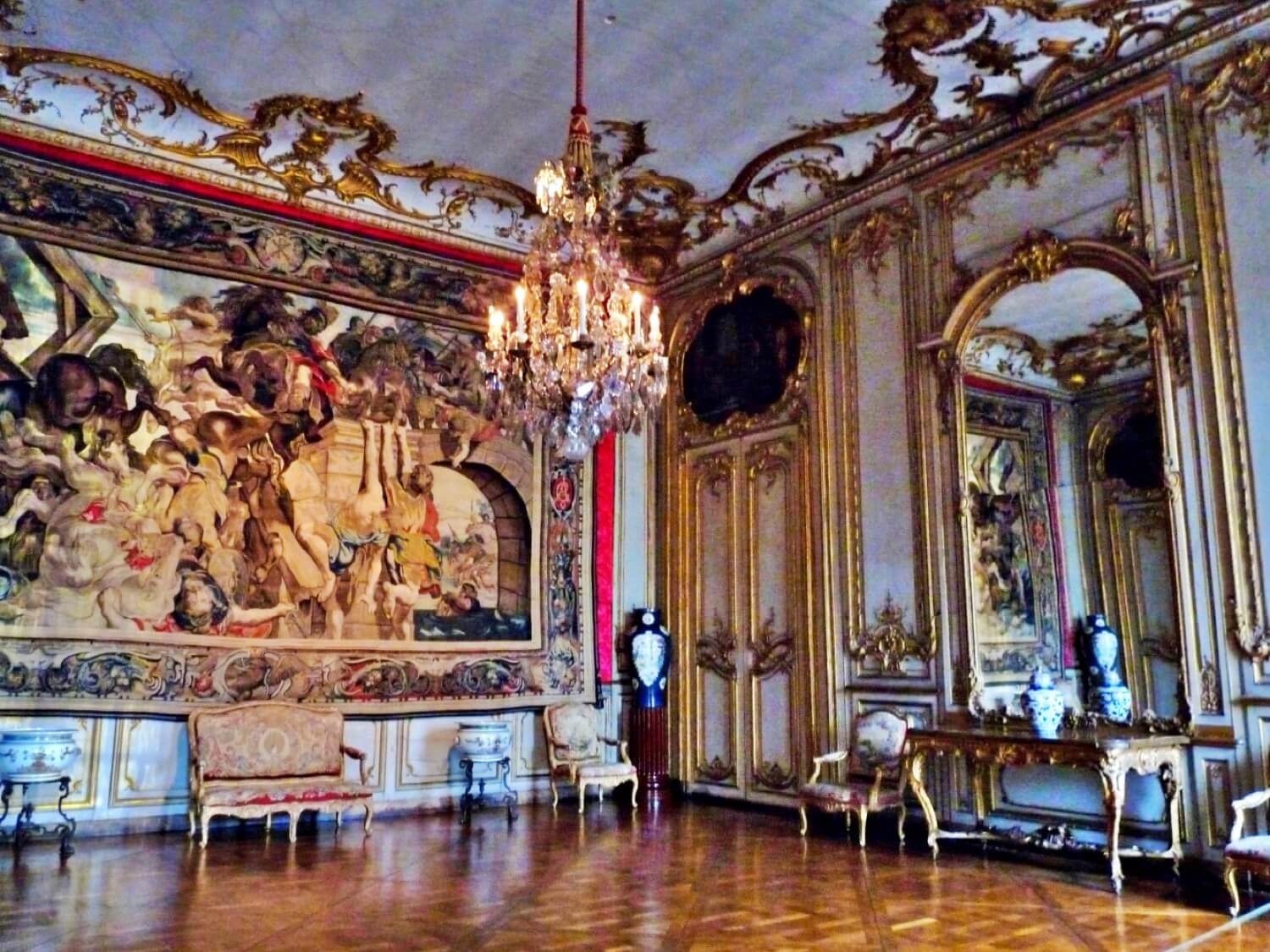
La salle du Synode réunit en réalité deux salles jumelles, la Salle des gardes et la Salle à manger séparées par des arcades. Les deux vases à couvercle, en porcelaine de Chine à décor bleu et blanc, datent de la fin de l'époque Ming, soit du milieu du xviie siècle, et témoignent, parmi d'autres œuvres présentées, du goût du cardinal pour les arts d'Extrême-Orient.
Salon des évêques
à la manière du salon de l'Œil-de-Bœuf de Versailles, le Salon des évêques joue le rôle de seconde antichambre avant la chambre du roi6. Dans les boiseries blanc et or assez simples étaient enchâssés les portraits des sept prédécesseurs du cardinal et le sien propre. Seul celui-ci a été conservé, les autres ont été détruits en 1773 et furent remplacés plus tard par des allégories dues à Joseph Melling. Le palais ayant été transformé en hôtel de ville et le salon des évêques en salle des séances du conseil municipal, elles incarnent six vertus civiques : La Prudence, La Paix, L'Immortalité, La Concorde, Le Zèle et La Félicité publique. Pour les uns, les couleurs froides et le dessin très sobre marquent l'évolution du peintre – élève de Boucher – vers un style néo-classique, alors que d'autres jugent ces œuvres « fades ». Contrairement aux tableaux, les huit bustes d'empereurs romains – des copies du xviie siècle – ont conservé leur emplacement d'origine voulu par le cardinal.
Chambre du roi
connue sous le nom de chambre du Dais sous l'Ancien Régime, c'est une pièce de prestige dont la fonction s'inspire directement de l'étiquette en usage au château de Versailles : servir de cadre à la cérémonie du lever et du coucher du prince. Elle se distingue par ses boiseries en chêne sculpté, peint et doré, et son plafond en stuc de style rocaille. Dans le fond de la pièce, l'alcôve royale fait face aux trois fenêtres donnant sur l'Ill. Elle est encadrée par des colonnes cannelées peintes en faux marbre, surmontées de chapiteaux corinthiens et reliées par une balustrade blanc et or. Trois tapisseries faisant partie de L'Histoire de Constantin – une suite de huit tapisseries d'après des cartons de Rubens présentes dans l'ensemble des grands appartements – ornent le fond de l'alcôve. Acquises par le cardinal de Rohan en 1738, elles sont issues des ateliers parisiens du Faubourg Saint-Marcel. Les tableaux des trumeaux d'entre-fenêtres sont des originaux de Pierre-Ignace Parrocel, un peintre issu d'une grande famille d'artistes avignonais que le cardinal ramena en 1740 de Rome où le jeune homme se formait. Ces œuvres représentent Jésus et la Samaritaine et La Tentation du Christ.
Salon d'Assemblée
la grande tapisserie murale fait partie de la suite des huit tapisseries L'Histoire de Constantin décorant les grands appartements, elle représente La Bataille du Pont-Molle (ou bataille du pont Milvius).
Bibliothèque
quatre autres tapisseries illustrant la vie de Constantin représentent Le Mariage de Constantin, L'Apparition du Chrisme, Sainte Hélène et la Vraie Croix et Le Baptême de Constantin. Deux portraits de monarque en costume de sacre – Louis XIV et Louis XV se font face. Ce sont des copies d'œuvres de Hyacinthe Rigaud, réalisées par Pierre Legendre. Le buste est celui du cardinal de Rohan, exécuté par Edmé Bouchardon en 1730.
Chapelle
la chapelle est contiguë à la bibliothèque. Elle est dotée d'un décor de scagliola polychrome et de trois copies d'après Le Corrège confiées à Robert de Séry (1686-1733) : La Nativité, La Vierge avec saint Jérôme et sainte Madeleine et Le repos pendant la fuite en Égypte (1724). Le tapis, d'inspiration turque, a été achevé par la manufacture d'Aubusson en 1743. Il porte les armes du cardinal de Rohan.
Petits appartements
Les appartements du prince-évêque sont orientés vers le nord, du côté de la cour d'honneur.
Antichambre du prince-évêque
Cette pièce a servi d'antichambre à l'appartement privé sous les cardinaux, puis de petite salle à manger sous l'Empire. Sévèrement endommagée lors du bombardement de 1944, elle a fait l'objet d'importants travaux de restauration et n'a pas conservé son mobilier. En particulier, l'ancien poêle a été remplacé par un poêle en faïence analogue, en forme d'obélisque, issu de la manufacture strasbourgeoise Acker vers 1771.
Chambre à coucher de Napoléon Ier
D'abord cabinet du prince-évêque, cette pièce prit le nom de « chambre à coucher de Napoléon Ier » sous l'Empire. Plusieurs hôtes de marque y auraient séjourné : Napoléon en 1805, 1806 et 1809 ; Charles X du 7 au 8 septembre 1828 ; le roi-citoyen Louis-Philippe du 18 au 21 juin 1831. Du nouveau mobilier conçu par Jacob-Desmalter en 1807 il ne subsiste que le lit. En 1809 l'ébéniste parisien réalisa également les sièges qui meublèrent d'abord le salon de compagnie de l'impératrice au premier étage8. Selon la même source, l'empereur n'aurait de fait jamais occupé cette chambre.
Cabinet de l'hôtel Oesinger
Restaurées, les boiseries proviennent du premier étage de la maison habitée au xviiie siècle par l'industriel François-Daniel Oesinger au 140, Grand-Rue. La cheminée est celle du salon de la maison où vécut le professeur Christophe-Guillaume Koch au 8, quai Finkwiller. Le tapis fut confectionné en Anatolie de l'Est au xviie siècle. Le portrait est celui de Nicolas François Coliny (1710-1776), médecin à Strasbourg. Il fut exécuté par Charles-Alexis Huin (1735-1796) à Strasbourg en 1773.
Les pièces principales de cette suite épiscopale sont complétées par des garde-robes, des lieux d'aisance et un escalier de dégagement qui communique avec la chapelle.
Useful information
Parking PAYANT (Parking Gutenberg, 3 Place Gutenberg. Tarif: 0,60 €/15 minutes; 4,80 €/2 heures; 44 €/24 heures)
Adulte: 6,50 €
Tarif réduit: 3,50 €
Enfant (moins de 18 ans): gratuit
WC GRATUIT
-
External links
Nearby castles
Palais du Rhin
Bas-Rhin
0.8km
castle, chateau
Château de Pourtalès
Bas-Rhin
4.7km
castle, chateau
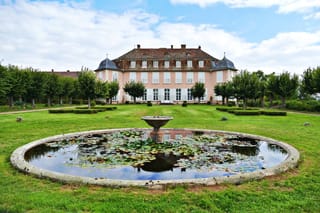
Château de Kolbsheim
Bas-Rhin
12.6km
castle, chateau
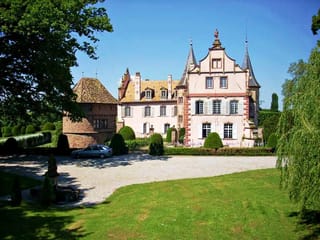
Château d'Osthoffen
Bas-Rhin
14.6km
castle, chateau
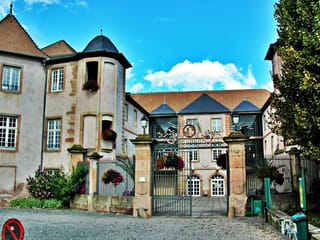
Château des Rohan (Mutzig)
Bas-Rhin
22.5km
castle, chateau
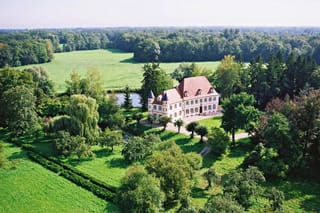
Château de Werde
Bas-Rhin
23.1km
castle, chateau