Château de Beaumesnil
Eure Normandie France
castle, chateau
Château de Beaumesnil
Eure Normandie France
castle, chateau
Château de Beaumesnil is a 17th-century Louis XIII baroque style château located in the commune of and close to the village of Beaumesnil in Eure department of Normandy in northern France
Le château de Beaumesnil est situé dans la commune de Beaumesnil, département de l’Eure, en Normandie

Previous names
Château de Beaumesnil, Château de Beaumesnil
Description
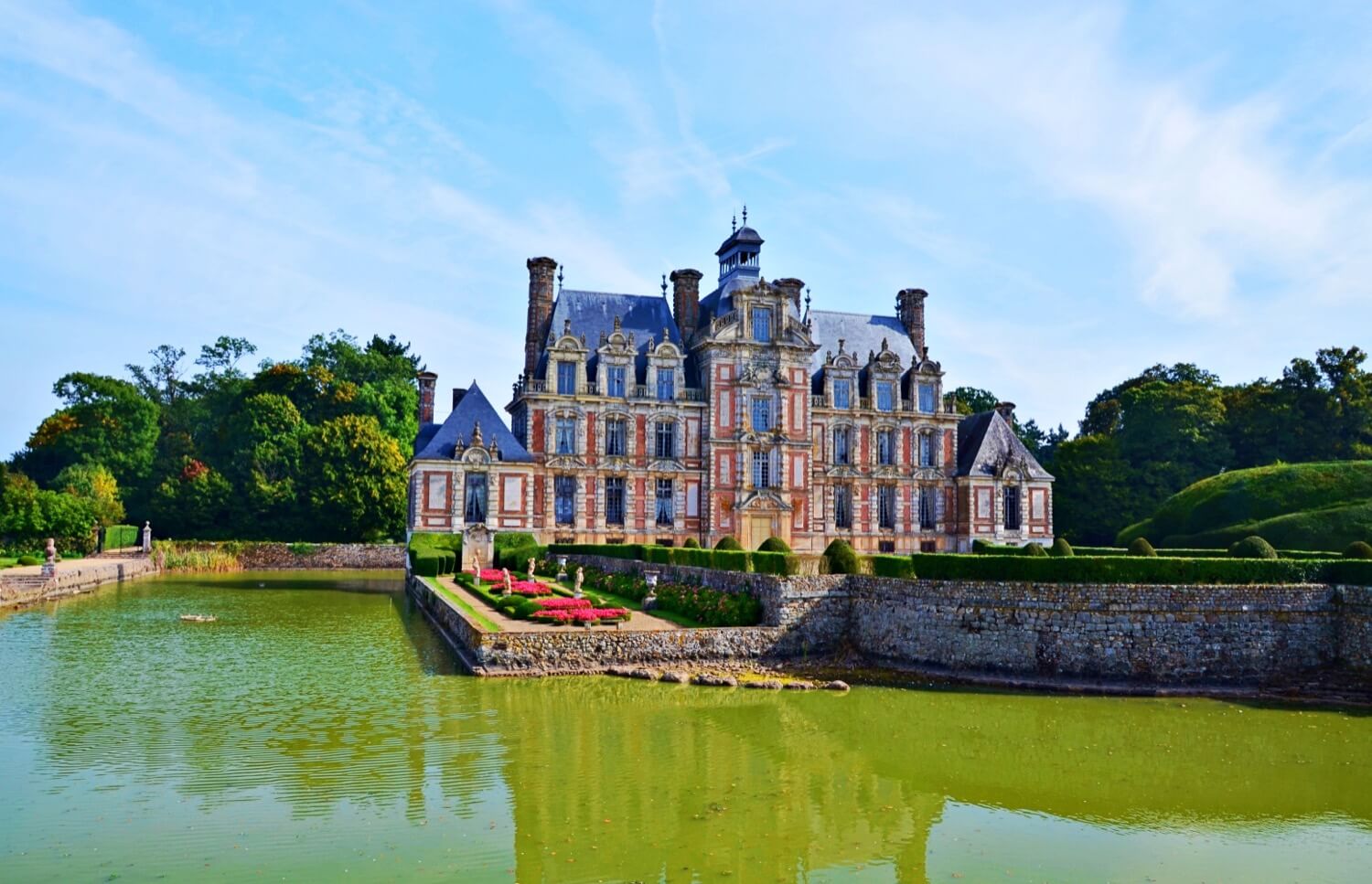
Château de Beaumesnil is a 17th-century Louis XIII baroque style château located in the commune of and close to the village of Beaumesnil in Eure department of Normandy in northern France. The château, now an official historical monument of France, is surrounded by a moat, having been built on the site of a medieval castle of the same name.
Description
The château, which is an official historical monument of France, is located on a 60 hectare estate to the north-east of the village of Beaumesnil, 140 km west of Paris and midway between the towns of Lisieux and Évreux. A large proportion of the estate is woodland, but in traditional French formal style an east-west axis contains the château, its forecourt and moat at the western end while the central and eastern part of the axis are laid to grass.
Château
The château, one of France's smaller châteaus, designed and built by John Gallard during the reign of Louis XIII between 1633 and 1640, is constructed of stone and brick walls with a slate roof on the ruins of the motte-and-bailey castle that had stood on the site since medieval times. The east and west facades are heavily decorated with carvings — windows have grotesque masks inspired by the Commedia dell'arte, intertwined letters "M" and "D" allude to Marie Dauvet Des Marets, wife of Jacques, Marquis of Nonant and daughter Nicolas Brûlart de Sillery, Chancellor of France while the shields of the Montmorency-Laval branch of the Laval family appear above the main doorways.
The north and south pavilions were added to the building during the eighteenth century. The donjon (keep) that was built on a mound to the south of the site was converted into an icehouse. The mound is now covered with a boxwood maze. The château and forecourt were built on the bailley with the forecourt. A footbrige provides access to the château from the east and a vehicular bridge provides access to the forecourt and château from the west. Another footbridge connects the forecourt with the motte.
The eastern side of the château overlooks a parterre laid to lawn with woodland on either side. In the 18th century, wings were added to both the northern and southern ends of the château. The "state" rooms — the library, the drawing room, the dining room, the mistress' apartment are on the first floor and are accessed using the grand staircase.
Gardens
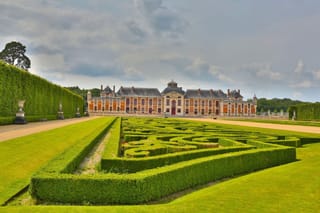
The château, which is nicknamed "Norman Versailles", is located in a 60 heactare estate landscaped by La Quintinie, a student of André Le Nôtre, though little is left of la Quintinie's original gardens. Much of the estate to the east of the château is wooded with a parterre laid to lawn, almost a kilometre in length, providing an impressive perspectives from the château's state rooms. The parterre is broken by a large pond, approximately one hectare in area, that has many features of a formal pond such as regular edging with specific geometric shapes.
Two formal flower beds were laid out in the 18th century to the east of the château, the smaller Jardin des quatre saisons (Four Seasons garden) on the northern side of the forecourt and the larger semi-circular Jardins demi-lune (Halfmoon garden) on the northern bank of the moat.
As part of a conservation plan, a kitchen garden with over 500 varieties of ancient vegetables, including unusual varieties like devil's ear lettuce and rainbow corn has been cultivated.
The library
The château's library and 16th century bookbinding museum were built up by the German-Jewish financier Hans Fürstenberg (1890 - 1982) who had fled Nazi Germany in 1937. He bought the château in 1938 and moved is collection of 16,000 books there, many of which dated from the seventeenth or eighteenth century. As the invasion of France drew near, valuable archives of the Bibliothèque nationale, the private archives of the King of the Belgians, the archives of Rouen and the Archives de France were moved to the château's library for safekeeping. Part of the collection was sent to Vichy France for safekeeping and the rest confiscated by the Nazi invaders. Fürstenberg's own collection ended up at the Schloss Tanzenberg in Kärnten, Austria. During the war, part of Fürstenberg's collection was lost, but the rest was returned to the château. After the war Fürstenberg rebuilt his collection, but in his later years sold parts of it to various institutes. Shortly after Fürstenberg's death, the library was further depleted when a number of items were sold to fund the Fondation Fürstenberg-Beaumesnil.
History
Beaumesnil was first mentioned in the Treaty of Saint-Clair-sur-Epte in 911 (the setting up of the Duchy of Normandy as part of the lands of the Counts of Meulan. In 1066 Roger de Beaumont, son-in-law to Waleran III, Count de Meulan, provided William the Conqueror with 60 ships. In 1250 Robert de Harcourt was given permission to build a stone donjon (keep) on the motte. This was later extended to incorporate a bailey, both of which were on islands.
During the Hundred Years' War, the castle fell to the English in 1415 and in 1418 was given to Robert Willoughby by Henry V. Beaumesnil was retaken by the French in 1441. In 1449 the castle, was restored to Jean II Tournebu who, in 1463, sold the property to Jean de Lorraine, Count of Harcourt.
In 1634 it was recorded that the castle had eight towers and a dwelling house with parlour, bedroom and kitchen, but little else was known of its structure. In that year Jacque Nonant, started the construction of the chateau on the site of the castle, the work being completed in 1641. The chateau passed through a number of hands and on the eve of the French Revolution was owned by Armand Joseph de Bethune, Duke of Chârost who was the first French nobleman to renounce his feudal rights. Nevertheless, the revolutionary army ransacked the chateau and guillotined Bethune-Charlost's son and heir.
Bethune-Charlost died in 1800 and his widow recovered the property and married Eugene Alexander Montmorency-Laval. Montgmorency-Laval set about a program of restoration including the building of a chapel in 18xx as a thanksgiving for the restoration of the Bourbon monarchy. Successive owners continued the restoration work and when the last owner Hans Fursetnberg died in 1982, his estate was used to set up the Fondation Fürstenberg-Beaumesnil.
Owners
In 1927 de Maistre sold the chateau to the American company Domaine of Beaumesnil, Inc., whose controlling director was Grand Duke Dimitri Pavlovich, member of the House of Romanov and first cousin of Tsar Nicholas II.] In 1938 Pavlovich sold the chateau to the Jewish financier and bibliophile Hans Furstenburg, a refugee from Nazi Germany. Furstenburg died in 1982 and bequeathed the chateau to a foundation that was entrusted to conserve the property and his library.
Le château de Beaumesnil est situé dans la commune de Beaumesnil, département de l’Eure, en Normandie. Une partie du château et du parc fait l’objet d’un classement au titre des monuments historiques depuis le 20 décembre 1966, le reste du château étant inscrit au titre des monuments historiques depuis le 8 mai 1926 et le reste du parc inscrit depuis le 5 février 1997.
De la forteresse élevée au XIIIe siècle, il ne subsiste, pour la mémoire, qu’une motte couverte d’un labyrinthe végétal qui matérialise l’emplacement d’une ancienne tour talutée.
Rare exemple de château d’époque Louis XIII (l’essentiel de la construction, dirigée par l’architecte Jean Gallard, se situe entre 1633 et 1640), la demeure actuelle, contemporaine de la fontaine Médicis et de l’hôtel de Sully, porte l’empreinte de la Renaissance finissante, mais on y trouve aussi la marque de courants nouveaux, venus d’Italie (style florentin) et de Hollande. Les matériaux utilisés sont la brique et la pierre. La brique, bon marché, était produite en grande quantité en Normandie mais, pour remédier aux éventuels défauts de fabrication, il était d’usage de renforcer les parties les plus fragiles avec de la pierre.
Côté ouest, l’entrée principale est précédée par un pont, une vaste cour formant terrasse et un escalier d'une vingtaine de marches aboutissant à mi-hauteur entre le sous-sol et le premier étage. Venant du parc, côté est, on franchit un autre pont qui débouche sur un double escalier donnant directement sur le premier étage. L’ensemble comprend:
un avant-corps central surmonté d’un lanternon, symbole de puissance où deux feux signalaient toute la nuit aux alentours l’emplacement du château;
un corps de logis rectangulaire comportant trois travées de part et d’autre de l’avant-corps, où se trouvaient les appartements des maîtres de maison et les pièces réservées aux invités de marque;
deux pavillons latéraux, ajoutés au XVIIIe siècle, où on logeait les personnes de moindre importance;
le tout coiffé d’une haute toiture en ardoise.
Le logis se compose de quatre niveaux : un sous-sol, deux étages et un étage de combles.
Sur les façades, construites par les Frères Martin et Toussaint La Flèche, c’est la ligne verticale, soulignée notamment par la hauteur des baies et des cheminées, qui domine. La décoration est assez chargée : chaque baie, chaque fenêtre, chaque lucarne est surmontée d’un fronton cintré ou triangulaire dont le centre est occupé par un mascaron inspiré des masques de la Commedia dell'arte. Le motif répétitif d’un M et d’un D entrelacés rappelle les initiales de la première propriétaire (Marie Dauvet Des Marets). On note l’association de trois couleurs: le bleu de l’ardoise, symbole du ciel, le blanc de la pierre, couleur royale, et le rouge de la brique, couleur des empereurs romains.
Le grand escalier d’honneur est entièrement logé dans l’avant-corps. Au niveau inférieur du corps de logis, qui abrite des soubassements à la belle architecture voutée, se trouvent:
la salle à manger des communs;
la cuisine, meublée et animée. Une cheminée monumentale, à l’intérieur de laquelle un tourne broche mécanique est installé; il permettait que les petits marmitons ne se brûle le visage à tourner la broche des heures durant. Un puits, un coussiège (sorte de banc en pierre construit dans le renfoncement des fenêtres) qui permettait de profiter de la lumière naturelle pour effectuer des travaux de couture; la cuisine est directement reliée au premier étage par un escalier de service.
Au second niveau, on découvre successivement:
la bibliothèque, où se trouve un tableau représente Marie de Médicis (le grand-père de l’épouse du premier propriétaire fut un de ses ministres); au-dessus de ce tableau, on lit la devise des Montmorency; le carrelage rouge reprend différents emblèmes de cette famille (l’aigle, le lion, le trèfle à quatre feuilles au milieu d’une branche de laurier et la croix des Croisés);
le Grand Salon en partie Louis XV, avec, au centre, des sièges dits «courants» (qu’on déplaçait fréquemment), recouverts de tissus aux motifs de fables de La Fontaine et de personnages exotiques et, le long des murs, des sièges cannés dits «meublants» (qu’on ne déplaçait pas), dont on recouvrait l’assise d’une galette en hiver; un paravent à quatre pans protégeait des courants d’air la personne installée sur le lit de repos, meuble confortable souvent utilisé pour la conversation; la cheminée est décorée d’une coquille Saint-Jacques au naturel; des lambris, sculptés dans les parties supérieures, sont présents sur les quatre murs; le tapis, qui recouvre une grande partie du parquet, était roulé et rangé quand la pièce n’était pas utilisée; au-dessus de la cheminée, la glace est composée de cinq éléments car la technique française du début du XVIIe siècle ne permettait pas encore la fabrication d’une grande surface d'un seul tenant; au plafond, la partie centrale, peinte en bleu, est encadrée par un bandeau d’ornement.
une salle à manger avec une table dressée, dont le sol est carrelé, comme dans la bibliothèque, aux armes des Montmorency; des tapisseries ont été posées par la suite mais la règle voulait qu’il n’y ait pas de tissu accroché aux murs en raison du risque d’imprégnation des odeurs ; de même, la cheminée a été ajoutée au XIXe siècle; avant, elle n’avait pas sa place dans ce type de pièce;
les appartements de Madame, dont une chambre dans laquelle on reconnaît un portrait d’Henriette de France, reine d’Angleterre; le secrétaire était équipé d’un dispositif ingénieux : l’ouverture du cylindre déclenchait le déplacement de la tablette et le retrait de celle-ci commandait la fermeture du cylindre ; le décor d’un dessus de porte est agrémenté de brins de muguet.
un petit bureau.
Le niveau supérieur abrite:
le musée de la reliure; dans laquelle on conserve un extrait des minutes de l’interrogatoire de Ravaillac, exposé dans une vitrine;
une galerie de cuisiniers célèbres auteur de livre de cuisines comme Antonin Carême ou Brillat Savarin;
une exposition de tables d’égoïstes et des arts de la table au fils des siècles;
Le dernier étage du château n'est pas ouvert à la visite.
Useful information
Adulte: 8,50 €
Enfant (4-12 ans): 5,50 €
Tarif réduit (13-25 ans, handicapé): 7 €
Famille nombreuse: 3 enfants payants, le quatrième enfant gratuit
Groupe: nous contacter
info@chateaubeaumesnil.com
-
External links
Nearby castles