Yarmouth Castle
Isle of Wight England England
castle, chateau
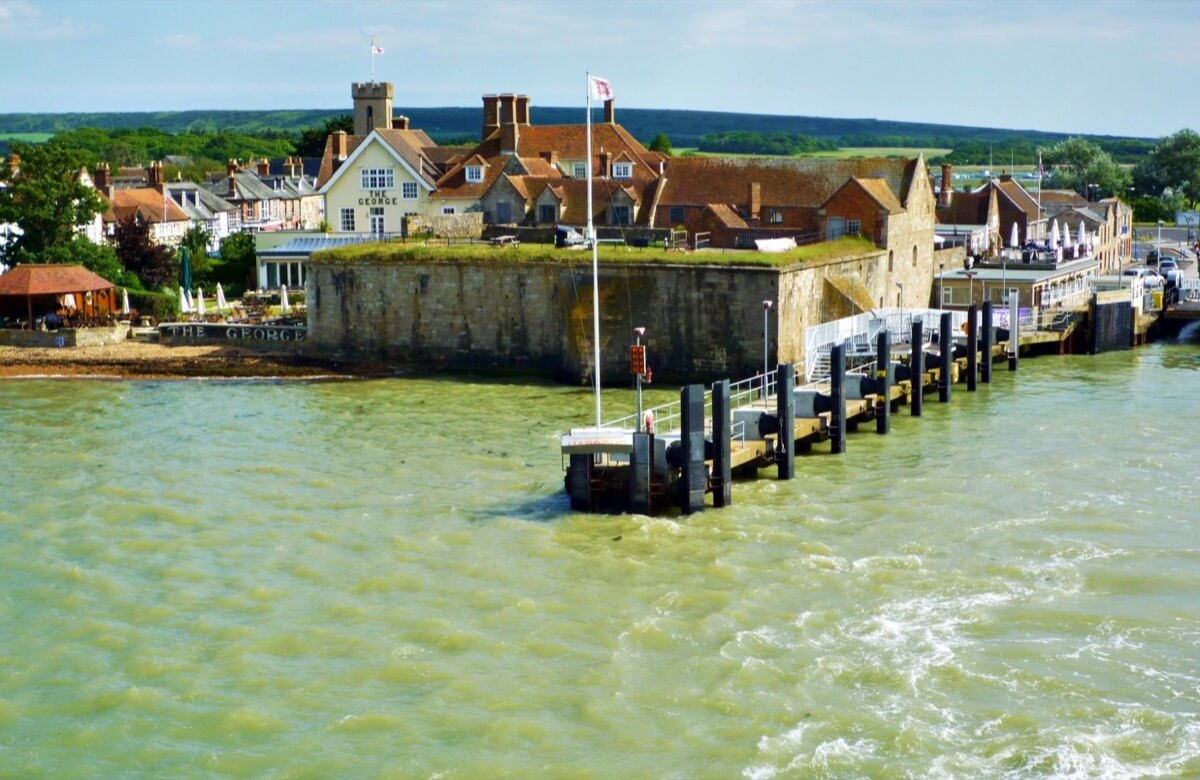
Yarmouth Castle is an artillery fort built by Henry VIII in 1547 to protect Yarmouth Harbour on the Isle of Wight from the threat of French attack
Previous names
Yarmouth Castle
Description
Yarmouth Castle is an artillery fort built by Henry VIII in 1547 to protect Yarmouth Harbour on the Isle of Wight from the threat of French attack. Just under 100 feet (30 m) across, the square castle was initially equipped with 15 artillery guns and a garrison of 20 men. It featured an Italianate "arrow-head" bastion on its landward side; this was very different in style from the earlier circular bastions used in the Device Forts built by Henry and was the first of its kind to be constructed in England.
During the 16th and 17th centuries the castle continued to be maintained and modified; the seaward half of the castle was turned into a solid gun platform and additional accommodation was built for the fort's gunners. A bulwark was built on the east side of the castle and an additional gun battery was placed on the town's quay, just to the west. For most of the English Civil War of the 1640s it was held by Parliament; following the Restoration, it was refortified by Charles II in the 1670s.
The fortification remained in use through the 18th and 19th centuries, albeit with a smaller garrison and fewer guns, until in 1885 these were finally withdrawn. After a short period as a coast guard signalling post, the castle was brought back into military use during the First and Second World Wars. In the 21st century, the heritage organisation English Heritage operates the castle as a tourist attraction.
Architecture
Yarmouth Castle is a square fortification, nearly 100 feet (30 m) across, with an arrow-head bastion protecting the landward side. The north and west walls face the sea, protected by angular buttresses, and a 10-metre (33 ft) wide moat originally protected the south and east side, although this has since been filled in. The castle's 16th-century bulwark, which originally covered the area to the west of Pier Street and the north of Quay Street, and its quay battery have also been destroyed.
The walls of the castle are mainly built from ashlar stone, with some red brick used on the south side. The walls are pierced by a small number of gunloops, including in the "ears" of the bastion, which would have overlooked the moat. When first built the interior of the castle formed a sequence of buildings around a courtyard, but the southern half of the castle was filled in shortly afterwards to produce a solid gun platform able to support heavy guns. It was later raised again in the 17th century to its current height. The parapet is now covered with turf, with 19th-century rounded corners, and the platform still has the rails on which the four naval guns would have traversed, dating from 1855. A small lodging room, built on the platform at the top of the stairs, has since been destroyed.
The arrow-head design of the castle's bastion reflected new ideas about defensive fortifications spreading out from Italy in the 16th century. Earlier Henrician castles had used the older European style of semi-circular bastions to avoid presenting any weak spots in the stonework, but an arrow-headed design enabled defenders to provide much more effective supporting fire against an attacking force. Yarmouth was among the first fortifications in Europe, and the first in England, to adopt this design.
The accommodation and other facilities are on the south side of the castle. On the ground floor, the entrance to the castle leads through to a courtyard, linked to four barrel-vaulted rooms in the south-west corner, originally 17th-century lodgings for the garrison. Two of these chambers were converted for use as magazines and the fittings of one of these still remains in place. In the south-east corner is the Master Gunner's House, comprising a parlour, hall and kitchen on the ground floor, and a chamber and attic on the floors above. The parlour and hall would have originally been separated by a screen; the chamber would also have been subdivided. On the first floor is a small chamber, supported on arches above the courtyard, which was used as a lodging. On the second floor, the Long Room runs on top of the barrel-vaulted chambers, its massive, original roof still intact.
Useful information
No parking
http://www.english-heritage.org.uk/visit/places/yarmouth-castle/prices-and-opening-times
http://www.english-heritage.org.uk/visit/places/yarmouth-castle/prices-and-opening-times
http://www.english-heritage.org.uk/visit/places/yarmouth-castle/prices-and-opening-times
External links
Nearby castles