Walmer Castle
Kent England England
castle, chateau
Walmer Castle is an artillery fort originally constructed by Henry VIII in Walmer, Kent, between 1539 and 1540
Previous names
Walmer Castle
Description
Walmer Castle is an artillery fort originally constructed by Henry VIII in Walmer, Kent, between 1539 and 1540. It formed part of the King's Device programme to protect against invasion from France and the Holy Roman Empire, and defended the strategically important Downs anchorage off the English coast. Comprising a keep and four circular bastions, the moated stone castle covered 0.61 acres (0.25 ha) and had 39 firing positions on the upper levels for artillery. It cost the Crown a total of £27,092 to build the three castles of Walmer, Sandown, and Deal, which lay adjacent to one another along the coast and were connected by earthwork defences. The original invasion threat passed, but during the Second English Civil War of 1648–49, Walmer was seized by pro-Royalist insurgents and was only retaken by Parliamentary forces after several months' fighting.
In the 18th century, Walmer became the official residence of the Lord Warden of the Cinque Ports and was gradually modified from a military fortification into a private residence. Various Prime Ministers and prominent politicians were appointed as Lord Warden, including William Pitt, the Duke of Wellington and Lord Granville, who adapted parts of the Tudor castle as living spaces and constructed extensive gardens around the property. By 1904, the War Office agreed that Walmer had no remaining military utility and it passed to the Ministry of Works. Successive Lord Wardens continued to use the property but it was also opened to the public. Walmer was no longer considered a particularly comfortable or modern residence, however, and Lord Curzon blamed the poor condition of the castle for his wife's death in 1906.
Lord Wardens since the Second World War have included Winston Churchill, Robert Menzies and Queen Elizabeth The Queen Mother, but they have made only intermittent use of Walmer Castle. In the 21st century, Walmer Castle is run as a tourist attraction by English Heritage. The interior of the castle displays a range of historical objects and pictures associated with the property and its Lord Wardens, protected since the 19th century by special legislation. The grounds include the Queen Mother's Garden, designed by Penelope Hobhouse as a 95th birthday gift for Elizabeth in 1997.
Architecture
Castle
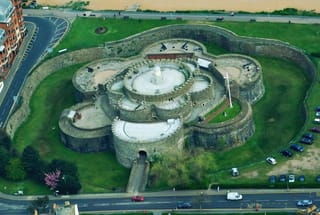
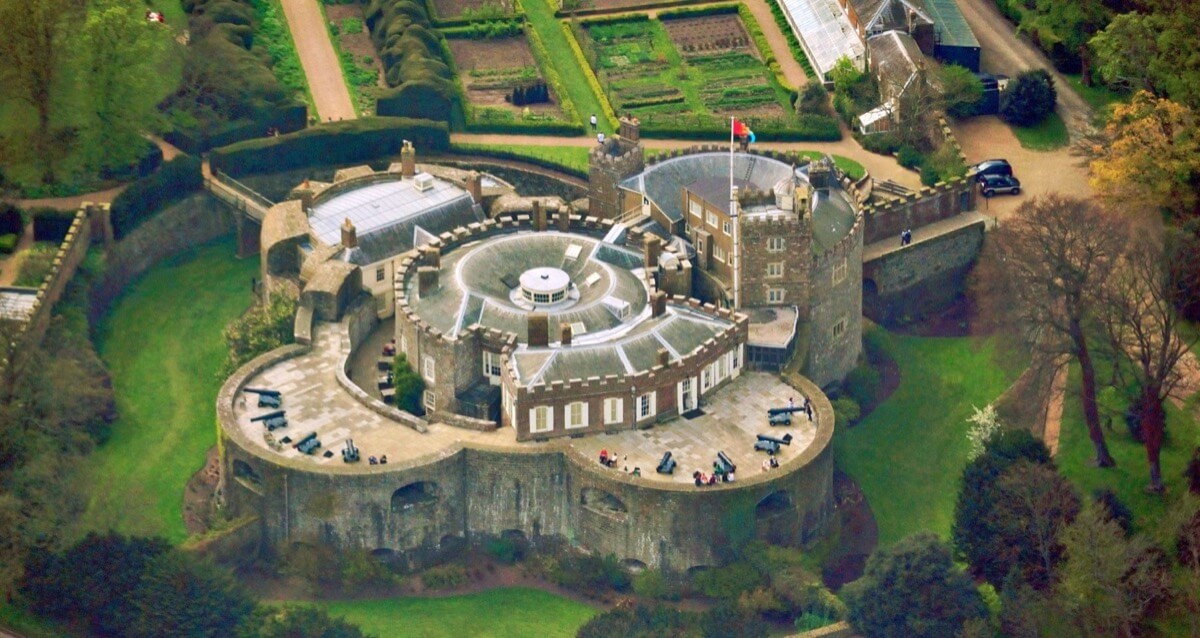
Walmer Castle retains most of its original 16th-century structure, with a tall keep, 83 feet (25 m) across, at the centre, flanked by four rounded bastions, one of which served as a gatehouse, and a moat, surrounded in turn by a curtain wall. Its curved walls are 15 feet (4.6 m) thick. It was nearly identical to its sister castle at Sandown and was approximately 167 by 167 feet (51 by 51 m) across, covering 0.61 acres (0.25 ha). The historian John Hale considered the original castle to form a transitional design between older medieval English designs and newer Italian styles of defence.
The castle had three tiers of artillery – the heaviest and longest range weapons occupying the upper levels, including the keep – with a total of 39 firing positions, and 31 gunloops in the basement for handguns should close defence be required. The embrasures in the walls were all widely splayed to provide the maximum possible space for the guns to operate and traverse, and the interior of the castle was designed with vents to allow the smoke from its guns to escape.
From the 18th century onwards, the interior of the castle was converted to provide accommodation for the Lord Wardens, almost all of which is now open to visitors. The castle is still entered through the ground floor of the gatehouse in the western bastion, which contains the original porter's lodge. In the middle of the castle is the keep, which originally housed the Servants' Hall and now a set of tea rooms. In the southern bastion is a set of rooms which are reached through the Hall Room, originally built as gunners' lodgings in the 18th century and converted into the entrance hall to the castle in the 1930s. On the far side of the bastion are the Sackville and Willingdon Rooms, built in the 18th century; the Willingdon Room is now used as a museum for objects relating to William Pitt. The Lucas Room has been redecorated in a mid-19th century style and is used to present various items of Wellington memorabilia. The north and east bastions are filled in, providing solid foundations for the gun platforms above.
The second floor contains the Lord Warden's private apartments in the west bastion and the western half of the keep. In the southern bastion is the Duke of Wellington's Room and the Lucas Room, originally part of an apartment of rooms selected by William Pitt for his use, as they formed the warmest part of the castle. The corridor running across the castle through the keep was built by Pitt to link the north and south halves of the castle.
The Prince Consort's and Queen Victoria's rooms in the keep are named after their use during the royal visit of 1842, although their decoration today dates from the interwar period. The Dining Room, Drawing Room and Ante Room, which overlook the northern bastion, date from the 1730s, when the Duke of Dorset constructed them to form a private set of chambers. These rooms feature a range of pink and purple window glass, which tradition says was installed by the Earl of Liverpool to protect his wife's eyesight; recent analysis shows that some of the pink-tinted glass dates from the 1730s, and discoloured naturally over time, while other panes were intentionally purchased around 1800 in these hues, but probably as status symbols and not for any medical purpose.
Gardens
The gardens of Walmer Castle date mainly from the 1790s and 1860s and comprise around 32 acres (13 ha) of land, split evenly between formal ornamental gardens and parkland. The main body of the gardens stretches away from the castle towards the north-west, and is made up of protected, well-drained, chalk-based soil, forming a maritime microclimate.
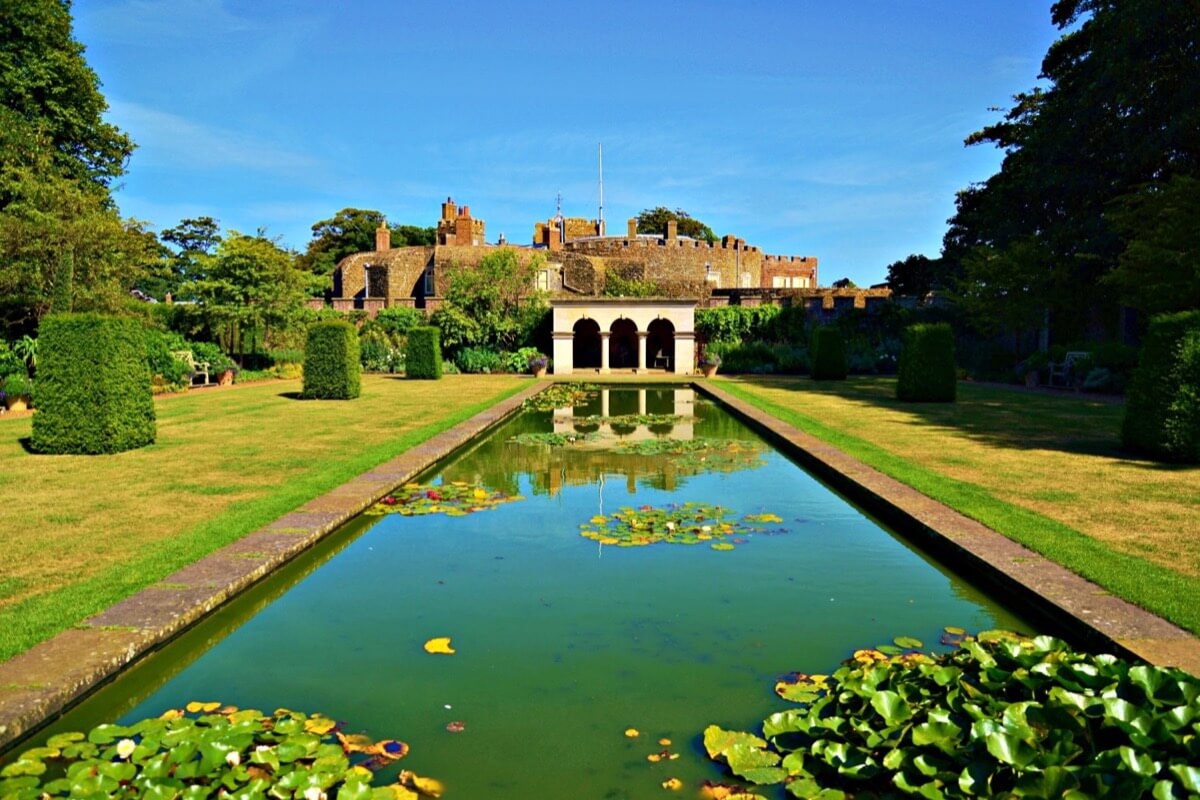
The castle is approached through the castle meadow, an area of open parkland, lined with Holm oaks planted in the 1860s, and is surrounded by the dry moat, now a garden dating from at least the 1850s and planted with trees and shrubs. Adjacent to the castle are the Queen Mother's Garden and the kitchen garden and glasshouses. The Queen Mother's Garden was built by English Heritage as a 95th birthday gift for the then Lord Warden in 1997, the site having been originally part of the wider kitchen gardens, before being turned into a tennis court in the 1920s. Designed by Penelope Hobhouse, the garden incorporates classical and Islamic themes, with a 92-foot-long (28 m) pool, a viewing mound and a classical pavilion. The two glasshouses have been restored, functioning as cold greenhouses, while the remainder of the kitchen garden is planted with a mixture of vegetables, fruit trees and flowers.
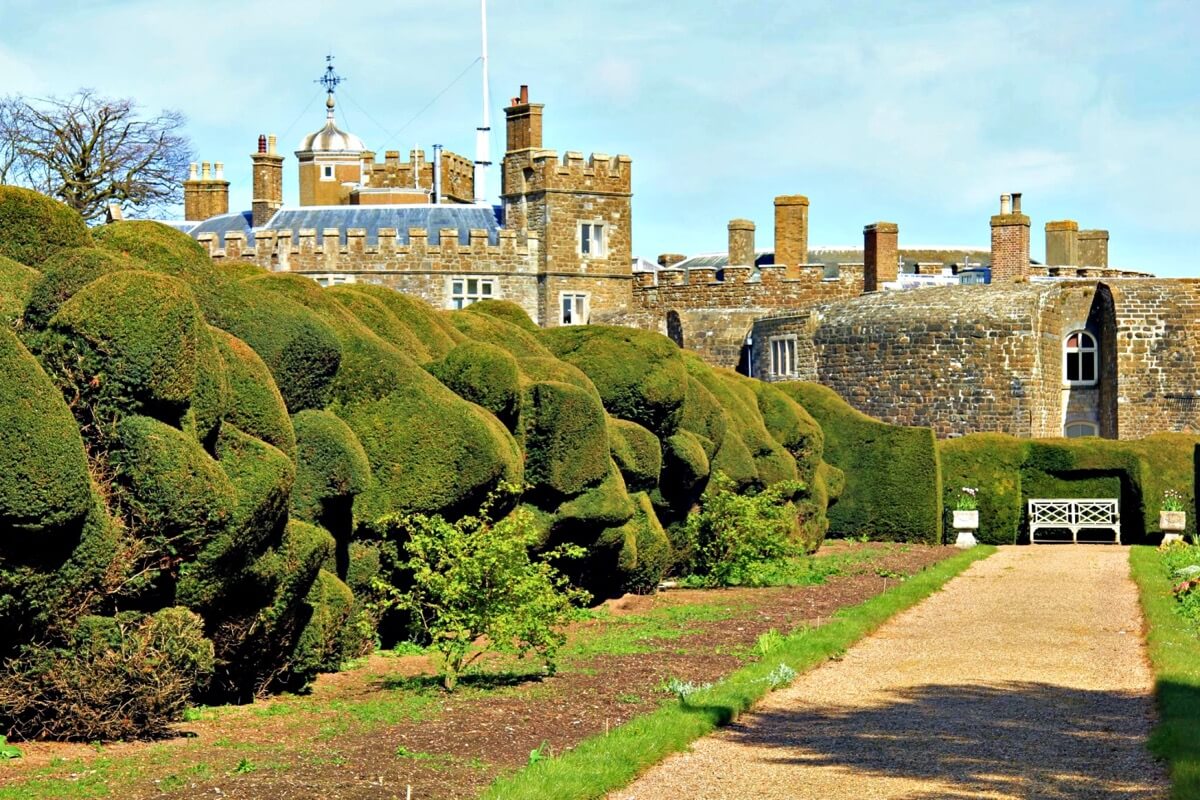
The 262-foot-long (80 m) Broadwalk is the main axis of the gardens and separates the glasshouses from the 328-foot-long (100 m) Oval Lawn, planted with lime trees and yews. The Broadwalk is lined by the "Cloud Hedge", a formal 19th-century yew hedge that grew out of control in the Second World War and was left in its current, undulating style. Two terraces in the middle of the garden, designed by William Masters in an Italianate style, separate the further half of the garden.On the other side are the paddock, planted with Holm oaks, and a curved belt of woodland of beech, ash and chestnut trees, badly damaged in the storms of 1987 and 1990. At the far end is the Glen, a woodland hollow formed from an old chalk quarry in the 19th century.
Useful information
Public parking FREE (opposite the castle entranc)
http://www.english-heritage.org.uk/visit/places/walmer-castle-and-gardens/prices-and-opening-times
http://www.english-heritage.org.uk/visit/places/walmer-castle-and-gardens/prices-and-opening-times
http://www.english-heritage.org.uk/visit/places/walmer-castle-and-gardens/prices-and-opening-times
No dogs allowed, but Assistance Dogs welcome
External links
Nearby castles