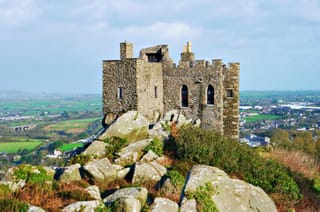
St Michael's Mount
Marazion England England
castle, chateau
St Michael's Mount (Cornish: Karrek Loos yn Koos, meaning "hoar rock in woodland") is a small tidal island in Mount's Bay, Cornwall, England, United Kingdom

Previous names
St Michael's Mount
Description
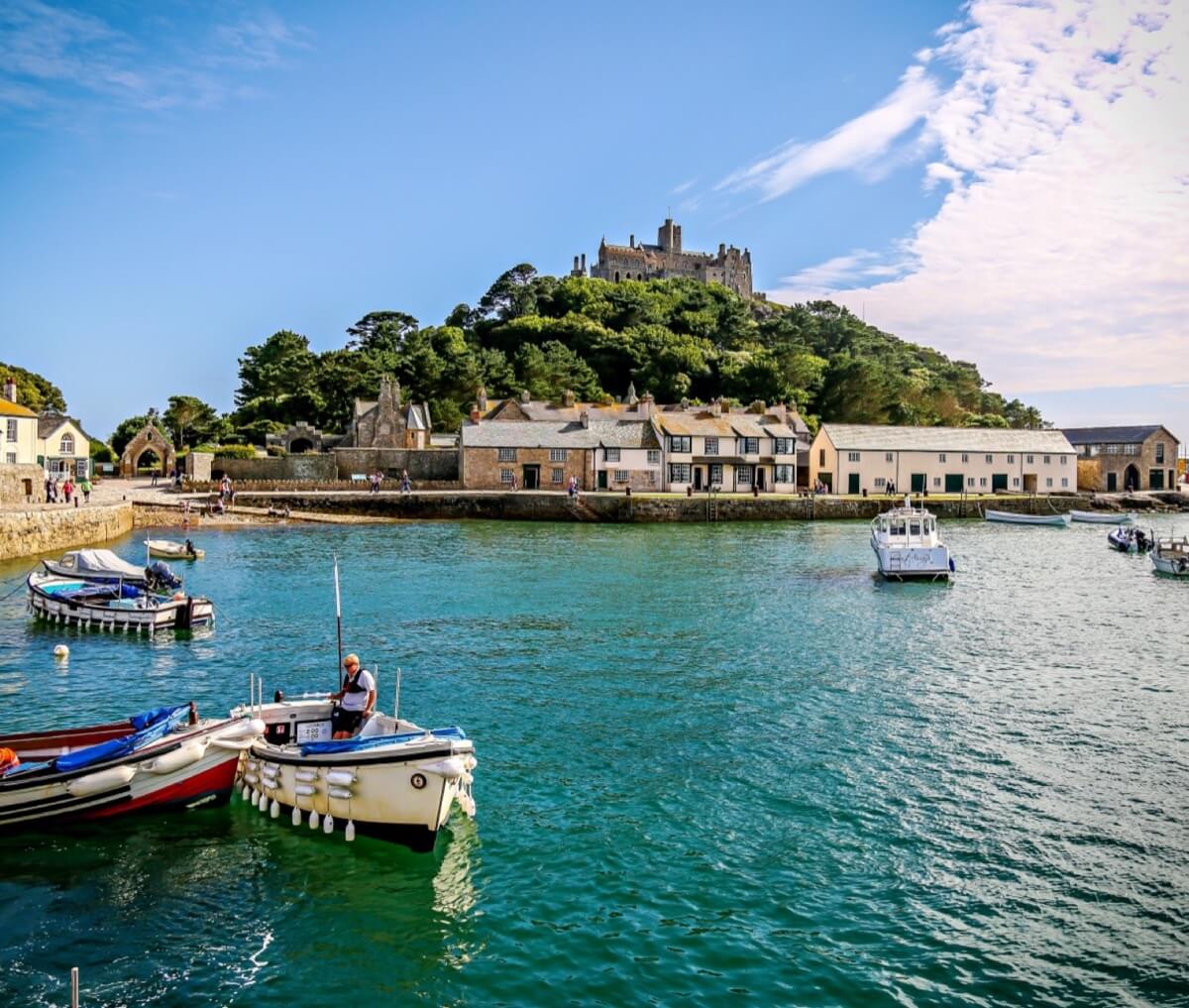
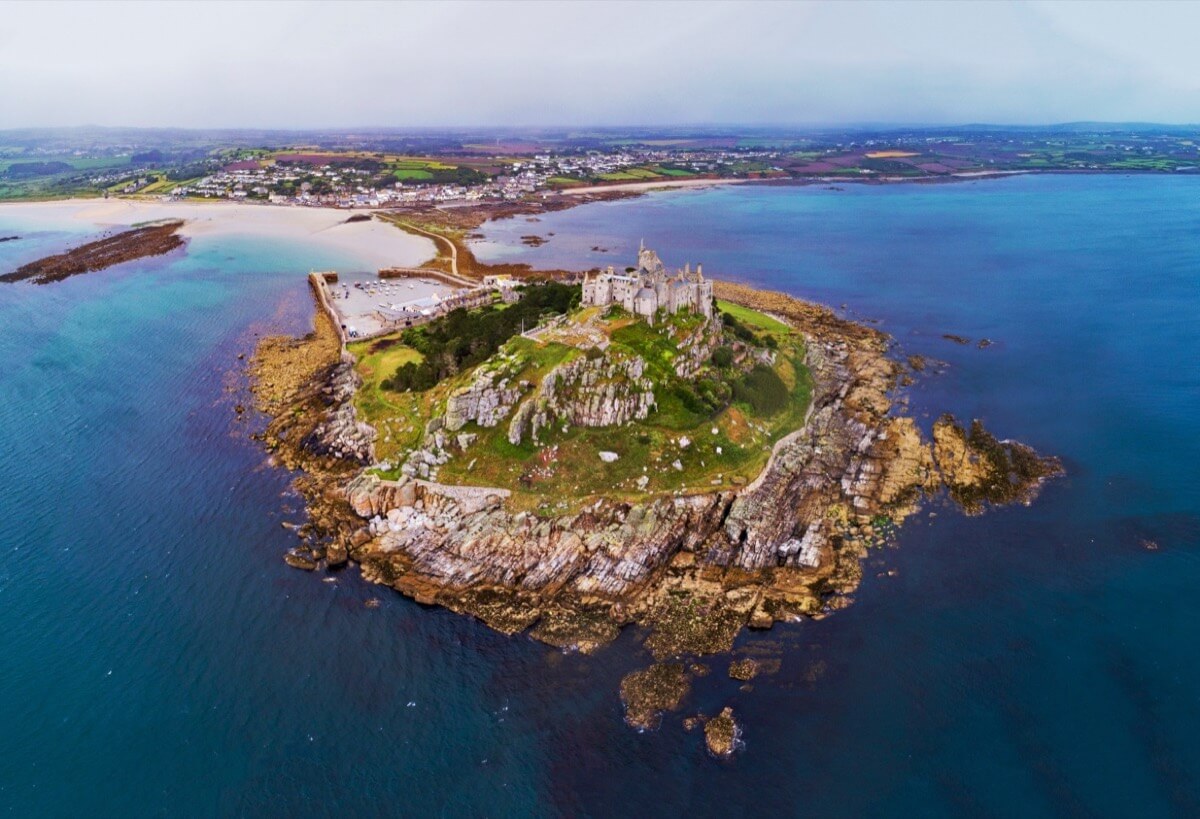
St Michael's Mount (Cornish: Karrek Loos yn Koos, meaning "hoar rock in woodland") is a small tidal island in Mount's Bay, Cornwall, England, United Kingdom. The island is a civil parish and is linked to the town of Marazion by a man-made causeway of granite setts, passable between mid-tide and low water. The population of this parish in 2011 was 35. It is managed by the National Trust, and the castle and chapel have been the home of the St Aubyn family since approximately 1650. The earliest buildings, on the summit, date to the 12th century.
Its Cornish language name—literally, "the grey rock in a wood"—may represent a folk memory of a time before Mount's Bay was flooded, indicating a description of the mount set in woodland. Remains of trees have been seen at low tides following storms on the beach at Perranuthnoe. Radiocarbon dating established the suberging of the hazel wood at about 1700 BC.
Historically, St Michael's Mount was a Cornish counterpart of Mont Saint-Michel in Normandy, France (with which it shares the same tidal island characteristics and the same conical shape, in spite of being much smaller, at 57 acres, than Mont St Michel which covers 247 acres), when it was given to the Benedictine religious order of Mont Saint-Michel by Edward the Confessor in the 11th century.
St Michael's Mount is one of forty-three (unbridged) tidal islands that one can walk to from mainland Britain. Part of the island was designated as a Site of Special Scientific Interest in 1995 for its geology.
Prehistory
There is evidence of people living in the area during the Neolithic (from circa 4000 to 2500 BCE years). The key discovery was of a leaf-shaped flint arrowhead, which was found within a shallow pit on the lower eastern slope, now part of the modern gardens. Other pieces of flint have been found, and at least two could be Mesolithic (circa 8000 to 3500 BCE). During the Mesolithic, Britain was still attached to mainland Europe via Doggerland, and archaeologist and prehistorian Caroline Malone noted that during the Late Mesolithic, the British Isles were something of a "technological backwater" in European terms, still living as a hunter-gatherer society whilst most of southern Europe had already taken up agriculture and sedentary living. At this time the mount would likely to have been an area of dry ground surrounded by a marshy forest. Any Neolithic or Mesolithic camps are likely to have been destroyed by the later extensive building operations, but it is reasonable to expect the mount to have supported either a seasonal or short-term camp for Mesolithic people.
None of the flints, so far recovered, can be positively dated to the Bronze Age (c. 2500 to 800 BCE) although any summit cairns would have most likely been destroyed when building the castle. A hoard of copper weapons, once thought to have been found on the mount, are now thought to have been found on nearby Marazion Marsh. Defensive stony banks on the north-eastern slopes are likely to date to the early 1st millennium BC, and are considered to be a cliff castle.[4] The mount is one of several candidates for the island of Ictis, described as a tin trading centre in the Bibliotheca historica of the Sicilian-Greek historian Diodorus Siculus, writing in the first century BC.
History
It may have been the site of a monastery in the 8th – early 11th centuries, and Edward the Confessor gave it to the Norman Abbey of Mont Saint-Michel. It was a priory of that abbey until the dissolution of the alien houses as a side-effect of the war in France by Henry V, when it was given to the Abbess and Convent of Syon at Isleworth, Middlesex in 1424. Thus ended its association with Mont St Michel, and any connection with Looe Island (dedicated to the Archangel Michael). It was a destination for pilgrims, whose devotions were encouraged by an indulgence granted by Pope Gregory in the 11th century.
Siege, occupation and ownership
Sir Henry de la Pomeroy captured the Mount in 1193, on behalf of Prince John, in the reign of King Richard I. The monastic buildings were built during the 12th century and in 1275 an earthquake destroyed the original Priory Church, which was rebuilt in the late 14th century, remaining in use.[citation needed] Syon Abbey, a monastery of the Bridgettine Order acquired the Mount in 1424.
John de Vere, 13th Earl of Oxford, seized and held it during a siege of twenty-three weeks against 6,000 of Edward IV's troops in 1473–74, Perkin Warbeck, a pretender to the English throne. occupied the Mount in 1497. Sir Humphrey Arundell, Governor of St Michael's Mount, led the Prayer Book Rebellion of 1549. During the reign of Queen Elizabeth I, it was given to Robert Cecil, Earl of Salisbury, by whose son it was sold to Sir Francis Bassett. During the Civil War, Sir Arthur Bassett, brother of Sir Francis, held the Mount against the Parliament until July 1646.
18th century
Little is known about the village before the beginning of the 18th century, save that there were a few fishermen's cottages and monastic cottages. After improvements to the harbour in 1727, St Michael's Mount became a flourishing seaport.
In 1755 the Lisbon earthquake caused a tsunami to strike the Cornish coast over 1,000 miles (1,600 km) away. The sea rose six feet (2 m) in ten minutes at St Michael's Mount, ebbed at the same rate, and continued to rise and fall for five hours. The 19th-century French writer Arnold Boscowitz claimed that "great loss of life and property occurred upon the coasts of Cornwall."
19th century
By 1811 there were fifty-three houses and four streets. The pier was extended in 1821 and the population peaked in the same year, when the island had 221 people. There were three schools, a Wesleyan chapel, and three public houses, mostly used by visiting sailors. The village went into decline following major improvements to nearby Penzance harbour and the extension of the railway to Penzance in 1852, and many of the houses and buildings were demolished. A short underground, funicular narrow gauge railway was built in Victorian times. It was used to bring luggage up to the house. It occasionally operates, but only for demonstration reasons and is not open to the general public, although a small stretch is visible at the harbour. It is Britain's last functionally operational 4 ft 6 in (1,372 mm) railway.
In the late 19th century an anchorite's remains were discovered in a tomb within the domestic chapel. The Mount was sold in 1659 to Colonel John St Aubyn. As of 2016 his descendants, the Lords St Levan, remain seated at St Michael's Mount.
Second World War
The Mount was fortified during the Second World War during the invasion crisis of 1940–41. Three pillboxes can be seen to this day.
Sixty-five years after the Second World War, it was suggested based on interviews with contemporaries that the former Nazi Foreign Minister and onetime Ambassador to London, Joachim von Ribbentrop, had intended to live at the Mount after the planned German conquest. Archived documents revealed that during his time in Britain in the 1930s, when he had proposed an alliance with Nazi Germany, General von Ribbentrop frequently visited Cornwall.
National Trust
In 1954, Francis Cecil St Aubyn, 3rd Baron St Levan gave most of St Michael's Mount to the National Trust, together with a large endowment fund. The St Aubyn family retained a 999-year lease to inhabit the castle and a licence to manage the public viewing of its historic rooms. This is managed in conjunction with the National Trust.
Useful information
Paid parkinh (CASH ONLY)
https://www.stmichaelsmount.co.uk/plan-your-visit/opening-days-times
https://www.stmichaelsmount.co.uk/plan-your-visit/opening-days-times
https://www.stmichaelsmount.co.uk/plan-your-visit/opening-days-times
- All carers are admitted free of charge with registered disabled visitors
- NATIONAL TRUST MEMBERS FREE
enquiries@stmichaelsmount.co.uk
- Free admission for coach drivers plus either free tea and biscuits, or a £10 voucher to use on the mainland at the Godolphin Arms
- Dogs are welcome
- have four disabled parking bays in Slipway car park and 12 bays in Follyfield car park for registered disabled badge holders.
External links
Nearby castles