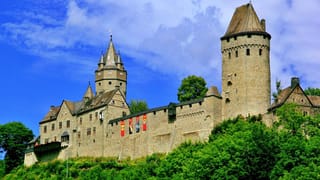
Klusenstein Castle
Arnsberg Nordrhein-Westfalen Germany
castle, chateau
Burg Klusenstein
Arnsberg Nordrhein-Westfalen Germany
castle, chateau
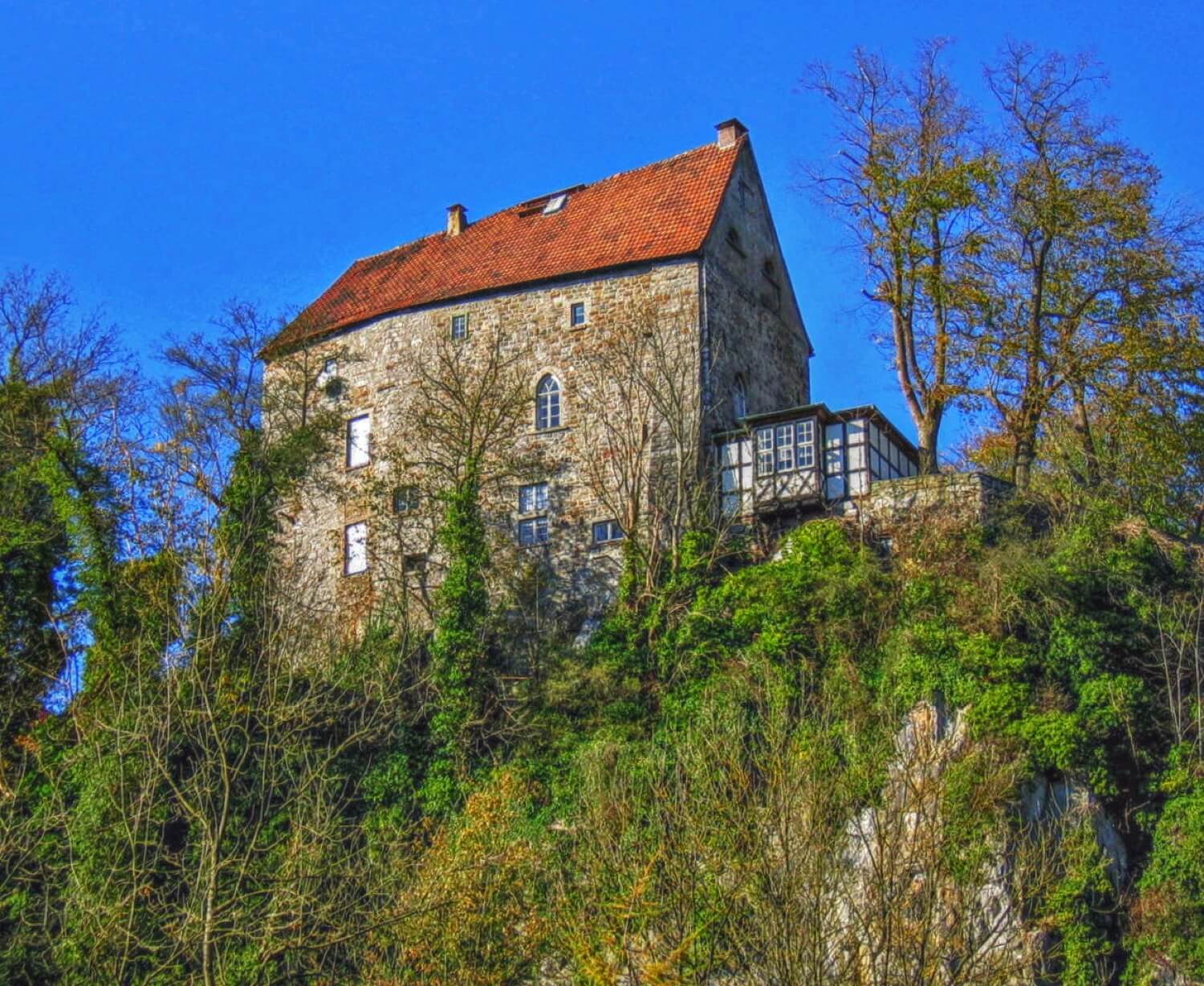
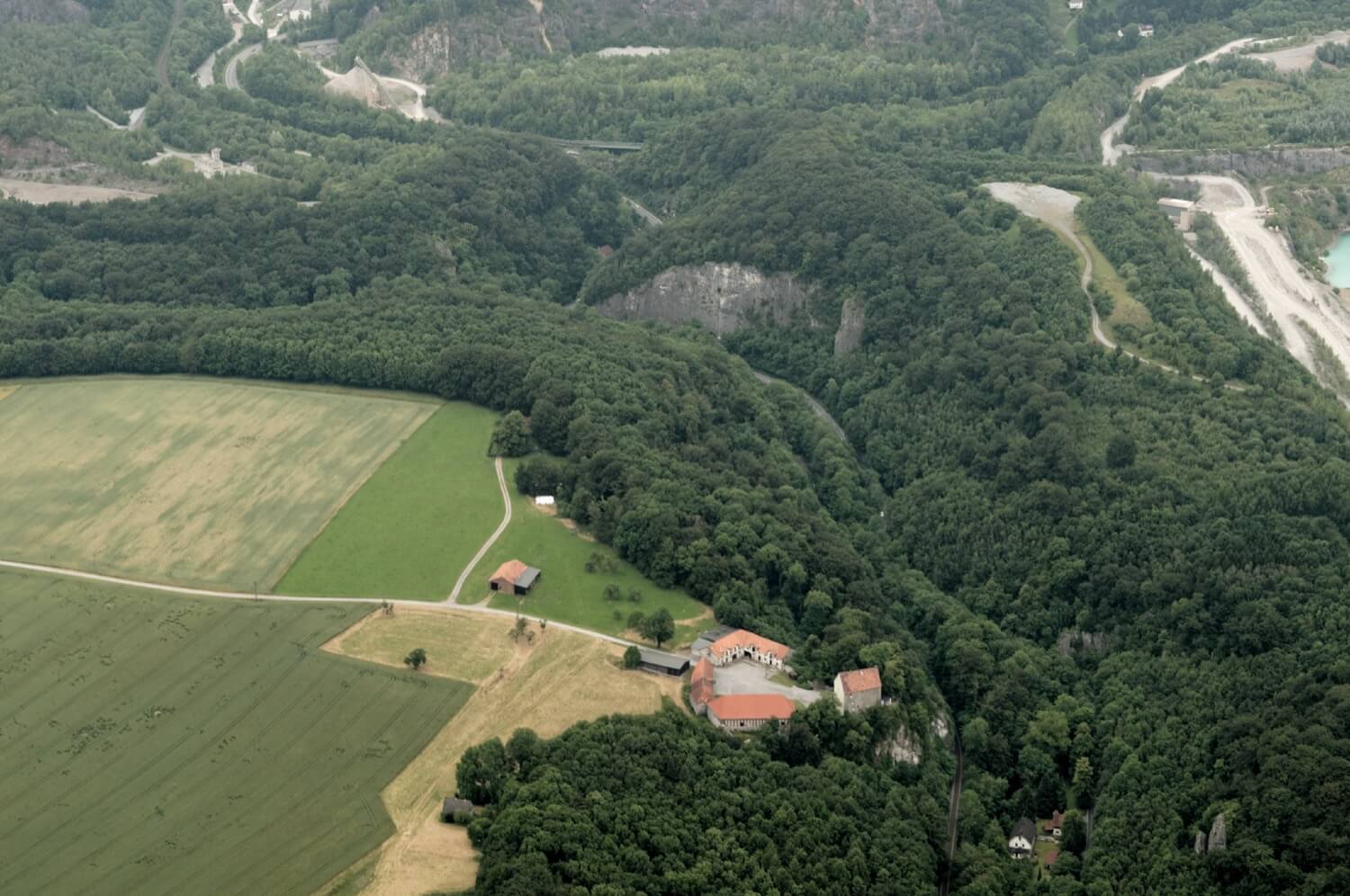
Klusenstein is a castle in Hemer, Germany, located on a 60m high cliff above the valley of the Hönne river
Die Burg Klusenstein befindet sich auf einer 60 Meter hohen Klippe am Rande des Hönnetals auf dem Gebiet der Stadt Hemer
Previous names
Klusenstein Castle, Burg Klusenstein
Description
Klusenstein is a castle in Hemer, Germany, located on a 60m high cliff above the valley of the Hönne river. The castle was built in 1353 as a boundary fortification of the earldom Mark.
The castle was built in 1353 by Gerhard of Plettenberg, a vassal of earl Engelbrecht III of the Mark. Levold of Northof (1279-1359?), the chronicler of earl Engelbrecht, wrote:
In denseluen jair, als die vurs. Greue Engelbrecht auer Meer reysden, beghan Gerit van Plettenbrecht in afwesen des Greuen dat Slot ind Stat to nyenraide in Suderlande to tymmeren ind oick Slot ten Cluysensteyn.
In the year when Earl Engelbrecht was traveling beyond the sea, Gerit of Plettenberg in the absence of his earl began to build the castle and town of Neuenrade in the Sauerland, as well as the castle of Klusenstein.
The castle formed the boundary fortification of the earldom Mark to the bishopric state of Cologne and the earldom Arnsberg. All three territories met at the Hönne river valley, the castle was also overlooking an old road crossing the valley. During the feud between earl Engelbert and Gottfried IV of Arnsberg, the castle was under siege in 1366, but did not fall.
When the last earl of Arnsberg, Gottfried IV, sold the earldom to the bishop of Cologne, the castle lost its importance. Until the 17th century the family of Werminghausen owned the castle. During the 30 years war (1618-48) both Swedish and Hessian troops stayed in the castle. In 1695 the Brabeck family bought the castle, and was sold in 1812 to the Löbbecke family. In 1904 it was sold to the Hoesch company, and now belongs to the company Rheinkalk.
For the 650th anniversary in 2003 the castle and the adjoining buildings were renovated.
The origin of the name Klusenstein isn't fully known. While the second part stein simply means rock, the word Kluse may either refer to a rift in the rock, or alternatively from the dialect word for or hermitage.
The castle is located on a 60m high cliff over the Hönne river valley, at around the narrowest part of the valley. At the bottom of the rock is a small cave in total 51m long. One corridor bends upward, but about 30m below the plateau it is blocked by stones. There were legends about a secret escapeway of the castle, in 2003 the top entrance to the cave was found below the eastern palais destroyed in 1840.
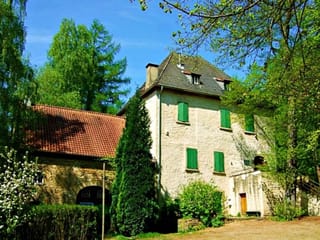
Below the castle is a mill, however though named Klusenstein mill it did not belong to castle. Since 1912 the railway connecting Balve and Menden runs directly below the castle.
Die Burg Klusenstein befindet sich auf einer 60 Meter hohen Klippe am Rande des Hönnetals auf dem Gebiet der Stadt Hemer. Sie wurde im Jahr 1353 erbaut und war Grenzbefestigung der Grafschaft Mark zum angrenzenden Territorium Kurkölns und der Grafschaft Arnsberg. Gemeinsam mit den umliegenden Gebäuden bildet die Burg den Ortsteil Klusenstein.
Die Höhenburg wurde im Jahr 1353 von Gerhard von Plettenberg, einem Drosten von Graf Engelbert III. von der Mark erbaut. Levold von Northof (1279–1359), der Chronist von Graf Engelbrecht III., schrieb
„In denseluen jair, als die vurs. Greue Engelbrecht auer Meer reysden, beghan Gerit van Plettenbrecht in afwesen des Greuen dat Slot ind Stat to nyenraide in Suderlande to tymmeren ind oick Slot ten Cluysensteyn.
(In demselben Jahr, als Graf Engelbrecht (Engelbert) über das Meer reiste, begann Gerhard von Plettenberg in Abwesenheit des Grafen das Schloss und die Stadt Neuenrade im Sauerland zu zimmern, und auch das Schloss Klusenstein.)“
Während der Fehde zwischen Graf Engelbert und Graf Gottfried IV. von Arnsberg wurde die Burg belagert, konnte aber nicht erobert werden. Nachdem aber Gottfried die Grafschaft Arnsberg an den Bischof von Köln verkauft hatte, verlor die Burg ihre strategische Bedeutung.
Bis zum 17. Jahrhundert lebte die Familie von Werminghausen auf der Burg. 1695 wurde die Burg von der Familie Brabeck erworben. 1812 erwarb sie die Familie Löbbecke, 1904 die Firma Hoesch. Heute ist sie in Besitz der Firma Rheinkalk und verpachtet.
1990 wurden verschiedene Teile der Burganlage unter Denkmalschutz gestellt. Anlässlich der 650-Jahr-Feier wurde 2003 die 1749/50 als Viehhaus errichtete Fachwerkscheune der Burg renoviert.
Die Burg besitzt von einem Kellerraum ausgehend einen inzwischen vermauerten Notausgang durch einen Kamin der Großen Burghöhle.
Useful information
Gratis
Umliegender Park
Privateigentum, für Besucher geschlossen
-
Nearby castles