Great Palace (Meiningen)
Schmalkalden-Meiningen Thüringen Germany
manor, mansion
Großes Palais (Meiningen)
Schmalkalden-Meiningen Thüringen Germany
manor, mansion
The Great Palace in Meiningen is a palace of the Dukes of Saxony-Meiningen from the 19th century
Das Große Palais in Meiningen ist ein Palast der Herzöge von Sachsen-Meiningen aus dem 19
Previous names
Great Palace (Meiningen), Großes Palais (Meiningen)
Description
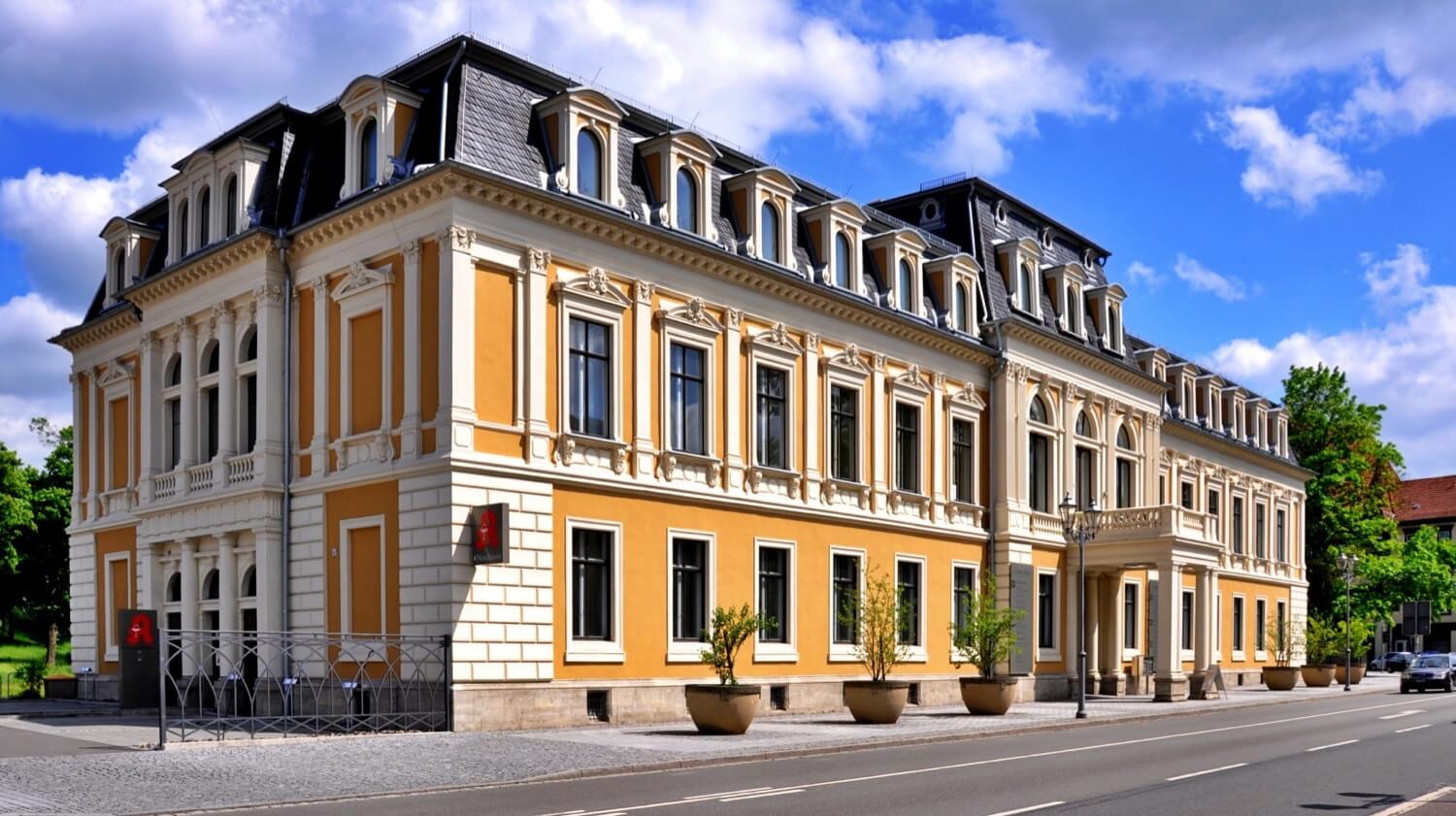
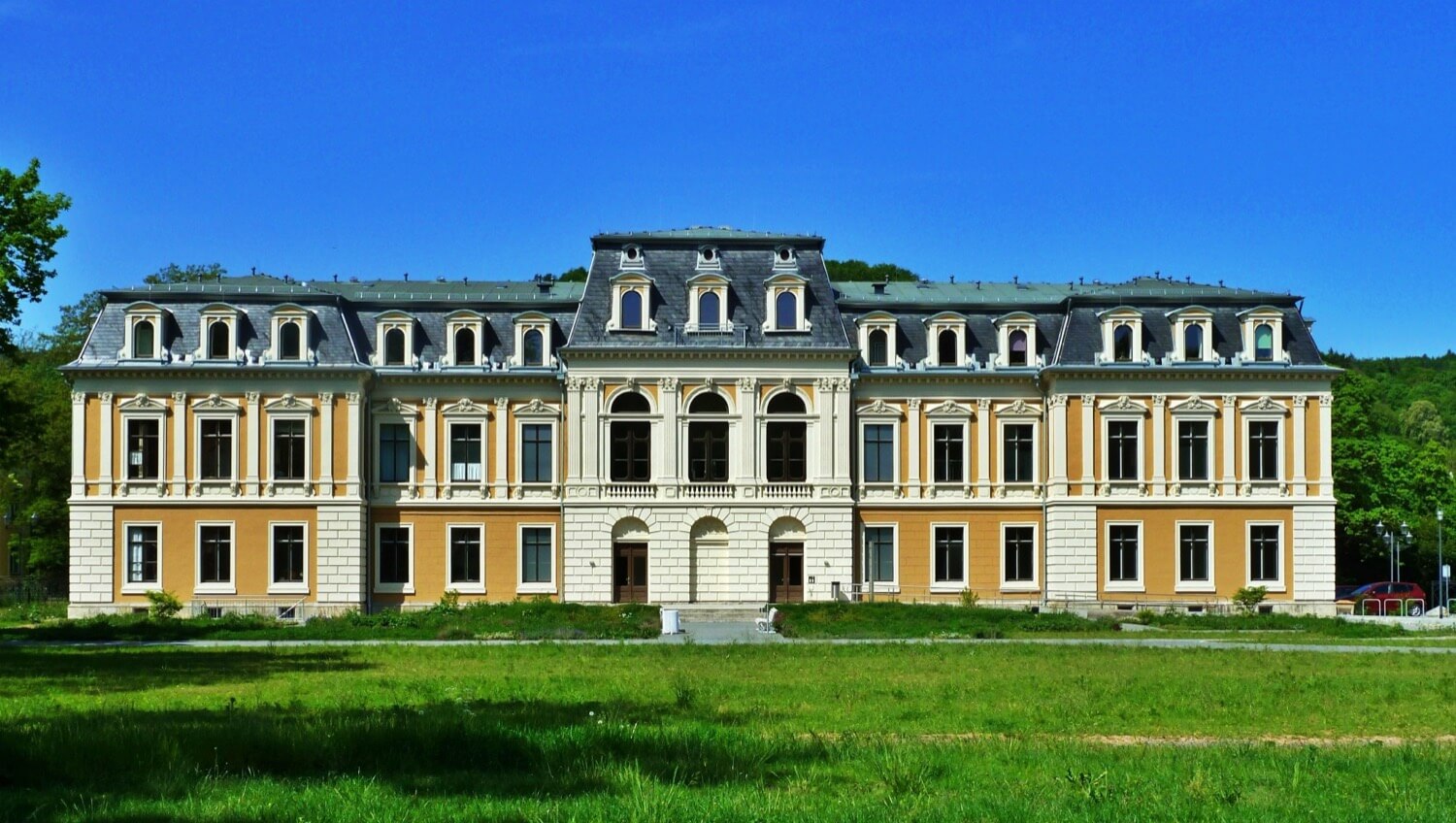
The Great Palace in Meiningen is a palace of the Dukes of Saxony-Meiningen from the 19th century. It is also known as the "Wittumspalais" or "Erbprinzenpalais".
Building
The Great Palace is a three-storey building with a richly structured facade in the style of the French Neo-Renaissance . On the street side it has a central projection with a balcony on pillars in front of it. On the ground floor there are rustic iron and marbled support columns in the foyer . From there, an elaborately designed staircase leads to the first floor, where all the walls of the stairwell are structured with pilasters that take up two thirds of the height of the room and close to a surrounding ledge. As a continuation of the pilasters to the stucco ceiling, the walls are decorated with statues in the form of caryatids and hermsMistake. The ceilings and walls of almost all rooms have elaborately designed stucco work , which during the GDR era were "hidden" with suspended ceilings and exposed walls. They come from the time of the renovation and have been restored. Today the palace is used as a health center with doctor's offices , pharmacy and therapists. The total usable area is 1630 m². In the large rooms of the practices, room-in-room systems with glazed walls and ceilings are installed, which allow a clear view of the richly decorated stucco ceilings.
History
The palace was built from 1821 to 1823 in the classical style by the architect Johann Andreas Schaubach as a Wittumspalais for the Duchess Luise Eleonore . In 1863 a renovation and an extension took place under the direction of senior building officer Otto Hoppe and the building received its dominant and representative shape in the style of the neo-renaissance that still exists today. After Duke Bernhard II's forced abdication in 1866 , the Great Palace became his residence. In 1890 the Hereditary Prince and later Duke Bernhard III took over the palace . his residence. Even after the end of the duchy in 1918 it remained in the possession of the duchy of Saxony-Meiningen until 1945.
The Great Palace survived the Second World War unscathed. After the expropriation of the ducal estates, a teacher training institute was initially based here. Then the district office of Meiningen moved in . The building, which was called the Council of the District from 1952 to 1990, fulfilled this function until 1999. After a few years of vacancy, the Great Palace was extensively renovated from 2007 to 2009. Since then there has been a "health center" with several medical practices and other health facilities.
https://second.wiki
Das Große Palais in Meiningen ist ein Palast der Herzöge von Sachsen-Meiningen aus dem 19. Jahrhundert. Es wird auch als „Wittumspalais“ oder „Erbprinzenpalais“ bezeichnet.
Geschichte
Erbaut wurde der Palast von 1821 bis 1823 im klassizistischen Stil vom Architekten Johann Andreas Schaubach als Wittumspalais für die Herzogin Luise Eleonore. 1863 fand ein Umbau und eine Erweiterung unter der Leitung von Oberbaurat Otto Hoppe statt und das Gebäude erhielt seine bis heute bestehende dominante und repräsentative Gestalt im Stil der Neorenaissance. Nach der 1866 erzwungenen Abdankung von Herzog Bernhard II. wurde das Große Palais zu dessen Residenz. 1890 nahm im Palais der Erbprinz und spätere Herzog Bernhard III. seinen Wohnsitz. Auch nach dem Ende des Herzogtums im Jahr 1918 blieb es bis 1945 im Besitz des Herzoghauses Sachsen-Meiningen.
Den Zweiten Weltkrieg überstand das Große Palais unbeschadet. Nach der Enteignung der herzoglichen Güter hatte hier zunächst eine Lehrerbildungsanstalt ihr Domizil. Anschließend zog das Landratsamt Meiningen ein. Diese Funktion erfüllte das Bauwerk, das von 1952 bis 1990 als Rat des Kreises bezeichnet wurde, bis 1999. Nach einigen Jahren Leerstand wurde das Große Palais von 2007 bis 2009 umfassend saniert. Seitdem befindet sich hier ein „Gesundheitszentrum“ mit mehreren Arztpraxen und anderen Gesundheitseinrichtungen.
Bauwerk
Das Große Palais ist ein dreigeschossiger Bau mit reich gegliederter Fassade im Stil der französischen Neorenaissance. Es besitzt zur Straßenseite einen Mittelrisalit mit einem vorgesetzten Balkon auf Säulen. Im Erdgeschoss befinden sich im Foyer Rustikalisenen und marmorierte Stützsäulen. Von dort führt eine aufwändig gestaltete Treppenanlage in das erste Obergeschoss, wo alle Wände des Treppenhauses mit Pilastern gegliedert sind, die zwei Drittel der Raumhöhe einnehmen und an einem umlaufenden Sims abschließen. Als Fortsetzung der Pilaster bis zur Stuckdecke sind die Wände mit Statuen in Form von Karyatiden und Hermen versehen. Die Decken und Wände nahezu aller Räume besitzen aufwändig gestaltete Stuckaturen, die zur DDR-Zeit mit abgehängten Decken und vorgesetzten Wänden „versteckt“ wurden. Sie stammen aus der Zeit des Umbaus und sind restauriert worden. Das Palais wird heute als Gesundheitszentrum mit Arztpraxen, Apotheke und Therapeuten genutzt. Die Nutzfläche beträgt insgesamt 1630 m². In den großen Räumen der Praxen sind Raum-in-Raum-Systeme mit verglasten Wänden und Decken eingebaut, die einen freien Blick auf die reich verzierten Stuckdecken gewähren.
Useful information
Gratis
Englischer Garten
- Der Palast wird als medizinisches Zentrum genutzt
- Kein Besuch
-
Nearby castles
Schloss Elisabethenburg
Schmalkalden-Meiningen
0.3km
castle, chateau
Elisabethenburg Palace
Schmalkalden-Meiningen
0.3km
manor, mansion
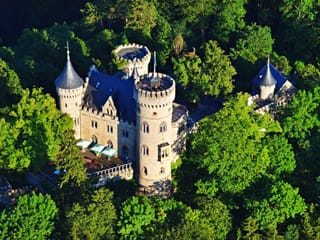
Schloss Landsberg (Meiningen)
Schmalkalden-Meiningen
3.6km
castle, chateau
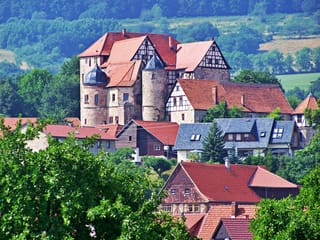
Johanniter Castle Kühndorf
Schmalkalden-Meiningen
6.8km
castle, chateau
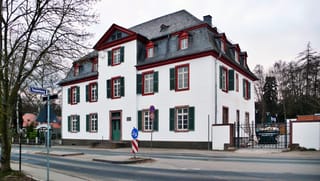
Jagdschloss Fasanerie
Lower Franconia
9.5km
castle, chateau
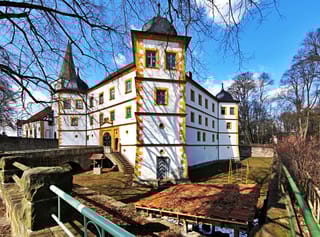
Schloss Marisfeld
Hildburghausen
11.2km
castle, chateau
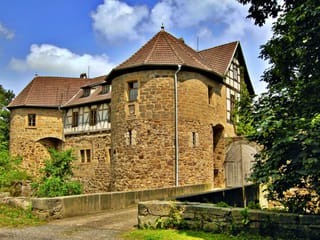
Burg Bibra
Schmalkalden-Meiningen
11.4km
castle, chateau