Friedenstein Castle
Gotha Thüringen Germany
castle, chateau
Schloss Friedenstein
Gotha Thüringen Germany
castle, chateau
Friedenstein Castle (German: Schloss Friedenstein) is an early Baroque palace built in the mid-17th century by Ernest I, Duke of Saxe-Gotha at Gotha, Thuringia, Germany
Das Schloss Friedenstein in Gotha (Thüringen) ist eine frühbarocke Schlossanlage an der Stelle der 1567 geschleiften Burg Grimmenstein
Previous names
Friedenstein Castle, Schloss Friedenstein
Description
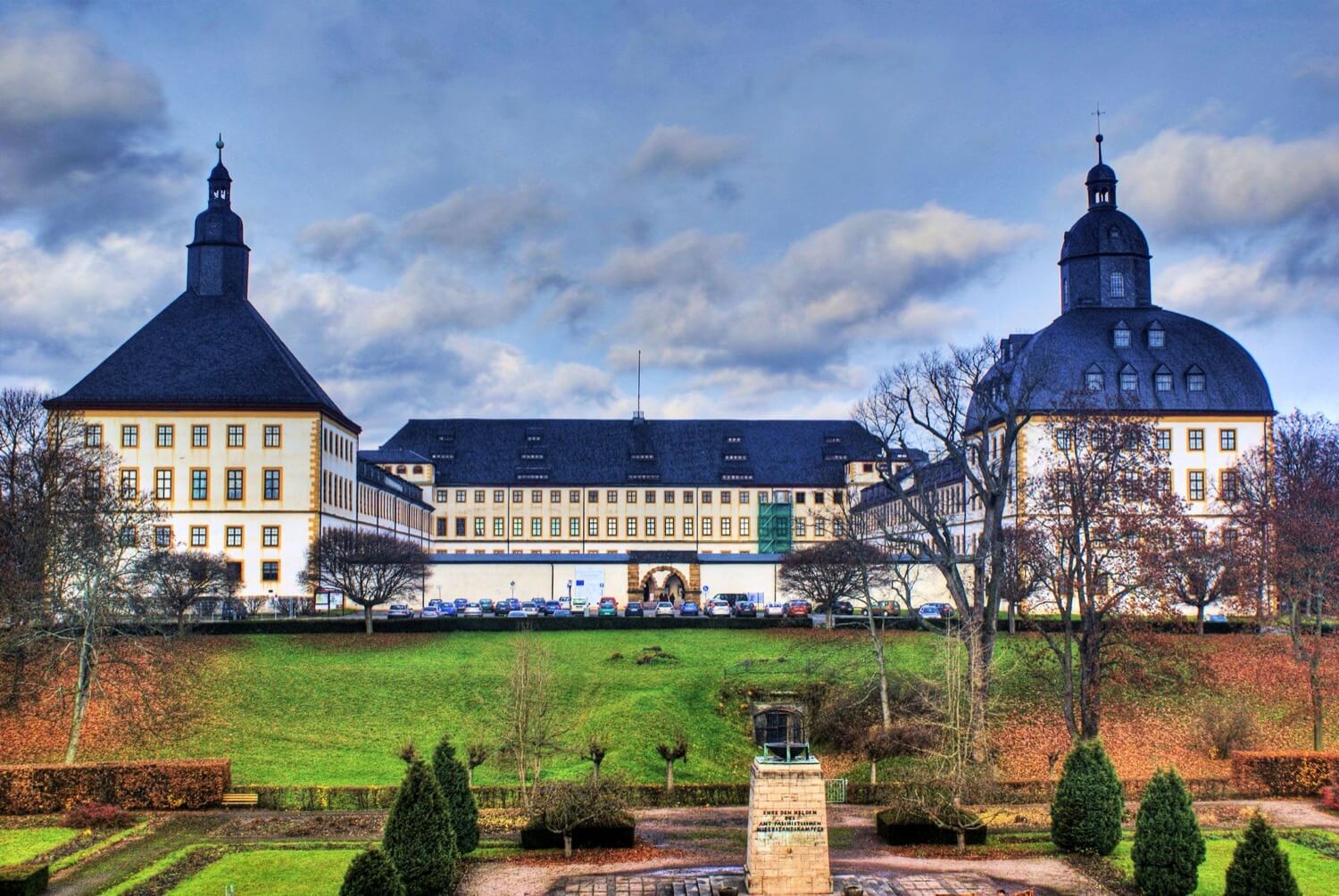
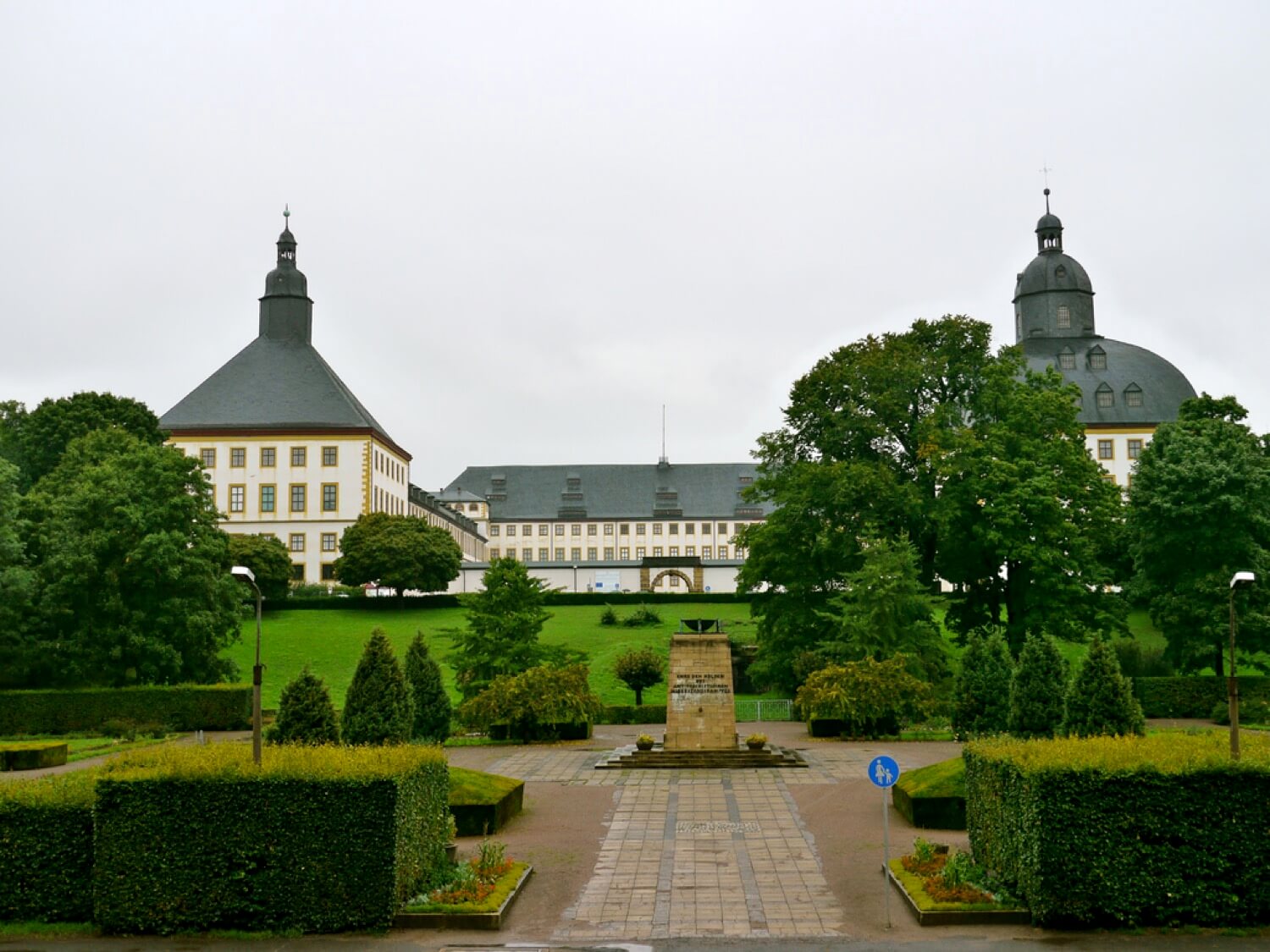
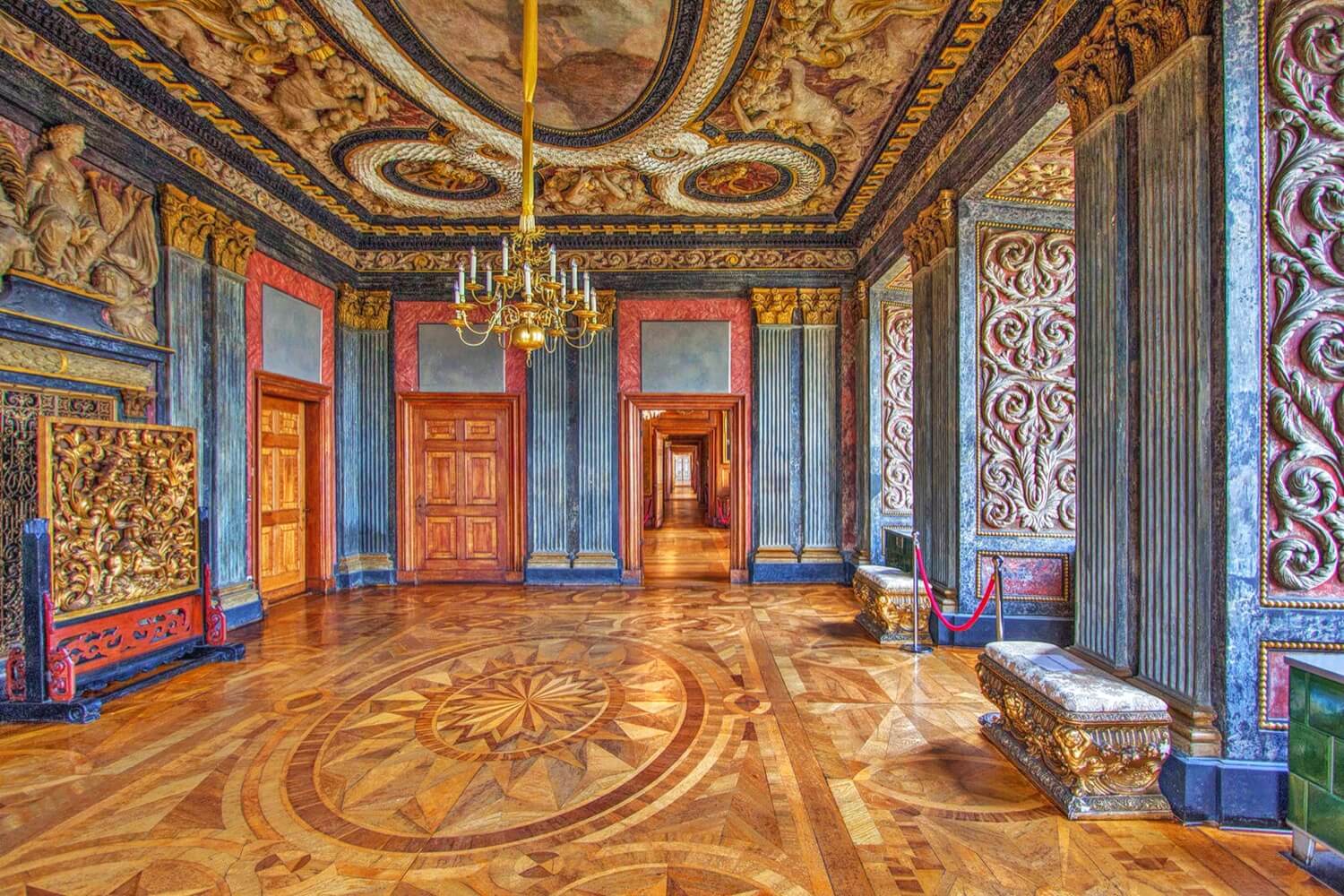
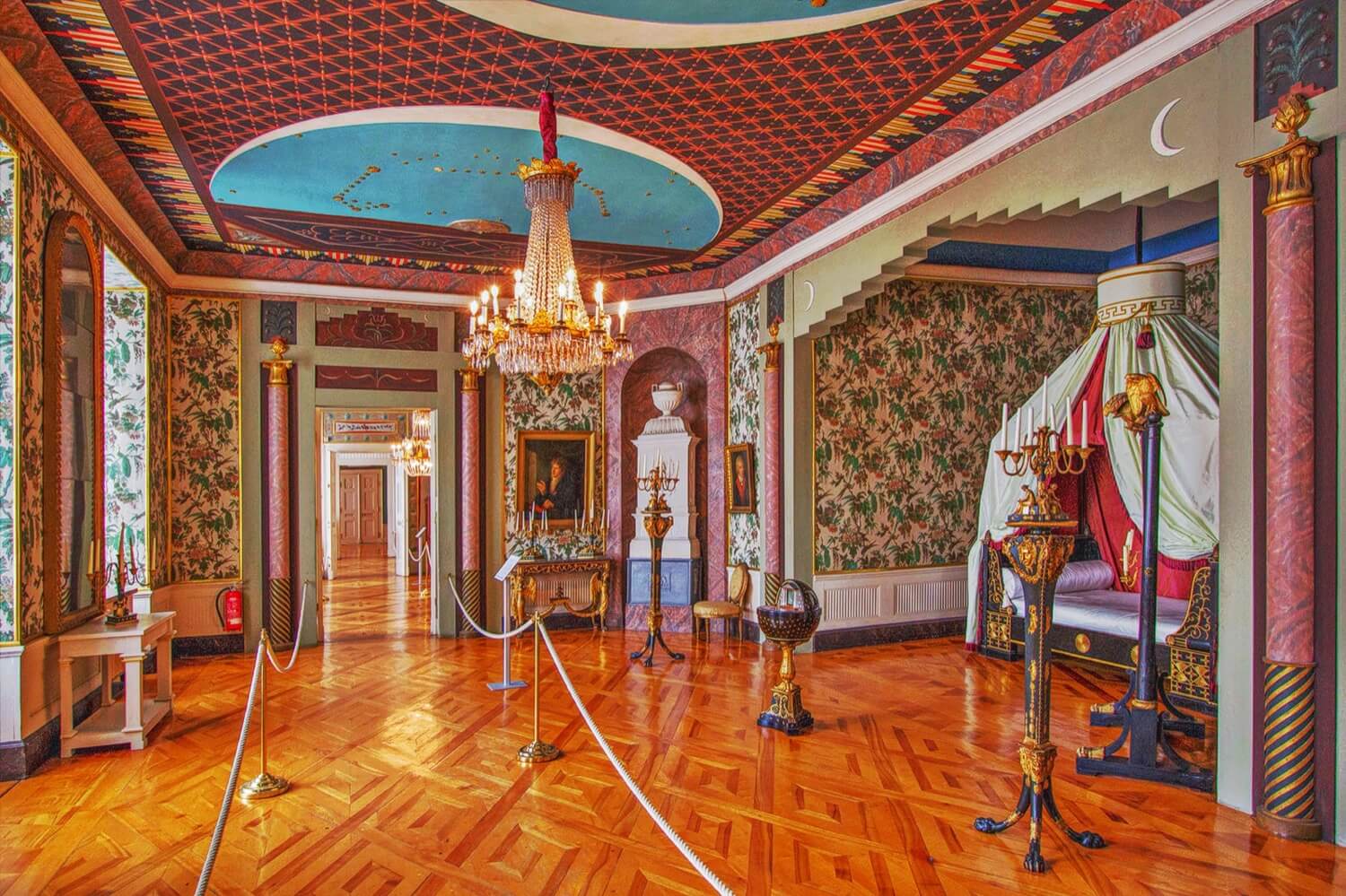
Friedenstein Castle (German: Schloss Friedenstein) is an early Baroque palace built in the mid-17th century by Ernest I, Duke of Saxe-Gotha at Gotha, Thuringia, Germany. In Germany, Friedenstein was one of the largest palaces of its time and one of the first Baroque palaces ever built. Friedenstein served as the main seat of the Dukes of Saxe-Gotha and later as one of the residences of the Dukes of Saxe-Coburg and Gotha, closely linked with the Royal Family of Great Britain through the marriage of Queen Victoria and Prince Albert. The final two ruling Dukes were both princes of the United Kingdom.
The castle complex today houses several museums. It is also notable for hosting the Ekhof-Theater (de), one of the oldest theatres in operation in Germany, still featuring the original Baroque machinery for changing the scenery.
The site where Friedenstein stands today, dominating the town of Gotha and its surroundings, was previously occupied by Grimmenstein Castle. It was first mentioned in 1316 and rebuilt in 1531-43 when it was also fortified in accordance with the changed requirements for a fortress in the age of gunpowder. In 1547, the Ernestine branch of the House of Wettin as members of the Protestant Schmalkaldic League had lost the Battle of Mühlberg against the Catholic forces of Emperor Charles V. As a result, Johann Friedrich I, Kurfürst von Sachsen (John Frederick I) was stripped of his title as "Elector of Saxony" ( Kurwürde ). Imperial forces blew up the fortifications of Grimmenstein but left the castle itself largely intact. It was rebuilt in 1552-54. However, in 1567 the fortress was almost completely razed as a result of the attempt of Johann Friedrich II (John Frederick II) to regain the Kurwürde by force of arms.
In 1640, Ernest I, Duke of Saxe-Gotha, also known as Ernst der Fromme ("Ernest the Pious"), first ruler of the newly created Duchy of Saxe-Gotha, settled on Gotha as the site for his Residenz. Gotha at the time was the largest town in the Duchy. In 1641/42 work began on the park, followed by construction of the palace itself in 1643. In naming the castle Friedenstein (literally "peace-rock"), Ernst made a point of drawing a clear line between this new palace and the warlike history of its predecessor. In addition, with the Thirty Years War still ongoing, the name also expressed a desire for peace after decades of warfare.
Based on plans by Casper Vogell (de) (or Caspar Vogel, c. 1600-1663), Andreas Rudolph (de) (1601-1679) was in charge of building the castle. When it was finished in 1656, Friedenstein was the first ever Residenz in the Baroque style built on German soil that was completed during the lifetime of the ruler who ordered it. To justify the expense of such a vast structure, Ernest explicitly referred to the need to accommodate the administration for the new Duchy.
In July 1655, work began on fortifying the castle. By 1672, four bastions had been completed. The outer works were finished by 1687 and, beginning in 1663, the town of Gotha was also fortified. In 1672, the House of Saxe-Altenburg ended and most of the Duchy passed to Ernst, who now was ruler of Saxe-Gotha-Altenburg. Although the Duchy now had two Residenzen, Gotha was by far the more important one.
However, Ernst was unwilling to exclude any of his surviving sons from his heritage. So after his death in 1675, the Duchy was split in 1680/81 into seven separate territories: Saxe-Gotha-Altenburg, Saxe-Coburg, Saxe-Meiningen, Saxe-Römhild, Saxe-Eisenberg, Saxe-Hildburghausen and Saxe-Saalfeld. Ernst's oldest son, Friedrich I, became Duke of Saxe-Gotha-Altenburg, with his main Residenz at Gotha.
In 1826, after the death of the heirless Friedrich IV, the Duchy was split and Gotha passed to Ernst I of the House of Saxe-Coburg and father of Albert, Prince Consort who was to marry Queen Victoria. Ernst I now styled himself "Duke of Saxe-Coburg and Gotha", although he technically held the two separate Duchies of Saxe-Coburg and Gotha in personal union.
For the Dukes of Saxe-Coburg and Gotha, the latter was only a secondary residence, the focus was squarely on Coburg, where the Ehrenburg Palace was the main residence. Ernst II, successor of Ernst I and older brother of Albert, did not live in the castle when in Gotha, but at the Winterpalais in the town. During his long reign (died in 1893), the castle only housed the administration of the Duchy. Since Ernst II was without heir, he made his nephew, Alfred, the second son of Queen Victoria and Prince Albert, his heir. Alfred renounced his title of Duke of Edinburgh and his seat in the House of Lords and went to Germany.
In 1899, his only son Alfred reportedly shot himself during his parents' 25th wedding anniversary celebrations at Friedenstein. After being cared for in the castle for some days he was sent to a sanatorium near Meran, where he died on 6 February 1899. As Alfred's uncle, Prince Arthur, Duke of Connaught, and cousin, Prince Arthur of Connaught, both renounced their right of succession to the Duchy, the title passed to Charles Edward (Karl Eduard), the son of the Duke of Albany, fourth son of Victoria and Albert. Since Charles Edward was only 16 at the time, until his 21st birthday on 19 July 1905 a regency was installed. World War I caused a conflict of loyalties for Charles Edward/Karl Eduard, but he sided with Germany, leading the British government to strip him of his titles in the United Kingdom.
In November 1918, during the German Revolution Charles Edward was deposed by the local "Workers' and Soldiers' Council" and on 23 November he signed his abdication, thus ending the existence of the Duchy. The castle was now used as a museum.
During World War II an air raid shelter was constructed in the casemates of the castle. In 1944, part of the park and outbuildings were heavily damaged by Allied bombing.
After the end of the war, a significant part of the art treasures of the Friedenstein museums was transported to the Soviet Union as war reparations. However, most of it was restored in the late 1950s.
During the time of the German Democratic Republic (GDR), renovation work in the castle began in 1965 and many of the additions of the late 19th and early 20th century were removed from the interior.
In what became known as the Kunstraub von Gotha (de), in the night from 13 to 14 December 1979, five valuable paintings were stolen from the castle: Frans Hals (Brustbild eines jungen Mannes), Anthonis van Dyck (Selbstbildnis mit Sonnenblume), Jan Lievens (Alter Mann), Jan Brueghel the Elder (Landstraße mit Bauernwagen und Kühen) und Hans Holbein the Elder (Heilige Katharina). A special commission of the GDR police failed to solve the theft. Until today, the paintings have not been retrieved.
In 2004, the castle and parks came into the care of the Stiftung Thüringer Schlösser und Gärten.
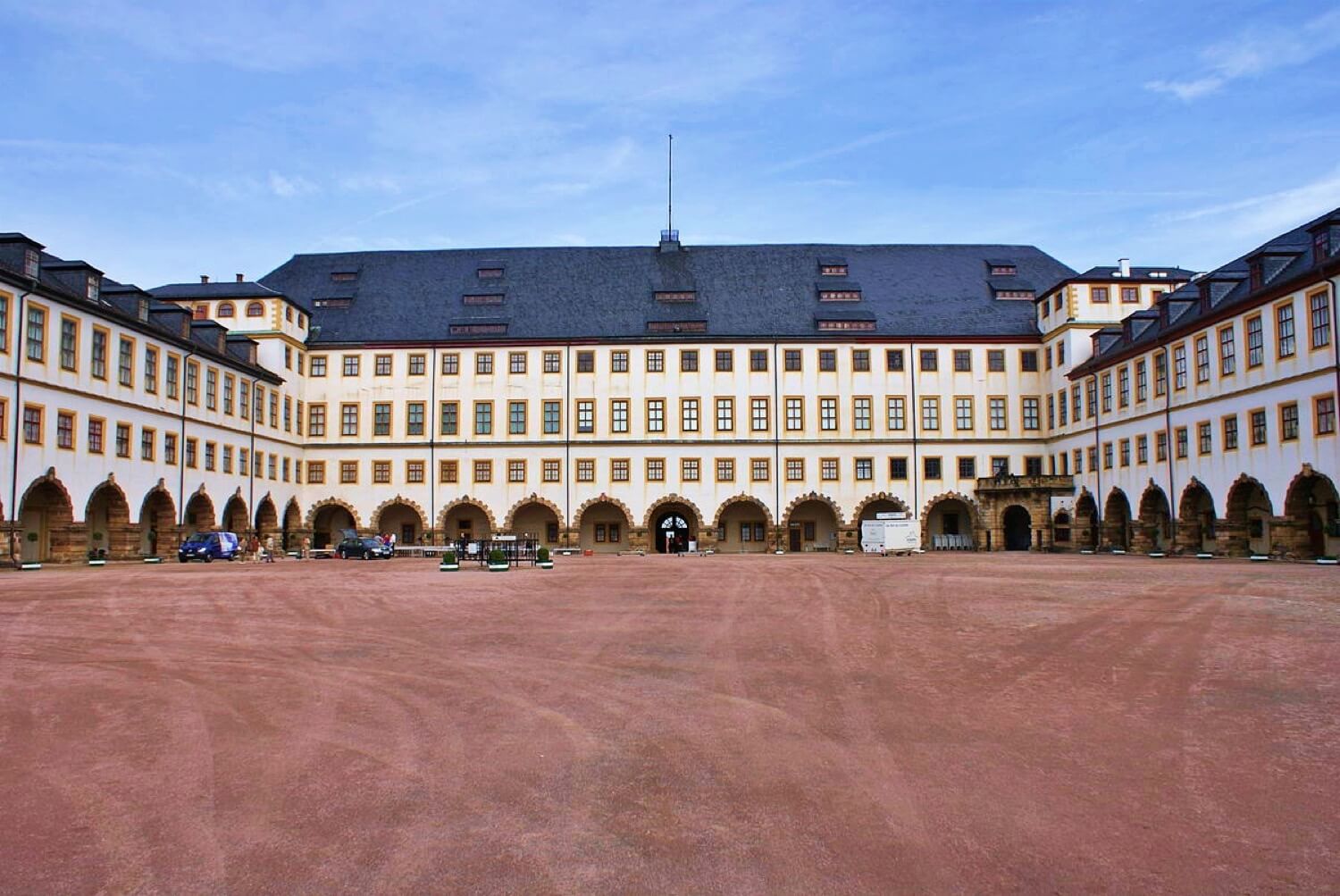
The castle built for Ernst I was constructed according to general principles favoured by Protestant rulers in the 17th century. It took the form of a so-called "sub-ordinated" palace, meaning that the four wings are not on an equal footing but that there is one dominating main wing. At Friedenstein that is the four-story north wing, facing the town. The two side wings have three floors (but end in the four-story towers or pavilions) and the final wing had just one floor. Initially, all the state apartments were housed in the four-storied sections of the palace.
The palace dominates the town by its sheer size: the main wing is 100 metres long, the two side wings are 140 metres long. Although the interior of the palace has been significantly altered since the time of Ernst I, the exterior has remained largely unchanged. The simple, unadorned exterior was originally selected to contrast with the palaces of Catholic princes, which at the time were still mostly influenced by the elaborate Renaissance style. The only major embellishment at Friedenstein were four larger-than-life statues located at the four corners of the palace, showing Moses, Elijah, John the Baptist and Martin Luther. Other external features were a few reliefs salvaged from the old Grimmenstein and some decoration above the main gate to the courtyard, located in the centre of the north wing. The austere facades are structured not by ornamental features but only by the symmetrical arrangement of the windows and a cornice running around the whole building between the first and second floors. On the side facing the courtyard, an arcade was constructed running around all four wings of the palace. The major later change to the external appearance of the palace has been the addition of the two buildings on the left and right of the main wing facing the town, known as Pagenhaus and Wachthaus, added in 1778/79. At that time the four statues were also removed.
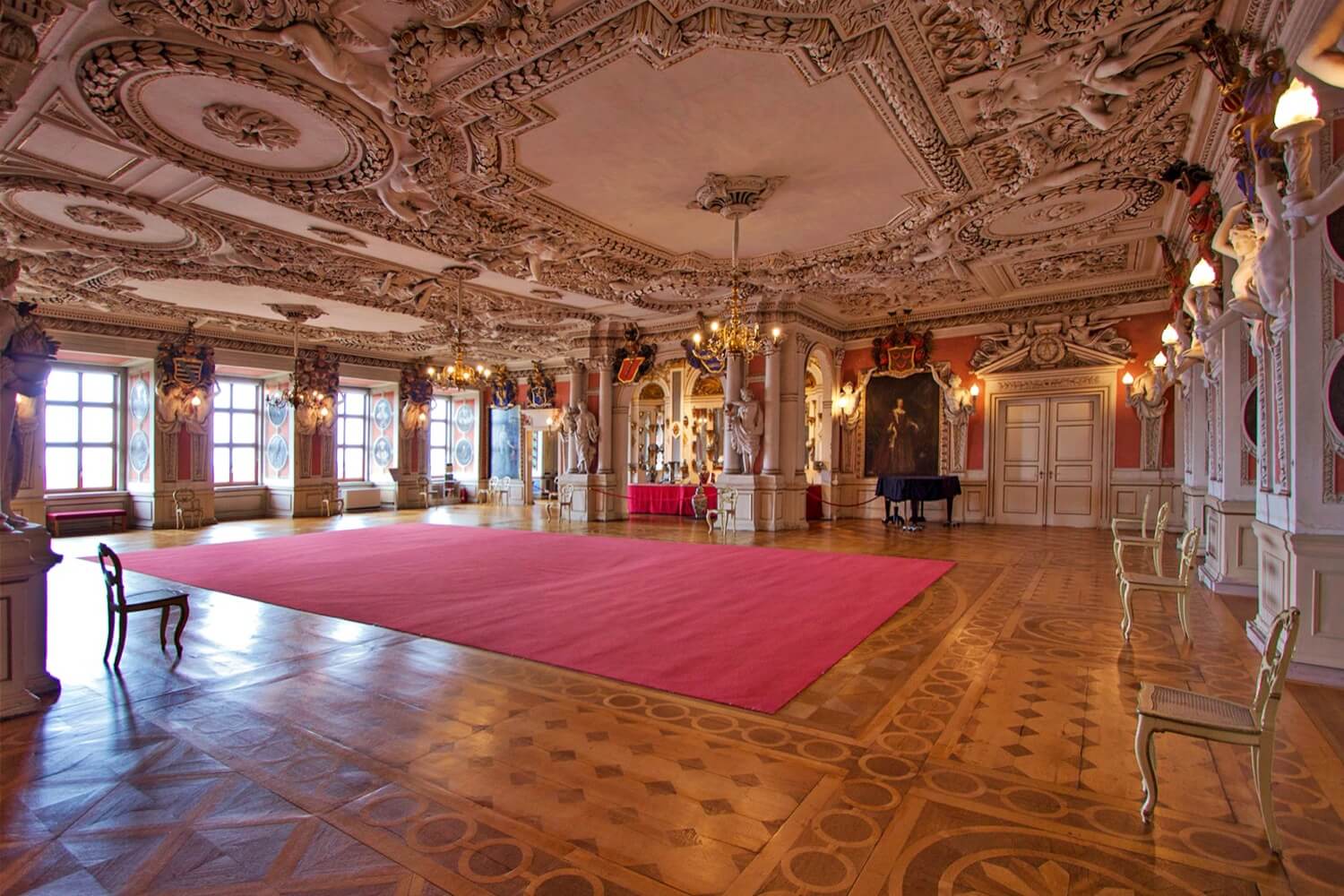
None of the original state rooms constructed for Ernst I remain today. The palace sections that have maintained their original use include the chapel and the Geheimes Archiv on the ground floor of the north wing. Otherwise the ground floor of all the wings housed servants' and storage rooms as well as an armoury, a stable, a mint and a smithy. The fourth wing contained a riding hall. The first upper floor of all the wings is slightly lower than the others – it used to house the offices of the Ducal administration. The second floor contained the main representatives areas reached by two staircases located at the juncture between the north and the side wings.
The palace interior was completely rearranged as early as the reign of Friedrich I, Ernst's son. In 1677, the east pavilion was struck by lightning and burned down. Fire walls helped to contain the fire to that part of the palace. It was realized that the Great Hall in the north wing, stretching over two floors and reaching above the chapel, prevented the addition of fire walls to the main wing. The hall was thus demolished and replaced by a new fire wall along with new state apartments: a flight of five rooms each for Duke and Duchess. These rooms were finished by around 1685. After that a new main hall, the Tafelgemach or Hauptsaal was added. After 1687, a crypt for the burial of the Ducal family was created beneath the chapel and the chapel itself rebuilt. In 1681/82, the former ballroom in the west pavilion was replaced by a theatre (see below). In 1684-87, the east pavilion was rebuilt and crowned with a rounded roof, distinguishing it from the west pavilion which retains its original roof shape. Friedrich III had the rooms of the Duchess renovated in 1747/51 and some years later, rooms for Friedrich III were added to the east pavilion. Friedrich's son Ernst II moved out of the Baroque state apartments in the main wing and into new rooms in the east wing, between the Mirror Hall and the east pavilion. Ernst II also had various other changes made to the palace and its surroundings, including tearing down some of the original gate buildings and ramparts and replacing the riding hall to the south with the simple wall now closing off the arcades of the south wing.
Starting in 1797, the former guest quarters in the west wing were redesigned and new ones added. Rooms were planned for heir apparent Emil August and his bride. Since work was not finished in time for the wedding, the Princess moved into the rooms in the northwest corner and Emil August into the unfinished west wing. After his wife died in 1801, Emil August had her rooms changed for his own needs. The bastions around the palace were removed around the year 1800 without ever having been used in defence.
Emil August's brother and successor, Friedrich IV did not live in the palace but in the town. His main contribution to the palace was bringing together the gallery of paintings from Friedenstein and other castles in the vicinity. This was located on the second floor of the west pavilion. Friedrich also created the Kunst- und Naturalienkabinett on the third floor of the north wing – the nucleus of the Ducal museums.
After the change in dynasties, the new Duke Ernst I von Sachsen-Coburg und Gotha had the rooms in the northwest corner redesigned. His son Ernst II, however, did not live in the palace but at the Winterpalais (de) in the town. With Friedenstein not used as a residential palace, the focus shifted to its function as administrative centre of the Duchy. Various changes occurred during the long reign of Ernst II: Space for the museum became too tight, so it was decided in 1863 to construct a specialised building. This new museum was built in 1864-79 south of the palace. After a new theatre had been built in town in 1837-40, the Ekhof-Theater lost its function as the main stage. In 1847, new stables ( Marstall ) were built, freeing up space in Friedenstein itself. Finally, in 1860/61 the main state apartments were fundamentally redecorated to bring them in line with the tastes of the times.
The use of the palace changed again under Alfred. Despite the work done in the 1860s, the palace was not suitable for running a household in accordance with the demands of a ruling prince, lacking sufficient guest quarters for example. As a consequence, most of the Duchy’s administration was moved out of the palace and into the town. Substantial redecoration work was done to the state apartments at that time. The final round of redesigns occurred under Charles Edward after 1905. Many of the changes wrought by the final two princes were undone by renovation work after 1965, however.
Located in the west pavilion, the Schlosstheater was built in 1681-87 by Caspar Lindemann and Hans Hoffmann. It is one of the oldest still operating theatres in Germany.
Today, the theatre is named after its best-known Direktor. In 1774, an actor group led by Conrad (or Konrad) Ekhof, called "the father of German acting", came from Weimar to Gotha. Ekhof began working at the Schlosstheater and became Direktor of the newly created "court theatre" while acting in many plays himself. Having turned it into one of the leading theatres in Germany, after his death in 1778 the fame of the theatre declined rapidly.
The current appearance of the theatre dates mostly to renovation in 1774/75, although the ceiling (looking like Coffer but actually printed on canvas) is still the original from the 1680s. In the 1770s, the balcony was extended and a second one added above. The theatre features a Baroque Kulissenbühne (de) still in working condition, which makes it possible to change the scenery in view of the audience while the curtain is open. The mechanism was restored in the 1770s but is largely unchanged from 1683.
Friedenstein is surrounded by substantial gardens, developed individually but today linked into one park. The first garden was created even before the castle itself. The vegetable garden south of the castle was started in 1641/42. In 1645 and 1649, other gardens followed; the Hertzogin Lustgärtlein in the west and another Lustgarten to the east. Due to the existence of the massive fortifications around the castle, these first gardens were fairly small.
In 1707/08, a water feature was added north of the castle on the slope towards the town. Around 1700, the western Lustgarten was redesigned in a Barqoue style (this garden does not exist anymore today). More gardens were created east of the castle and in 1706 the eastern Lustgarten was also redesigned. From 1708 to 1711/14 the Friedrichsthaler Garten was created with a Lusthaus that eventually became the French Baroque style Schloss Friedrichsthal.
The axis between Friedrichsthal and Friedenstein was turned into the Orangeriegarten between 1747 and 1774, designed by Gottfried Heinrich Krohne (de). This is the oldest part of the gardens still in existence today. By the time it was finished, however, this type of garden had become unfashionable.
After 1767, Ernst II combined the individual gardens into a single ensemble. The bastions were demolished and new sections added:
The English landscape garden to the south is based on ideas of Lancelot Brown and was originally designed by John Haverfield (de). It is one of the oldest such parks in continental Europe, built after 1769.
After 1779, the Herzoginnengarten was built, south of the Orangerie and in 1781 a Gothic revival building was added (Teeschlösschen).
Finally, the fortifications were replaced by the Herzögliche Anlagen.
In the 19th century, only minor alterations were made to the gardens. After the change in dynasties, the English garden was opened to the public in 1827. In the second half of the 19th century the last remaining formal gardens were replaced - the new museum building and the Tannengarten replaced the kitchen garden in 1869-82.
Major changes in the 20th century were limited to memorials and the areas immediately to the north and south of the castle proper. In 1904, the statue of Ernst der Fromme to the north was erected. This area between town and castle has since been restored in 1998, although it was previously occupied in turn by a fire pond, an air raid shelter and a parking area. South of the castle, a memorial to the dead of World War I was built in 1927 on the Reitplatz. In 1930, this area was part of the Deutsche Rosenschau. In 1947, the statue of the soldier was removed by the Soviet authorities and twenty years later replaced with a memorial to “the victims of fascism”. This memorial in turn was demolished in 2011.
The palace houses the Schlossmuseum (state apartments), Museum der Natur (natural history) and the "Historical Museum Gotha" in the north and west wing, the Thüringisches Staatsarchiv Gotha (de) in the west wing and the Forschungsbibliothek Gotha (de) in the east wing.
The Schlossmuseum currently combines the Baroque and neoclassical state apartments, the Ducal Kunstkammer, the Neue Münzkabinett (numismatic collection) and the Ekhof-Theater.
The gallery of paintings has been moved to the New Museum building outside the palace itself. This reorganisation is part of the general overhaul of the museums that began in 2010 under the label Barockes Universum Gotha ("Baroque universe Gotha").
Das Schloss Friedenstein in Gotha (Thüringen) ist eine frühbarocke Schlossanlage an der Stelle der 1567 geschleiften Burg Grimmenstein. Es ist der größte Schlossbau Deutschlands aus dem 17. Jahrhundert und beherbergt heute eine Vielzahl von Museen und Kunstsammlungen.
Herzog Ernst I. von Sachsen-Gotha („Ernst der Fromme“) hatte 1640 bei einer Erbteilung Gotha als Hauptstadt für sein neues Herzogtum erhalten. Da sich in der Stadt keine geeignete Residenz befand, begann er früh mit den Planungen für einen Schlossneubau. Nach den Plänen des Architekten Caspar Vogel führte der Baumeister Andreas Rudolph (1601–1679) den Schlossbau 1643–1654 aus. Am 26. Oktober 1643, 12 Uhr wurde der Grundstein für Schloss Friedenstein gelegt. Der Herzog sehnte sich nach den Zerstörungen des Dreißigjährigen Kriegs nach Frieden. Diese Grundhaltung kommt nicht nur in dem Namen des neu erbauten Schlosses, sondern auch in der „Friedenskuss“-Darstellung am Nordportal von Schloss Friedenstein zum Ausdruck, die 1650 anlässlich des Westfälischen Friedens dort angebracht wurde.
Ebenfalls im Jahre 1650 errichtete Herzog Ernst der Fromme in Räumen des Westflügels des Schlosses Friedenstein die Münzstätte Gotha für sein Herzogtum Sachsen-Gotha. Von 1654 bis 1672 wurde das Schloss befestigt. Die riesigen Ausmaße des Schlosses erklären sich dadurch, dass Herzog Ernst I. nicht nur Wohn- und Repräsentationsräume, sondern auch Verwaltungen, Wirtschaftsräume, Zeughaus, Münze und Kirche unter einem Dach haben wollte. In der Zeit bis 1675 diente das Schloss als fürstliche Residenz für Herzog Ernst I. Von 1640 bis 1894 war es Residenz und Verwaltungssitz des Herzogtums Sachsen-Gotha. Es verfügt über Wohn- und Repräsentationsräume vom Barock bis zum Klassizismus. Die Stuckarbeiten der Herzoglichen Gemächer im Nordflügel entstanden durch die Brüder Samuel und Johann Peter Rust sowie Giovanni Caroveri. In den Jahren 1708 bis 1711 ließ sich Herzog Friedrich II. von Sachsen-Gotha-Altenburg (1676–1732) östlich unterhalb der Festungsanlagen des Schlosses Friedenstein, an der Allee vor dem Siebleber Tor, das barocke Schloss Friedrichsthal als Sommerpalais erbauen.
Während Ernsts II. Regentschaft (1772–1804) wurden die Festungsanlagen abgetragen und die dadurch hinzugekommenen Flächen in die Parkanlage integriert. Eine kleine Interims-Sternwarte (bis zum Bezug der Seeberg-Sternwarte), ein Physikalisches Kabinett und ein ständiges Theater (das Ekhof-Theater) wurden eingerichtet. Die Sammlungen und die Bibliothek wurden erweitert. Letzteres erfolgte auch unter seinen Nachfolgern August (1804–1822) und Friedrich IV. (1822–1825). Mit dem Aussterben der Linie Sachsen-Gotha-Altenburg ging das Schloss Friedenstein an die Linie Sachsen-Coburg und Gotha über.
Die Kasematten der Befestigungsanlagen blieben erhalten, wenn auch größtenteils verfüllt. Im Zweiten Weltkrieg diente ein Teil als bombensichere Luftschutzräume für die Bevölkerung der Gothaer Innenstadt. Durch die Kasematten der Nordost-Bastion finden Führungen statt. Der Zugang "Kasematten" wurde erst für den Luftschutz geschaffen.
Die immer noch sehr bedeutenden Herzoglichen Kunstsammlungen auf Schloss Friedenstein und im Herzoglichen Museum wurden erstmals zwischen 1879 und 1890 von ihrem ersten Direktor Carl Aldenhoven inventarisiert und dokumentiert. Während des Zweiten Weltkrieges waren sie in Schutzorte ausgelagert worden. Nach dem Einmarsch der 3. US-Armee im April 1945 kam es bereits zu Hunderten von Diebstählen. Als die Rote Armee im Juli 1945 einrückte, wurde der gesamte restliche Bestand der Gothaer Kunstsammlungen, die Bibliothek mit 330.000 Hand- und Druckschriften und das Münzkabinett beschlagnahmt und im Frühjahr 1946 als Ausgleich für die von der Wehrmacht angerichteten Schäden in Russland in die Sowjetunion abtransportiert. Von dieser Kriegsbeute kehrte 1958/59 der größte Teil zurück. Darunter befand sich mit dem Gothaer Liebespaar das berühmteste Stück der Gothaer Sammlungen.
Kunstraub von Gotha: In der Nacht vom 13. zum 14. Dezember 1979 wurden aus dem Schloss fünf wertvolle Gemälde gestohlen: Frans Hals (Brustbild eines jungen Mannes), Anthonis van Dyck (Selbstbildnis mit Sonnenblume), Jan Lievens (Alter Mann), Jan Brueghel der Ältere (Landstraße mit Bauernwagen und Kühen) und Hans Holbein der Ältere (Heilige Katharina). Eine 30-köpfige Ermittlergruppe der DDR-Kriminalpolizei ermittelte vergeblich. Bis heute (2014) sind die Gemälde verschollen.
Heute sind verschiedene Kultur- und Forschungseinrichtungen im Schloss untergebracht:
Das Schlossmuseum umfasst die ehemaligen herzoglichen Wohn- und Repräsentationsräume und besitzt eine der bedeutendsten Sammlungen von Skulptur des Klassizismus, darunter viele Werke von Jean Antoine Houdon oder eine der frühsten ägyptischen Sammlungen Europas. In der seit Dezember 2009 eröffneten Kunstkammer zeigt sich die Vielfalt der Gothaer Sammlung: von sagenhaft verzierten Nautiluspokalen bis hin zu einem original Hut von Napoleon gibt es allerhand Kuriositäten aus aller Welt zu sehen.
Im Westturm von Schloss Friedenstein befindet sich das Ekhof-Theater und in der 3. Etage die Ausstellung „Tiere im Turm“ des Museums der Natur, welches noch um drei weitere Ausstellungsbereiche erweitert wird. Das Historische Museum (ehem. Museum für Regionalgeschichte und Volkskunde) ist ebenfalls im Westturm und wurde 1928 durch den Verein für Gothaische Geschichte und Altertumsforschung gegründet und zeigt umfangreiche Sammlungen zur Geschichte und Kultur des Gothaer Landes.
Im Ostflügel ist die Forschungsbibliothek Gotha untergebracht, die den Grundbestand der früheren Schlossbibliothek einschließt. Nach dem Zweiten Weltkrieg war die Herzogliche Bibliothek samt Münzkabinett als Beutegut in die UdSSR verbracht und 1956 weitgehend zurückgegeben worden.
Das Münzkabinett Gotha gehört mit 130.000 Objekten zu den bedeutendsten Sammlungen in Deutschland. Es erlitt in der Nachkriegszeit erhebliche Verluste. Dann verbrachte es die Trophäenkommission der Roten Armee 1946 in die Sowjetunion, von wo es 1958/59 zurückkehrte. Die Münzsammlung hat seit 2012 mit dem Münzkabinett im Westflügel von Schloss Friedenstein wieder eine öffentlich zugängliche Ausstellung. Die numismatische Literatur findet sich in der Bibliothek.
Das Thüringische Staatsarchiv Gotha, heute im Westflügel, geht unmittelbar auf das 1641 gegründete herzogliche Staatsarchiv von Sachsen-Gotha zurück.
Das Forschungszentrum Gotha der Universität Erfurt für kultur- und sozialwissenschaftliche Studien befindet sich seit Juni 2009 im historischen Pagenhaus des Schlosses.
Das Schloss befand sich innerhalb einer eigenen starken Befestigung (1654–1672), deren Kasematten eine sehenswerte Attraktion darstellen und teilweise öffentlich begehbar sind. Ihre Existenz, mehrere Meter unter dem heutigen Schlosspark, war selbst Einheimischen lange Zeit unbekannt.
Auf den überschütteten ehemaligen Befestigungswerken wurde eine der ersten englischen Parkanlagen in Deutschland errichtet. Nach den Vorstellungen Ernst II. von Sachsen-Gotha-Altenburg entstand ab 1769 in der südlichen Fortsetzung der Parkanlagen, in Anlehnung an die Ideen des Landschaftsparks, sogar der erste neu geplante Englische Garten auf dem europäischen Kontinent.
Seit 2001 findet alljährlich am letzten Augustwochenende in und um Schloss Friedenstein das Gothaer Barockfest statt. Unter dem Motto „Vive la joie!“ (Es lebe die Freude) lassen über 100 Laiendarsteller die Zeit Herzog Friedrichs III. von Sachsen-Gotha-Altenburg wieder aufleben. Das heute größte Barockfest Mitteldeutschlands ist aus dem 1988 erstmals abgehaltenen Museumsfest hervorgegangen.
Nach einem langjährigen Restitutionsstreit mit dem Haus Sachsen-Coburg und Gotha schuf 2001 die investive gütliche Einigung zwischen dem Land Thüringen und dem Haus Sachsen-Coburg-Gotha bzw. seinen Stiftungen Rechtssicherheit für das Schloss und die darin befindlichen Sammlungen. Am 1. Januar 2004 wurden das Schloss, der Park und die Orangerie an die Stiftung Thüringer Schlösser und Gärten übertragen. Zum gleichen Zeitpunkt wurde die Stiftung Schloss Friedenstein Gotha unter der Trägerschaft der Stadt Gotha und des Freistaats Thüringen gegründet. Diese Stiftung vereint die Sammlungen des Schlossmuseums, des Historischen Museums, des Museums der Natur, sowie des Herzoglichen Museums und hat den Auftrag, die Sammlungen zu erhalten und der Öffentlichkeit zugänglich zu machen.
Im Zuge einer Neukonzeption der Gothaer Museumslandschaft zum „Barocken Universum Gotha“ wird diese seit 2010 schrittweise umstrukturiert. So eröffnete im Dezember 2009 auf Schloss Friedenstein die neue Kunstkammer. Das zuvor über Jahrzehnte als Museum der Natur genutzte ehemalige Herzogliche Museum wurde im Oktober 2013 wieder seiner ursprünglichen Bestimmung übergeben. Im nunmehrigen Herzoglichen Museum Gotha werden seither die bedeutendsten Teile der vielfältigen Kunstsammlungen der Gothaer Herzöge, darunter die Gemäldesammlung (u.a. mit dem Gothaer Liebespaar und Gemälden von Lucas Cranach), die Ägypten- und Antikensammlung, Porzellane und Skulpturen gezeigt.
Das Museum der Natur, mit den Ausstellungsbereichen Thüringer Wald und Ursaurier, wurde in die Räume von Schloss Friedenstein verlagert. Die erste Dauerausstellung mit dem Titel „Tiere im Turm“ ist seit Dezember 2010 im Westturm des Schlosses zu sehen. Parallel dazu wurden die historischen Gebäude des 1785 gegründeten Verlages Justus Perthes in der Justus-Perthes-Straße 3-9 seit 2012 bis 2014 zum Perthes-Forum umgebaut. Die Baumaßnahmen mit einer Fläche von rund 11.000 m² (€ 18,2 Mio.) wurden im November 2014 fertiggestellt. Das Perthes-Forum wird nun die bisher im Schloss untergebrachten Depoträume und Werkstätten der Restauratoren, die Bibliothek und das Archiv, ergänzt um einen Lesesaal, aufnehmen, sowie umfangreiche Depotbestände der Forschungsbibliothek Gotha, einschließlich der Sammlung Perthes Gotha, sowie das Thüringische Staatsarchiv Gotha.
Im Westturm des Schlosses befindet sich mit dem Ekhof-Theater eines der ältesten dauerhaft bespielten Theater Deutschlands. Gegründet wurde es durch Friedrich I. von Sachsen-Gotha-Altenburg (1646–1691). Das Theater besitzt die einzige vollständige erhaltene Bühnenmaschinerie des Barock. Sie stammt aus dem Jahre 1685. Benannt ist das Theater nach seinem Direktor Conrad Ekhof (1720–1778).
Im Rahmen des Ekhof-Festivals finden jährlich barocke Opern- und Schauspielaufführungen statt. Das Highlight: Alle Bühnenelemente werden traditionell auf Klingelzeichen in Bewegung gesetzt, sodass sich die Bühne wie von Zauberhand verwandelt.
Die Schlosskirche im Nordflügel wurde 1646 mit der Taufe des Erbprinzen Friedrich eingeweiht und bereits 1685–1697 umgebaut. Sie diente bis 1918 als Hofkirche. An der Westseite befindet sich die Fürstenloge mit der Büste Ernst des Frommen und darüber einer schwarzen, von zwei Engeln gehaltenen Tafel mit seinem Wahlspruch: In silentio et spe. Durch Stillsein und Hoffen werdet ihr stark sein, (Jesaja 30,15 LUT) An der Ostseite sind Altar, Kanzel und Orgel übereinander angeordnet. Die Stuckaturen stammen von den Brüdern Rust, die Deckengemälde von Seivert Lammers (1648–1711). Die später bis auf das Gehäuse ersetzte Orgel wurde bis 1697 von Severin Holbeck eingebaut.
Am Karfreitag 1717, dem 26. März, kam Johann Sebastian Bach nach Gotha, um eine von ihm verfasste Passionsmusik in der Schlosskirche zu dirigieren, und am Karfreitag 1725 führte Gottfried Heinrich Stölzel, der von 1719 bis 1749 Hofkapellmeister war, hier erstmals seine Fassung der Brockes-Passion auf.
Um 1800 erhielt die Kirche eine Chorempore; weitere Umbauten des 19. Jahrhunderts betrafen den Altar, der 1844 ein Altarbild Jesus segnet die Kinder von Paul Emil Jacobs erhielt, die Orgel, die 1856 unter Beibehaltung des barocken Orgelprospekts durch Friedrich Knauf (1802–1883) aus Großtabarz, später in Gotha, erneuert wurde, sowie das Gestühl. Seit 1920 ist die Schlosskirche Gemeindekirche. Sie gehört heute zum Pfarrbezirk St. Michael/Schloss der Evangelisch-Lutherischen Stadtkirchgemeinde Gotha, die Teil des Propstsprengels Eisenach-Erfurt der Evangelischen Kirche in Mitteldeutschland ist. Gottesdienste finden noch zu besonderen Anlässen, Kasualien und an Festtagen statt. Die Kirche ist nicht Teil des Museumsrundgangs.
Mit der Gruft unter der Schlosskirche sind auch zwei populäre Gothaer Sagen verknüpft. Die Grumbachs Gebeine betitelte Überlieferung berichtet, dass die Überreste des 1567 in Gotha hingerichteten Ritters und Abenteurers Wilhelm von Grumbach über 100 Jahre nach seinem Tod aus ungeklärten Gründen in die Gruft gelangten. Bis heute sollen seine Gebeine in einer unscheinbaren Holzkiste zwischen den fürstlichen Särgen stehen.
Die Sage von der Ahnherrin des Schlosses (auch Die Weiße Frau auf dem Friedenstein) erzählt davon, wie jedes Mal, wenn dem Herzogshaus ein Unglück oder ein Todesfall bevorstand, aus der Gruft eine Weiße Frau heraufstieg und wehklagend durch die Räume des Schlosses wandelte. Dabei konnte sie jedoch nur von denjenigen gesehen werden, die das Unglück direkt betraf. Der Sage nach handelte es sich bei der Geistererscheinung um Herzogin Dorothea Maria von Anhalt, der Mutter des Schlosserbauers Ernsts des Frommen. Indes liegt diese gar nicht in der Gruft begraben.
Nearby castles
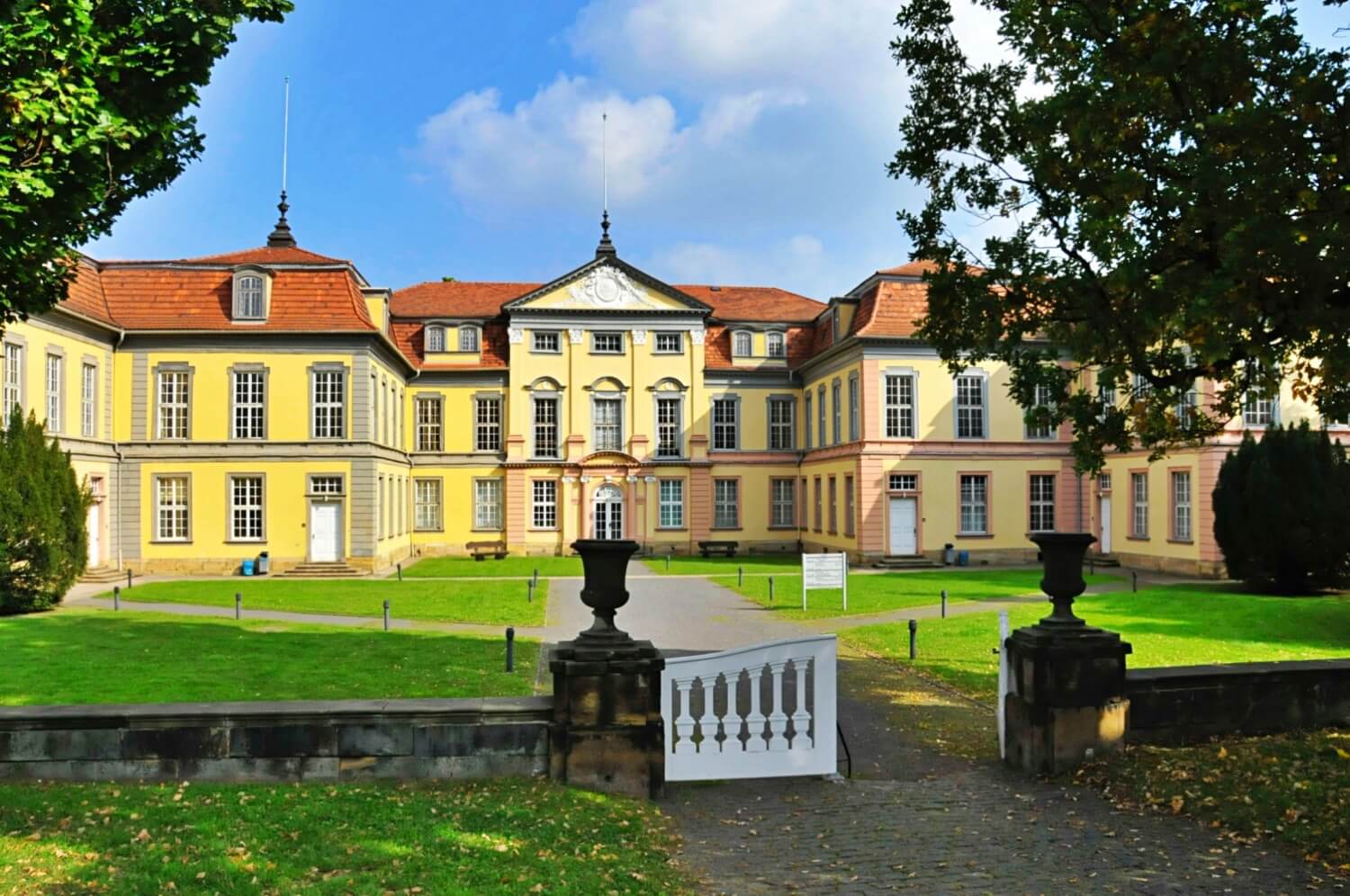
Schloss Friedrichsthal
Gotha
0.5km
castle, chateau
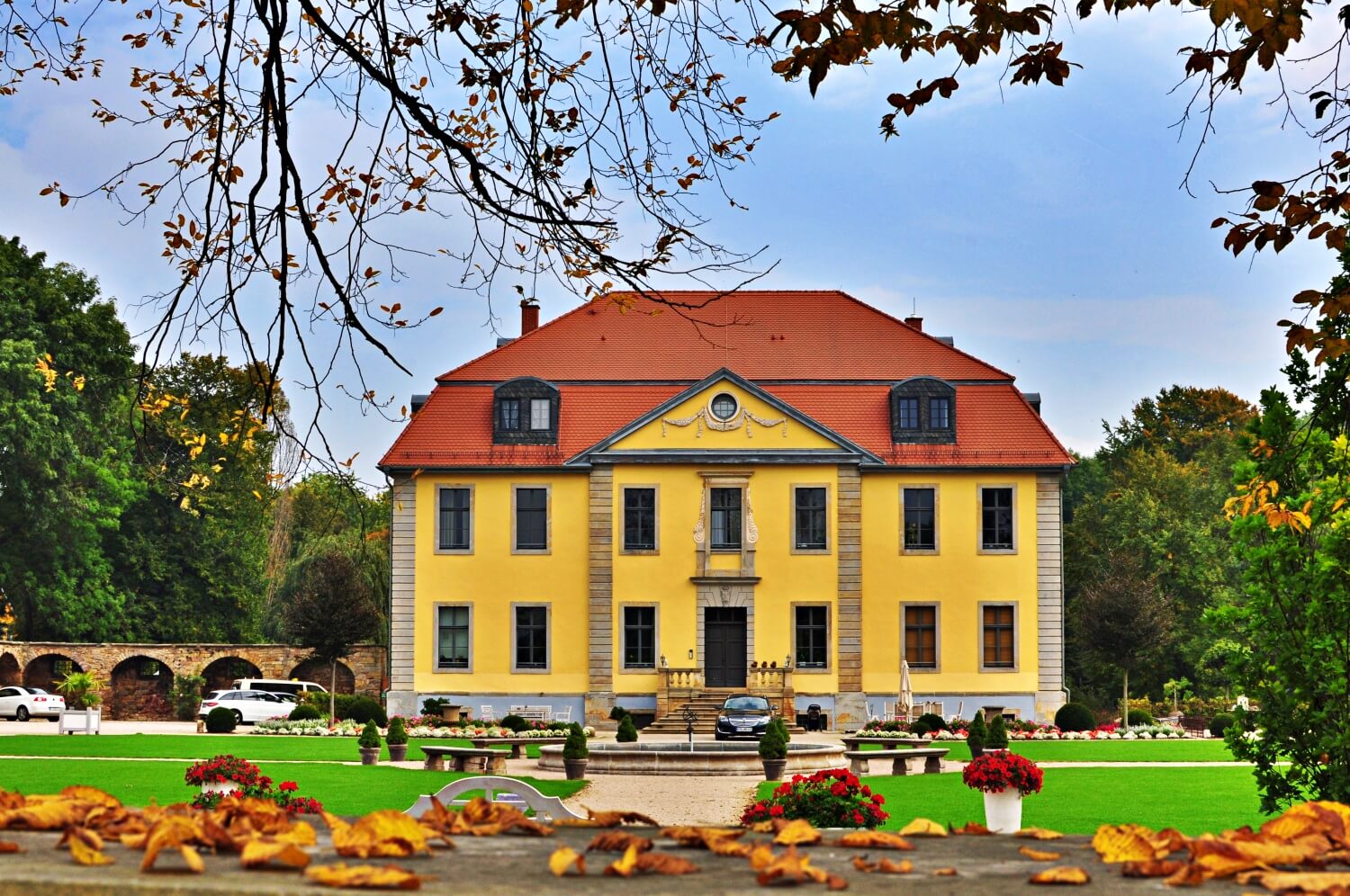
Schloss Mönchhof
Gotha
2.5km
castle, chateau
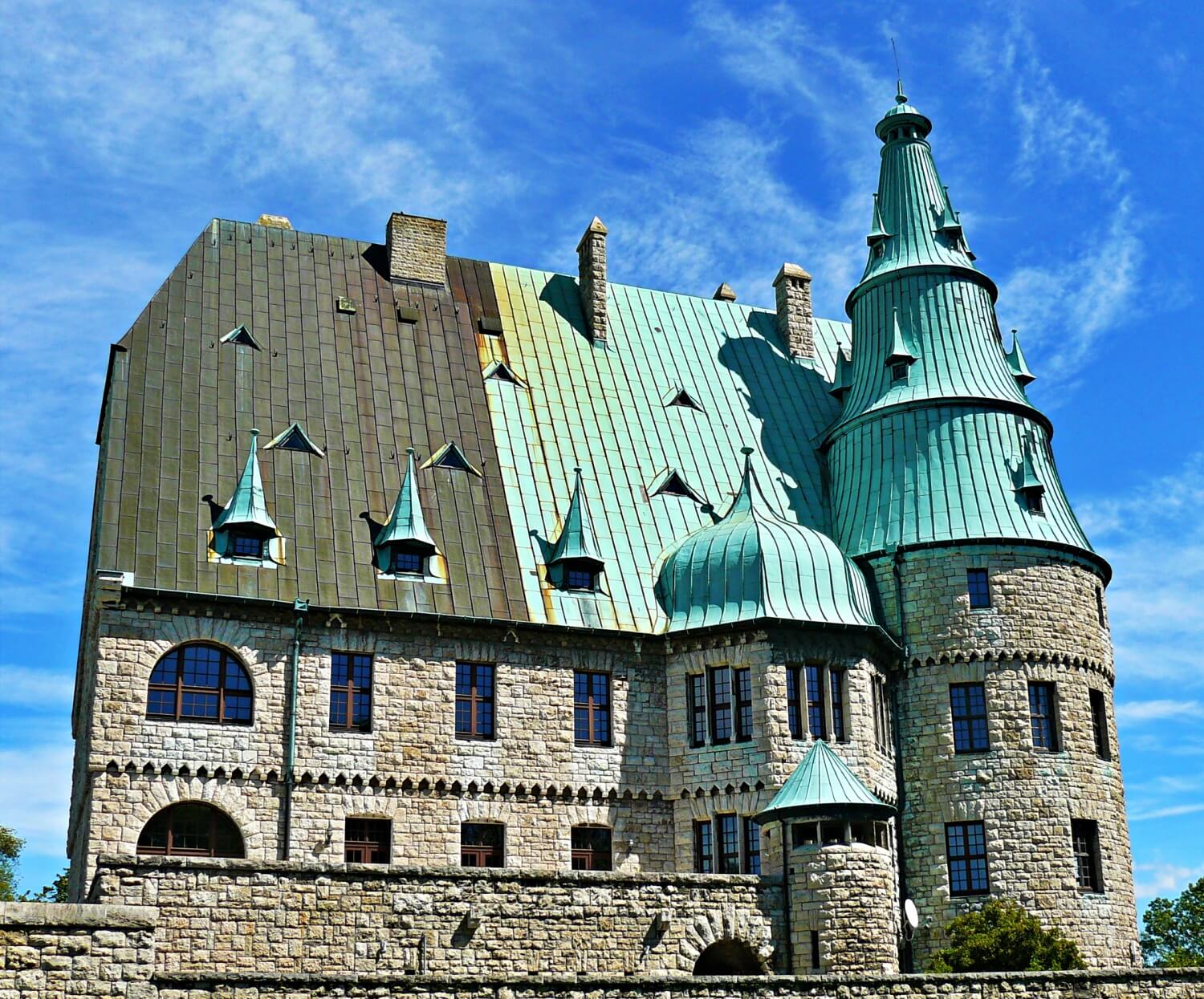
Haus Muhlberg
Gotha
11.8km
castle, chateau
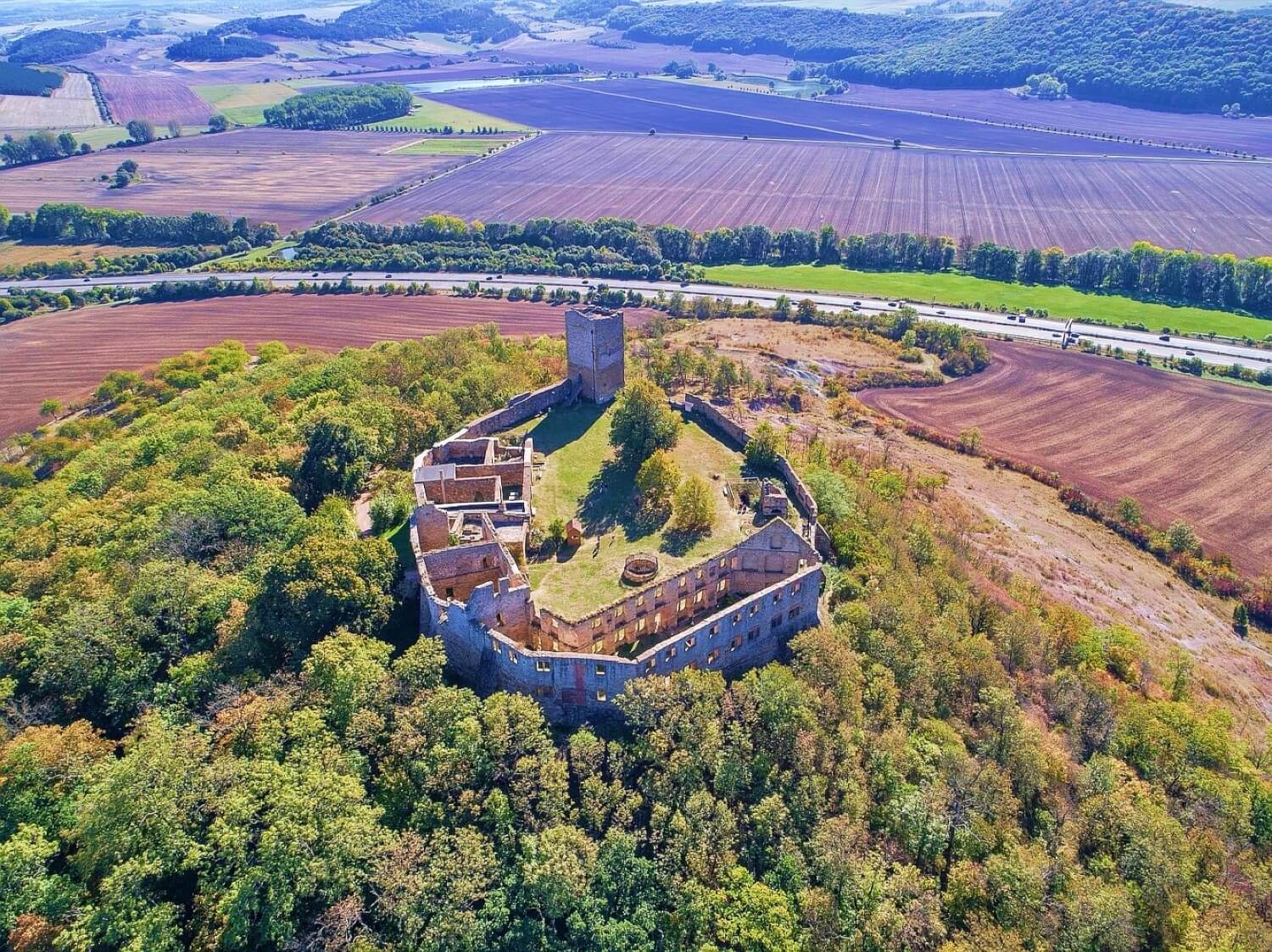
Burg Gleichen
Gotha
11.9km
castle, chateau
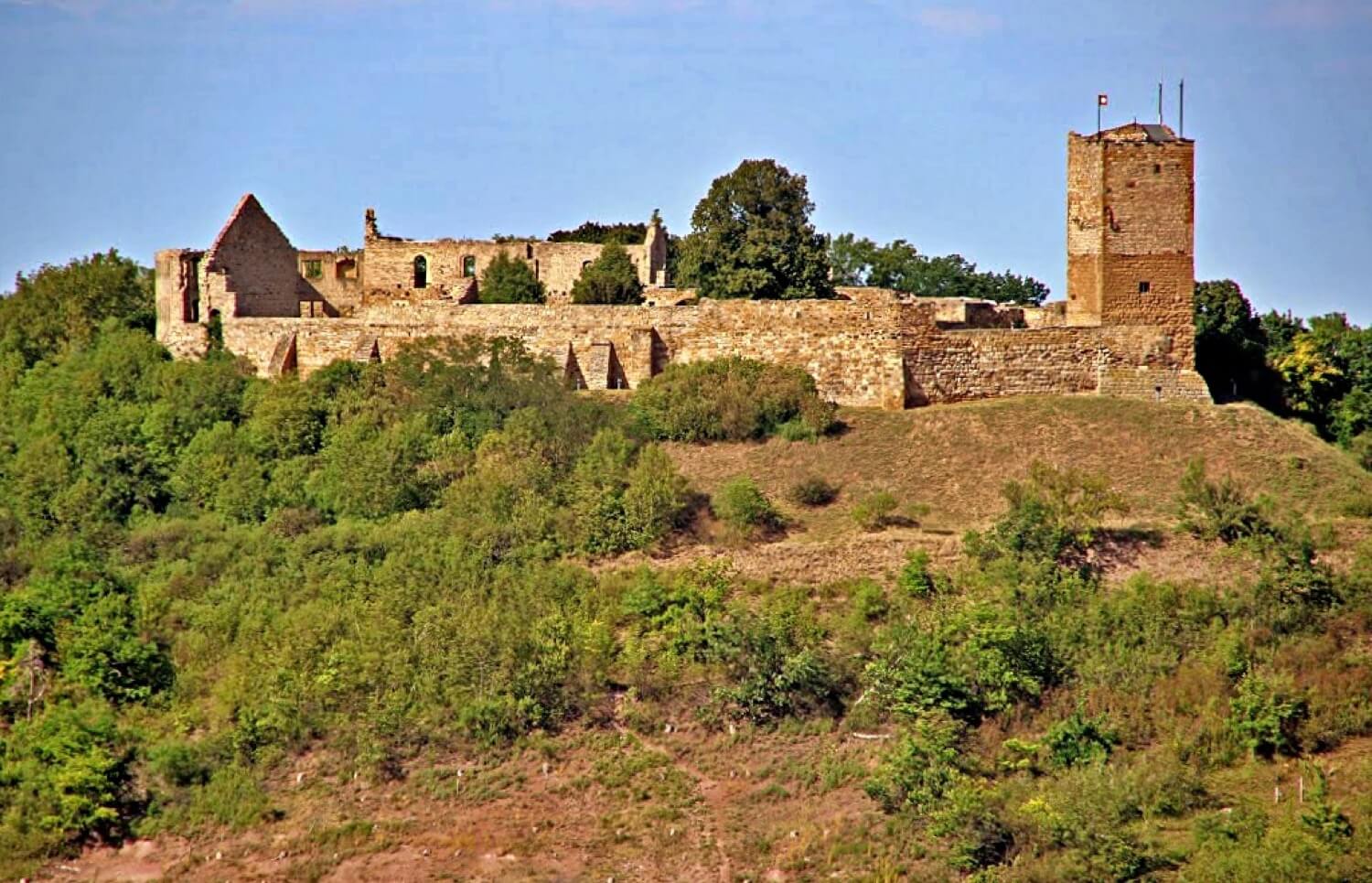
Gleichen Castle
Gotha
11.9km
castle, chateau
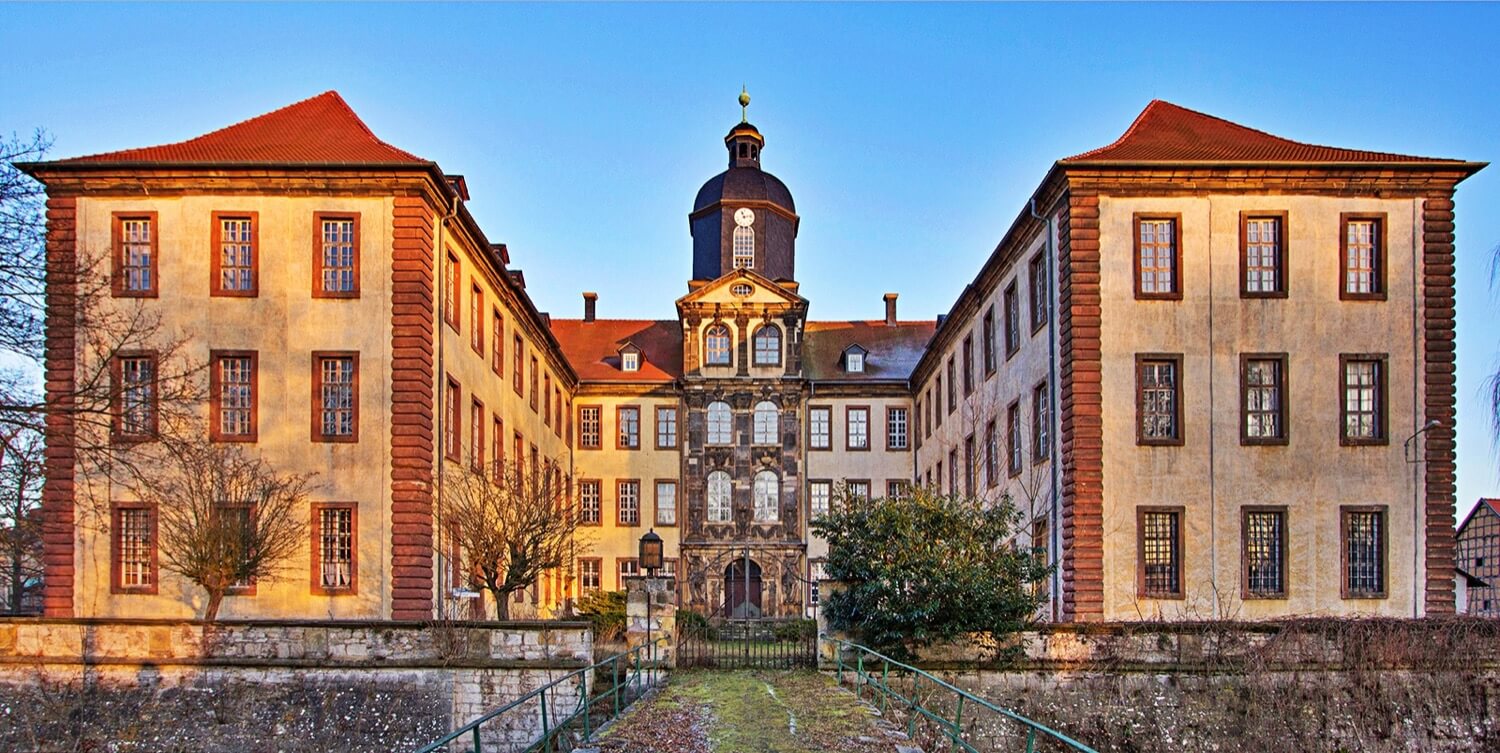
Schloss Friedrichswerth
Gotha
12.4km
castle, chateau
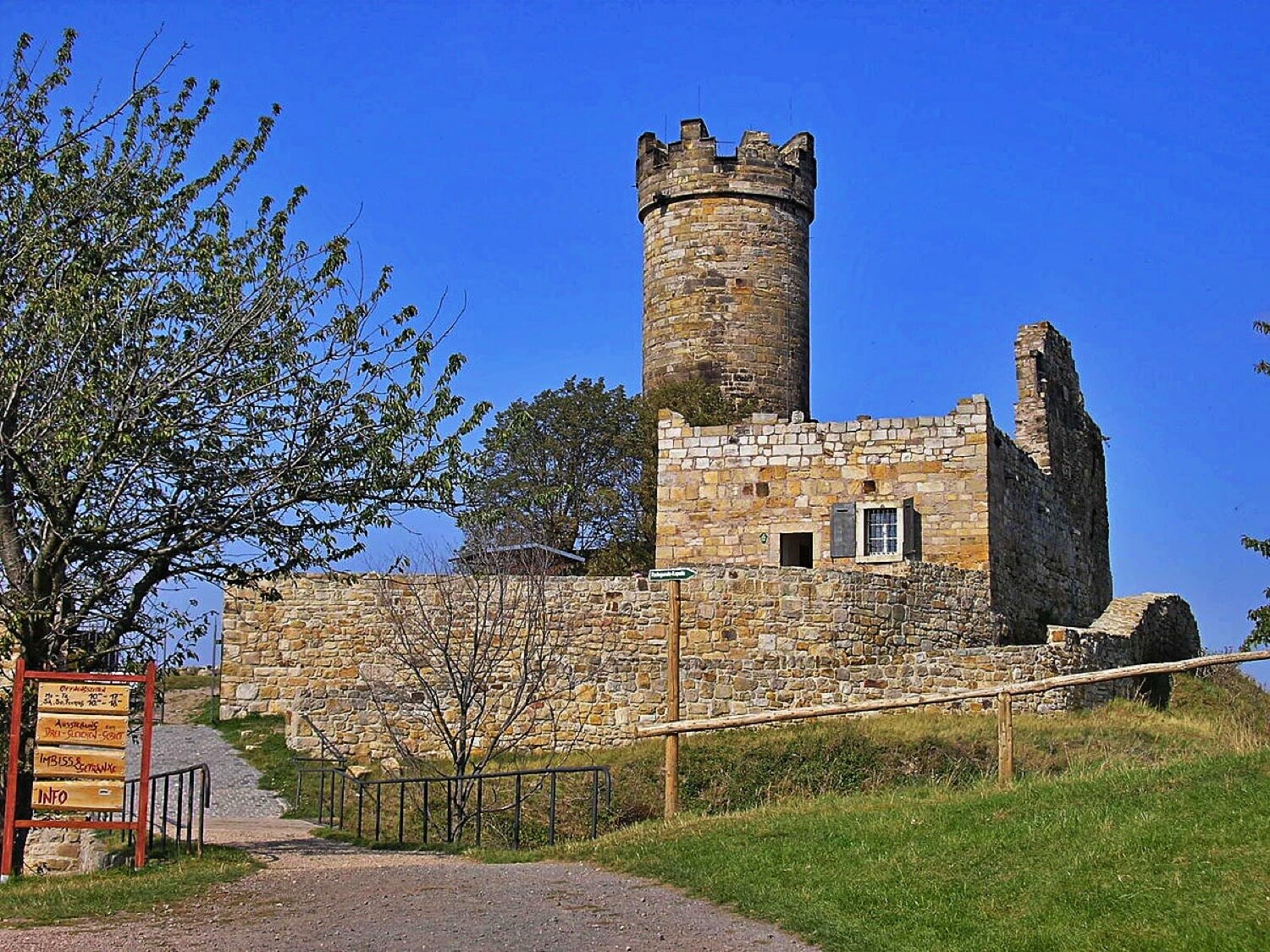
Mühlburg Castle
Gotha
12.4km
castle, chateau