Burg Wildenburg
Birkenfeld Rheinland-Pfalz Germany
castle, chateau
Burg Wildenburg
Birkenfeld Rheinland-Pfalz Germany
castle, chateau
Wildenburg Castle is a ruined castle near Kempfeld in the county of Birkenfeld in the German state of Rhineland-Palatinate
Die Burg Wildenburg ist eine Burgruine bei Kempfeld im Landkreis Birkenfeld in Rheinland-Pfalz (Deutschland)
Previous names
Burg Wildenburg, Burg Wildenburg
Description
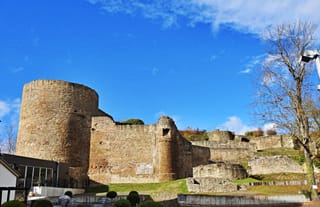
Wildenburg Castle is a ruined castle near Kempfeld in the county of Birkenfeld in the German state of Rhineland-Palatinate.
History
The predecessor of the Wildenburg was probably a Celtic refuge fort with double ramparts from the La Tène period (ca. 450-50 B.C.). The Wildenburg rampart is one of a number of Celtic fortifications in southern Hunsrück between the hillfort of Otzenhausen, the Ringkopf, the Altburg and the Alteburg in Soonwaldsteig. A short section of the rampart has been reconstructed as a "Gallic Wall".
Around the year 350 A. D. a late Roman fort was established on the Wildenburg for a short time.
In the Late Middle Ages Wildenburg was built by the Wildgrafen family on the rocks at the western tip of the circular rampart. It was first mentioned in 1330 and was pillaged and destroyed by marauding troops from Lorraine in 1651. After being partially rebuilt in 1660, the lower ward of the castle acted as the administrative headquarters for the Amt of Wildenburg until the abolition of the county in the 1792.
Description
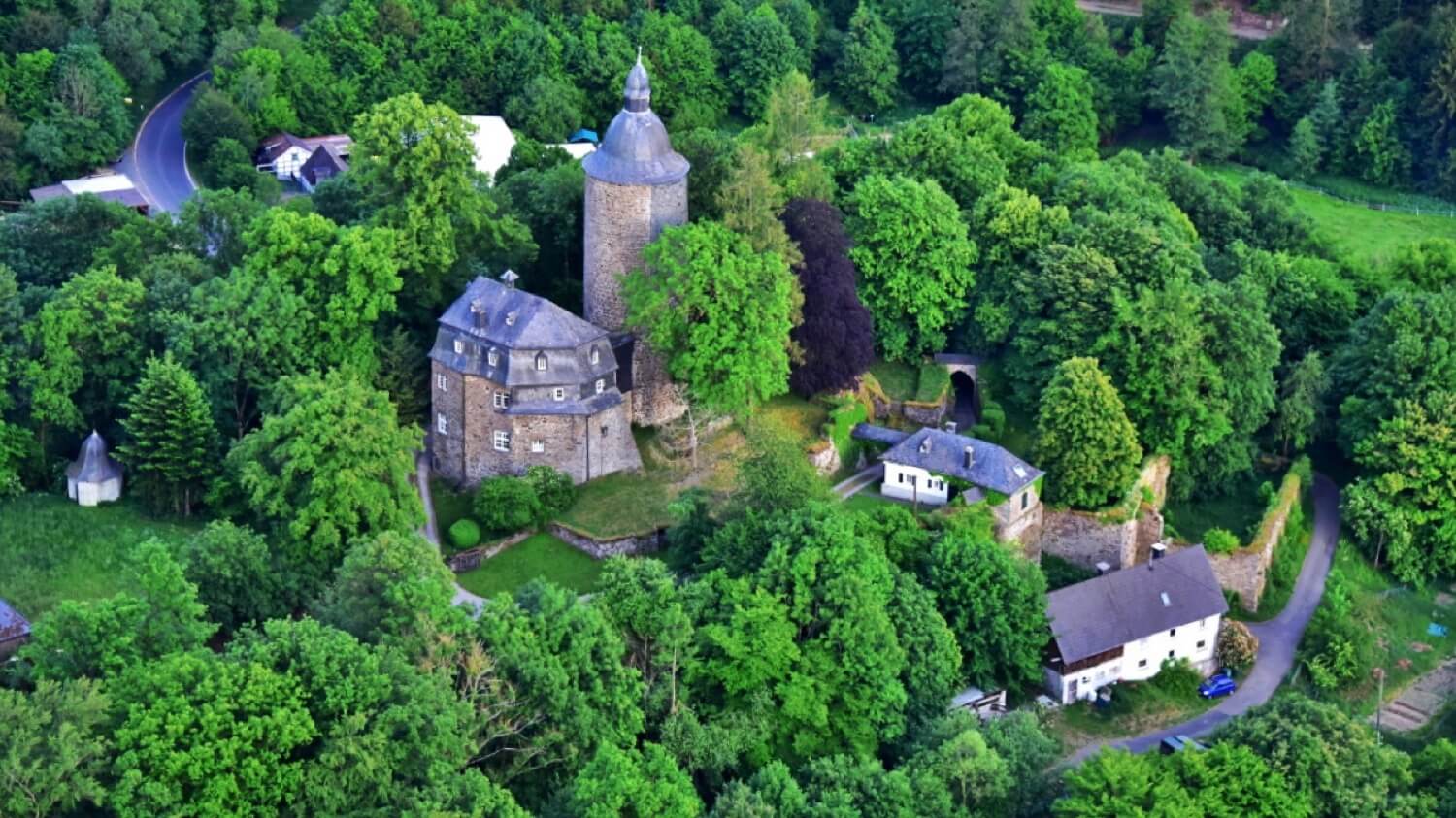
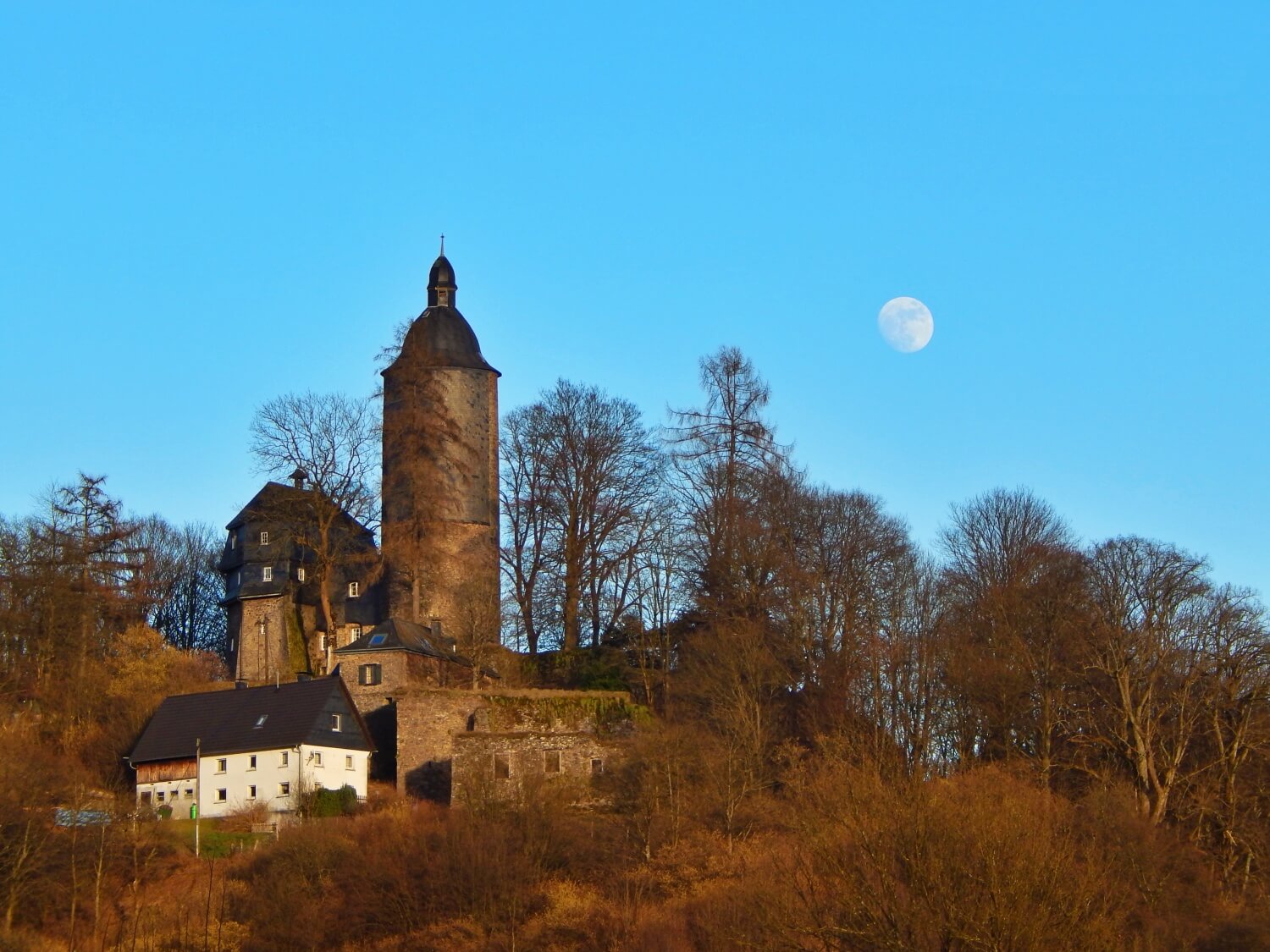
Of the upper bailey (Oberburg) that was built on rocks only a few wall remains have survived. However, in 1980, a 22-metre-high observation tower was built on the top of the rocks that was opened in 1981.
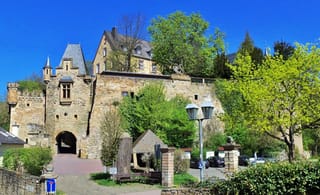
In 1859 the buildings of lower bailey (Unterburg), including the gate tower, domestic buildings and enceinte, were restored for the Prussian Forestry Commission. These buildings were further converted into the present-day castle cafe and headquarters of the Hunsrück Club.
Die Burg Wildenburg ist eine Burgruine bei Kempfeld im Landkreis Birkenfeld in Rheinland-Pfalz (Deutschland). Teile der Anlage befinden sich im Nationalpark Hunsrück-Hochwald.
Geschichte
Vorläufer der Wildenburg war eine vermutlich keltische Fluchtburg mit doppelter Wallanlage aus der Latènezeit (ca. 450–50 v. Chr.). Der Wildenburger Wall gehört zu einer Reihe von keltischen Wallanlagen im südlichen Hunsrück zwischen dem Ringwall von Otzenhausen, dem Ringkopf, der Altburg und der Alteburg im Soonwald. Ein kurzer Abschnitt des Walls wurde als „gallische Mauer“ (murus gallicus) rekonstruiert.
Um das Jahr 350 n. Chr. wurde auf der Wildenburg für kurze Zeit eine spätrömische Befestigung eingerichtet.
Im Spätmittelalter wurde von Wildgraf Friedrich von Kyrburg auf dem Felsen an der Westspitze des Ringwalls die Wildenburg erbaut (erstmals 1330 erwähnt) und 1651 von marodierenden lothringischen Truppen gebrandschatzt und zerstört. Nach teilweisem Wiederaufbau im Jahre 1660 diente die Unterburg dem Amt Wildenburg als Verwaltungssitz bis zur Aufhebung der Grafschaft im Jahre 1792.
Umfeld
Einem örtlichen Denkmalstein zufolge befand sich unterhalb der Burg auch ein Weiler, von dem jedoch heute nichts mehr erhalten (Wüstung). Zudem liegt unterhalb der Burg auch das Wildkatzenzentrum Wildenburg, eines der drei Tore des Nationalparks Hunsrück-Hochwald.
Useful information
Gratis
Wanderwege
Privateigentum, nur außerhalb zu besuchen
-
Nearby castles