Castle of Abrantes
Abrantes Santarém Portugal
castle, chateau
Castelo de Abrantes
Abrantes Santarém Portugal
castle, chateau
The Castle of Abrantes (Portuguese: Fortaleza de Abrantes) overlooks the city of Abrantes, in the municipality of Abrantes in the district of Santarém, Ribatejo, divided between the two civil parishes of São João and São Vicente
O Castelo de Abrantes, também referido como Fortaleza de Abrantes, no Ribatejo, localiza-se nas freguesias de São João e São Vicente, povoação e concelho de Abrantes, distrito de Santarém, em Portugal
Previous names
Castle of Abrantes, Castelo de Abrantes
Description
The Castle of Abrantes (Portuguese: Fortaleza de Abrantes) overlooks the city of Abrantes, in the municipality of Abrantes in the district of Santarém, Ribatejo, divided between the two civil parishes of São João and São Vicente. It was part of the Reconquista fortifications that made up the Linha do Tejo (English: Tagus Line), a line of castles and outposts during the Middle Ages, recently integrated into a tourist region called the Região de Turismo dos Templários (English: Tourist Region of the Templars).
History
The area of the Abrantes Castle was at one time occupied by a Lusitanian castro structure. It was conquered during the Roman invasion of the peninsula around 130 BC by Consul Decimus Junius Brutus, and occupied for a time by Roman legions after Brutus expanded and remodelled it. Successive invasions by Alans (411), Visigoths (492) and Moors (716) further indicated the strategic importance of this site, justifying the establishment of a permanent military garrison. However, the area and its river did not constitute an important link between the settlements of the Iberian Peninsula until the 12th century.
During the Christian Reconquista (English: Re-conquest), the settlement in the area of Abrantes was taken from the Moors by forces in the service of Afonso Henriques (1112-1185), who restructured the defences of the site to attract settlers into the region. He granted the lands to the Order of Santiago (1172) so that they could watch over and assist pilgrims on the Way of Saint James. Later, it was incorporated into the Linha do Tejo (English: Tagus Line) that the Knights Templar established to control and maintain the lands reconquered from the Muslims. The castle outpost, as well as the castles of Almourol, Castelo Branco, Monsanto, Pombal, Tomar, Torres Novas and Zêzere formed a defensive barrier of garrisons along the middle course of the Tagus River.
As part of this line, Abrantes was able to resist the forces of the Almohad Caliphate under the command of Moroccan Abem Jacob (1179), who retreated after suffering many deaths. Abrantes was rewarded for its heroic resistance by receiving a foral in 1179 and was rebuilt. During the reign of Sancho I (1185-1211), a new attack from the Almoáda, under the command of Caliph Abu Yusuf Ya'qub al-Mansur, was successful in 1191 in retaking all the Christian conquests in the territories south of the Tagus, with the exception of Évora. In 1250, Afonso III (1248-1279) initiated a strengthening of the defences of the castle, including the construction of the prison block and an expansion of the walls, which was brought to completion between 1300 and 1303 in the reign of his successor Dinis. Afonso III donated the village of Abrantes to his wife, Queen Elizabeth of Portugal, beginning a tradition of royal patronage by the Queens of Portugal.
During the Portuguese Interregnum Abrantes allied itself with the Master of Aviz, and fought the forces of Castile in the Battle of Aljubarrota.
A new foral was conferred (1510) during the reign of Manuel I of Portugal (1495-1521). In 1531, the two top floors of the prison block were destroyed by the 1531 Lisbon earthquake.
In the second half of the 16th century, the Abrantes Castle entered into decline, particularly during the 1580 Portuguese succession crisis. In the context of the Portuguese Restoration War, in the last quarter of the 17th century, Peter II determined that the castle and its settlement should be reconstructed into a medieval castle-keep, in the style of Vauban. To this end, the medieval walls were lowered and strengthened, and two secondary walls were constructed within the bastions in 1704. By this process of remodelling, which included the construction of the palace of the Marquess of Abrantes (by Rodrigo de Almeida e Meneses, 1st Marquess of Abrantes), making the fortress a key to the Province of Estremadura. Similar expansions were accomplished in 1731 by the military engineer Engeleer, with the construction of the bastions and renovation of the already existing walls.
In the 18th century, the castle's installations were adapted for use as a garrison of a regiment of Royal Cavalry. Between 1792 and 1799, the same quarters were expanded and occupied by a legion commanded by the Marquess of Alorna. By the beginning of the 19th century, during the Peninsular War the castle and town underwent, on two occasions, the passage of Napoleonic troops into Portugal:
on 22 November 1807, it was occupied by troops under the command of Jean-Andoche Junot, who took the title of Duke of Abrantes (March 1808);
in October 1810 it was reoccupied, after the rout of French troops at the Lines of Torres Vedras, under the command of Marshall André Masséna.
In 1809, the fortifications were improved under engineer Manuel de Sousa Ramos, just before they were occupied by Masséna's forces, who destroyed the palace of the Marquess of Abrantes.[1] Afterwards, the castle installations were de-activated as quarters, and converted to a military presidio, resulting in alterations to its structure.
In 1860 repairs were made at the prison block, reinforced by an exterior wall, ordered built by the Baron of Batalhã.
In the middle of the 20th century, the castle's buildings and structures were classified as an Imóvel de Interesse Público (Property of Public Interest) by decree (July 1957) by the Direcção-Geral dos Edifícios e Monumentos Nacionais (DGEMN) (General-Directorate for Buildings and National Monuments). At the end of the 1960s, remodelling projects were advanced to consolidate and restore the walls of the castle, which continued until the 1970s (and included the partial reconstruction of the detention block).
On 1 June 1992, the fort came under the authority of the Instituto Português do Patromónio Arquitectónico (IPPAR), forerunner of the Instituto de Gestão do Património Arquitectónico e Arqueológico (Decree 106F/92).
In 2002, a program was established to maintain and promote the structure, which included a public tender to renovate the building; the castle was closed between 2002 and 2004 to enable renovations to be carried out. After these were concluded, the castle was formally re-inaugurated on 18 April 2004.
Architecture
The Castle has an imposing position on the right margin of the Tagus River, surmounting a hilltop overlooking the town and local landscape. It is a characteristic hilltop fortification, located on a 197-metre high plateau dominating the town, designed to take advantage of the steep incline of the northeast escarpment. The southern, southeastern and eastern portions of the castle are reinforced by bastions and curtain walls. In addition to the isolated detention and block (in the centre of the grounds), the eastern end of the castle are dominated by the Paços do Marquis, Paços dos Condes and the church of the Santa Maria do Castelo.
The military fort, like other medieval forts, was the centre of power and refuge in case of attack; the community lived outside the walls, in the almedina, a space that includes the two major churches of São Vicente and São João.
The castle is constructed from masonry rock in an irregular polygonal form surmounting a rocky cliff face with steep vertical walls. Originally of Romanesque architecture, it took on aspects of Gothic architecture through successive additions, remodelling and rebuilding after the 13th century. The only remnants of the austere medieval castle are the detention block, the weapons portico (on the north-east angle) and the parapet for lookouts that commanded panoramic views of the region.
The rectangular detention block in the middle of the castle commons originally had three levels, but the two upper levels were destroyed in the 1531 earthquake. Remodelling completed in the 19th century took from the character of the façade.
The first line of walls are reinforced by cylindrical towers and interrupted by vertical openings. The castle's bastions, completed in the 18th century, are distributed around the older part of the settlement of Abrantes.
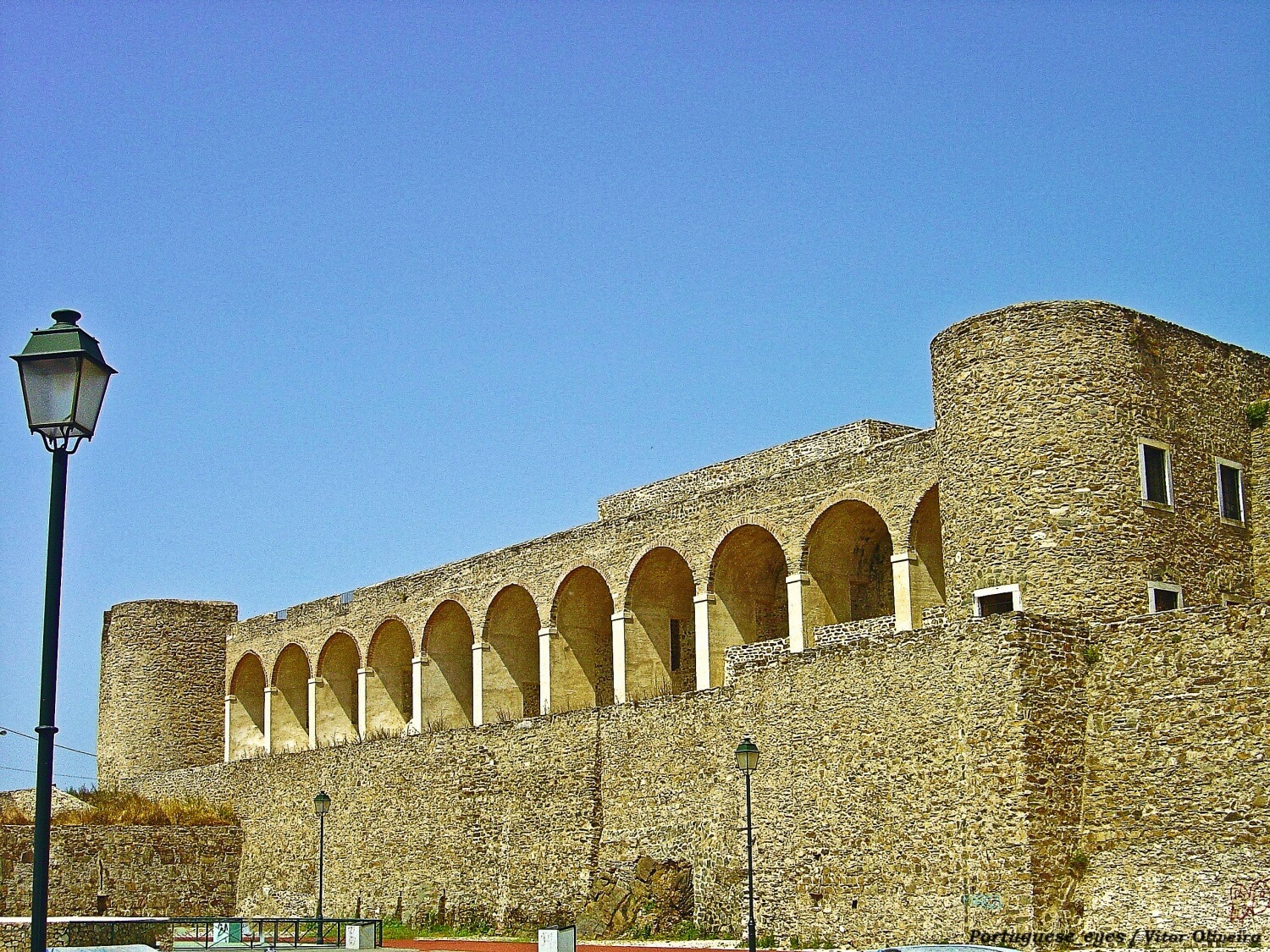
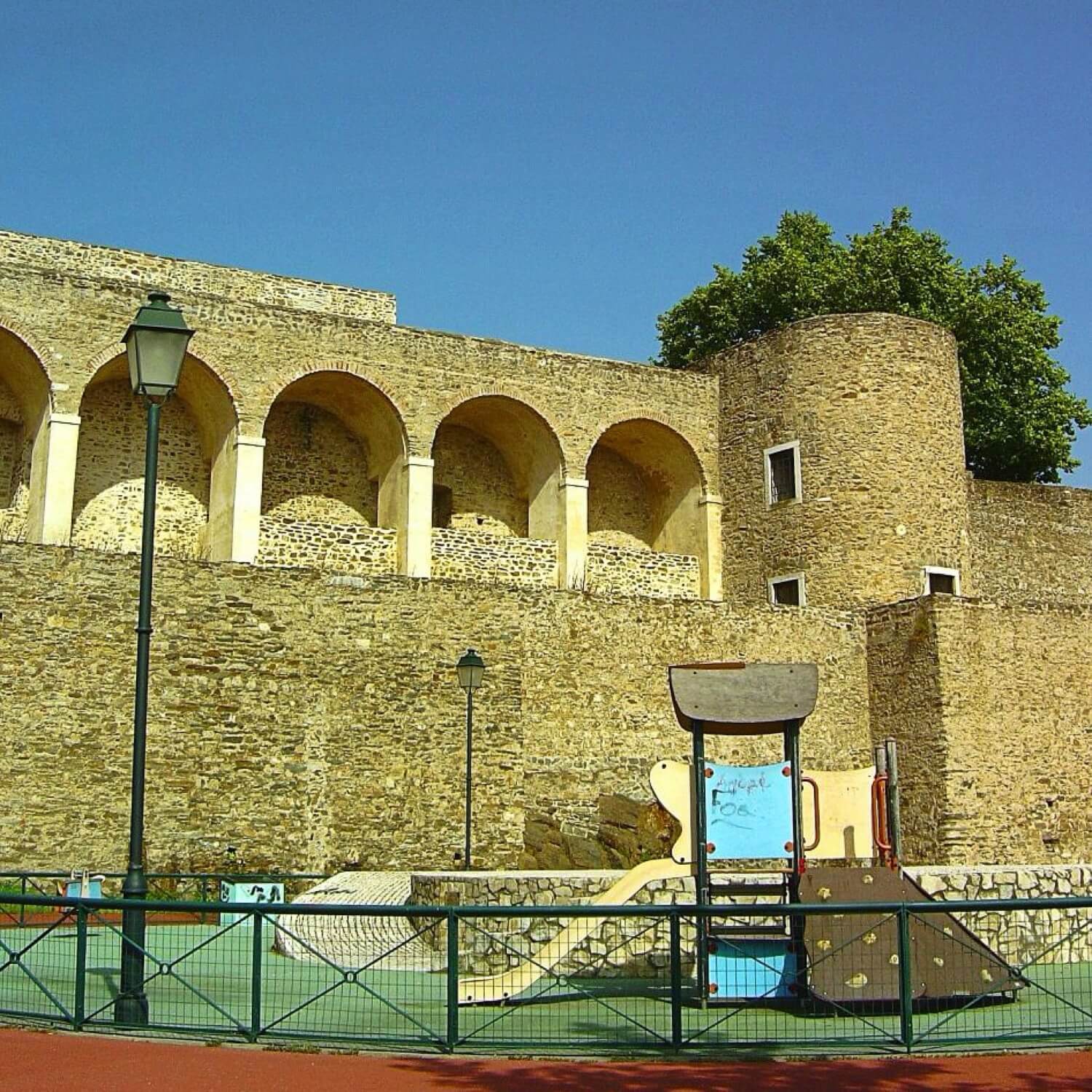
The old military square, and on the western extent of the castle, are the ruins of the old Paço dos Condes de Abrantes(English: Residence of the Counts of Abrantes). Begun in 1530, by the sheriff of the vila, Diogo Fernandes de Almeida, it was designed to take advantage of the wall to reinforce the structure. The Paços, marked by grandiose architectural elements in the Baroque style, was substantially modified in the 18th century by the first Marquis of Abrantes, Rodrigo Anes de Sá Almeida e Menezes. Of these elements the loggia, consisting of an arcade of 11 perfect spans, aligned symmetrically on two cylindrical tiers, are the most distinctive part of the Abrantes complex.
In the interior, the Church of Santa Maria do Castelo, in the Gothic style has been converted into a museum exhibiting a collection of Roman sculpture, funerary artefacts from the 15th and 16th century, as well as azulejos.
O Castelo de Abrantes, também referido como Fortaleza de Abrantes, no Ribatejo, localiza-se nas freguesias de São João e São Vicente, povoação e concelho de Abrantes, distrito de Santarém, em Portugal.
Em posição dominante sobre uma colina à margem direita do rio Tejo, outrora constituindo a chamada Linha do Tejo, um conjunto de fortalezas que atualmente faz parte da Região de Turismo dos Templários.
História
Antecedentes
Alguns autores acreditam que o seu sítio tenha sido ocupado desde a pré-história por um castro, conquistado, no âmbito da Invasão romana da Península Ibérica, no ano de 130 a.C., pelo cônsul Decimus Junius Brutus e ocupado posteriormente por Visigodos e Muçulmanos, argumentando que o sítio se constituía em uma encruzilhada de vias terrestres, justificando a sua ocupação e guarnição militar. Outros autores, ao contrário, compreendem que o médio curso do rio Tejo não possuiu, a rigor, qualquer organização ligada aos principais poderes peninsulares até ao século XII.
O castelo medieval
À época da Reconquista cristã da Península Ibérica, em 1118 ou 1148, a povoação foi conquistada aos mouros pelas forças de D. Afonso Henriques (1112-1185), que lhe determinou a reconstrução das defesas. As necessidades de defesa da chamada Linha do Tejo, valorizaram-lhe o sítio, num período em que a Ordem dos Templários dotava o médio curso do rio de uma impressionante linha defensiva, na qual se inscreveu. Resistiu, desse modo, ao assédio das forças do Califado Almóada sob o comando de Abem Jacob, as quais tiveram que se retirar sofrendo pesadas baixas. Em recompensa por esse feito heroico, recebeu do soberano a sua Carta de Foral (1179).
Posteriormente, D. Afonso III (1248-1279) conferiu-lhe importantes melhoramentos na defesa, iniciados em 1250 e concluídos entre 1300 e 1303, já no reinado de D. Dinis (1279-1325), com destaque para a torre de Menagem e a ampliação das muralhas. Este monarca doou a vila a sua esposa, D. Isabel de Aragão, passando, a partir de então, a integrar o património das rainhas de Portugal.
À época da crise de 1383-1385 alinhou-se ao lado das forças do Mestre de Avis, rezando a tradição que foi neste castelo que se tomou a decisão de dar combate às tropas de Castela em Aljubarrota.
Sob o reinado de D. Manuel (1495-1521), a povoação recebeu o Foral Novo (1510).
Na segunda metade do século XVI, o Castelo de Abrantes entrou em decadência, particularmente durante a Dinastia Filipina.
A praça-forte setecentista
No contexto da guerra da Restauração da Independência portuguesa, no último quartel do século XVII, D. Pedro II (1667-1706) determinou a sua reedificação, transformando a povoação e seu castelo medieval em uma moderna praça-forte abaluartada (Praça-forte de Abrantes), ao estilo Vauban. Para esse fim as muralhas medievais foram rebaixadas e reforçadas, tendo-lhes sido adossados dois meio-baluartes (1704). À época era reputada como "a chave da Província da Estremadura".
No século XVIII, as instalações do castelo foram adaptadas para o uso como quartel, passando a aquartelar um regimento da Cavalaria Real. Posteriormente, entre 1792 e 1799, essas instalações foram ampliadas e ocupadas pela legião comandada pelo marquês de Alorna.
Do século XIX aos nossos dias
No início do século XIX, quando da Guerra Peninsular, a vila suportou, em duas ocasiões, a passagem das tropas napoleônicas:
em 22 de Novembro de 1807, foi ocupada pelas tropas sob o comando do general Jean-Andoche Junot, agraciado com o título de duque de Abrantes (Março de 1808);
em Outubro de 1810 foi reocupada, após a derrota das tropas sob o comando do marechal André Masséna nas Linhas de Torres.
Posteriormente, as instalações do castelo foram desativadas como aquartelamento, dando lugar a um presídio militar, acarretando adulteração de estruturas.
Em meados do século XX o conjunto foi classificado como Imóvel de Interesse Público por Decreto de Julho de 1957. No fim da década de 1960 foram encetadas obras de consolidação e restauro nas muralhas do castelo, que se estenderam até ao início da década de 1970, destacando-se a reconstrução parcial da antiga torre de menagem. Recentemente, a partir de 2002, formulou-se um projeto global de intervenção e de valorização do conjunto.
Características
Construído em alvenaria de pedra, apresenta planta poligonal irregular (orgânica), acompanhando o afloramento rochoso em que se ergue, com muralhas de faces predominantemente retas.
Originalmente em estilo românico, as reformas que lhe foram introduzidas no século XIII conferiram-lhe o aspecto gótico.
Do antigo e austero castelo medieval, envolto por um jardim público de onde se descortina uma invejável panorâmica, restam atualmente apenas a sólida Torre de Menagem, a Porta de Armas (no ângulo nordeste) e a arcaria de suporte a dois distintos panos de muralhas que servem de parapeito a um miradouro sobre a cidade.
A Torre de Menagem, com planta quadrangular, invulgarmente localizada no centro da praça de armas, compunha-se originalmente por três pavimentos, tendo os dois superiores ruído no terremoto de 1531. As suas feições foram descaracterizadas por obras promovidas no século XIX.
O primeiro pano de muralhas é reforçado por torres cilíndricas e rasgado por aberturas retangulares. Os baluartes setecentistas distribuem-se ao redor da povoação, a meia encosta.
Na antiga praça de armas, pelo lado oeste, erguem-se as ruínas do antigo Paço dos Condes de Abrantes, iniciado em torno de 1530 pelo Alcaide-mor da Vila, Diogo Fernandes de Almeida, tendo demolindo, para o erguer, aquele trecho de muralhas. Esta edificação foi substancialmente modificada no século XVIII por iniciativa do 1° Marquês de Abrantes, D. Rodrigo Anes de Meneses. O Paço dos Marqueses de Abrantes, marcado pela grandiosidade dos seus elementos arquitetónicos em estilo barroco, entre os quais se destaca a loggia, arcada de onze vãos de volta perfeita, ladeada simetricamente por dois torreões cilíndricos.
Ainda no interior do recinto amuralhado medieval ergue-se a Igreja de Santa Maria do Castelo de estilo gótico, convertida em museu histórico, onde se conservam coleções de escultura romana, escultura tumular do século XV e século XVI, além de painéis de azulejos sevilhanos e outras obras de arte.
Useful information
Free
Free
Free
Free
Castle Garden
cultura@cm-abrantes.pt
Closed on Mondays and holidays
-
External links
Nearby castles