Castle Chwarszczany
Powiat myśliborski Zachodniopomorskie Poland
castle, chateau
Замок в Хварщанах
Powiat myśliborski Zachodniopomorskie Poland
castle, chateau
Zamek w Chwarszczanach
Powiat myśliborski Zachodniopomorskie Poland
castle, chateau
Замок в Хварщанах
Powiat myśliborski Zachodniopomorskie Poland
castle, chateau
Chwarszczany is a village in the administrative district of Gmina Boleszkowice, within Myślibórz County, West Pomeranian Voivodeship, in north-western Poland, close to the German border
В 1232 році Владислав Одоніч надав село ордену Тамплієрів
W 1232 roku Władysław Odonic nadał wieś wraz z pobliskimi dobrami zakonowi templariuszy
В 1232 году Владислав Одонич предоставил село ордену Тамплиеров
Previous names
Castle Chwarszczany, Замок в Хварщанах, Zamek w Chwarszczanach, Замок в Хварщанах
Description
Chwarszczany is a village in the administrative district of Gmina Boleszkowice, within Myślibórz County, West Pomeranian Voivodeship, in north-western Poland, close to the German border. It is located at the junction of voivodeship road 127 and national road 31. The village has a population of 222.
The origins of this chapel lie in the gift to the Knights Templar of 1,000 hides of land (1 hide is approximately 17 hectares) by Władysław Odonic, Duke of Greater Poland, in 1232. This land was in the Kostrzyn region and centred on the town. This donation fulfilled more than simply religious reasons, as it provided a safeguard in a borderland and enabled the settlement of the area. The Dukes of Pomerania, however, considered this whole district as belonging to their castle of Kinice, and not to Kostrzyn and Santok. In order not to become expelled from the area they hurried to make their own donation. Thus, in 1234 Barnim I, the Duke of Pomerania, gave the Templars a further 200 hides which were centered on Dargomyśl, pointing out that this land is located in his own territory.
It is not known where the Templars of Chwarszczany came from, but it may have been the Silesian commandery in Oleśnica Mała. In 1241 the property portfoloio of the Templars was expanded with the addition Lubno and Oborzany, donated by Włast, a Polish magnate. By the middle of the 13th century, the Brandenburg margraves of the Ascanian dynasty gained control of the property. Following disputation, in 1261 an agreement was reached between the Templars and the margraves: the Templars ceded rights to a commandery in Myślibórz, and gave up lands situated by the road from Kostrzyn to Gorzów. In return they received confirmation of the possession of Chwarszczany with ten villages with the addition of the village of Kaleńsko.
In 1286 Otto VI, Margrave of Brandenburg-Salzwedel, entered the monastery in the town, giving the commandery greater significance. In the 1290s Bernhard von Eberstein became the Templar preceptor of Poland, Neumark, Bohemia and Moravia. In 1308, the member of the order Günther von Köthen sold the village of Cychry belonging to the commandery to two brothers of the rich Hokemann family of Frankfurt upon Oder. This is the last mention of the Templars in the area, with the chapel being taken over by the Hospitallers following the suppression of the Templars.
В 1232 році Владислав Одоніч надав село ордену Тамплієрів. З 1250 року до кінця XIII століття на плоскому пагорбі над річкою Мишла вони побудували каплицю і, ймовірно, оточили велике плато укріпленнями, включаючи навіть деякі інші будівлі. Вона служила місцеперебуванням командирського штабу, а з 1262 року - комтурів, проте це не було значне припущення.
У 1312 роки Хварщани, після секуляризації тамплієрами, перейшли у володіння іоанніттів.
Після перенесення іоаннітів до Швідвіна з Хварщанського замку було влаштовано садибу. Під час Семирічної війни замок був частково зруйнований. У 1858 році каплиця була перебудована і садиба функціонувада ще до кінця Другої світової війни.
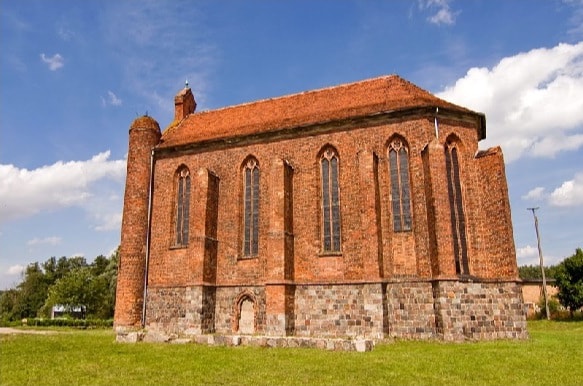
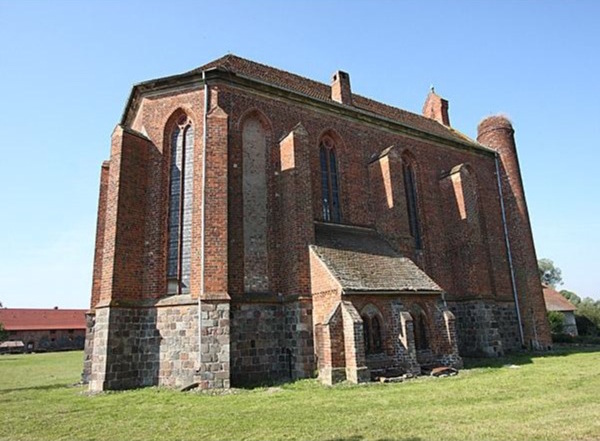
В даний час єдиним залишком від замку є каплиця.
W 1232 roku Władysław Odonic nadał wieś wraz z pobliskimi dobrami zakonowi templariuszy. Od 1250 roku do końca XIII wieku na płaskim wzniesieniu nad rzeczką Myślą zbudowali oni kaplicę i prawdopodobnie otoczyli rozległe plateau umocnieniami obejmującymi jeszcze jakieś inne zabudowania. Mieściła się tu siedziba komandorii, a od 1262 roku - komturii, nie było to jednak założenie znaczne.
W 1312 roku Chwarszczany, po sekularyzacji templariuszy, przeszły w posiadanie joannitów.
Po przeniesieniu joannitów do Świdwina z chwarszczańskiego zamku urządzono folwark. Podczas wojny siedmioletniej został on częściowo zniszczony. W 1858 roku odbudowano kaplicę, a folwark funkcjonował jeszcze do końca II wojny światowej.
Obecnie jedyną pozostałością po zamku jest kaplica.
В 1232 году Владислав Одонич предоставил село ордену Тамплиеров. С 1250 года до конца XIII века на плоском холме над рекой Мишле они построили часовню и, вероятно, окружили большое плато укреплениями, включая даже некоторые другие здания. Она служила местопребыванием командирского штаба, а из 1262 года - комтуры, однако это не было значительное предположение.
В 1312 года Хварщаны, после секуляризации тамплиерами, перешли во владение иоанниттив.
После переноса иоаннитов в Швидвин с Хварщанського замка было устроено усадьбу. Во время Семилетней войны замок был частично разрушен. В 1858 году часовня была перестроена и усадьба функционувада еще до конца Второй мировой войны.
В настоящее время единственным остатком от замка является часовня.