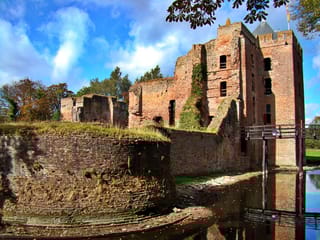
Egmond Castle
Bergen Noord-Holland Netherlands
castle, chateau
Kasteel Egmond
Bergen Noord-Holland Netherlands
castle, chateau
Egmond Castle (Dutch: Kasteel Egmond), also called the Ruins of Egmond (Dutch: Ruïne van Egmond), is a ruined medieval castle in the Dutch province of North Holland
Van het kasteel van Egmond te Egmond op den Hoef is niet veel meer over

Previous names
Egmond Castle, Kasteel Egmond
Description
Egmond Castle (Dutch: Kasteel Egmond), also called the Ruins of Egmond (Dutch: Ruïne van Egmond), is a ruined medieval castle in the Dutch province of North Holland. It is located in Egmond aan den Hoef in the municipality of Bergen and lies about 7 kilometres (4.3 mi) west of Alkmaar. The castle dates from the 11th century and is the ancestral seat of the Egmond family, whose members became sovereign Dukes of Guelders, Counts of Egmond and Princes of Gavere, Counts of Buren and Leerdam. It is a national monument of the Netherlands.
Origins
The origins of Egmond Castle is closely connected to Egmond Abbey, which was founded by the counts of Holland in Egmond-Binnen. When they Abbey lands became so large, the abbot decides to appoint a certain Berwout as steward of these estates in 1129. Berwout and his descendants live in a (fortified) farm or manor ("Hoeve") north of the abbey. As Berwout and his descendants took part in the crusades, they were rewarded with the hereditary lordship over Egmond.
First Castle | 1206–1285
Walter I, Lord of Egmond got involved in the Loon war, a war of succession over the County of Holland (and its dependency Zeeland) from 1203 until 1206, brought on by the death of count Dirk VII. During this war, Louis II, Count of Loon sets the fortified manor at fire in 1203. Walter I decided to build a circular stone castle as replacement. It had a diameter of 27 meters, a strong keep on the south side and a curtain wall. The main purpose was to serve as a place for refuge and defence in times of peril. The main living and residential buildings were in the forecourt. This circular castle existed until the end of the 15th century.
Second Castle - First Building Phase | 1285–325
William II, Lord of Egmond constructed a new castle in the forecourt as a replacement for the old circular castle. He divided the forecourt in a western and eastern side. On the eastern side, the main castle was erected with a large tower, the so called donjon. And on the western side the forecourt was erected including two towers. In the same time, the castle chapel was also built.
Third Castle - Second Building Phase | 1325–1573
The second castle was destroyed by the Frisians in 1321. John I, Lord of Egmond erected a new castle as a replacement.
John III of Egmont was the first Count of Egmont as well as an important statesman in the Burgundian Netherlands. He decided to enlarge and decorate the castle: a large hall including paintings of his ancestors, towers and a beautiful gatehouse with turrets on each corner were added, wooden bridges were replaced by stone ones. The main tower, the donjon, gets a height of 28 metres. People call the castle the largest and most beautiful one of Holland.
As the Egmond family rose to prominence within the Burgundian Netherlands, they spent more and more time in the south of the Netherlands, e.g. in the Egmont Palace in Brussels, the Egmont castle in Zottegem or the castle in La Hamaide.
Lamoraal I, Count of Egmont and first prince of Gavere was the grandson of John III. He was a leading general and statesman in the Spanish Netherlands during the 16th century. His beheading in Brussels in 1568 sparked the national uprising which led to the independence of the Netherlands. Troops led by Diederik Sonoy set both Egmond castle and the abbey on fire in 1573. The destruction was at the command of the Prince of Orange to prevent that the Spanish army could occupy these strategic locations.
Ruins
Count Lamoraal II, son of Lamoraal I, was the last member of the Egmond family who owned the castle. Due to debts, he was forced to sell the castle and the surrounding estates to the States of Holland and West Friesland in 1607, who remained the owner for the remainder of the 17th century. Gerrit van Egmond van Nijenburg, a scion from a younger (bastard) branch of the Egmond family, decided to buy the ruins in 1722. His son, Jan van Egmond van Nijenburg, restored two towers at the entrance of the castle.
Just like the Ruins of Brederode the ruins of Egmond Castle became a favourite subject of the artists in the Dutch golden age. Painters like Meindert Hobbema and Jacob van Ruisdael or sketchers like Roelant Roghman or Cornelis Pronk depicted the ruins in romantic settings or how they imagined the castle looked like in more glorious times. These paintings are scattered around the world and can be admired in places like the Rijksmuseum in Amsterdam or the Art Institute of Chicago.
Ms Jacoba van Foreest, married with Mr Tinne, became proprietors of the ruins in 1798. They are responsible for the disappearance of the ruins, as they sold it for demolition with exception of the so-called 'rentmeestertoren' or 'clock tower'. However, in the end, they stopped the maintenance and tore it down in 1832. Nothing remained of the castle as from 1836 onwards. The loss of the castle ruins started discussions in the Netherlands around heritage awareness and how to treat monuments. As a result, Brederode castle, the other great ruins in Holland, became one of the first national monument of the Netherlands.
Excavations
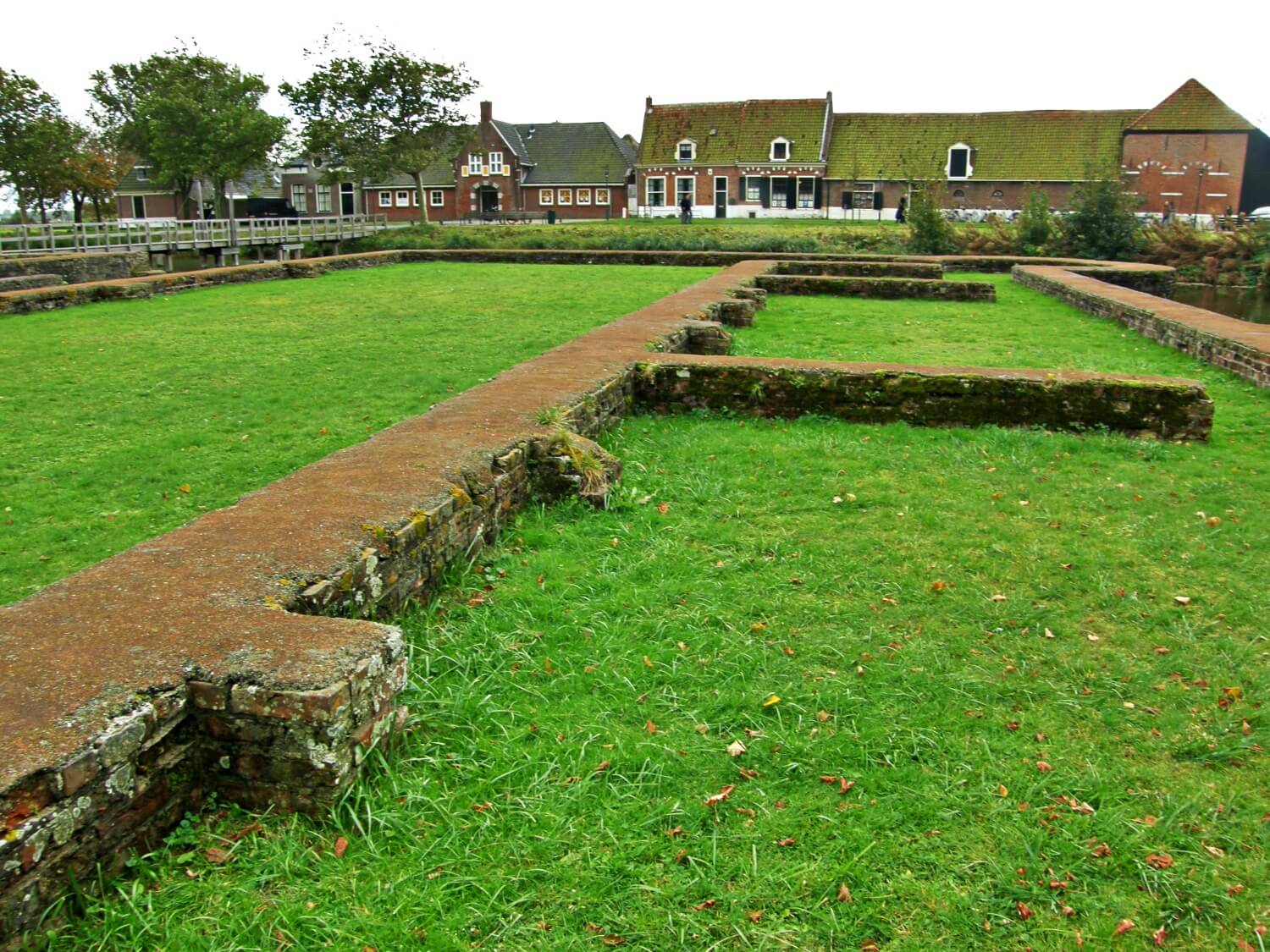
The province of North Holland became the owner of the castle grounds in 1933, nothing more than a swamp. They immediately started to perform archaeological excavations, which lasted until 1936. Both the fundaments of the first circular and the second square castle were discovered, and not only the exterior walls, but also some of the interior walls. Further, they established that the castle did not have cellars. The decision was made to brick up the walls to raise the fundaments above the grounds. These are the ruins we see today, with some small remainder of the clock tower.
Modern times
Today, the ruins can freely be visited. A statue has been erected in memory of count Lamoraal I of Egmont in 1997, a copy from the statue which stands in the 'Egmont city' Zottegem in Flanders. From time to time, there a discussions to restore (parts of the) castle, but none has been realized.
Van het kasteel van Egmond te Egmond op den Hoef is niet veel meer over. Gelukkig heeft men de oorspronkelijke fundamenten in het midden van de vorige eeuw opgemetseld en van een beschermende laag voorzien, waardoor we een goed beeld kunnen krijgen van de vorm van een middeleeuws kasteel.
Plattegrond
De ANWB heeft bij de slotgracht enkele informatieborden geplaatst, waarop zeer in het kort wordt aangegeven wanneer het kasteel is ontstaan en hoe de plattegrond er uit ziet. Daarnaast staat een tweede informatiebord met het indrukwekkende en kleurrijke familiewapen van een van de belangrijkste bewoners van het kasteel, Lamoraal, graaf van Egmond. Behalve de wapens van Egmond en Arkel, bevat het wapen ook de leeuwen van Gelre en Gulik. De eerste twee wapenonderdelen zijn die van de voorouders van Lamoraal van Egmond. De wapens van Gulik en Gelre tonen de familiebanden van het geslacht met de befaamde Karel van Gelre, die immers ook een van Egmond was.
Lamoraal van Egmond
Lamoraal van Egmond was het trieste lot beschoren de geschiedenisboekjes te halen door zijn onthoofding, samen met Horne, in Brussel in 1568. Hij was trouw geweest aan Spanje en zijn katholieke geloof; hij trachtte voortdurend beide partijen, Filips II en de Nederlandse edelen, met elkaar te verzoenen. Hij vertrouwde echter te veel op Alva en liet zich wat al te gemakkelijk door diens mannen gevangen nemen. Daarop werd hij een kopje kleiner gemaakt. Dat deze terechtstelling het doel, het verzet van Oranjegetrouwen tegen de Spaanse overheersing te breken, niet is gelukt, weet vrijwel een ieder, dankzij de Tachtigjarige Oorlog.
Triest genoeg, was het gevolg van deze oorlog dat het slot van Egmond in 1573 met de grond gelijk werd gemaakt. Niet door de Spanjaarden, maar in opdracht van Willem van Oranje, die bang was dat het kasteel anders in handen van de Spanjaarden zou vallen.
Abdij van Egmond
De abdij van Egmond werd in de twaalfde eeuw gesticht door de heren van Egmond. De kloosteroverste stelde Berwout van Egmond aan als rentmeester van de Abdij, die een hoeve ging bewonen bij Egmond. Deze hoeve bouwde hij uit tot een versterkte woning. Dat was niet tot genoegen van de kloosteroversten. Er ontstond een strijd tussen hen, die er in resulteerde dat het kasteel werd verwoest. Het werd echter weer opgebouwd in de vorm van de ringburcht, waarvan wij nu de fundamenten nog kunnen terugzien. Ter vervanging van deze ringburcht werd tegen het einde van de dertiende eeuw de nieuwe vierkante burcht gebouwd.
Twee kastelen
Er is bij het slot van Egmond dus eigenlijk sprake van twee kastelen. Het oudste is de vrijwel ronde burcht in het noorden van het huidige burchtterrein, die zoals we zagen een voorganger heeft gehad. De nieuwe vierkante burcht werd zuidelijk van de ronde burcht gebouwd. De vierkante donjon dateert uit het eind van de dertiende eeuw, maar de uitbreiding daarvan tot een vierkante burcht met een grote, rechthoekige voorburcht dateren uit de veertiende tot de zestiende eeuw. Van dit alles zijn dus alleen de fundamenten van de beide burchten bewaard en een steenklomp van een toren van de voorburcht.
Ligging slotruïne van Egmond
Door financiële problemen werd de staat in de zeventiende eeuw eigenares van de burchtresten. Later kwam het burchtterrein met de resten weer in het bezit van de van Egmonds en nog weer later in andere handen. In 1798 werd de burcht voor sloop verkocht, waarop in de jaren daarna vrijwel alles bovengronds verdween.
De ruïne is niet moeilijk te vinden. Ze ligt aan de noordkant van het dorp Egmond, oostelijk van de oude kerk en is vrij toeganelijk.
Kasteel Egmond
In Egmond aan den Hoef in Noord-Holland liggen de resten van het eens vermaarde kasteel dat Egmond. Hier resideerden eens de heren, later graven Egmond. Het kasteel dateert uit de twaalfde eeuw.
https://www.absolutefacts.nl/kastelen/data/egmondslotruine.htm
Useful information
Free
Free
Free
Free
- Permanent and temporary exhibitions
- Informative tables
- National monument
- Ruins of the castle
- Family activity: 1.50 EUR
-
External links
Nearby castles