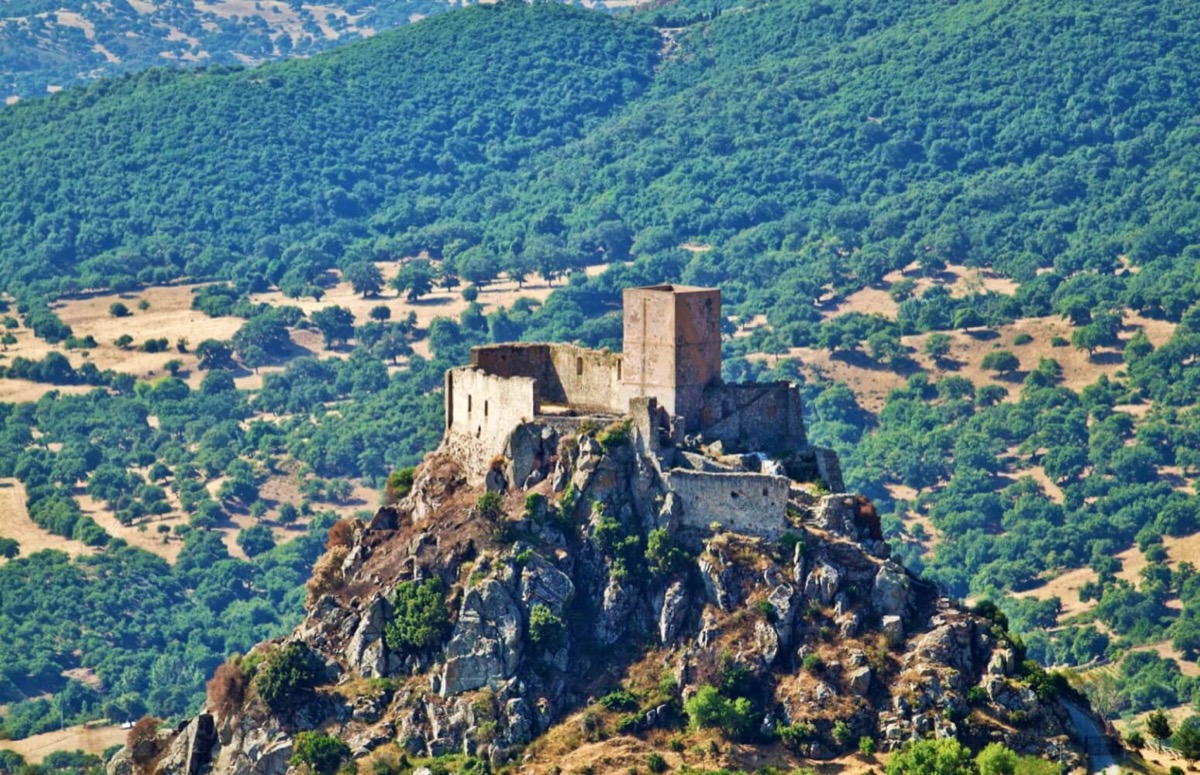
Castle of Burgos
Provincia di Sassari Sardegna Italy
castle, chateau
Castello di Burgos
Provincia di Sassari Sardegna Italy
castle, chateau
A legendary figure in the history of Sardinia once lived in the Castle of Burgos, in the province of Sassari: Adelasia of Torres (1207-1259), last Judge of Torres and queen consort of the island
Il castello di Burgos (o del Goceano) è un edificio fortificato situato in cima ad una rupe granitica presso Burgos in Sardegna, nella sub-regione storica del Goceano
Previous names
Castle of Burgos, Castello di Burgos
Description
A legendary figure in the history of Sardinia once lived in the Castle of Burgos, in the province of Sassari: Adelasia of Torres (1207-1259), last Judge of Torres and queen consort of the island.
Burgos is a small town at the foot of this 12th-century castle, nestled on a granite peak in the sub-region historically known as Goceano: in this fortress, Adelasia retired in solitude for the last years of her life.
During the Middle Ages, between the 9th and 14th centuries, Sardinia was divided into administrative Giudicati, which were autonomous and sovereign states governed by kings or Judges (“Giudici”), according to a semi-democratic system that was considered highly developed at the time.
In 1236, Adelasia found herself at the helm of the Torres Giudicato, and two years later – having married Enzo, son of Emperor Frederick II of Swabia – was crowned Queen of Sardinia.
Enzo, however, stayed on the island only a few months: his father assigned him as imperial vicar so he could follow the complex events in Central and Northern Italy, where the conflicts between Empire, Papacy and Comuni were at their height. After her husband’s departure, Adelasia retired in the Castle of Burgos.
The great Sardinian writer Grazia Deledda (who won the 1926 Nobel prize for literature) dedicated a beautiful short story to Adelasia, “The Seal of Love”. Here are some poignant excerpts from it.
“In the new home, she chose as her dwellings the highest rooms, and from the very first day she looked out the window that best dominated the road leading from the castle down to the lands of Goceano, disappearing through the valleys of Logudoro.”
“At the foot of the rocky Burgos hill, the road narrowed almost to a path and climbed between the rocks and bushes up to the castle’s esplanade; it was almost always deserted, but the queen’s sad eyes continued to stare into the distance, and if some knight appeared her heart started beating like that of a girl at her first romantic rendezvous. But the knight often turned out to be a peasant traveling on his nag, or a soldier on patrol.”
“Even at night, in her clear, lonely nights, she looked out the window. Then, alone in her widow’s large bed, she could still see the road as if it were part of her, like veins in her arms or the braid that came down to her heart. She could see it in her sleep, as if it started from her eyes and went down to the sea, and crossed the water – a road of desire and vain hope – until it could reach her young husband. And in the morning, when mastic trees and boulders glistened with dew, she believed she had wet them with her tears…”
http://www.italianways.com
Il castello di Burgos (o del Goceano) è un edificio fortificato situato in cima ad una rupe granitica presso Burgos in Sardegna, nella sub-regione storica del Goceano.
Struttura
Il castello, che sorge su un picco granitico ai piedi del monte Rasu a 647 m s.l.m., è composto da una triplice cinta muraria, dai muri perimetrali (che circondano un cortile interno) e dalla grande torre maestra che supera i 15 metri d'altezza.
Venne probabilmente edificato durante la prima metà del XII secolo per volere del giudice di Torres Gonnario II de Lacon-Gunale.
Nel 1194, durante la guerra fra il giudicato di Torres e il giudicato di Cagliari, il giudice calaritano Guglielmo I Salusio IV, dopo aver preso di assalto il castello, secondo alcune fonti commise violenza carnale nei confronti della moglie del giudice turritano, la catalana Prunisinda, che perì di lì a poco a Santa Igia.
Successivamente il castello passò per un breve periodo nelle mani di Pisa ma venne rioccupato dal giudicato di Torres. Nel 1233, alla morte di Barisone III di Torres, la sorella Adelasia di Torres, sposò Enzo di Hohenstaufen, figlio dell'imperatore Federico II, che divenne Re di Sardegna. Il matrimonio durò poco perché alla cattura di Enzo da parte dei bolognesi Adelasia si ritirò nel castello in prigionia volontaria fino alla sua morte.
Il castello passò poi con alterne vicende ai Genovesi, al ramo sardo dei Doria e ai giudici di Arborea, in particolare a Mariano IV, che fondò il villaggio omonimo. Infine passò agli Aragonesi che lo abbandonarono lasciandolo in rovina.
Useful information
GRATUITO
Passeggiata libera nel castello con vista sulla città
Chiuso per restauro
-
External links