Forte di San Leo
Provincia di Rimini Emilia-Romagna Italy
fortress
Forte di San Leo
Provincia di Rimini Emilia-Romagna Italy
fortress
The Fortress of San Leo is a castle on the border of the Romagna and Marche; the castle is best known as the site where Count Cagliostro died
Il forte di San Leo, conosciuto anche come rocca di San Leo si trova nell'omonimo comune in provincia di Rimini
Previous names
Forte di San Leo, Forte di San Leo
Description
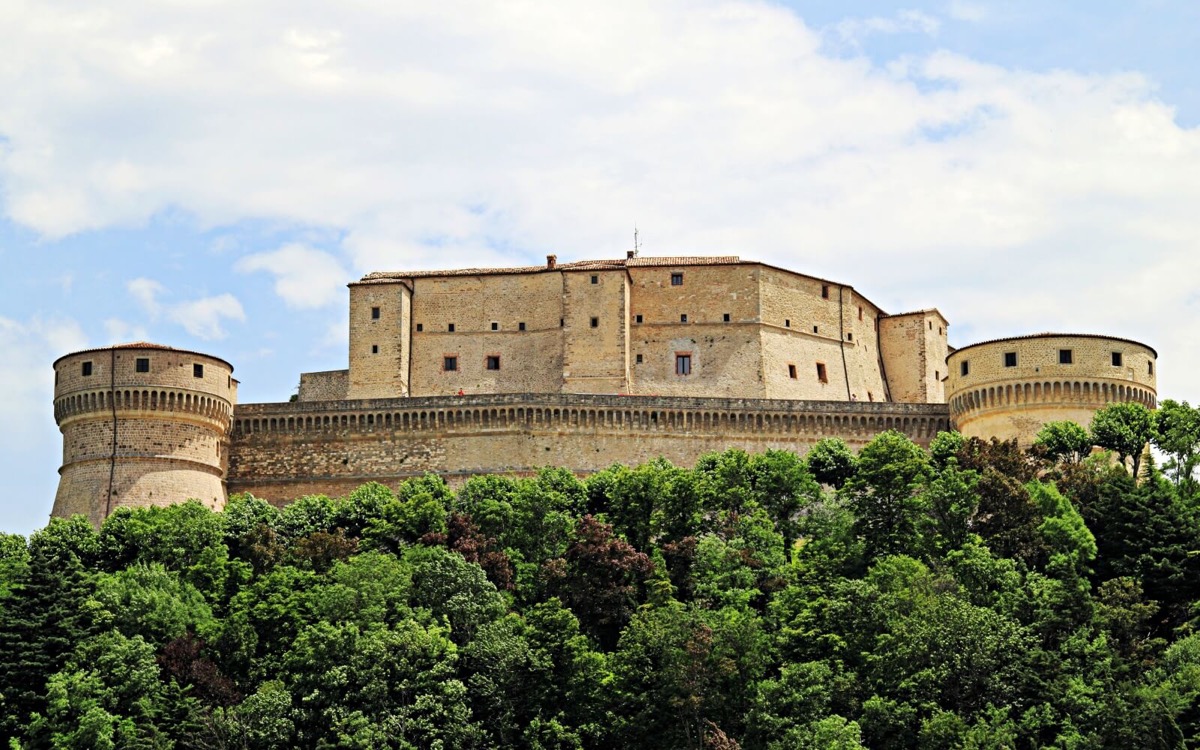
The Fortress of San Leo is a castle on the border of the Romagna and Marche; the castle is best known as the site where Count Cagliostro died. It was one of the palaces owned by Federico da Montefeltro and his wife Battista Sforza and was a fortified, palatial retreat. It is now a museum.
History
The first fortification on the top of the mountain was built by the Romans. In the Middle Ages it was bitterly fought over by the Byzantines, Goths, Franks and Lombards. Between 961 and 963 Berengar II, the last king of the Lombard Kingdom of Italy, was besieged by Otto I of Saxony. Around the middle of the eleventh century the Counts of Montecopiolo came to Montefeltro, the ancient name of San Leo, from which they took the name and title. In the second half of the 14th century the Malatesta were able to capture the fortress, but until the middle of the 15th century, the castle was often retaken by the Montefeltro. In 1441 the young Federico da Montefeltro scaled the walls of the fort. Faced with the new military dangers, he had the fortress rebuilt, entrusting the task to the Sienese engineer Francesco di Giorgio Martini.
The new structure allowed for a dynamic counter-offensive, providing for cross-fire. The fortress sides were equipped with artillery and the access points were rendered unreachable by enemy fire thanks to military outposts.
In 1502, Cesare Borgia, with the support of Pope Alexander VI, took possession of the fortress. At the death of the pope, in 1503, Guidobaldo da Montefeltro took possession of his dominions. In 1516 the Florentine troops, supported this time by Pope Leo X and guided by Antonio Ricasoli, penetrated the city and commandeered the fort.
From 1527 until the devolution to the Papal State from the Duchy of Urbino in 1631, San Leo belonged to the Della Rovere. With the new ownership, the fortress was used as a prison. Among the inmates were Felice Orsini and Freemason Alessandro Cagliostro . In 1906 the fortress ceased to be a prison and for eight years, until 1914, it hosted a "compagnia di disciplina".
In the period of Italia Unita, the municipality of San Leo belonged to the province of Marche (Province of Pesaro and Urbino), until 15 August 2009 when it was separated together with six other municipalities of the Valmarecchia, following the outcome of a referendum held on 17 and 18 December 2006.
Currently the castle houses a museum and an art gallery in arms.
Description
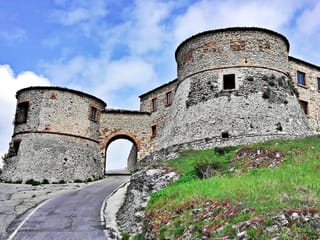
In the fortress there are two distinct parts: the keep, with its square turrets and the gothic entrance is the older part and residential wing; and the more recent round towers and massive corbeled wall that connects them. The two towers, the wall, and the keep surround the so-called Place d'Armes.
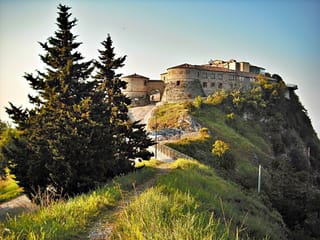
The area is dotted with rocky peaks that rise steeply from the sea cliffs. On each of these peaks, the ruins of a castle or fort recall a tumultuous past. To the visitor who walks up the Romagna plain, the City-Fortress appears as a huge shield of high smooth rock. It appears like a ship with the bow to the East, the bell tower like a mast, and the handful of houses scattered around.
Il forte di San Leo, conosciuto anche come rocca di San Leo si trova nell'omonimo comune in provincia di Rimini. È situato sulla cima della cuspide rocciosa che sovrasta l'abitato leontino e domina la Valmarecchia. Nel 2015 ha fatto registrare 72 617 visitatori.
Storia
Città d'arte, da sempre capitale storica del ducato di Montefeltro, prigione di Felice Orsini e di Cagliostro, San Leo è stata anche capitale del Regno Italico di Berengario II, il quale fu sconfitto a Pavia nel 961.
Una prima fortificazione sulla cima del monte fu costruita dai romani. Nel Medioevo fu aspramente contesa da Bizantini, Goti, Franchi e Longobardi. Tra il 961 e il 963 vi fu stretto in assedio Berengario II, ultimo re del regno Longobardo d'Italia da Ottone I di Sassonia. Intorno alla metà dell'XI secolo i conti di Montecopiolo giunsero a Montefeltro, antico nome di San Leo, da cui trassero il nome e il titolo di conti. Nella seconda metà del Trecento i Malatesti riuscirono ad espugnare la rocca, alternandosi nel dominio ai Montefeltro sino alla metà del Quattrocento. Nel 1441 il giovanissimo Federico da Montefeltro fu autore di un'intraprendente scalata del forte. Per tenere testa alle nuove tecniche militari egli fece riedificare la rocca affidando il compito all'ingegnere senese Francesco di Giorgio Martini.
La nuova struttura permetteva una controffensiva dinamica, garantendo direzioni di tiro incrociate. Per garantire questa condizione i lati della rocca erano dotati di artiglieria e le vie d'accesso vennero rese non raggiungibili dal fuoco nemico grazie ad avamposti militari.
Nel 1502 Cesare Borgia, con il sostegno di papa Alessandro VI, si impadronì della fortezza. Alla morte del pontefice, nel 1503, Guidobaldo da Montefeltro riprese il possesso dei suoi domini. Nel 1516 le truppe fiorentine, sostenute questa volta da Leone X e guidate da Antonio Ricasoli penetrarono nella città e requisirono il forte.
Sino alla devoluzione allo Stato Pontificio del ducato di Urbino, nel 1631, San Leo appartenne dal 1527 ai Della Rovere. Con il nuovo possesso la destinazione dell'edificio passò da rocca a carcere, le cui celle erano ricavate negli alloggi dei militari. Fra i reclusi che vi furono imprigionati spiccano i nomi di Felice Orsini e dell'avventuriero palermitano Cagliostro. Nel 1906 la fortezza cessò di essere un carcere e per otto anni, fino al 1914, ospitò una "compagnia di disciplina".
Nell'Italia unita il comune di San Leo ha fatto parte delle Marche (provincia di Pesaro e Urbino) fino al 15 agosto 2009, quando ne è stato distaccato congiuntamente ad altri sei comuni dell'Alta Valmarecchia in attuazione dell'esito di un referendum svolto il 17 e 18 dicembre 2006. Contro la variazione territoriale le Marche hanno proposto ricorso alla Corte costituzionale, ma questa lo ha ritenuto infondato.
Attualmente gli ambienti della fortezza ospitano un museo d'armi e una pinacoteca.
Useful information
GRATUITO
GRATUITO
GRATUITO
GRATUITO
Esposizione gratuita di cannoni all'ingresso
info@sanleo2000.it
Museo delle armi
-
External links
Nearby castles