Château de Varennes
Saône-et-Loire Bourgogne-Franche-Comté France
castle, chateau
Château de Varennes
Saône-et-Loire Bourgogne-Franche-Comté France
castle, chateau
The first stone of the building was placed in the middle of the 11th century
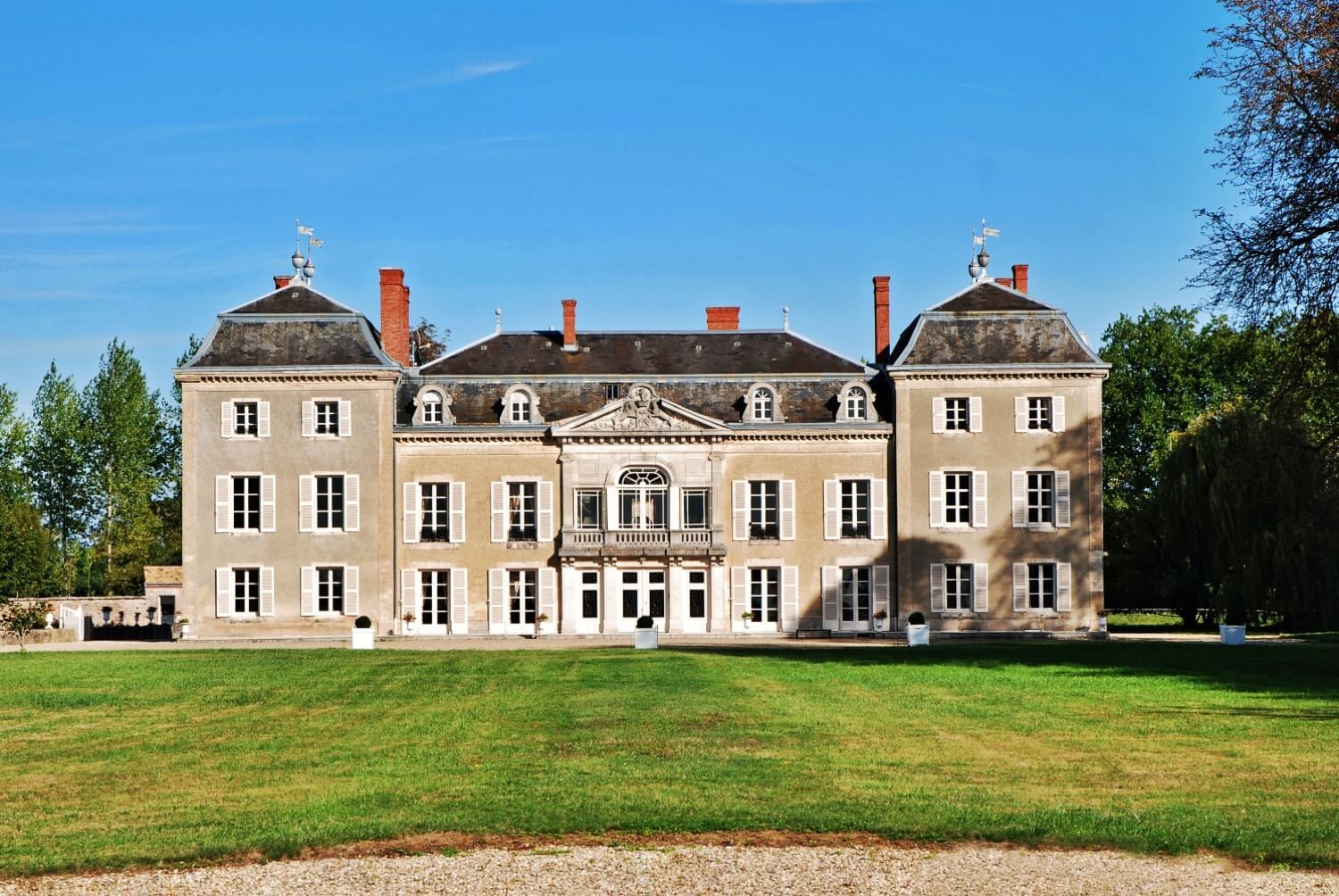
Le château de Varennes est situé sur la commune de Charette-Varennes en Saône-et-Loire, à la lisière sud du bourg de Varennes
Previous names
Château de Varennes, Château de Varennes
Description
The first stone of the building was placed in the middle of the 11th century. From that period remains the entrance pavilion that precedes the service quarters. This perfectly preserved Square Tower, exposing its mullioned windows, has a beautiful stone stairway and a vaulted cellar supported by a central pillar. After the 11th century, Varennes evolved from a fortified castle to a seigniorial residence: moats are filled in.
The service quarters were built in the early 16th century. This is where winegrowers had their dwelling. Striking from an architectural standpoint, their front is made of an amazing covered space supported by wooden pillars with gothic mouldings. From there, one can access cellars enlarged in the 19th century and the winery where the wine is still produced today.
West, the stables were built in the 17th century. From there, one can also admire sculpted billowing stones which frame the porches designed to facilitate the entrance for carriages. On the right of the building, a bread oven still stands which construction is anterior to a newer one’s built in the small annex in the middle of this court.
The honeycombed manorial pigeon house with its central pivoting ladder was built at the end of the 16th century. So was Saint Emilien chapel – now in ruins – a couple of yards away in the middle of vines. The chapel construction was ordered by Jean de Nagu in 1577.
The heart of the castle is quite distinct from the service quarters. It was almost entirely re-furbished at the end of the 16th century.
During religion wars, Huguenots pillaged and devastated Varennes several times. Most notably in 1563, the lady had to escape and had her life spared only for she disguised herself as a servant girl. Her son, canon Pierre de Nagu, was undressed to be re-dressed up like a beggar and was finally dragged along on a donkey to the city of Belleville nearby where he died shortly after.
Niches with scallop shells – very common symbol during Renaissance – decorate the round cone-shaped towers of that central part of the castle.
The south-facing inner court is surrounded by buildings in U-shape. In the middle still remains the water well, an indispensable attribute of castle life. The strongly pitched roofs are made of burgundy tiles. Their surface represents 1 hectare. The French-style roof structure is similar to that of a ship and some parts are sculpted.
The Renaissance gallery with its arches like basket handles was added to a gothic facade during the large refurbishment in 1577.
The great staircase with straight banister in the west wing are made of cut stones.
Owners of the Château de Varennes throughout history
The faith of the Château de Varennes is that of its masters: modest and humble with the Villions and the Maréchals. It probably was a magnificent and wealthy place at the time of the Sires of Beaujeu and the powerful Nagu family, owner of Varennes from 1395 to 1769.
1050-1200 Pierre de Varennes and his descendants
1200-1290 Villion-Varennes
1290-1322 Maréchal-Varennes
On Thursday following Easter 1322, Hugonin Maréchal, son of Geoffroy, sold Varennes to Guichard V, Sire of Beaujeu.
1322-1395 Sires of Beaujeu
In 1395, Edouard II, Sire of Beaujeu, gave the domain of Varennes to Sir Jean Nagu, his squire, for him and his descendants in order, so said he, to reward him for his services.
The Nagu family was given this name from the domain of Nagu in Ouroux, Rhône. Later on, the Nagus would be ennobled. François of Nagu officially obtained for the Seigneury of Varennes to be made marquisate in December 1618. He himself was a character: appointed bailiff and governor of Macon by Queen Marie of Médicis in 1611, gentleman of King Louis XIII, State counselor in 1617, field marshal under the authority of Prince of Condé, extraordinary ambassador in Sweden in 1630, major in Bresse, Bugey and Burgundy in 1637, General Lieutenant of the King’s Army, he died in Aigues-Mortes and was buried in Marchampt.
The Nagus, who were amazed by the splendor of the capital and the parties in Versailles, decided to leave the countryside to settle in Paris. Charles Gabriel of Nagu sold the Marquisate of Varennes in 1769 to Sir Pierre Giraud, officer of the hundred Swiss guards of the King’s corps and royal secretary at the finance ministry in Lyon.
1769-1794 Giraud de Varennes
At All Saints’ Day 1793, Pierre Giraud was having trees marked in his wood of Montoux when two police representatives came to arrest him. Policeman Charbonnet, who knew him, told him to run off, but he refused and was taken to Lyon, and later on to Paris.While he was leaving, he gave his watch to his winegrower Sambardier and told him: ‘If I come back, you will give it back to me; if I don’t, keep it.’ After a stay in prison, he was brought to trial. He was accused to be at the Tuileries in Paris on August 10th 1792 and help the King to escape. On July 4th 1794, he was condemned to death sentence and his head was cut off, an exceptional event in the Rhône.
The castle was confiscated, declared national property and sold at auction in 16 separate batches.
This was followed by various auctions.
The Allemand brothers bought Varennes. On December 12th 1809, François and Hector Allemand sold the castle of Varennes to Antoine-Marie Belliard and his son-in-law Jean Mathieu, who lived in Saint Lager, ancestors of the Charvériat family, native of Ain (Montceaux and Charveyriat), who still owns it today.
Varennes: past and present
In 2015, one of the members of the Charvériat family, who currently owns the Château de Varennes, made a surprising discovery in the regional archives of Seine-Maritime: a beautiful hand-painted plan of the Château de Varennes dated 1764. As they left Beaujolais to move to Normandy, the Nagus must have brought with them the plan of their former estate as a souvenir of where they came from. Was this plan also used as a tool to sell the castle and its estate to its new owner? It is indeed very precise, with a floor layout of the buildings and many garden details.
http://www.chateaudevarennes.eu
Le château de Varennes est situé sur la commune de Charette-Varennes en Saône-et-Loire, à la lisière sud du bourg de Varennes.
Le château, propriété privée, ne se visite pas.
Historique
La seigneurie de Varennes-sur-le-Doubs appartenait au xiiie siècle à la maison de Vienne, qui la vendit en 1291 aux ducs de Bourgogne. Elle passa en 1543 à Elyon de Mailly, seigneur d'Arc-sur-Tille, Charette et Terrans, puis, après divers propriétaires au cours du xviie siècle, à Claude de Ragot, seigneur d'Epoisses. Gabrielle de Fourcy, épouse du comte de Mainville, brigadier des armées du roi, la vendit avec la châtellenie de Frontenard et la seigneurie de la Motte-Frontenard, en 1729, à Jean-François de Truchis, seigneur de Terrans, dont la famille possédait déjà des terres à Varennes depuis 1607-1610. Depuis lors, elle est restée dans la branche ainée de cette famille.
Du château féodal, qui, chose rare en Bourgogne, était protégé par une triple enceinte de fossés particulièrement étendus, une tour encore mentionnée par Claude Courtépée subsista jusqu'à la fin du xviiie siècle. Un château, peu important et habité rarement, avait été construit non loin de l'ancien donjon, à un emplacement d'où la vue d'étend au-delà de la vallée du Doubs jusqu'aux monts de la Côte-d'Or et du Jura.
Architecture
Claude-François-Charles de Truchis, né à Dôle en 1765 hérita de la terre de Varennes. Il y trouva les traces caractéristiques d'une motte féodale disparue et de sa basse-cour. S'y trouvait également un premier château datant de 1730 mais dont malheureusement aucune représentation n'a été retrouvée même si les principaux éléments des bâtisses sont bien lisibles sur le plan du domaine de 1790, lequel plan est encore conservé dans les archives du château. De retour d'immigration quand il quitta l'armée de Condé, il restaura le château et l'agrandit puis y ajouta la ferme et les écuries. Les travaux d'agrandissement commencèrent donc en 1809 et se poursuivirent jusqu'en 1829.
Son fils, William, après avoir servi aux mousquetaires noirs de la garde du roi se fixa à Varennes lors de son mariage et fit retracer un vaste parc qui entoure le château. Il en termina la construction par le côté Nord, toute la façade Ouest, le grand escalier, le billard et le salon. C'est un architecte local, originaire du bourg de Charette, Fondet, qui donna les plans.
William eut un fils, Stanislas né en 1857 qui héritera du château. Il y fit des réparations importantes et réaménagera complètement l'intérieur ; en outre, il reconstitua tout le domaine foncier de Varennes. Stanislas de Truchis terminera le programme d'architecture par la construction d'une chapelle, très proche de la façade Est du château. Les fondations de cette chapelle dédiée au Saint Sacrement et à saint Maurice, commencèrent en 1913 et l'inauguration intervient le 24 novembre 1923. L'architecte était Adolphe Prost, de Dijon, élève de Suisse. L'architecte imposa dans ce projet le souhait de reproduire et d'intégrer l'art roman bourguignon (en particulier clunisien) ainsi que l'architecture et l'art décoratif des premiers temps du christianisme.
La famille de Truchis possède également les châteaux de Terrans et de Lays-sur-le-Doubs, à proximité immédiate de celui de Varennes. La chanteuse Zazie est issue de la famille Truchis de Varennes (de son vrai nom Isabelle de Truchis de Varennes).
Armoiries
Truchis : les armoiries montrent un casque de profil orné de panaches et d’un lion brandissant une épée, le tout surmontant un écu d'azur à un pin d'or, soutenu par deux lions de même affrontés ; sur la bannière, flotte la devise VIRTUTE ET VIRIBUS.
Useful information
Parking GRATUIT (privé, sur place; parking PMR)
Chambre d’hôtes: à partir de 235 €/nuit/2 personnes
Wi-Fi GRATUIT
info@chateaudevarennes.fr
-
External links