Château des Adhémar
Drôme Auvergne-Rhône-Alpes France
castle, chateau
Château des Adhémar
Drôme Auvergne-Rhône-Alpes France
castle, chateau
The Château des Adhémar is a castle, later converted to a Renaissance style château, in the French town of Montélimar in the Drôme département
Le château des Adhémar se situe dans la ville de Montélimar, dans la Drôme
Previous names
Château des Adhémar, Château des Adhémar
Description
The Château des Adhémar is a castle, later converted to a Renaissance style château, in the French town of Montélimar in the Drôme département. It is located on a hill in the centre of the town.
History
Its origins are found in the 11th century when the first castle was built by the Count of Toulouse, the Duke of Narbonne. Little of this remains.
In the second half of the 12th century it became the property of the Adhémar de Monteil family, lords of Rochemaure, later lords of Grignan, then at the height of their power. The palace they built substantially exists today.
In the 14th century, it was taken by the papacy, joining the Pope's castles until 1447, when Montélimar was returned to the kingdom of France. The site of many armed conflicts, especially during the Wars of Religion, the castle suffered much damage and was transformed into a citadel, then back to a pleasant residence with the return of more peaceful times. In the 15th century it was used as a prison.
In the middle of the 16th century, Louis Adhémar rebuilt in the Renaissance style. During the French Revolution, the castle was partially destroyed.
The castle was a prison again between 1791 and 1926, a use which has meant that it remained practically intact.
Architecture
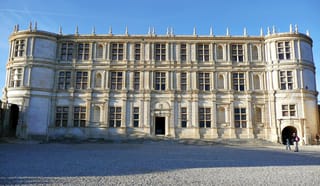
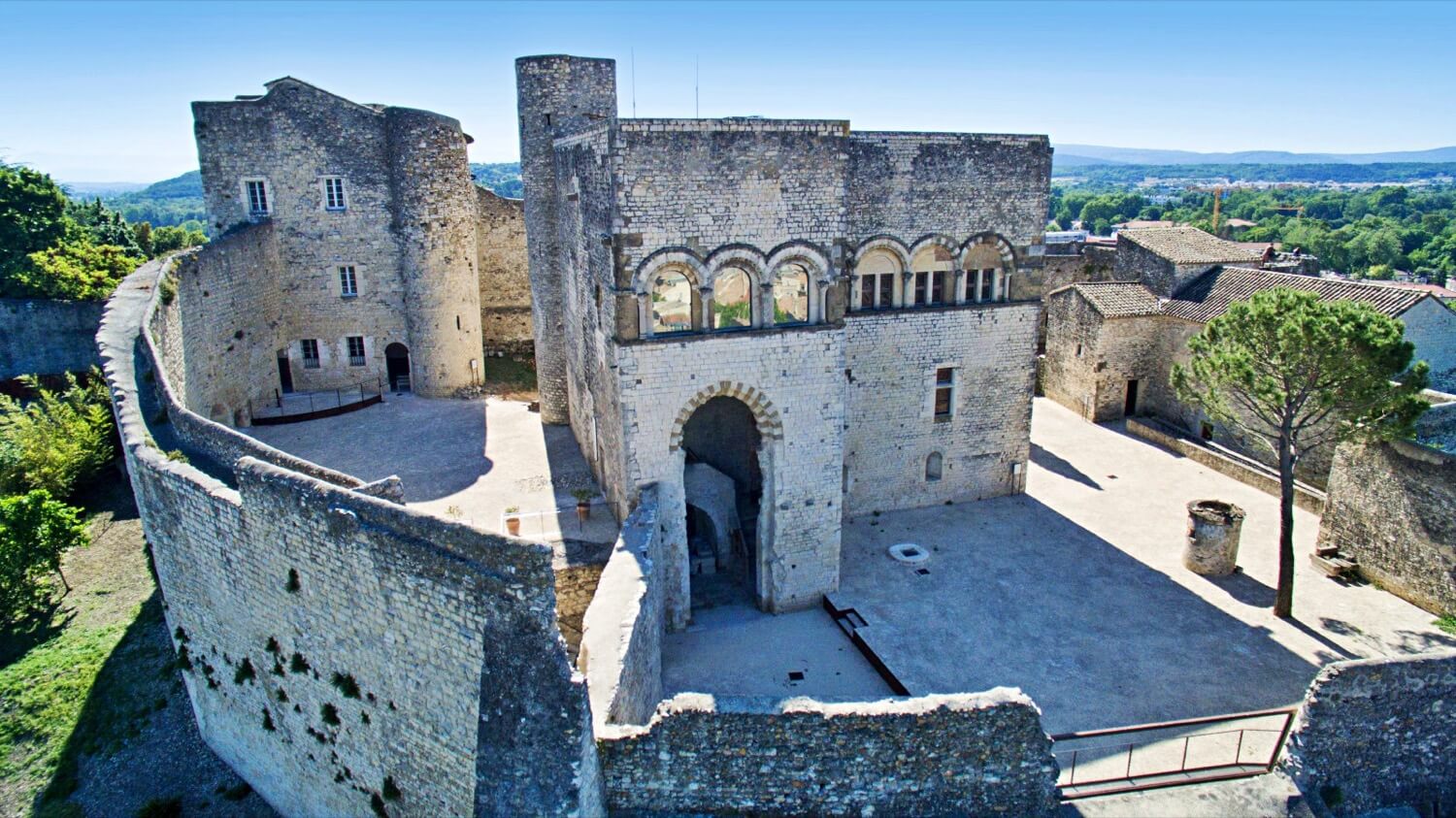
The château is considered to be one of the last examples of Romanesque castle architecture. having a fortified curtain wall, round walk, keep, a house and chapel, combining social, family, political and religious life in one. Only the Narbonne tower is outside the first wall, some metres to the north. Of the original 12th-century residential buildings, only the palace remains. There are three large rectangular rooms reached through a monumental doorway. The spectacular decoration of the lodgings is concentrated on the first floor gallery, with no fewer than nine semicircular arches with sculptured columns. This series of windows extends the full length of the building.
The keep has three floors. The austere architecture, with thick walls, reminds visitors of the castle's medieval origins.
The castle has been listed as a monument historique by the French Ministry of Culture since 1889.
Contemporary art
The property of the Département de la Drôme since 1947, the Adhémar’s castle is a monument historique and, since 2000, a contemporary art centre. This centre works with artist projects linking both a high standard of proposals and a real firmly fixed territorial spot. The aim of the centre of contemporary art through the three castles of the Drôme general council (Adhémar at Montélimar, Grignan, Suze-la-Rousse) is to match contemporary creation and cultural heritage. Since its creation, about a fifty temporary exhibitions has been performed with renowned national artists, even international and younger ones.
Besides the contrast between medieval architecture and the various forms of present creation, the castle originality is expressed by the artists who have to keep in mind the important heritage of the place. Thus, each artist develops a strategy in their creation to emphasize, to refute, to express, to reveal or to conceal the powerful architectural presence of the Adhémar’s castle.
Exhibitions
2001 : André Morin, Alberto Giacometti, Ange Leccia, Laetitia Benat, Nicolas Delprat
2002 : Danielle Jacqui, Daniel Buren, Ivan Fayard, Patrick Tosani
2003 : Krijn de Koning, Felice Varini, Jean-Luc Moulène, Damien Beguet
2004 : Virginie Litzler, Alexandre Ovize, Nicolas Prache, Sarkis, Adam Adach, Stéphane Calais
2005 : Delphine Balley, Clare Langan, Christine Laquet, Stéphanie Nava, Tadashi Kawamata, Françoise Quardon, Pierre David
2006 : Alina Abramov, Armand Jalut, Aurélie Pétrel, Bernhard Rüdiger, David Renaud, Philippe Durand
2007 : Eoin Mc Hugh, Le Gentil Garçon, Marie-José Burki, Etienne Bossut
2008 : Cécile Hesse, Gaël Romier, Sophie Lautru, John Armleder, Lilian Bourgeat, Christine Rebet
2009 : Jean-Louis Elzéard, Magali Lefebvre, Sarah Duby, Xavier Veilhan, Jean-François Gavoty, Loris Cecchini, Yvan Salomone, Delphine Gigoux-Martin, Gilles Grand, Benjamin Seror
2010 : Julien Prévieux, Pierre Malphettes, Delphine Balley, Yan Pei Ming
2011 : Victoria Klotz, Ann Veronica Janssens, Betty Bui, Eric Rondepierre
2012 : Guillaume Bardet, Olga Kisseleva, Emmanuel Régent, Marie Hendriks
2013 : Mehdi Meddaci, Guillaume Bijl, Mat Collishaw, Glenda León
Le château des Adhémar se situe dans la ville de Montélimar, dans la Drôme. Il abrite aujourd'hui un centre d'art contemporain.
Histoire
On dispose de peu d'informations sur le premier château construit au xie siècle par le comte de Toulouse, probablement en même temps que la chapelle Sainte Guitte. Il s’agissait d’une motte castrale (un donjon construit sur une motte et protégé par un talus de terre et un large fossé).
Dans la deuxième partie du xiie siècle le château initial est transformé en palais par les Adhémar, castrum montilium Adhemari, exprimant la richesse de la lignée. Il orne encore aujourd’hui les hauteurs de la ville de Montélimar.
Au xive siècle fut construite la « tour de Narbonne » seule partie subsistante d’un château appartenant aux comtes du Valentinois. Le vieux château appartenait alors au Pape. Ce château (à l’exception du donjon) a été détruit vers 1580 sur ordre du duc de Lesdiguières, chef des armées protestantes du Dauphiné pour faire la place à un ensemble de fortifications plus moderne.
Le logis seigneurial a été classé monument historique en 1889.
Architecture
Le logis seigneurial (ou palatium) se compose d’une salle, aux vastes proportions, l’aula inférieure, dotée d’un plafond à la française et, à l’étage, d’une pièce de même dimension - soit 125 m² - l’aula supérieure. Cette dernière, ouverte à l’ouest, dispose d’une enfilade de larges fenêtres en plein cintre et se prolonge par une loggia avec le même type d’ouvertures. Le tout est orienté vers la ville. Rare exemple d’ensemble palatial d’architecture romane, le château des Adhémar garde en ses murs l’expression de la puissance des Adhémar de Monteil. Le donjon, le palais, la chapelle, bâtiments qui concentraient à la fois la vie sociale, familiale, politique et religieuse, sont entourés d’une enceinte fortifiée surmontée d’un chemin de ronde.
Centre d'art contemporain
Propriété du département de la Drôme depuis 1965, le château des Adhémar accueille depuis 2000 un centre d'art contemporain. Cette structure de diffusion référente accompagne des projets d’artistes dans la singularité d’un propos liant ambition artistique et ancrage territorial. Elle s’inscrit dans le projet des trois châteaux départementaux (Montélimar, Grignan, Suze-la-Rousse) dont l’objectif est de croiser création contemporaine et patrimoine.
Depuis sa création, une cinquantaine d’expositions temporaires ont été réalisées avec des artistes de renommée nationale, voire internationale (John Armelder, Daniel Buren, Felice Varini, Ann Veronica Janssens, Olga Kisseleva…), et de jeunes créateurs (Delphine Balley, Le Gentil Garçon, Marie Hendriks, Emmanuel Régent…).
Useful information
Parking GRATUIT (parking autocar, à proximité du château ou bien d’utiliser les parkings du centre-ville et d’accéder au château à pied; camping-cars: avenue des Portes du Soleil)
Adulte: 6 € (visite libre); 6 € (visite guidée)
Tarif réduit: 4 € (visite libre); 4 € (visite guidée)
Groupe adulte: forfait 70 €+ 3 € par personne
Groupe enfant: 50 € (forfait)
WC GRATUIT
https://www.chateaux-ladrome.fr/fr/nous-contacter
-
External links
Nearby castles