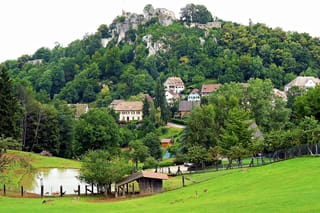
Château du Landskron
Haut-Rhin Grand Est France
castle, chateau
Château du Landskron
Haut-Rhin Grand Est France
castle, chateau
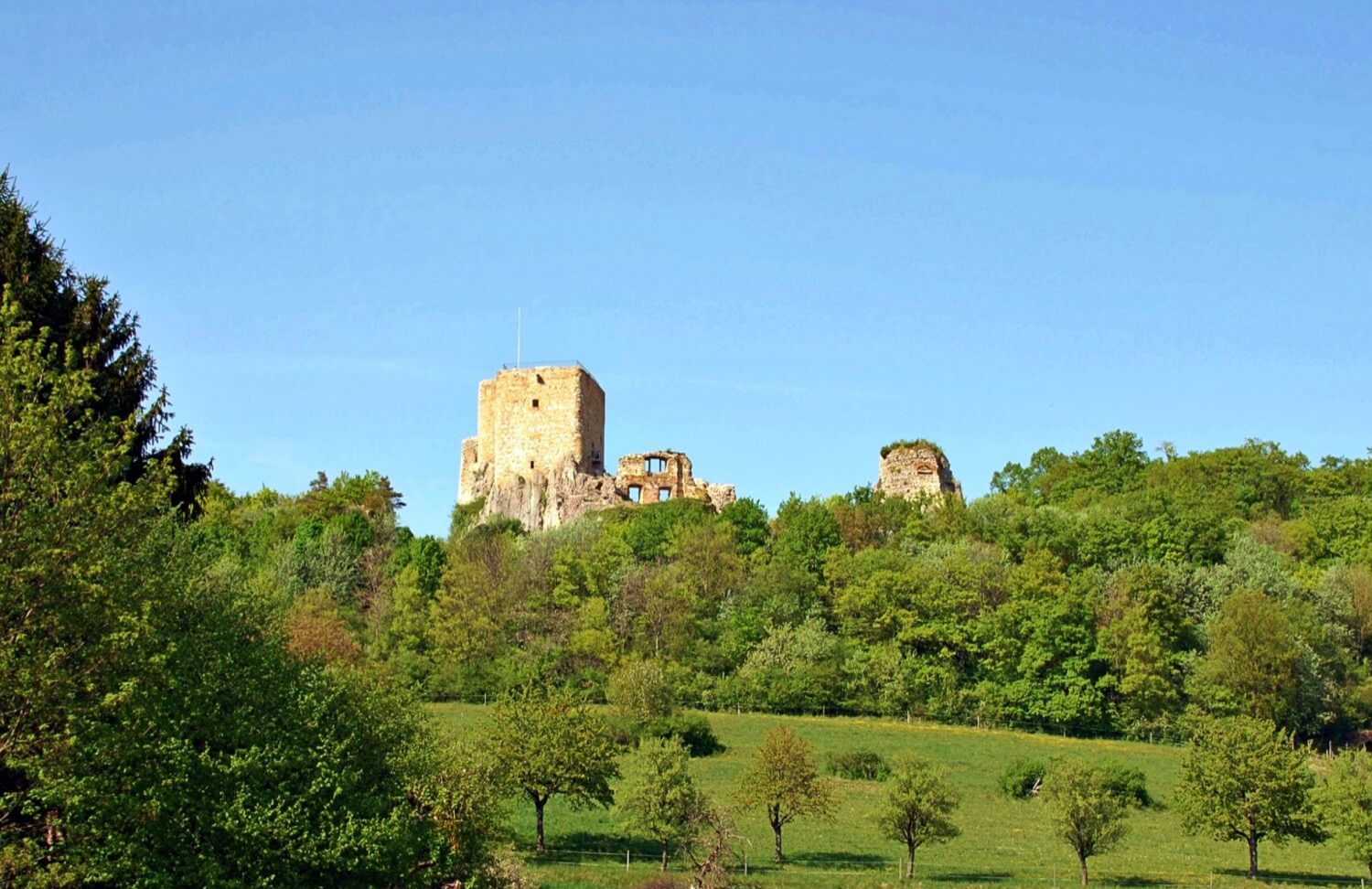
The Château de Landskron (or Landskron Castle) is situated in the southern part of Alsace, in the east of France, mere footsteps away from Switzerland, in the commune of Leymen
Le château du Landskron se trouve sur une colline du Sundgau à Leymen, Haut-Rhin, Grand Est, France, à quelques pas de Hofstetten-Flüh en Suisse
Previous names
Château du Landskron, Château du Landskron
Description
The Château de Landskron (or Landskron Castle) is situated in the southern part of Alsace, in the east of France, mere footsteps away from Switzerland, in the commune of Leymen. The village situated at the north of the ruin, Leymen, in the département of Haut-Rhin, lies in France while Flüh, at the south east foot of the ruin, is in Switzerland.
The castle was built before 1297. It had a very important strategic position in that it allowed the control of the Eastern Sundgau, the elbow of the Rhine and the city of Basel. Several disputes concerning the ownership have been reported. Like the Château de Ferrette and Château de Morimont, the Château de Landskron was owned by Habsburg for a time. In 1462, the castle was given to the Lord of the Bailiwick of Lupfen, Sébastien de Reichenstein, who later enlarged and transformed the castle to adapt it to firearms in 1516. In 1648, by the Peace of Westphalia which ended the Thirty Years' War, the lands and lordships of the Habsburgs in Alsace, including the Château de Landskron, passed into the hands of the King of France. After 1665, Vauban was responsible for rebuilding the castle into a military garrison, while many other Alsatian castles were abandoned and gradually destroyed. In the 1690s, it was used as a state prison. The few prisoners who were imprisoned there until the French Revolution were predominantly political prisoners and the mentally ill. Bernard Duvergez, a courtier at the French court, was held there from 1769 until 1790 when he was discovered by revolutionaries looking for political prisoners. He died while waiting for them to find him a better place. He is the subject of a local novel, The Prisoner of Landskron
The castle survived the Revolution, whereas the houses of the wealthy in Leyman were burned. The castle was destroyed in 1813 by the Austrian and the Bavarian armies fighting Napoléon Bonaparte.
After that time it was a ruin. In the 1970s, the former owners installed a colony of monkeys into the ruins. Since 1984, the castle has belonged to the Association pour la Sauvegarde du Château de Landskron (Association for the Protection of Landskron Castle) and was partly restored in 1996. Further restoration work is planned.
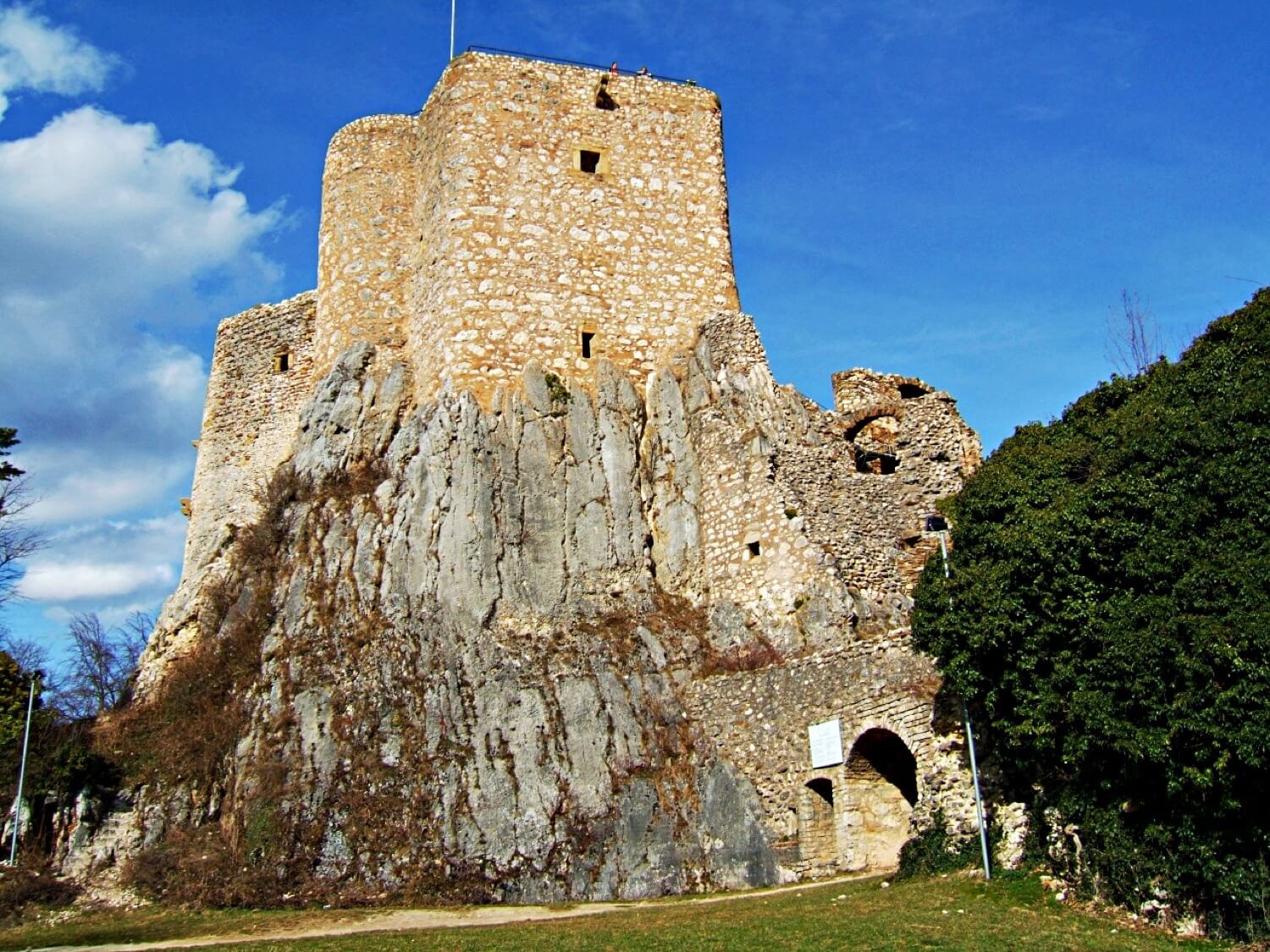
One of the main characteristics of the castle is its big rectangular tower or keep.
The Château de Landskron has been classed as a monument historique by the French Ministry of Culture since 1923.
Le château du Landskron se trouve sur une colline du Sundgau à Leymen, Haut-Rhin, Grand Est, France, à quelques pas de Hofstetten-Flüh en Suisse.
Il fait l’objet d’un classement au titre des monuments historiques depuis le 28 mai 1923. Ses ruines ont été rendus accessibles et recèlent du haut de son donjon historique un panorama franco-suisse des environs.
Historique
Construit avant 1297, le château du Landskron, situé à quelques mètres de la frontière avec la Suisse avait une position stratégique très importante, car il permettait le contrôle du Sundgau oriental, du coude du Rhin et de la ville de Bâle. Dès cette époque des rivalités au sujet des droits de propriété sur le château ont été rapportées. Tout comme les châteaux de Ferrette et de Morimont, le château du Landskron passe sous possession des Habsbourg et son histoire se confond avec l'Autriche antérieure.
En 1462, le château est donné en bailliage aux seigneurs Reich de Reichenstein qui l'agrandisse et le transforme en forteresse en 1516 afin de l'adapter aux armes à feu.
Le 24 octobre 1648, par les traités de Westphalie et de Münster qui mettent fin à la guerre de Trente Ans, les terres et seigneuries des Habsbourg, en Alsace, passent aux mains du Roi de France. Après 1665 Vauban a été chargé de restructurer la forteresse, alors que les autres châteaux-forts alsaciens étaient voués à l'abandon, l'arasement sinon à la destruction, à l'exception des châteaux de Lichtenberg et de Lützelstein. Vauban y effectue d'important travaux de fortification qui y accueille, désormais, une garnison militaire. Concurrencé par les places fortes de Huningue et de Neuf-Brisach, il est également utilisé à partir des années 1690 en tant que prison d'État. Les quelques prisonniers qui y ont été enfermés, jusqu'à la Révolution française, étaient en majorité des prisonniers incarcérés par lettres de cachet et des prisonniers politiques.
En décembre 1813, au début de la campagne de France et à la fin des guerres du Premier Empire, le château est détruit par les Autrichiens et les Bavarois à l'exception du donjon qui fut sauvé grâce à l'action du curé de Hagenthal-le-Bas qui réussit à convaincre le général de Wrede, chargé de démanteler la forteresse d'épargner le donjon en témoignage de sa victoire. Toutefois depuis cette date le château du Landskron est en ruine.
Dans les années 1970, les propriétaires de l’époque y ont implanté une colonie de singes. Depuis 1984 le château du Landskron appartient à l'association binationale franco-suisse Pro-Landskron et a été partiellement rénové en 1996. D’autres travaux de restauration sont prévus.
Une caractéristique particulière du château du Landskron est son donjon qui est une grande tour rectangulaire.
Useful information
Le parking GRATUIT
Gratuit
Gratuit
Gratuit
L'ENTRÉE GRATUITE
pro.landskron@orange.fr
-
External links
Nearby castles