Château d'Avully
Haute-Savoie Auvergne-Rhône-Alpes France
castle, chateau
Château d'Avully
Haute-Savoie Auvergne-Rhône-Alpes France
castle, chateau
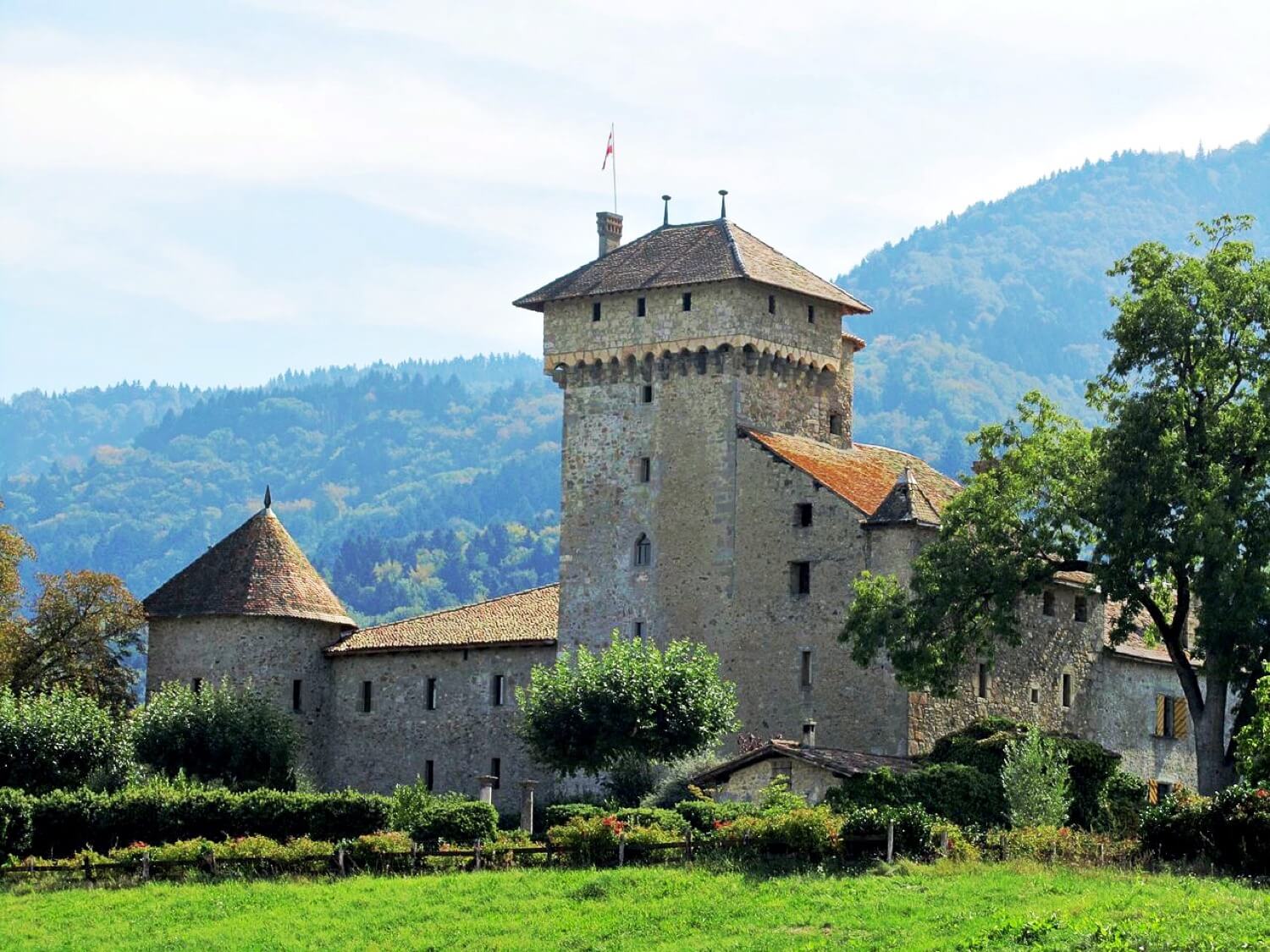
In the center of the village of Brenthonne, a road leads us to the old Castle of Avully, hidden in the trees
Le château d'Avully est une ancienne maison forte, du XiV siècle, chef-lieu de la seigneurie d'Avully, située sur la commune de Brenthonne dans le département de la Haute-Savoie, en région Auvergne-Rhône-Alpes
Previous names
Château d'Avully, Château d'Avully
Description
In the center of the village of Brenthonne, a road leads us to the old Castle of Avully, hidden in the trees. Situated bellow the slopes of the Voirons Mountains, this ancient manor was built on the site of a Gallo-Roman villa during the first century AD, as gleaned from the numerous pottery sherds found in the soil during the castle’s restoration.
The family of Avully is mentioned as early as 1172, and they depended on the lords of Faucigny.
During the XIIth and XIIIth centuries, the Chablais territory was split between several feudal families. The prince bishop of Geneva exercised his authority over the left bank of Lake Geneva. His administrative authority extended from Geneva to Bouveret and his diocese was split into eight deaneries, of which one was Allinges. Allinges included its castle, as well as Avully, Rochette, Buffavent, and Coudrée. The Chablais was also placed under the authority of numerous lords, the counts of Geneva, the Sires of Faucigny, and the Counts of Savoy.
The earliest record of Avully is of a certain Namtelme, son of the knight Guichard of Avully, family vassal of the Lord of Langin, who has a fort situated at the foot of the Voirons. The fort has a tower and several ramparts. In 1335, the Count of Savoy ordered the Lord of Avully to strengthen the castle’s defenses, as the castle is located in a plain and has no natural defenses. From 1362 – 1363, the Lord of Avully participated in the Savoyard crusade. We don’t read that Jean of Avully took part in the expedition of the Green Count of Savoy, in the direction of Gallipoli, key to the Dardanelles, in order to defend the Count’s cousin, the Byzantine Emperor.
At the beginning of the XVth century, Jeanne of Avully is cited with her brother Humbert, as being party to the characters received at the House of Savoy at Ripaille. Humbert of Avully had been made liege-lord of the Red Count, Amadeus VII. Life touched by the noble court, together with ambitious designs, was luxurious but not without needing large sums of money.
With Humbert de Avully, the family of Boëge entered into the history of Avully. He married Françoise de Boëge, who had been named by her father, Pierre, in 1412 as sole inheritor of his estate. Pierre de Balleyson and Guigon de Rovorée were named executers of this act. Jean of Rovorée-Avully’s daughter, Philiberte, married the noble Georges d’Antioch, Lord of Yvoire, and one of the two lords of Nernier. It was she who, in 1499, sold the castle, territories, and dependencies for 8,000 florins to Bonifice of St. Michel, originally from Geneva. The act was signed at the castle of Yvoire, of which the Rovorée has lordship.
It was this St Michel who remodeled the castle for the last time, giving it the form seen today. St Michel and his family held the castle for the longest time, thus adding the most to its history, which includes Antoine de St Michel, its dealings with the citizens of Bern, Geneva, Théodore de Bèze, François de Sale, the Pope, and Marguerite of Austria.
According to Galiffe, a Genevan historian, The St Michel family was an old Genevan family. It was in 1386 that Michel of St Michel was made Bourgeois of Geneva.
We theorize that they were bankers who financed maritime expeditions in search of Middle Eastern spices and Cypriot sugar.
De Foras, in his armorial, wrote that the family became Protestants during the beginning of the Reformation, probably through the marriage of a family from Bern called Watteville. François de St Michel, nicknamed ‘‘The Spaniard’’, was named counsillor of Geneva in 1519. His wife, Marguerite, was thought to be Spanish or Portuguese, according to a chronicle by Bonivard. She was declared ‘‘capitain’’ of the Amazons, all of the noble ladies who were received in Geneva on August 4th, 1523, for the marriage of Princess Béatrice of Portugal and Charles III, Duke of Savoy.
These Amazons often numbered, according to the chronicle of the time, 300, armed with darts and silver shields. They were often invited to Avully for great parties. The most interesting of them was Antoine de St Michel. Protestant and President of the Consistory of Thonon, he converted to Catholicism after four years of discussion with François de Sales. He did everything in his power to stop the fratricidal struggles and ensure the return of religious peace.
This important figure, original and intelligent, ambitious and turbulent, attracted the anger of Genevans and a price was put on his head as soon as his conversion became known. To give an idea of the work of Antoine de St Michel, later Baron of Hermance and of Avully, it is necessary to reread some lines from the historian Alain Duffour (Wars of Geneva 1589 – 1593, 1958 Julien Edition).
Those of Geneva and Bern had engineered these wars in order to snatch territory from the Duke of Savoy in order to guarantee a ‘‘good peace’’. […] Antoine de St Michel entered the scene and managed to earn the confidence of both sides. He was Protestant (provisionally) and was descended on his mother’s side to De Watteville, a great family of Bern. He had already served as an intermediary between the Duke of Savoy, his master, and Geneva in 1580. The Baron of Avully proposed to the Duke of Savoy arbitration between the Swiss, which intrigued Fribourg and Berne in May 1589. Zurich and Lucerne refused to receive it. The Baron then proposed to the Duke of Savoy to ally with the city of Bern and the French who supported Geneva against Savoy. He manipulated both sides, and he did not have to do much to move his pawns into place. The essential for him was the resulting peace, as he was a great landowner needing a market to sell his harvest of wheat and wine. ‘‘What a comedian!’’ wrote Duffour, ‘‘He knew how to bluff!’’ French territories, Bern, and Geneva burned and looted all the Savoyard castles, but always spared Avully. Until, Antoine converted and Avully was attacked for three days in May of 1603. Resisting victoriously against repeated assaults, their assailants had to withdraw their dead and wounded, and according to the Genevan register, fourteen cows and forty sheep.
Let us return to the Baron of Avully’s conversion to Catholicism. This conversion, along with the influence of François de Sales, led other nobles to Catholicism as early as 1594. Influenced by his words and but also his interests, Antoine de St Michel entreated to Protestantism in Turin the 26th of August 1596, before the Papal Nuncio.
Théodore de Bèze, Calvinist and friend to the Baron of Avully, became furious after the announcement of the former’s conversion, and responded with the strongest of rebukes.
In response, the lord published a letter at Lyon in 1602 titled ‘‘Offensive and Defensive Weapons against the Calvinists.’’ Antoine de St Michel died in 1610. The check against scaling Geneva pushed back the efforts, ambitions and interests of the House of Savoy beyond the Alps.
The Lords of Avully only occupied their castle during the summer. The rest of the time, they lived at the court of Turin where riches, honors, and important posts were awarded to their family. Antoine de St Michel knew to keep his own house in the proper order, served and maintained by numerous servants.
After the family of St Michel, the castle passed to other hands; those of Scaglia by inheritance and those of Ferrod de Sares by way of sale. In March 1756, it was bought by François de Sales, lord of Brens, along with numerous forts situated at the foot of Langin Hill.
The castle stayed in this family until 1896, at which time it was sold to the Mouchets of Saxel, a family of wood merchants. During the revolution, the castle of the municipality of Brenthonne had escaped total destruction.
Therefore, due to the reluctance to carry out the orders of the revolutionaries, the owner was able to save the towers, but the dungeon was destroyed and the moat was filled in. The mayor Guarin Lacroiz, ancestor to the current owner, lived there with his family as a farmer. The Count of Foras, author of the Armorial of Savoy, noted in 1860 that the archives of Avully were very complete and well-preserved.
Unfortunately, the farmer at the time burned part of the castle when asked to vacate the premises. Years of farmers, vandals, and those who profited from using the castle as a stone quarry left the castle in ruins.
After 44 years of work; the Castle of Avully is once again restored to its former glory, where one can admire the residence of Louis of Savoie and Jean de Vernay and Guillaume d’Allinges and the Baron of Coudrée.
This reconstruction would not have been possible without the wonderful support of several friends of the History of Savoy, in particular :
- Mr Henri Baud, Sous Préfet,
- Dr Jacques Miguet,
- Charles Bonnet, Archéologue Cantonal,
- Prof. Tanner, University of Geneva,
- M. Michaud, Architect for Historical Monuments,
- Conseil Général de la Haute-Savoie,
- Mme Joséphine Bel and her daughter Yvonne.
We do not forget the help of various craftspeople: stonecutters, masons, carpenters, and other skilled workers, who completed their magnificent work in the spirit of their colleagues from the Middle Ages.
Avully, La Rochette, Buffavent, Langin, les Allinges, Ripaille, Coudrée, Rovorée, Yvoire, the Canton of Vaud, Valais, and Peidmont reminds us that XVth century Savoy possessed more territory than France.
At one time a residence for noble, privileged families, the castle is now at the disposal of numerous visitors who come to admire the magnificent gardens, dungeon, the tower, watch towers, moat, etc.
http://www.chateau-avully.com/
Le château d'Avully est une ancienne maison forte, du XiV siècle, chef-lieu de la seigneurie d'Avully, située sur la commune de Brenthonne dans le département de la Haute-Savoie, en région Auvergne-Rhône-Alpes.
Les ruines de l'ancienne maison forte, restaurée depuis, font l’objet d’une inscription au titre des monuments historiques par arrêté du 3 mai 1974. Auparavant, le 30 août 1946, un arrêté du Ministère de l’Éducation nationale (section architecture), basé sur la loi du 2 mai 1930 et sur l'avis de la Commission départementale des sites, avait classé l'entier des lieux comme «site pittoresque de la Haute-Savoie», sur plusieurs hectares bornés par le ruisseau d'Avully, les chemins de Bons-en-Chablais à Armoy ainsi que le chemin vicinal.
Situation
Le château d'Avully est situé dans le nord du département de la Haute-Savoie sur la commune de Brenthonne, membre des communes du Bas-Chablais. Il contrôlait, comme le château de Brens, le passage entre le mont de Boisy et les Voirons permettant l'accès au Chablais.
Situé à 500 mètres à l'est du bourg, il dispose d'une vue exceptionnelle sur le lac Léman et les montagnes environnantes.
Historique
La maison forte d'Avully fut construite sur l'ancien site d'une importante villa romaine, comme l'atteste la présence de fragments de tuiles et de céramiques romaines, découverts lors de la restauration du site par l’actuel propriétaire.
Dans les douves, des centaines de fragments de céramique ont également été retrouvés, ainsi que de carreaux de poêle en céramique vernissée caractéristiques du haut Moyen Âge. De semblables, originaires de Savoie, ont été trouvés en Suisse romande, notamment à Nyon (canton de Vaud) et à la Maison Tavel (Genève). Le village, sous occupation romaine, étant également, à l'époque, constitué de villas de ce type.
Un peu avant 1310, il est fait mention d'une famille d'Avully, vassale de celle de Faucigny.
Ils font vers 1323 aveu de la maison forte aux comtes de Savoie et en 1336 aux Dauphins de Viennois. À cette occasion, on précise que la place doit être fortifiée et son revenu s'élève à 10 livres. Par mariage, la maison forte échoit au XV siècle à la famille de Boëge.
Jacquemette de Boëge, fille de Jean de Boëge, en fait reconnaissance et la donne le 23 mai 1441 au duc Louis I de Savoie, qui la lui revend le 29 mai de la même année. Elle est vendue en 1499 à un bourgeois de Genève, Boniface de Saint-Michel. La maison forte sera fortement remaniée au cours du XVI siècle par ses successeurs qui la conserveront jusqu'en 1754.
En 1536, les Saint-Michel d'Avully se convertissent au protestantisme, lors de l'invasion bernoise. Mais à la fin du XVI siècle, Antoine de Saint-Michel, baron d'Avully, président du Consistoire de Thonon, confesse le 19 février 1596 en l'église Saint-Hyppolyte de Thonon la foi catholique après ces discussions avec François de Sales. Il abjurera solennellement le 26 août de la même année en la cathédrale de Turin devant le nonce. Son geste marquera le début du retour à la foi catholique du Chablais.
Au milieu du XVIII siècle, la famille de Sales rachètera le château. La restauration du château par la famille Guyon, à l'abandon depuis 1896, et qui commence à s'écrouler dans les années 1950, est entreprise à partir de 1971. Il est aujourd'hui ouvert au public.
Description
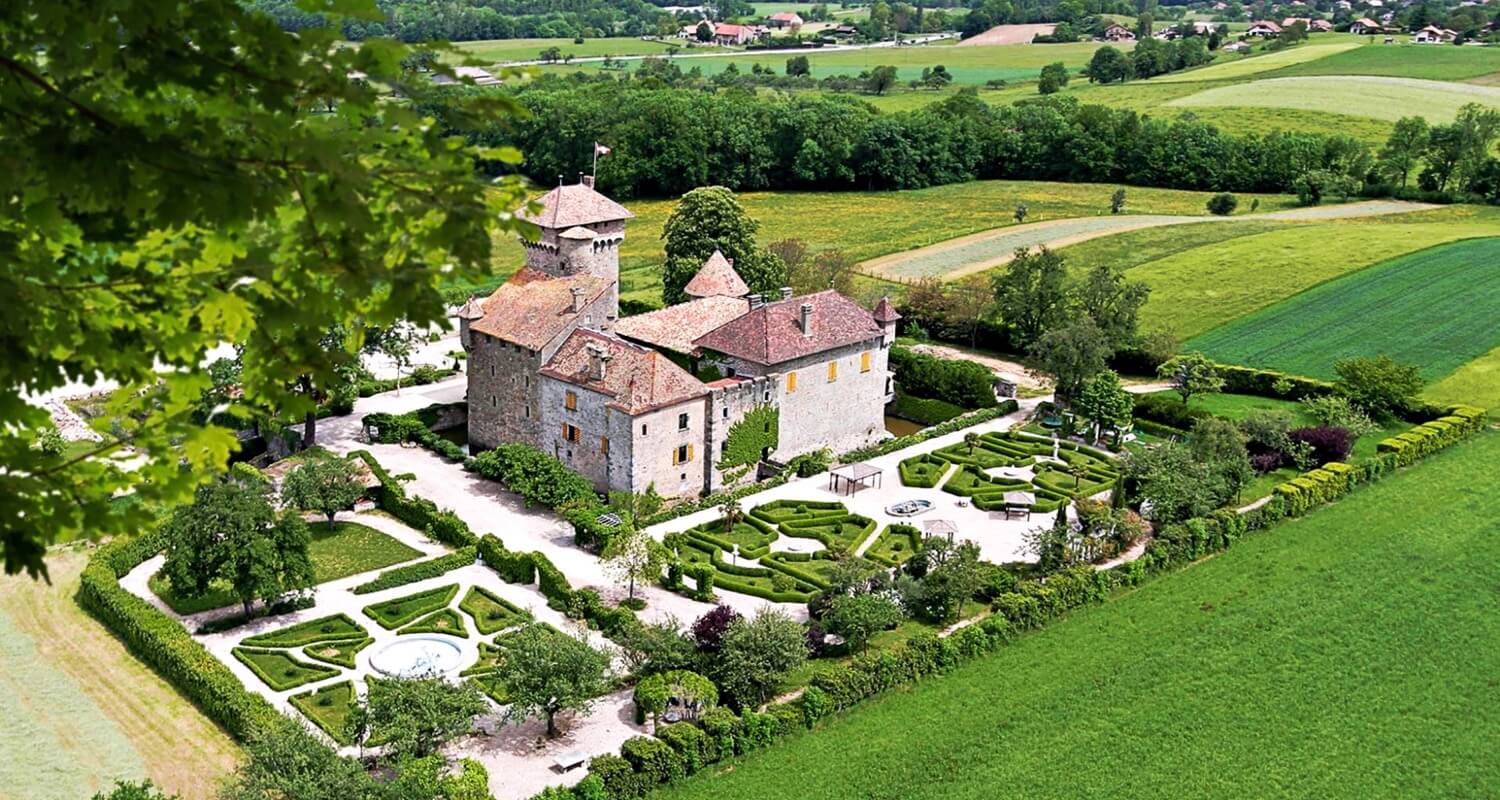
Avully est un exemple type des maisons fortes du XIII siècle qui a été adapté successivement et ce jusqu'au XVI siècle au mode et us de chaque époque et notamment la défense afin de l'adapter à l'emploi de l'artillerie. Le château d'Avully se présente aujourd'hui sous la forme d'une enceinte quadrangulaire large de 26 mètres et longue de 34 mètres, entouré de douves que précède une basse-cour entourée de remparts et de fossés.
L'angle nord de cette enceinte possède une tour en éperon et au sud, dans l'angle opposé, une tour carrée couronnée de mâchicoulis qui abrite une chapelle. Des échauguettes carrées encorbellées munissent les angles est et ouest.
On pénètre dans la haute-cour par une tour-porte quadrangulaire de 10 × 5,50 mètres dont la base date du XIV siècle. À son sommet courre un chemin de ronde sur mâchicoulis et elle est flanquée d'une tourelle qui abrite un escalier.
À l’intérieur les bâtiments sont agencés autour de la cour; deux corps de logis dont un s'ouvre au rez-de-chaussée par trois arcades ainsi que des loggias qui abrite un escalier du XVI siècle l'encadre.
Le corps de logis principal comprend, au rez-de-chaussée, la salle des gardes et la salle des écussons; y sont reproduits les blasons (appelés parfois «marques») de toutes les familles savoyardes. Au premier étage on trouve les salles des dames et du Cruet, et au second la salle des messieurs et la salle de chasse.
L’extérieur comprend les jardins à l'italienne et à la française, aménagés par les propriétaires, et la cour basse.
Useful information
Le parking GRATUIT
Adulte: 7,50 €
Etudiants, chômeurs, handicapés: 6 €
Enfant (de 5 à 15 ans): 5 €
Enfant (moins de 5 ans): gratuit
Groupe adultes (à partir de 5 personnes): 6 €
Groupe enfants (à partir de 5 enfants): 4 €
Tarif famille (2 adultes et 2 enfants): 20 € (4 € par personne supplémentaire)
info@chateau-avully.com
-
External links
Nearby castles