Archiepiscopal Palace of Alcalá de Henares
Madrid Comunidad de Madrid Spain
manor, mansion
Palacio arzobispal de Alcalá de Henares
Madrid Comunidad de Madrid Spain
manor, mansion
The Archiepiscopal Palace of Alcalá de Henares (Spanish: Palacio Arzobispal de Alcalá de Henares) is a palace located in Alcalá de Henares, in the Community of Madrid, Spain
El palacio arzobispal de Alcalá de Henares es un palacio fortaleza situado en el centro histórico de Alcalá de Henares (Comunidad de Madrid, España)
Previous names
Archiepiscopal Palace of Alcalá de Henares, Palacio arzobispal de Alcalá de Henares
Description
The Archiepiscopal Palace of Alcalá de Henares (Spanish: Palacio Arzobispal de Alcalá de Henares) is a palace located in Alcalá de Henares, in the Community of Madrid, Spain. It is now home to the Diocese of Alcalá de Henares. It is located in the Plaza del Palacio and this form part of the monumental set declared World Heritage Site by UNESCO.
The building complex dates from 1209. Two thirds were destroyed in a devastating fire in 1939, during the Spanish Civil War. The part of the building which is preserved is what is left intact after the 1939 fire, the damaged parts were not restored.
In this building came to reside different Castilian monarchs, were held synods and councils, and in here were born the youngest daughter of the Catholic Monarchs and future queen of England, Catherine of Aragon, and the German Emperor Ferdinand, son of Joanna "the Mad". In addition, it is famous for being the place where was performed the first meeting between the Catholic Monarchs and Christopher Columbus.
History
First it was a Mudéjar fortress commissioned in 1209 by Archbishop Rodrigo Ximénez de Rada (1209-1247), as a temporary residence of the archbishops of Toledo (Alcalá belonged to the archdiocese) and hence its name. It has suffered several fires and destructions, and has been remodeled several times to the present.
In the Archbishop's Palace were held the Courts in 1348 and was enacted the Ordinance of Alcalá, in that was unified the administration of justice to all the lands that formed the Crown of Castile.
In 1308 the kings Ferdinand IV of Castile and James II of Aragon met here to agree and sign the Treaty of Alcalá de Henares by which were distributed the territories obtained to al-Andalusian Taifas during the Reconquista.
Also in the 14th century, Archbishop Pedro Tenorio (1377-1399) rebuild the building fortifying it. He built a parade courtyard, rectangular, of more than 2 hectares. Surrounded by a walls with 21 towers; all rectangular less the albarrana of pentagonal, and the attached to it a semicircular plan. Currently are 16 towers, highlighting the "Tower of Tenorio" nominated in memory of the Archbishop.
In the 15th century, Archbishop Juan Martínez Contreras (1423-1434) build the east wing, decorated with large Gothic windows, the Anteroom and Hall of the Councils. The latter two were connected by a large túmido arc (in pointed horseshoe), and covered by a formidable Gothic-Mudéjar coffered ceiling.
On 20 January 1486, here was held the first interview between the queen Isabella I of Castile with Christopher Columbus to finance the trip to the Indies.
In 1524 Archbishop Alonso de Fonseca y Ulloa (1523-1534) commissioned to the architect Alonso de Covarrubias the construction of the west wing, with its courtyards and its magnificent staircase. His successor, Cardinal Juan Pardo de Tavera (1534-1545), finish the work.
Throughout its existence it housed in its inside the archives of the diocese of Toledo. Subsequently, its facilities were used for the custody of the Notary Clerks and the Judicial revenue. And from 1858 to 1939 was the Central General Archive of Alcalá de Henares.
Given the saturation of the Archivo de Simancas and its distance to the Court of Madrid, was determined the creation of the Central General Archive in 1858 in the Archbishop's Palace after its assignment to the State for this purpose by Archbishop Cirilo de Alameda y Brea (1857-1872).
This Archive received documents from the ministries and agencies suppressed following the reform of 1834. After the regulatory deadlines it forwarded the documents to the National Historical Archive, until on August 12, 1939 a fire destroyed the Central General Archive. Its successor, from 1969 is General Archive of the Administration (AGA), also in Alcalá de Henares.
Currently, from 1991, it is the seat of Bishopric of Alcalá de Henares, and residence of the bishop.
Disastrous fire of 1939
The Archbishop's Palace was barracks of tanks and ammunitions, both during and after the Civil War, when, for the failure to prevent flammable materials that were there there was a big fire. It was not the first suffered in its long history, but one of the most voracious, because it destroyed much of the buildings and of the documentation kept there three centuries.
Among the artistic treasures that were lost in the Archbishop's Palace are: the Mudéjar coffered ceiling of the Hall of Councils, the monumental staircase of Covarrubias -author of the façade-, the courtyard of Fonseca, the courtyard of the Hallelujah, the facade of the courtyard of the Ave Maria, paintings, and the first archaeological museum of the city.
The building
The building has undergone numerous constructions and rehabilitations, being especially devastating the fire of August 11, 1939, which destroyed two thirds of its structure: three courtyards ("the Fonseca" or "the Covarrubias", "the Hallelujah" and the "of the Fountain" or the "Small garden"), the "Staircase of honor", the "Facade of the Ave Maria", which was of Herrerian style and the "Garden of the Vicar". A rehabilitation of the less damaged parts was completed in 1996 and was necessary.
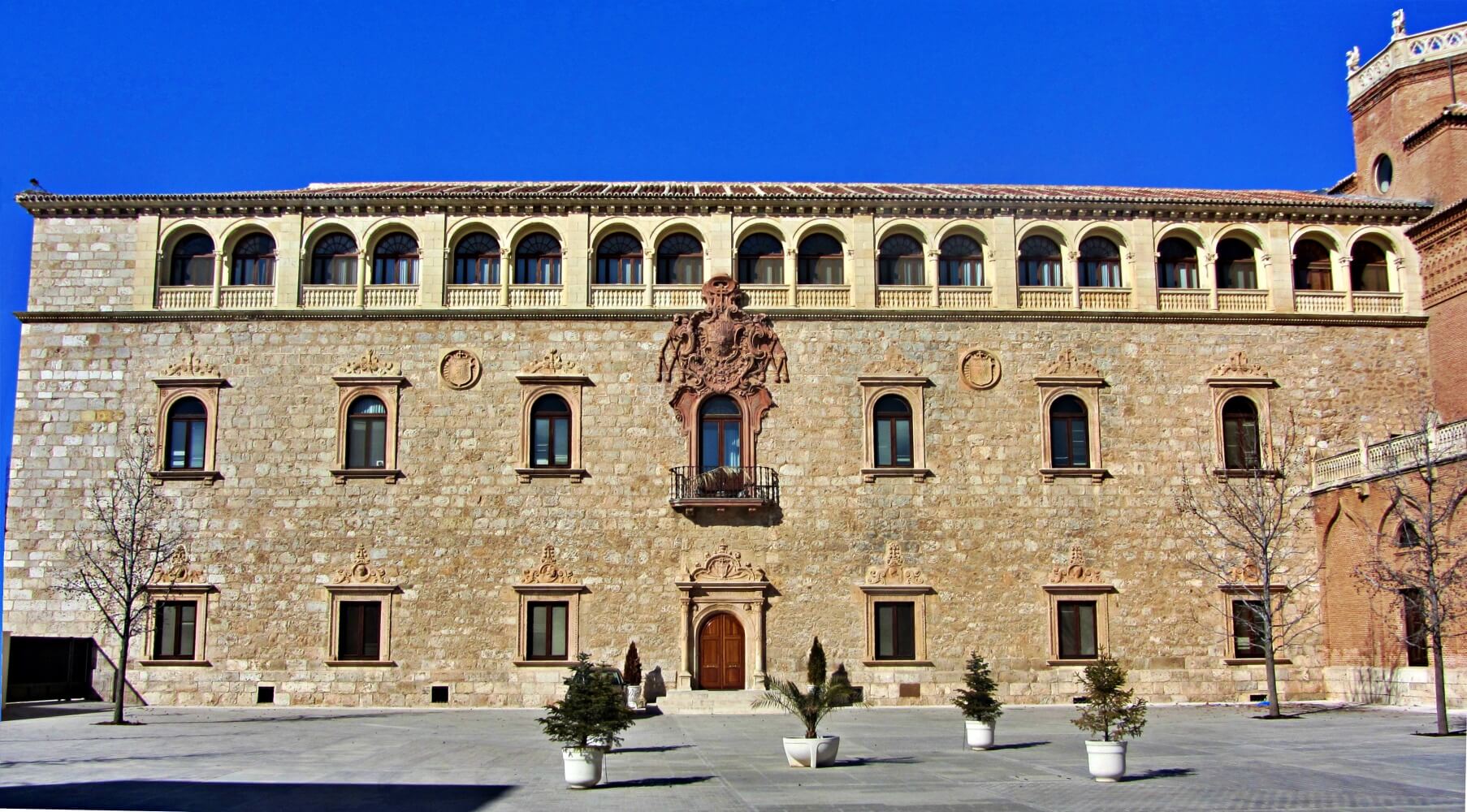
Currently has 16 towers, highlighting the "Tower of Tenorio". Entering through the parade courtyard, appears the Renaissance main facade of the building. It is divided into two bodies, being the low of ashlar, with two floors of Plateresque windows that joins an upper gallery of gemanates arches. On the central window is a Baroque coat of terracotta, which replaced the imperial of Charles V, Holy Roman Emperor. The blazon is of the Cardinal-Infante Luis Antonio of Bourbon, son of Philip V, first Bourbon replacing the Habsburg dynasty. This courtyard is closed at south by a cast iron grille, made in Belgium in the 19th century.
In the east wing, where was the "Hall of Councils", was done in the 19th century a major restoration in its exterior and interior by Juan José Urquijo y Manuel Laredo, following the Neo-Mudéjar style. In 1997 was opened the restored neo-Gothic chapel that replaces the missing Hall of Councils. In the lower floor has made a modern auditorium, replacing the "Hall of the Queen Isabella".
Antiquarium museum
In the Archbishop's Palace it were again rebuilt several parties burned, others were restored, and still continue rescuing parts of those gems. Through the Tower XIV it can access the Antiquarium and visit some of those aforementioned remains, which have recreated partially the galleries of the Ave Maria, the large Courtyard of Fonseca and the Staircase of Covarrubias.
For decades held in Alcalá the representation outside of the play "Don Juan Tenorio" by Zorrilla, in several Alcalá's monuments, and one of it is always the Archbishop's Palace, even some year has staged exclusively there.
The Antiquarium is an outdoors museum placed in the inside of the walled enclosure and accessible through the fourteenth tower.
Toponymy
The Archbishop's Palace owes its name to that Alcalá de Henares for eight hundred years belonged to the jurisdiction of the archbishops of Toledo, who were also the primates -the most preeminents- of all Spain, and that here had their residence. This made that Alcalá de Henares was always at the center of religious power, which for centuries was also synonymous with the political.
Historical people
Monarchs that born, lived and died in the Archbishop's Palace
In the Archbishop's Palace also lived many members of the Court and was killed the Castilian King John I in 1390, after falling off his horse nearby. Other monarchs used it as a temporary residence, for example, the Catholic Monarchs, so here was born their daughter Catherine of Aragon (who would be queen of England as wife of Henry VIII of England). Here in this Archbishop Palace too was born Ferdinand I, Holy Roman Emperor, son of Joanna the Mad and German emperor as successor of Charles V, Holy Roman Emperor (I of Spain).
El palacio arzobispal de Alcalá de Henares es un palacio fortaleza situado en el centro histórico de Alcalá de Henares (Comunidad de Madrid, España). Es actualmente sede de la Diócesis de Alcalá de Henares. Se encuentra en la plaza del Palacio y forma parte del conjunto monumental declarado Patrimonio de la Humanidad por la Unesco.
Historia
Primero fue una fortaleza mudéjar mandada construir en 1209 por el arzobispo Rodrigo Jiménez de Rada (1209-1247), como residencia temporal de los arzobispos de Toledo (Alcalá pertenecía a la archidiócesis) y de ahí su nombre. Ha sufrido varios incendios y destrucciones, y ha sido remodelado en varias ocasiones hasta la actualidad.
En 1308 se reunieron los reyes Fernando IV de Castilla y Jaime II de Aragón para acordar y firmar el Tratado de Alcalá de Henares por el cual se repartían los territorios conseguidos a las taifas andalusíes durante la Reconquista.
También en el siglo XIV, el arzobispo Pedro Tenorio (1377-1399) reconstruirá el edificio fortificándolo. Construyó un patio de armas, de planta rectangular, de más de 2 hectáreas de superficie. Rodeado por una muralla con 21 torreones; todos de planta rectangular menos la albarrana de planta pentagonal, y el adjunto a ésta de planta semicircular. Actualmente quedan 16 torreones, destacando el "Torreón de Tenorio" nominado en recuerdo del arzobispo.
En el siglo XV, el arzobispo Juan Martínez Contreras (1423-1434) edificará el ala oriental, adornada con amplios ventanales góticos, el Antesalón y el Salón de Concilios. Estos dos últimos estaban comunicados por un gran arco túmido (en herradura apuntada), y cubierto por un formidable artesonado gótico-mudéjar.
El 20 de enero de 1486, aquí se celebró la primera entrevista entre la reina Isabel I de Castilla con Cristóbal Colón para financiar el viaje a las Indias.
En 1524 el arzobispo Alonso de Fonseca y Ulloa (1523-1534) encargará al arquitecto Alonso de Covarrubias la construcción del ala occidental, con sus patios y su magnífica escalera. Su sucesor, el cardenal Juan Pardo de Tavera (1534-1545), terminaría las obras.
Durante toda su existencia albergó en su interior los archivos de la diócesis de Toledo. Posteriormente sus instalaciones se utilizaron para la custodia de las Escribanías Notariales y las de Rentas del partido judicial. Y desde 1858 hasta 1939 fue el Archivo General Central de Alcalá de Henares.
Ante la saturación del Archivo de Simancas y su distancia a la Corte de Madrid, se determinó la creación del Archivo General Central en 1858 en el Palacio Arzobispal, tras su cesión al Estado para este fin por el arzobispo Cirilo de Alameda Brea (1857-1872). Este Archivo recibía documentación procedente de los Ministerios y de los organismos suprimidos tras la reforma de 1834, transcurridos los plazos reglamentarios se reenviaban los documentos al Archivo Histórico Nacional. Durante la Guerra Civil no recibió daños graves, aunque fue cuartel y taller del ejército republicano, uso que mantuvo el ejército vencedor, pero el 11 de agosto de 1939 un incendio destruyó el Archivo General Central. Su sucesor, desde 1969, es el Archivo General de la Administración (AGA), también en Alcalá de Henares.
En la actualidad, desde 1991, es la sede del Obispado de Alcalá de Henares, y residencia del Obispo.
El edificio
La edificación ha sufrido numerosas construcciones y rehabilitaciones, siendo especialmente devastador el incendio del 11 de agosto de 1939, que destruyó dos tercios de su estructura: tres patios (el "de Fonseca o de Covarrubias", el "del Aleluya", y el "de la Fuente o del Jardín chico"), la "Escalera de honor", la "Fachada del Ave María", que era de estilo herreriano y se abría al "Jardín del Vicario". Las causas del fuego nunca se aclararon. Ha sido necesaria una profunda reconstrucción que se completó en 1996.
Entrando por el patio de armas, aparece la fachada principal renacentista del edificio. Está dividida en dos cuerpos, siendo el bajo de sillarejo, con dos pisos de ventanales platerescos a los que se une una galería superior de arcos geminados de medio punto. Sobre la ventana central hay un escudo barroco de terracota, que reemplazó al imperial de Carlos V. El blasón es del cardenal-infante Luis Antonio, hijo de Felipe V, primer Borbón que sustituye a la dinastía de los Austrias. Este patio se encuentra cerrado, al sur, por una reja de hierro fundido, realizada en Bélgica en el siglo XIX.
En el ala oriental, donde se encontraba el "Salón de Concilios", se realizó en el siglo XIX una importante restauración en su exterior e interior por Juan José Urquijo y Manuel Laredo, siguiendo el estilo neomudéjar. Las ventanas muestran un original juego de tracerías de formas neogóticas. En 1997 se inauguró la restaurada capilla neogótica que sustituye al desaparecido Salón de Concilios. En el piso inferior se ha realizado un moderno salón de actos, en sustitución del "Salón de la reina Isabel".
Useful information
Adulto: 11€
Menores de 5 años gratuito
Sólo es visitable el exterior del monumento
-
External links
Nearby castles