Castillo de Coca
Segovia Castilla y León Spain
castle, chateau
Castillo de Coca
Segovia Castilla y León Spain
castle, chateau
The Castle of Coca is a castle located in the Coca municipality, central Spain
El castillo de Coca es una fortificación de la localidad de Coca (Segovia, Castilla y León); fue construido en el siglo XV y está considerado por su propio municipio una de las mejores muestras del gótico-mudéjar español
Previous names
Castillo de Coca, Castillo de Coca
Description
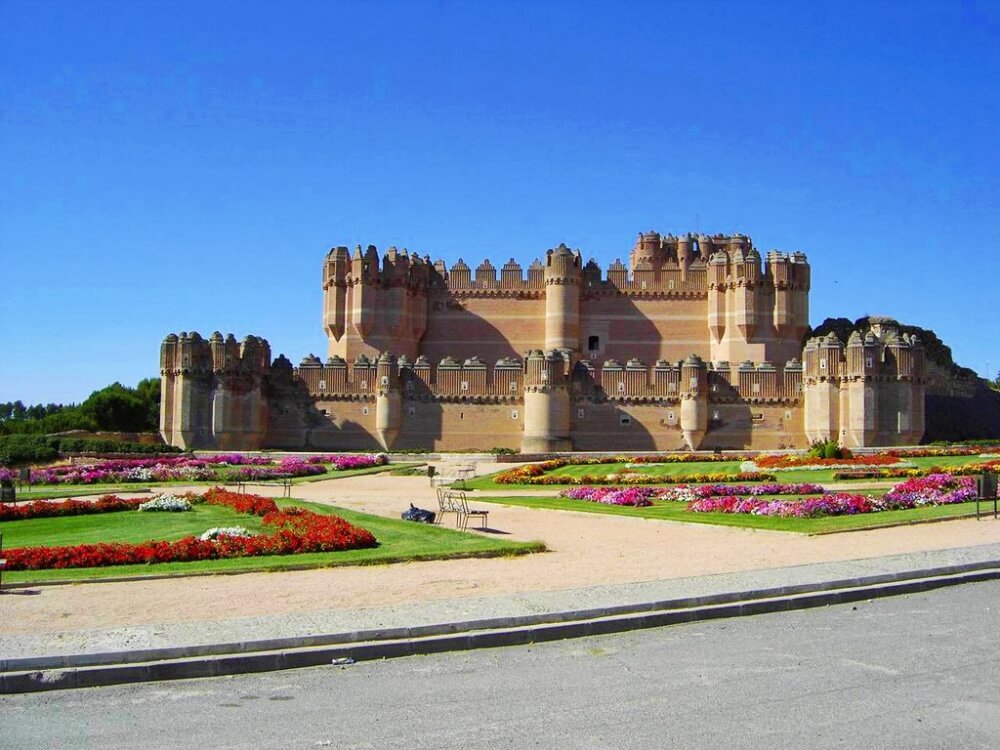
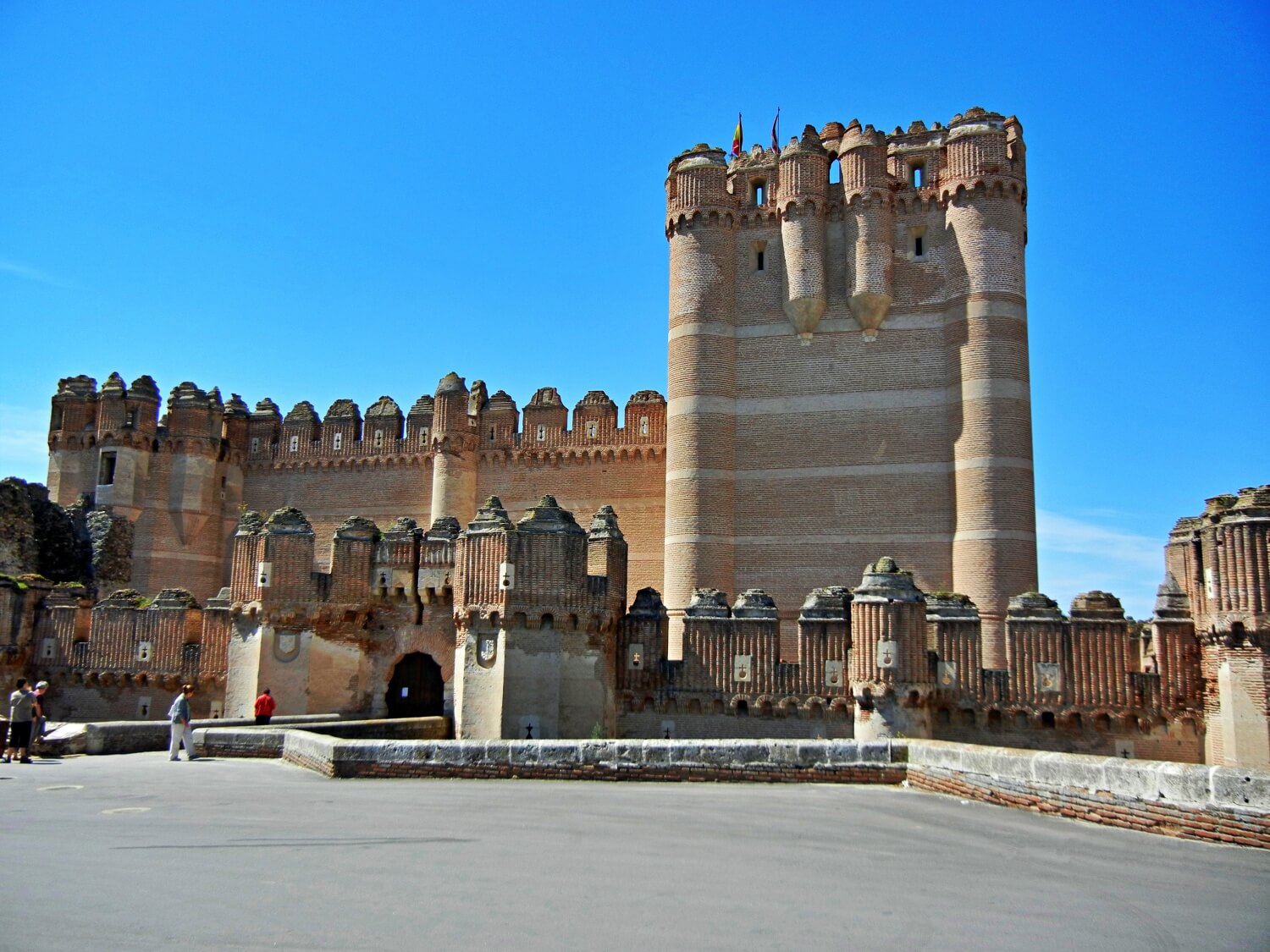
The Castle of Coca is a castle located in the Coca municipality, central Spain. The castle was constructed in the 15th century and has been considered to be one of the best examples of Spanish Mudejar brickwork which incorporates Moorish Muslim design and construction with Gothic architecture. A scale model of the castle has been built in the Mudéjar theme park and another replica built at a ratio of 1:25 is placed in the Minimundus miniature park in Klagenfurt, Austria.
Location
Coca Castle is located on the outskirts of the town of Coca, about 45 kilometers (30 miles) to the north of Segovia, on a slope. It overlooks the meander of the River Voltoya, a tributary of River Eresma. It is one of the few Spanish castles that have not been constructed on hilltops; rather it has been constructed on a steep esplanade. Coca is the birthplace of the Roman Emperor Theodosius I. The site has been inhabited since the second century BC when the Arevaci arrived and settled here. The castle is surrounded by a deep and wide moat that is one of the fortifying features as well.
Ownership
Coca castle was owned by the well-known Spanish aristocratic family the House of Alba de Tormes (sometimes known as the House of Alba) until the mid-nineteenth century. They handed over the property to Ministry of Agriculture in 1954. It has been declared a Spanish National Monument and is under protection.
Construction and architecture
The castle was constructed under the supervision of a Moorish architect and engineer. Such Moorish engineers were routinely commissioned to construct large buildings during the medieval times and were called "Alarife" (one who understand the art of construction). Brick has been used for most of the construction. However, the bricks used in the castle are different from ordinary bricks used to build houses. These are hardened bricks that are capable of withstanding enemy onslaught during sieges. The bricks have been laid smooth with the mortar, so the lines of the brickwork are clearly visible along with the mortar. This creates a distinctive pattern on the castle. The castle has been constructed in classic Mudéjar fashion. Brickwork and plaster work have been used to create geometrical patterns depicting a hybrid of Moorish Muslim and Christian Gothic architecture. While the main construction is of brick, limestone and plaster have been used in the balistraria, the embrasures. White limestone has also been used to decorate columns in the courtyard and the keep, as well as numerous other features on the facade of the keep.
Design and fortifications
The ground plan of the castle is rectangular, and it has a three-tiered defence system consisting of wall circuits enclosed within a moat and a central keep. The central keep is situated in the northern part of the castle and is known as the Tower of Homage.There are two curtain walls that enclose the enceinte, but the outer curtain wall is not intact. Today there are traces of the outer curtain wall, as well as a number of towers – some in ruins others standing – that mark the boundary where the outer moat circled the castle. All of the outer towers were rectangular in shape.The second curtain wall has a gate near the inner keep with a high brick arch enclosed by a geometric border, the alfiz, which is a classic Moorish design feature. The inner curtain wall has several towers and a talus as well. It has centered cylindrical towers on each side and smaller turrets between them, while the talus is constructed all the way down to the moat.
The towers on the corners of the walls are rectangular. The surviving wall is machicolated. This coupled with the talus served as a formidable defence. The battlements on the walls have been constructed as both ornament and as defensive fortifications, so they have been built with crests that jut out from the walls. Brickwork in Mudejar has been used here as well.
History
Early history
The oldest settlements in Coca date back to the Chalcolithic era, around 2,500–2,300 BC. The abundance of natural water and the geographical features were important for early settlers. In the fifth century CE, the village grew substantially, forming the historic city of Coca. The town of Coca was first established during Roman rule. It was called Cauca at that time. In 1439 Coca came under the control of Marquis of Santillana. In 1451 negotiations between Santillana and Fonseca families started. These would later culminate in 1453 with Coca being exchanged for Saldaña. Construction of the Coca Castle began as soon as the treaty was ratified by Juan II.
Medieval history
Alonso de Fonseca y Avellaneda has been credited with the construction of the castle. The castle was built under the supervision of a master builder and most of the work had been completed by 1493. In 1502 it was decreed that castle and the town could only be passed down to male heirs, so after Alonso's death it passed on to Antonio de Fonseca. In 1512 a number of extra ornamental features were added to the keep and the castle exterior under the supervision of engineers. The castle came under attack during the Revolt of the Comuneros in 1521. Communeras troops attacked the castle in retaliation to the burning of Medina del Campo. Medina del Campo had been previously attacked by the Royalists as it housed a large number of artillery pieces, and it had subsequently been razed after Royalists met heavy resistance. In 1645, Gaspar Alfonso Pérez de Guzmán, 9th Duke of Medina Sidonia was accused to treachery after he instigated the Andalusian independentist conspiracy of 1641, and was imprisoned in the castle.
The castle went through a period of repairs and renovations from the sixteenth to the eighteenth century CE. Most notable among these renovations was the addition of the Patio de Armas in sixteenth century, the construction of a gallery between the Keep (Torres del Homenaje) and Pedro Mata Tower in the seventeenth century CE and the extensive renovations of 1715. After 1730 the castle suffered a long period of neglect that led to it falling into disrepair, and subsequently many important artifacts were either lost or destroyed. During the Peninsular War, Coca Castle was captured by the French, who occupied the castle in 1808 and vacated it in 1812. During these four years the castle further deteriorated and much of it fell into ruin. The French troops were, obviously, not concerned with the upkeep of the castle and many ornamental features fell into ruin during this time. Another incident that led to the castle falling further into ruin was the 1828 sale of materials by the administrator of the castle. As the castle was under the ownership of the House of Alba at that time, the owners tore away a number of columns, marble pieces and other ornamental features and sold them off to the highest bidder.
Modern history
Coca Castle was declared a national monument of Spain by Decree-Law on August 9, 1926. By the same decree, it was nationalized. The control of the castle itself and the adjoining land was taken over by the government of Spain from the House of Alba. No major restorative work was done until 1954 when state-sponsored repairs and renovations were started. The Ministry in charge of the castle wanted to restore it so that they could open a school of forestry training. The repair and renovation work was conducted under the supervision of the Spanish avante garde architect Miguel de los Santos Nicolás. The team of architects, which included Francisco Pons Sorolla was given carte blanche by the General Directorate of Fine Arts. The renovations took four years and were completed in 1958. After the renovations the "Escuela de Capacitación Forestal" (Forestry school) was opened in 1958.
El castillo de Coca es una fortificación de la localidad de Coca (Segovia, Castilla y León); fue construido en el siglo XV y está considerado por su propio municipio una de las mejores muestras del gótico-mudéjar español. Propiedad de la Casa de Alba, cedido al ministerio de Agricultura de España desde el año 1954. Una maqueta a escala de este castillo se encuentra en el Parque temático Mudéjar de Olmedo y otra réplica en Minimundus, Klagenfurt, (Austria).
Situación
El castillo de Coca está situado a las afueras de la villa, se levanta sobre el meandro del río Voltoya, afluente del Eresma, en las afuera de la villa de Coca, Segovia, se encuentra el bello castillo que lleva el nombre de dicha villa. Construida en el siglo XV sobre una explanada de una zona escarpada, es uno de los mejores exponentes de la arquitectura gótico-mudéjar española y está declarado Monumento Nacional. Siendo una de las pocas fortalezas de España que no se asienta sobre un cerro, sino sobre unos escarpes del terreno. Rodea el edificio un ancho y profundo foso.
Descripción
Su construcción, atribuida a alarifes moriscos, se realizó en el siglo xv principalmente en ladrillo, utilizado no sólo como material de obra, sino también como elemento decorativo; la piedra caliza aparece en las aspilleras, las columnas del patio de armas y otros elementos decorativos.
Su sistema defensivo consta de tres partes: el foso y dos recintos amurallados con torreones. Además, dispone de un puente defensivo sobre el foso, que conduce al primer recinto amurallado; tras él, se registra una puerta rejada que lleva al patio de armas.
El recinto inferior es de planta cuadrada, y se encuentra flanqueado en sus esquinas por cuatro torres, siendo la de mayor tamaño la torre del homenaje, recorrida en su interior por una angosta escalera de caracol realizada en ladrillo que permite el acceso a diversas plantas destinadas a capilla, sala de armas y otras estancias. La Sala de armas posee una bóveda de nervaduras góticas con mosaicos decorados de motivos geométricos de varios colores. Desde lo alto de la torre se divisan los castillos de Cuéllar y de Íscar.
La torre de Pedro Mata sigue en tamaño a la del homenaje, seguramente porque junto a ella protege la puerta de acceso al patio de armas. Las dos restantes son la torre de la Muralla y la de los Peces. Dentro del recinto pueden encontrarse también otras salas con decoración de estuco y mural, así como una mazmorra.
Historia
La villa perteneció a la Corona de Castilla hasta que en 1439 fue cedida a Íñigo López de Mendoza, marqués de Santillana, quien en 1451 la permutó por la villa de Saldaña con Alonso de Fonseca y Ulloa, obispo de Ávila y arzobispo de Sevilla. En 1453, Alonso de Fonseca y Ulloa obtuvo del rey Juan II de Castilla el permiso real para edificar el castillo, aunque su construcción no se empezó hasta varios años después. Al tener que ausentarse de Coca, Alonso de Fonseca y Ulloa cedío en 1460 los derechos de la villa a su hermano Fernando de Fonseca, que los ejerció hasta su muerte en 1463. Alonso falleció en 1473 siendo arzobispo de Sevilla, y Coca fue heredada por su sobrino, Alonso de Fonseca y Avellaneda, hijo de Fernando, quien llevó a cabo la construcción de la mayor parte del castillo, hasta quedar prácticamente terminada en 1493. A partir de entonces fue residencia palaciega y escenario de grandes fiestas, a las que asistieron notables personalidades.
Nombró por su sucesor a su sobrino Alonso de Fonseca y Acevedo, quien mandó construir el castillo en 1473 y lo convirtió en residencia señorial, donde celebró grandes fiestas que eran frecuentadas por diferentes personalidades, entre las que destaca el cardenal francés Jean Jouffroi, que llegó a Castilla con la propuesta de matrimonio entre la infanta Isabel (después reina) con el duque de Berry de Guyena, hermano de Luis XI de Francia. También visitó el castillo Beatriz de Bobadilla, marquesa de Moya.
En 1502, los Reyes Católicos se aseguraron de que en caso de muerte de Alonso, el castillo pasase a su hermano Antonio Fonseca. Y al año siguiente la reina Isabel decretó que los herederos de la villa de Coca solo podrían ser varones, con lo que eliminó la posibilidad de que el castillo fuese heredado por una de las dos únicas hijas de su dueño. Por eso en 1504, Coca paso a su hermano, Antonio de Fonseca, capitán de los Reyes Católicos, que amplió los elementos defensivos del castillo, que más tarde tuvo que defenderse del infortunado ataque del marqués del Cenete, quien pretendía rescatar a su prometida, María de Fonseca, que estaba retenida por su tío.
En 1512 trabajaron en el castillo alarifes sevillanos (maestros de obras), que posiblemente fueron los artífices de muchas de sus decoraciones. En 1521 fue atacado por las tropas comuneras en represalia por el incendio de Medina del Campo llevado a cabo por el propio Antonio de Fonseca; al no conseguir acceder al castillo, destruyeron la cercana fortaleza de Alaejos. En 1645, fue prisión del duque de Medina Sidonia, acusado de haberse querido proclamar rey de Andalucía. Y más adelante, por casamientos, el castillo pasó a ser propiedad de la Casa de Alba.
En diferentes épocas pasó por importentes reformas: galerías del Patio de Armas en el siglo XVI; galería entre las Torres del Homenaje y de Pedro Mata en el siglo XVII, y otras mejoras en 1715. Pero a partir de 1730 su archivo fue trasladado a Madrid, y el castillo cayó en el abandono y la rapiña. En 1808, durante la Guerra de la Independencia, los franceses ocuparon la villa de Coca y sus tropas se instalaron en el castillo, al que causaron grandes destrozos, y cuando lo abandonaron en 1812 solo eran ruinas. Y en 1828, un administrador de la Casa de Alba sin escrúpulos vendió materiales del castillo, entre ellos columnas de mármol del patio, lo que acentuó todavía más su ruina.
En 1926, el castillo fue declarado Monumento Nacional. En 1931 fue declarado Monumento Histórico Nacional y en 1954 fue cedido al Ministerio de Agricultura por 100 años menos 1 día, siendo restaurado entre 1956 y 1958 para albergar la Escuela de Capacitación Forestal. En 1995 fue escenario de tres de los 15 capítulos del concurso televisivo de TVE titulado La noche de los castillos, aunque no utilizaron su interior, que fue sustituido por un decorado en el plató L-3 de los desaparecidos Estudios Buñuel-TVE.
Escuela de capacitación forestal
Tras su cesión al Ministerio de Agricultura en 1954, y a partir de la finalización de su restauración en 1958, partes de las salas del castillo pasaron a ser la sede de la Escuela de Capacitación Forestal, que es muy solicitada por alumnos de toda España: a partir de 1958 han pasado por sus aulas 39 promociones de Capataces Forestales.
Useful information
- Jubilados y pensionistas con carnet: 2,00 €;
- Adultos: 2,70€;
- Niños de 7 a 14 años acompañados por adultos: 2,00 €;
- Niños menores de 7 GRATUITO
- Agencias: 2,00 €;
- Asociaciones; 2,00 €;
-Colegios, con carta de presentación: 2,00 €;
visitascastillodecoca@hotmail.com
-
External links
Nearby castles