Castillo de Aracena
Huelva Andalucía Spain
castle, chateau
Castillo de Aracena
Huelva Andalucía Spain
castle, chateau
The origin pat of Aracena is at the top of the hill occupied by the Castle and the Priory Church
El castillo de Aracena se encuentra ubicado en el municipio español de Aracena en la provincia de Huelva, Andalucía
Previous names
Castillo de Aracena, Castillo de Aracena
Description
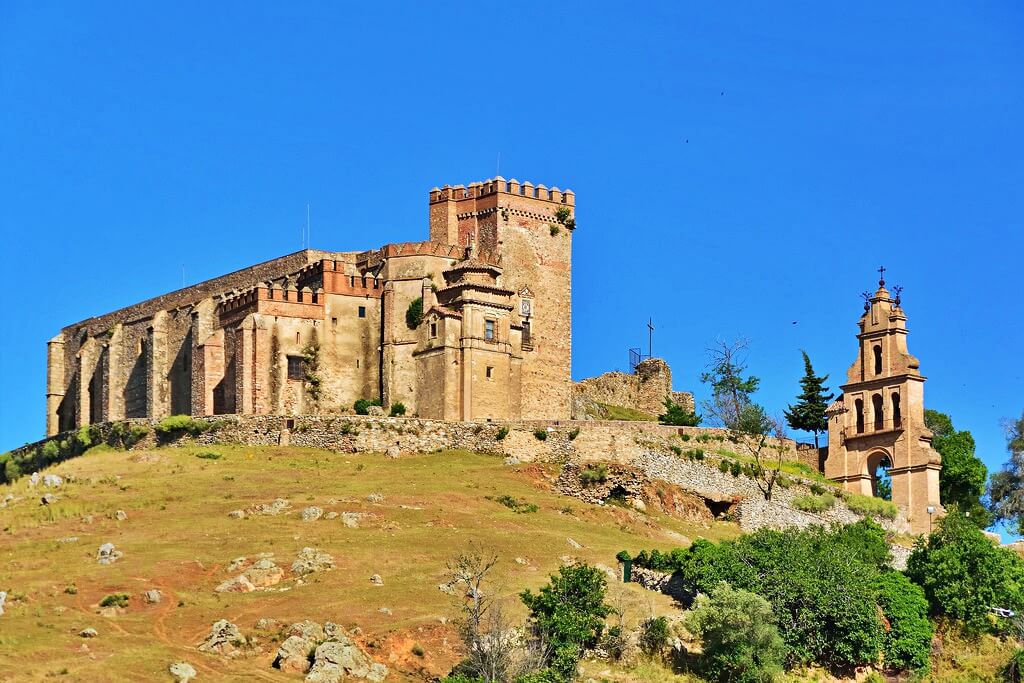
The origin pat of Aracena is at the top of the hill occupied by the Castle and the Priory Church. In medieval times it was a fortified town, defended by a stone wall and the fortress. Archaeological remains from the 10th-13th centuries have been found in this location, which are evidence of an Al-Andalus town related to the Qatrasana settlement documented in Islamic texts. The interior Aracena Castle contains dwellings from the Al-Andalus era and a number of buildings from the medieval fortress. The entry to the Castle enclosure is via the secondary gate to the Alcázar. This area, which is located at the highest and most easterly part of the hill, is that which makes up the fortified enclosure of Aracena next to the bailey.
During the Al-Andalus period there was a town which was the origin of the present Aracena. Archaeological finds point to 2 periods of occupation. The first stage corresponds to the 10th and 11th centuries during the time of the Caliphate of Cordoba and the Taifa Kingdom of Seville. The second stage developed from the 12th to the mid-13th centuries when Al-Andalus was part of the Almoravid and Almohad empires.
The conquest of the Islamic population by Portugal led to the construction of the Castle. It was built over the Al Andalus houses that were destroyed after the conquest by the Order of the Hospitaliers, midway through the 13th century. After the reconquest of the Sierra de Aracena, the frontier with Portugal was not definitively established until the Treaty of Alcañices in 1297, when Aracena passed into the possession of Castile as crown land and included in the Council of Seville. The Castle is part of the “Banda Gallega”, a set of fortifications that protected the territory of Seville from Portuguese attack or from the military orders based in the south of Extremadura.
The castle was built in the mid-13th century and remained in use until the early 16th century, when it lost its military function. The fortress of Aracena was divided into a bailey and a fortress, separated by a wall which featured the Main Tower. The Fortress of the Aracena castle occupies the east part of the complex, the highest point on the hill. It occupies less space than the bailey but has elements, such as the cistern, which enable it to be defined as a small fortress within the castle. The towers were square or rectangular and have terraces accessed by small stairways from the ramparts or chemin de ronde.
The Main Tower is located at the highest point on the hill, designed to be the last line of the defence, after the city wall, the castle and the fortress, able to resist after the capture of the fortress. It is square and had interior rooms. Its height estimated at 16 metres. A wall divided the castle between the bailey and the fortress. The castle hill was the starting point for populating the area, a “town within a castle" during the Middle Ages.
Over time, the population spread across the hillside and conquered the valley stretching out below, while “old town" was abandoned and forgotten. During the 15th and 16th centuries, the nerve centre of the town was the Plaza Alta where the Town Hall and the parish church of La Asunción were built. Urban expansion continued towards the Mudejar chapels (San Pedro, Santa Lucía, San Roque and Santo Domingo) located on the roads to Huelva, Portugal, Extremadura and Seville.
Now that restoration work has been completed on the Castle-Fortress as part of the Master Plan for the Fortified Enclosure of Aracena, and one of the actions scheduled to commemorate the centenary of the opening of the Las Maravillas Grotto, guided tours are now available.
http://www.andalucia.org/en/cultural-tourism/visits/huelva/monuments/castillo-de-aracena/
El castillo de Aracena se encuentra ubicado en el municipio español de Aracena en la provincia de Huelva, Andalucía.
Historia y descripción
La fortaleza se erigió en el siglo XIII, en la época islámica, sobre una antigua edificación fortificada musulmana. El recinto amurallado estaba partido en dos en su interior, con la torre de Homenaje defendiendo la barrera que dividía su interior. En torno a éste se asentaba la población dando origen al actual paisaje urbano. Durante la Baja Edad Media y Edad Moderna, Aracena continuó creciendo desde el Cerro del Castillo hasta el valle, primero como tierra realenga dependiente de Sevilla y posteriormente como Señorío bajo la jurisdicción del Conde Duque de Olivares, en el siglo XVII, y más tarde, del Conde de Altamira, quien se tituló Príncipe de Aracena.
La fortaleza consta de alcazaba, con torre del alcaide, aljibe y murallas flanqueadas por torres, así como una línea de cerca que albergaba en su interior las viviendas medievales.
Aracena fue cedida por la Corona de Castilla a la Orden del Temple. Dicha Orden mandó levantar la actual iglesia mudéjar que destaca por las esculturas de barro vidriado de Pedro Vázquez y que toma el nombre de la patrona de la localidad, Nuestra Señora del Mayor Dolor. Adosada a la Iglesia hay una torre mudéjar.
Es la iglesia más antigua y emblemática de Aracena. Consta de tres naves a igual altura con coro a los pies y presbiterio poligonal al que se adosa la torre en el lado del Evangelio. En el muro del hastiar aparece un porche, mientras el ábside se nos muestra interrumpido por un gran camarín barroco. En su interior destacan bóvedas nervadas de esquema estrellada.
La construcción del templo debió iniciarse a fines del siglo XIII. Las obras quedaron paralizadas a lo largo del siglo XIV, para reanudarse a principios del siglo XV, prolongándose durante toda esta centuria, en la que se aprecia claramente el influjo de la catedral de Sevilla. La tribuna del coro. La portada de los pies y la del lado norte son ya de un gótico tardío.
Useful information
- Adulto: 2,5 €
- Mayor de 65 años, persona con discapacidad superior al 33% debidamente acreditada:1 €
Niños de 6 a 12 años: 1 €
Grupo (más de 20 per.): 1,5 €
turismo@ayto-aracena.es
Visita al aire libre. Se realizará siempre que la condiciones climatológicas lo permitan
-
External links
Nearby castles