Alcázar of Segovia
Segovia Castilla y León Spain
castle, chateau
Alcázar de Segovia
Segovia Castilla y León Spain
castle, chateau
The Alcázar of Segovia (literally, "Segovia Fortress") is a medieval alcázar located in the city of Segovia (Castile and León, Spain), a World Heritage Site by UNESCO
El Alcázar de Segovia es uno de los monumentos más destacados de la ciudad española de Segovia (Castilla y León) y uno de los más visitados del país
Previous names
Alcázar of Segovia, Alcázar de Segovia
Description
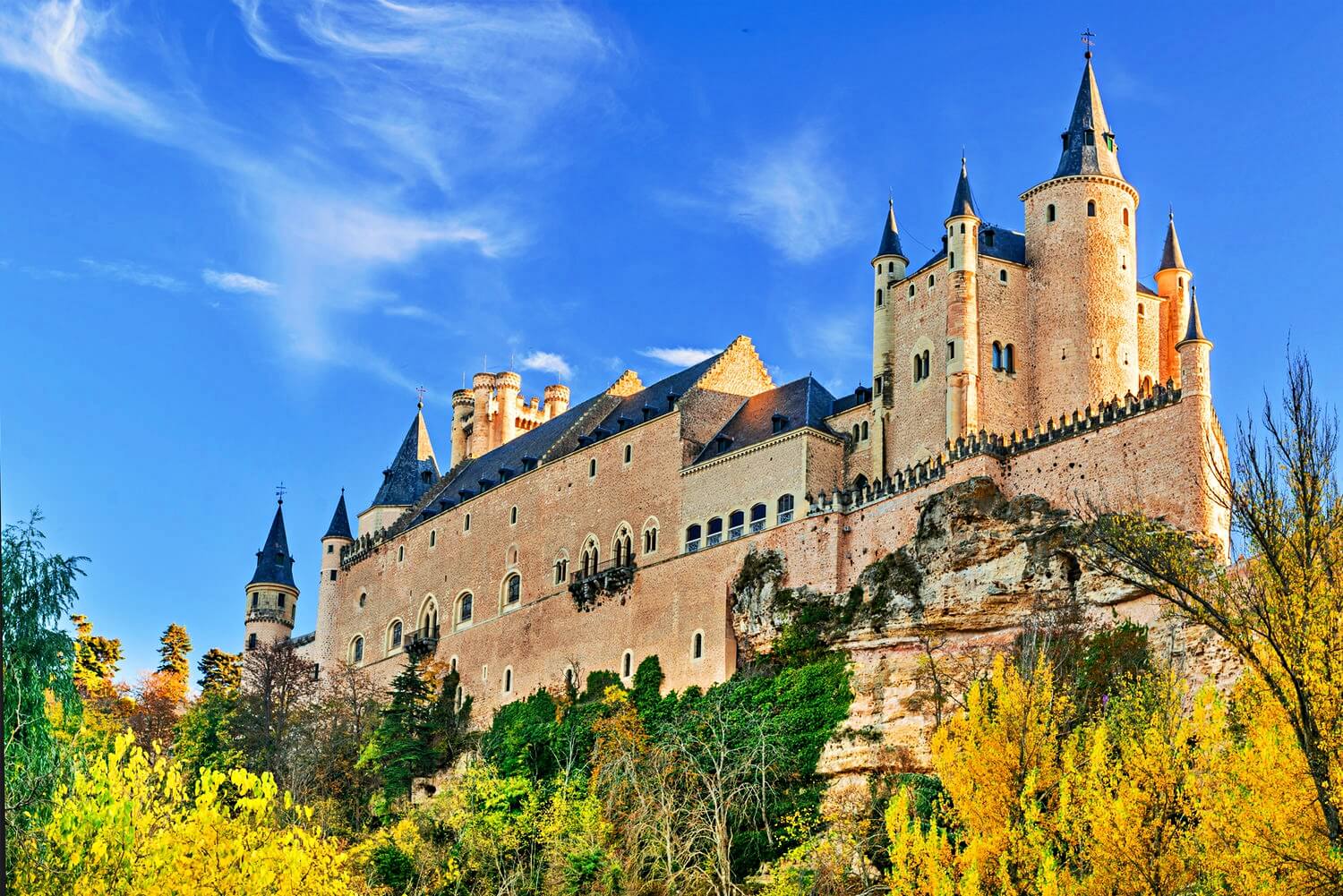
The Alcázar of Segovia (literally, "Segovia Fortress") is a medieval alcázar located in the city of Segovia (Castile and León, Spain), a World Heritage Site by UNESCO. Rising out on a rocky crag above the confluence of two rivers near the Guadarrama mountains, it is one of the most distinctive castle-palaces in Spain by virtue of its shape – like the bow of a ship. The Alcázar was originally built as a fortress but has served as a royal palace, a state prison, a Royal Artillery College and a military academy since then. It is currently used as a museum and a military archives building.
History
The Alcázar of Segovia, like many fortifications in Spain, started off as Roman fort, but apart from the foundations, little of the original structure remains. A Muslim era fort, which was itself largely replaced by the present structure, was built by the Berber Almoravid dynasty. The first reference to this particular "alcázar" was in 1120, around 32 years after the city of Segovia returned to Christian hands (during the time when King Alfonso VI reconquered lands to the south of the Duero river down to Toledo and beyond).
The shape and form of the Alcázar was not known until the reign of King Alfonso VIII (1155–1214), however early documentation mentioned a wooden stockade fence. It can be concluded that prior to Alfonso VIII's reign, the Muslim era structure was no more than a wooden fort built over the old Roman foundations. Alfonso VIII and his wife, Eleanor of England, made this alcázar their principal residence and much work was carried out to erect the beginnings of the stone fortification we see today.
The Alcázar of Segovia was one of the favorite residences of the monarchs of Castile in the Middle Ages, and a key fortress in the defence of the kingdom. It was during this period that most of the current building was constructed by the Trastámara dynasty.
In 1258, parts of the Alcázar had to be rebuilt by King Alfonso X after a cave-in and the Hall of Kings was built to house Parliament soon after. However, the single largest contributor to the continuing construction of the Alcázar is King John II who built the "New Tower" (John II tower as it is known today).
In 1474, the Alcázar played a major role in the rise of Queen Isabella I. On 12 December news of the King Henry IV's death in Madrid reached Segovia and Isabella immediately took refuge within the walls of the Alcázar where she received the support of Andres Cabrera and Segovia's council. She was enthroned the next day as Queen of Castile and León.
The next major renovation at the Alcázar was conducted by King Philip II after his marriage to Anna of Austria. He added the sharp slate spires to reflect the castles of central Europe. In 1587, architect Francisco de Morar completed the main garden and the School of Honor areas of the castle.
The royal court eventually moved to Madrid and the Alcázar then served as a state prison for almost two centuries before King Charles III founded the Royal Artillery School in 1762. It served this function for almost a hundred years until March 6, 1862 where a fire badly damaged most of the roofs.
It was only in 1882 that the damaged roofs of the building were slowly restored to its original state, thanks to the existence of engravings made by José María Avrial in 1839. In 1896, King Alfonso XIII ordered the Alcázar to be handed over to the Ministry of War as a military college.
Description
The distribution of the castle is divided into two areas: the exterior, with a Herrerian courtyard, moat, drawbridge and the keep, and the interior rooms that include a chapel and several noble rooms (room del Trono, de la Galera, de las Piñas, de los Reyes and others) that can be visited today.
Its plant is very irregular and adapts to the hill on which it rises. Highlights the very beautiful keep, square with four towers, hall covered with pointed barrel and twin windows. It was raised being the king John II of Castile and at first served as a Weapons room.
In the interior, the halls and rooms were decorated with great luxury and beauty by Mudéjar painters and artists is. Currently, it houses an Armory Museum and the General Military Archive of Segovia, the oldest historical archive of the Spanish Armed Forces.
Tower of John II of Castile
The tower of John II of Castile culminates in a large panoramic terrace. From it you can appreciate a great view of the city. Especially the neighborhood of las Canonjías, the cathedral and the Jewish quarter.
The two stairs that have to be saved to reach the top add 156 steps, most of them on a rather narrow and inclined spiral staircase.
When crossing the gate that gives access to the first staircase, notice the considerable thickness of the walls. When the first section ends, you will reach the guard room. Attached to the front wall is the bed where the watchman of the tower probably slept.
Above there are four floors. Its most usual use was as a prison. It was almost impossible to escape from here. Their tenants used to be characters of high condition, reason why they enjoyed certain comforts in their cells such as tapestries, carpets and furniture. The last State prisoner was the Cuban General Dámaso Berenguer in the thirties of the last century.
Interior rooms
According to The Illustrated Magazine of Art (1853)
The interior of the Castle of Segovia is in perfect accordance with the magnificence of its exterior. Many apartments are decorated with delicate traceries and pendant ornaments, in the style of the Alhambra, and, like those of the Alcazar of Seville, were executed by Arabian workmen during the Christian dominion of the fourteenth century, for in many places the crowns of the kings of Castille may be seen, surrounded by Latin mottoes [sic] and extracts from the Koran.
Hall of the Old Palace
Its construction corresponds to the reign of Alfonso VIII of Castile. In it the twinned windows that gave light to the palace are conserved, since the wall in which they were was the exterior wall of the old palace. The Mudéjar-style socles located between the windows come from a 13th-century house in the nearby Las Canonjías district. The decoration was completed with a set of German-style armor from the 15th century.
Hall of the Fireplace
Corresponds to the ordination of the fortress in the time of Philip II of Spain. The furniture is from the 16th century. On the walls you can see a portrait of Philip II and another of Philip III, a 16th century Flemish tapestry with the subject of Our Lady's betrothal and a curious representation where you can contemplate the appearance of the Alcázar before the reform of the roofs and where you can also see the Former Cathedral of Segovia that was located in the current square of the Alcázar.
Throne Room or that of del Solio
The portal that communicates with the Hall of the Fireplace conserves intact its original Mudéjar decoration. It covers an armored armor, similar to the one destroyed by the fire, which was carved in 1456. Underneath is a wide plaster frieze that maintains its original decoration despite the ravages of the fire.
The thrones under dossal with the coat of arms of the Catholic Monarchs and its motto "Tanto monta" are works of the beginning of the century. On the walls are the portraits of the kings themselves, who are part of the iconography of kings commissioned by the queen Isabella II of Spain. The portrait of Isabella I of Castile is signed by Madrazo and that of Ferdinand II of Aragon by Montañés.
Hall of the Galley
It receives its name from the old coffered ceiling that had the shape of an inverted ship hull. The room was built by the queen Catherine of Lancaster in 1412, during the minority of her son John II of Castile. The frieze is of Mudéjar plaster with a double inscription: the upper one with a Eucharistic prayer and the lower one with information about the work of the hall.
In the windows are two stained glass windows that represent one Henry III of Castile and his family and the other Henry II of Castile with scenes of the death of Peter I and John II. One of the walls is decorated with a painting depicting the coronation of the queen Isabella I of Castile as queen of Castile and of León in the church of San Miguel of Segovia , work of the mentioned Muñoz de Pablos.
Hall of las Piñas
Its name is due to the decorative motifs of the coffered ceiling. In the frieze can be seen angels carrying the coat of arms of Castile and León. The stained glass window represents Alfonso VII with his daughter Berenguela.
Royal Chamber
In its walls you can see scenes of the family life of the Catholic Monarchs. The bed has a brocade cover woven in gold.
Hall of the Kings
Philip II of Spain commissioned Hernando de Ávila the design of the statues corresponding to the kings of Asturias, León and Castile; except only that of Joanna the Mad after moving to Royal Palace of Madrid, Spain. One of the paintings in the room is a portrait of Philip II himself and the other two are portraits of two of his wives, Elisabeth of Valois and Anna of Austria.
Room of the Belt
Its name is because it is surrounded by walls, a long golden lace.
Chapel
There is a chapel in the Room of the Belt from which the king or queen saw the mass.
Weapons or Armory Room
The Alcázar has housed the armory of the House of Trastámara since old times, and was the precedent of the collections of weapons that finally met in the Royal Armoury of Madrid.
Museum of the Royal College of Artillery
In popular culture
The castle also served as the French home of Sir Lancelot du Lac, Joyous Gard, in the 1967 musical film Camelot.
El Alcázar de Segovia es uno de los monumentos más destacados de la ciudad española de Segovia (Castilla y León) y uno de los más visitados del país. Está ubicado en la Ciudad vieja, declarada Patrimonio Mundial de la Unesco en 1985.
En su ya bimilenaria existencia, el Alcázar segoviano ha sido castro romano, fortaleza medieval, palacio real, custodio del tesoro real, prisión de estado, Real Colegio de Artillería y Archivo General Militar .
Se trata de uno de los castillos-palacio de finales de la Edad Media, comienzos de la Edad Moderna, más distintivos de toda Europa en virtud de su forma de proa de barco.
Historia
Los restos más antiguos hallados en el lugar son unos sillares de granito similares a los del acueducto romano, lo que hace suponer que en tiempos de la dominación romana de la ciudad ya hubo de haber un castro o fortificación. Sobre los restos de éste, el alcázar fue erigido como fortaleza hispano-árabe. La primera noticia documental que se conserva del edificio data del año 1122, poco después de que Alfonso VI de León reconquistase la ciudad, aunque no es hasta 1155 cuando aparece citado con la denominación de alcázar, en una carta custodiada en el archivo de la catedral. Fue residencia del rey Alfonso VIII. En 1258, reinando Alfonso X, se hundió el palacio cuando el rey se encontraba en su interior. Este núcleo más antiguo corresponde con la sala de armas. Fue numerosas veces restaurado y ampliado, posiblemente desde Alfonso X hasta Felipe II. A este último se debe su aspecto actual, su "silueta" lo hace único entre los castillos españoles.
En la Edad Media, por su seguridad como por la proximidad de zonas de caza, el Alcázar se convirtió en una de las residencias favoritas de los Reyes de Castilla, en especial de Alfonso X. Fue habitado muchas veces y llegó a ser uno de los más suntuosos palacios-castillos en el siglo XV, siendo testigo mudo de acontecimientos claves de la Historia de España como la proclamación de Isabel la Católica (13 de diciembre de 1474) o la misa de velaciones entre Felipe II y Ana de Austria (14 de noviembre de 1570) en su capilla.
La fortaleza sirvió posteriormente como prisión de Estado hasta que en 1762 Carlos III fundó en Segovia el Real Colegio de Artillería que tuvo su sede en el alcázar. En 1862, un incendio destruyó las suntuosas techumbres de las salas nobles, que pudieron ser reconstruidas fielmente con posterioridad, gracias a la existencia de grabados realizados por José María Avrial y Flores en 1839.
En 1931 fue declarado monumento histórico artístico. En 1953 se creó el patronato del alcázar que es el responsable del museo que se puede visitar en su interior.
Descripción
La distribución del castillo se articula en dos áreas: la exterior, con un patio herreriano, foso, puente levadizo y la torre del homenaje, y las dependencias interiores que incluyen una capilla y varias salas nobles (sala del Trono, de la Galera, de las Piñas, de los Reyes y otras) que pueden visitarse en la actualidad.
Su planta es muy irregular y se adapta al cerro sobre el que se levanta. Destaca la muy bella torre del homenaje, cuadrada con cuatro torreones, estancia cubierta de cañón apuntado y ventanales geminados. Fue levantada siendo rey Juan II y en un principio sirvió de sala de armas.
En el interior, los salones y estancias fueron decorados con gran lujo y belleza por pintores y artistas mudéjares. Actualmente, alberga un Museo de Armas y el Archivo General Militar de Segovia, el archivo histórico más antiguo de las Fuerzas Armadas de España.
Torre de Juan II
La torre de Juan II culmina en una gran terraza panorámica. Desde ella se aprecia una gran vista de la ciudad. Especialmente del barrio de las Canonjías, la catedral y la judería.
Las dos escaleras que hay que salvar para llegar arriba suman 156 escalones, la mayor parte de ellos en una escalera de caracol bastante estrecha e inclinada.
Al cruzar el portón que da acceso a la primera escalera, fíjese en el considerable grosor de los muros. Cuando acabe el primer tramo llegará al cuarto de guardia. Pegado al muro frontero está el lecho donde probablemente dormía el vigilante de la torre.
Por encima hay cuatro plantas. Su uso más habitual fue como prisión. Era casi imposible escapar de aquí. Sus inquilinos solían ser personajes de alta condición, por lo que disfrutaban de ciertas comodidades en sus celdas tales como tapices, alfombras y mobiliario. El último preso de Estado fue el general Berenguer en los años treinta del siglo pasado.
Estancias interiores
Sala del Palacio Viejo
Su construcción corresponde al reinado de Alfonso VIII. En ella se conservan los ventanales geminados que daban luz al palacio, ya que el muro en que se encuentran era el muro exterior del palacio viejo. Los zócalos de estilo mudéjar situados entre las ventanas proceden de una vivienda del siglo XIII del cercano barrio de las Canonjías. La decoración se completaba con un conjunto de armaduras de tipo alemán del siglo XV.
Sala de la Chimenea
Corresponde a la ordenación del alcázar en tiempos de Felipe II. El mobiliario es del siglo XVI. En las paredes se pueden contemplar un retrato de Felipe II y otro de Felipe III, un tapiz flamenco del siglo XVI con el tema de los desposorios de Nuestra Señora y una curiosa representación donde se puede contemplar el aspecto del alcázar anterior a la reforma de las techumbres y donde se puede ver, asimismo, la antigua catedral de Santa María que se encontraba emplazada en la actual plazuela del alcázar.
Sala del Trono o del Solio
La portada que comunica con la Sala de la Chimenea conserva intacta su decoración mudéjar original. Cubre la estancia una armadura ochavada, similar a la destruida por el incendio, que fue labrada en 1456. Por debajo se encuentra un ancho friso de yeso que mantiene su decoración original a pesar de los estragos del incendio.
Los tronos bajo dosel con el blasón de los Reyes Católicos y su divisa "Tanto monta" son obra de principios de siglo. En las paredes se encuentran los retratos de los mismos reyes, que forman parte de la iconografía de reyes encargada por la reina Isabel II. El retrato de la reina Isabel está firmado por Madrazo y el de don Fernando por Montañés. La vidriera del ventanal representa a Enrique IV de Castilla y es obra del artista segoviano Carlos Muñoz de Pablos, también autor de las vidrieras que se pueden contemplar en las demás salas.
Sala de la Galera
Recibe su nombre del antiguo artesonado que tenía la forma de casco de barco invertido. La sala fue construida por la reina Catalina de Lancáster en 1412, durante la minoría de su hijo Juan II de Castilla. El friso es mudéjar de yeserías con una doble inscripción: la superior con una oración eucarística y la inferior con datos sobre la ejecución de la sala.
En los ventanales se encuentran dos vidrieras que representan una a Enrique III de Castilla y su familia y la otra a Enrique II con escenas de la muerte de Pedro I y Juan II. Uno de los muros está decorado con una pintura que representa la coronación de la reina Isabel la Católica como reina de Castilla y de León en la iglesia de San Miguel de Segovia, obra del mencionado Muñoz de Pablos...
Sala de las Piñas
Su nombre se debe a los motivos de decoración del artesonado. En el friso pueden observarse ángeles portando el escudo de armas de Castilla y León. La vidriera representa a Alfonso VII con su hija Berenguela.
Cámara Regia
En sus muros pueden observarse escenas de la vida en familia de los Reyes Católicos. La cama tiene una cubierta de brocado tejida en oro.
Sala de los Reyes
Felipe II encargó a Hernando de Ávila el diseño de las estatuas correspondientes a los reyes de Asturias, León y Castilla. Una de las pinturas de la sala es un retrato del propio Felipe II y las otras dos son sendos retratos de dos de sus esposas, Isabel de Valois y Ana de Austria.
Sala del Cordón
Su nombre se debe a que está rodeado por las paredes, de un cordón largo y dorado.Representa el cordón franciscano por penitencia de Alfonso X por su desmedido orgullo
Capilla
Hay una capilla en la sala de cordón desde la que el rey o reina veía la misa.
Sala de Armas o Armería
El alcázar albergó desde sus inicios la armería de la Casa de Trastámara y fue el precedente de las colecciones de armas que finalmente se reunieron en la Real Armería de Madrid.
Museo del Real Colegio de Artillería