Winchester Castle
Hampshire England England
castle, chateau
Winchester Castle is a medieval building in Hampshire, England
Previous names
Winchester Castle
Description
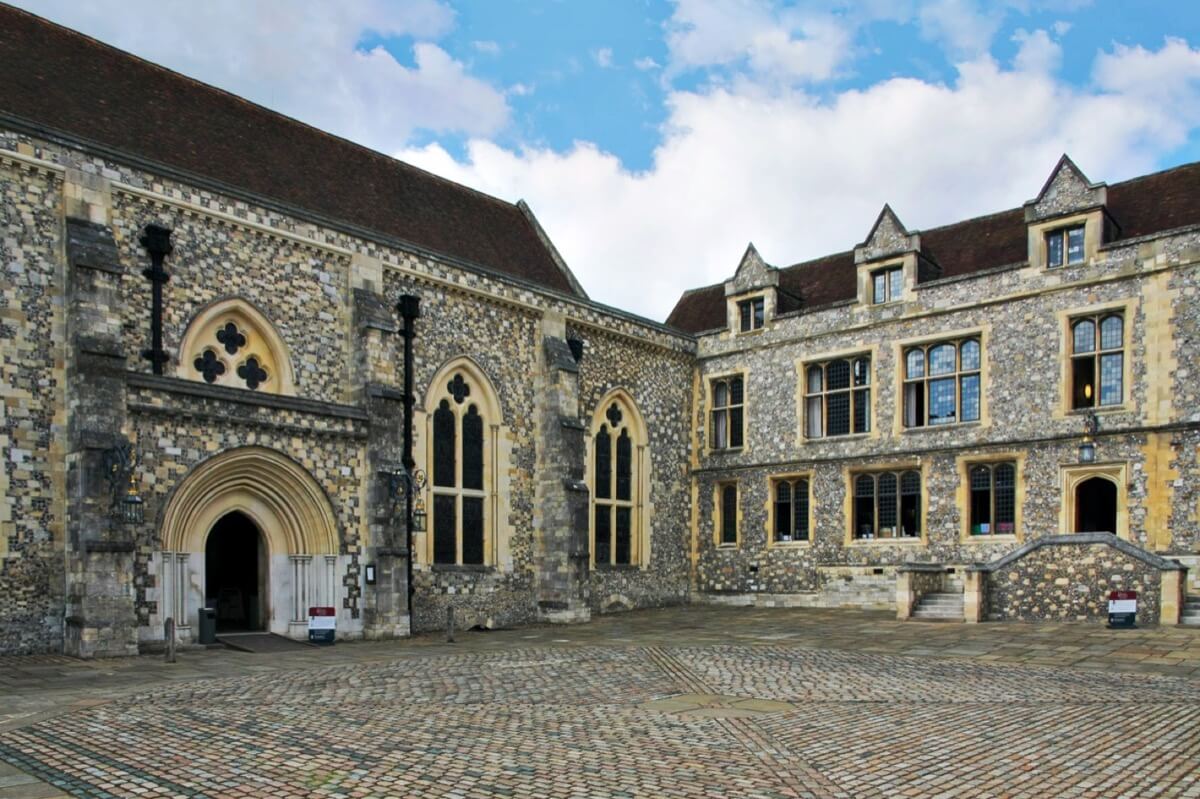
Winchester Castle is a medieval building in Hampshire, England. It was founded in 1067. Only the Great Hall still stands; it houses a museum of the history of Winchester.
The castle was built in 1067 and for over one hundred years it was the seat of Government of the Norman Kings. A round tower from the original castle complete with sally ports is still visible. In 1141, during The Anarchy, forces of the Empress Matilda were besieged by the forces of King Stephen at the castle.
Between 1222 and 1235, Henry III, who was born at Winchester Castle, added the Great Hall, built to a "double cube" design, measuring 110 ft by 55 ft by 55 ft (approx. 33.5m by 16.8m by 16.8m). The Great Hall was built of flint with stone dressings; originally it had lower walls and a roof with dormer windows. In their place were added the tall two-light windows with early plate tracery. Extensions to the castle were added by Edward II. The Great Hall is a Grade I listed building. Behind the Great Hall a medieval garden called Queen Eleanor's Garden was formed.
An imitation Arthurian Round Table was hung in the Great Hall. The table was originally constructed in the 13th century, and repainted in its present form for Henry VIII; around the edge of the table were painted the names of King Arthur's knights. A series of pictorial epigrams illuminated in medieval monastic style known as the Winchester Panels were also hung in the Great Hall. They are thought to depict the 25 knights of the Round Table and illustrate the challenges facing a maturing character as it progresses round the great "Wheel of Life".
In 1302, Edward I and his second wife, Margaret of France, narrowly escaped death when the royal apartments of the castle were destroyed by fire. On 19 March 1330, Edmund of Woodstock, 1st Earl of Kent was beheaded outside the castle walls in the Despenser plot against King Edward III. The castle remained an important residence and on 10 April 1472 Margaret of York, daughter of King Edward IV, was born there.
On 17 November 1603 Sir Walter Raleigh went on trial for treason for his supposed part in the Main Plot in the converted Great Hall. The castle was used by the Royalists in the English Civil War, eventually falling to Parliamentarians in 1646, and then being demolished on Oliver Cromwell's orders. Later in the 17th century, Charles II planned to build the King's House adjoining the site, commissioning Christopher Wren to design a royal palace to rival the Palace of Versailles, but the project was abandoned by James II.
Castle Hill, located nearby, is the location of the Council Chamber for Hampshire County Council and, since 2014, of the Winchester Register Office. The Great Hall was also the home of the Winchester Assizes and on 15 March 1953 another notorious trial took place there, when Edward Montagu, Michael Pitt-Rivers and Peter Wildeblood went on trial and were then acquitted of charges of having committed specific acts of indecency.
Useful information
Parking at Tower Street Car Park.
Admission FREE
Admission FREE
Admission FREE
the.great.hall@hants.gov.uk
External links
Nearby castles